
FOCAL POINT
Interested in sharing your handiwork? Visit www.ModelAviation.com for submission guidelines.
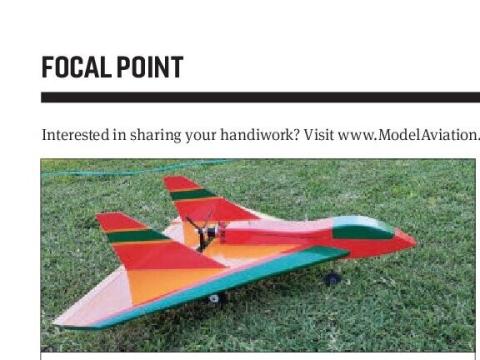
Force One Delta Wing
Russell Butler’s (Round Rock, Texas; email: russ.butler.rb.hb@gmail.com) Force One Delta wing was his pandemic COVID project. Built from a kit and originally powered with an O.S. engine, he later updated it to electric power with an E-flite 32 motor.
“It is fast,” he wrote. “It came in second in the all-other electric class in our club Pylon Racing event. It flies well and lands better.”

EMHW Pitts Special
Brenden McCormick (Valley View, Pennsylvania; email: brendenmccormick@att.net) sent in a photo of his EMHW 47% Pitts Special that was completed in the Jesse Panzer scheme. He stated that the kit took more than 2-1/2 years to build.
The airplane is covered with Stits Poly-Fiber. The paint is from Tropical Glitz, and the clear from KBS. Brenden uses a JETI radio and Advanced Radio SmoothFlite system for guidance and a Valach 170 four-stroke engine for power. The propeller is a Fiala 32 x 12, while graphics were provided by Callie Graphics. The final flying weight is 48 pounds.
The build can be found on Brenden’s YouTube channel, Just Plane Crazy, at www.youtube.com/@JustPlaneCrazy.

Maxford USA 1/5-Scale Spad XIII
Editor’s note: The incorrect photo was published for the following submission in the January 2025 issue of Model Aviation. We apologize for the error.
George Lumpkins (Katy, Texas; email: golumpk@swbell.net), a member of the Bayou City Flyers in Katy, was attending a club swap meet when he met a gentleman selling a Maxford USA Spad. It had two flights on it but would not fit into a vehicle assembled, so the man was offering it, less engine, “at a deal!” (George stated that it fits into a GMC Yukon XL Denali in one piece.) After a test-fit, a deal was struck.
The airplane has a 68-inch wingspan and is 53 inches long. George did not intend to use an internal-combustion engine and substituted an AXi 5330/3 FA electric motor, a Falcon 22 x 10 scale propeller, a Hobbywing HV 80-amp ESC, two SMC Racing four-cell high-voltage batteries in series, a Futaba radio, and 3.5 pounds of nose weight. He stated that he was more interested in thrust than speed.
A non-scale high angle-of-attack takeoff is the norm. George noted that it “flies like a well-designed biplane and is fully aerobatic.”

Bristol Boxkite
Gary Denzler’s (Brookville, Indiana; email: denzler@etczone.com) 1/4-scale, 82-inch wingspan Bristol Boxkite was built using balsa and spruce wood. The Cobra brushless motor swings a 20 x 10 propeller, while the servos work the joystick and rudder bar, making it look as though the pilot is actually flying the model. Gary used more than 200 feet of cable to hold it together.
The Boxkite was first flown in England in 1910 and was used as a trainer for pilots during World War I.

Monty Sailplane
Tony Beck (Charleston, South Carolina; email: t_beck@att.net) wrote that, in 2019, he was pondering a Super Radian F3Rudder Elevator Spoiler (F3RES) glider project with electric launch. Before construction started, the design went through many iterations in XFOIL, XFLR5, and Curtis S. Tailwind Gliders sailplane design spreadsheets. “At the time, our daughter’s family lived in Montana, so I designed the plane to disassemble to a shippable size so that I could fly with my son-in-law,” he wrote.
The glider’s basic wood structure has just a little carbon fiber in the wing joiners. Controlled by a Taranis X9D radio with a G-RX6 receiver, it is powered by four KST X08 servos for the spoilers, elevator, and rudder, a Dualsky 2308 V2 1,800 Kv motor and XC2512BA V2 ESC combo swinging a 9.5 x 5 CAM folding propeller, and a 1,400 mAh two-cell LiPo. The glider is covered in UltraCote Lite, with a flying weight of 27 ounces (765 grams).
“Once built, the model needed a name,” Tony stated. “Since it was going to Montana, Monty seemed natural, and it stuck.” He noted that the sailplane flies even better than he had hoped, and his son-in-law liked it too, so it stayed with him. “As soon as I got home, construction of Monty II started. Even though I have bigger and higher-performance sailplanes, Monty is the one that invariably goes to the field.”

Green Box Nobler
Mark Troutman (Katy, Texas; email: chasepaunup16@gmail.com) recently finished a “Green Box” Nobler. “I help widows liquidate estates, and this model showed up in the wrong box with just half a set of ribs, one fuselage side, and a very bad set of plans,” he wrote. “They had been in an attic in Texas for more than 50 years. I hate seeing kits that never got built, so I slowly started cutting pieces.”
The result was a McCoy .40 reedhead-powered model that is covered in silkspan and painted with butyrate dope. Mark stated, “I used to fly with legendary designer George Aldrich, who told me he got 10¢ per kit in royalties on his designs. I think he would have liked this one. It flies like a Nobler, which is always good.”

Flightline B-25
Thomas Perry (Commerce City, Colorado; email: ih8pilots@gmail.com) wrote that his new Flightline B-25 is modeled after a B-25J that flew with the 340th Bomb Group and 486th Bomb Squadron. The photo was taken on the runway at the Miniature Aero Sportsters flying field in Commerce City.
Callie Graphics provided the decals for the project. It features 3D-printed green bombs that whistle when they’re released, and Thomas is working with toilet paper and baby powder to make powder puff bombs. Thomas controls it with a Tactic eight-channel radio.

Travel Air Mystery Ship
Jake Chichilitti (Santa Rosa, California; email: jake.chichilitti@yahoo.com) built his Travel Air Mystery Ship from Model Aviation plans with laser-cut parts. The model was originally designed for electric power, but Jake converted it to use a four-stroke O.S. .40 engine with Futaba radio equipment.
The 60-inch wingspan model is covered in silkspan over balsa and painted using Brodak butyrate dope. The graphics are by Callie Graphics. The weight is 5 pounds, plus 12 ounces of nose weight.
The paint scheme replicates the Mystery Ship that was owned by the Shell Oil Company and placed second in the 1930 Thompson Trophy race.


