AROUND THE PATCH

FAIR SKIES
AND WARM
WINDS
By Thayer Syme | thayer@flying-models.com
WITHOUT QUESTION, the greatest pleasure that our hobby has afforded me has been the time spent with countless like-minded souls who I have met throughout the years. There is nothing better than sharing magic memories with a good friend, whether at the field or simply through those late-night phone calls as we endlessly discuss our latest projects and future dreams.
A few recent events have highlighted just how valuable those moments are and, sometimes, unfortunately, all too fleeting.
Regular readers will recall a few accounts of my collaboration with Marian Buszko during the last couple of years. To quickly summarize for those who are new to the column, Marian and I initially connected when he was exploring the possibilities of flying from a couple of smaller sites near his home in Florida. He was looking to augment a few micro, foam ARFs that he was flying at the time. After a bit of discussion, he decided to order a kit for Fred Reese’s Electric Kitten for the intended mission.
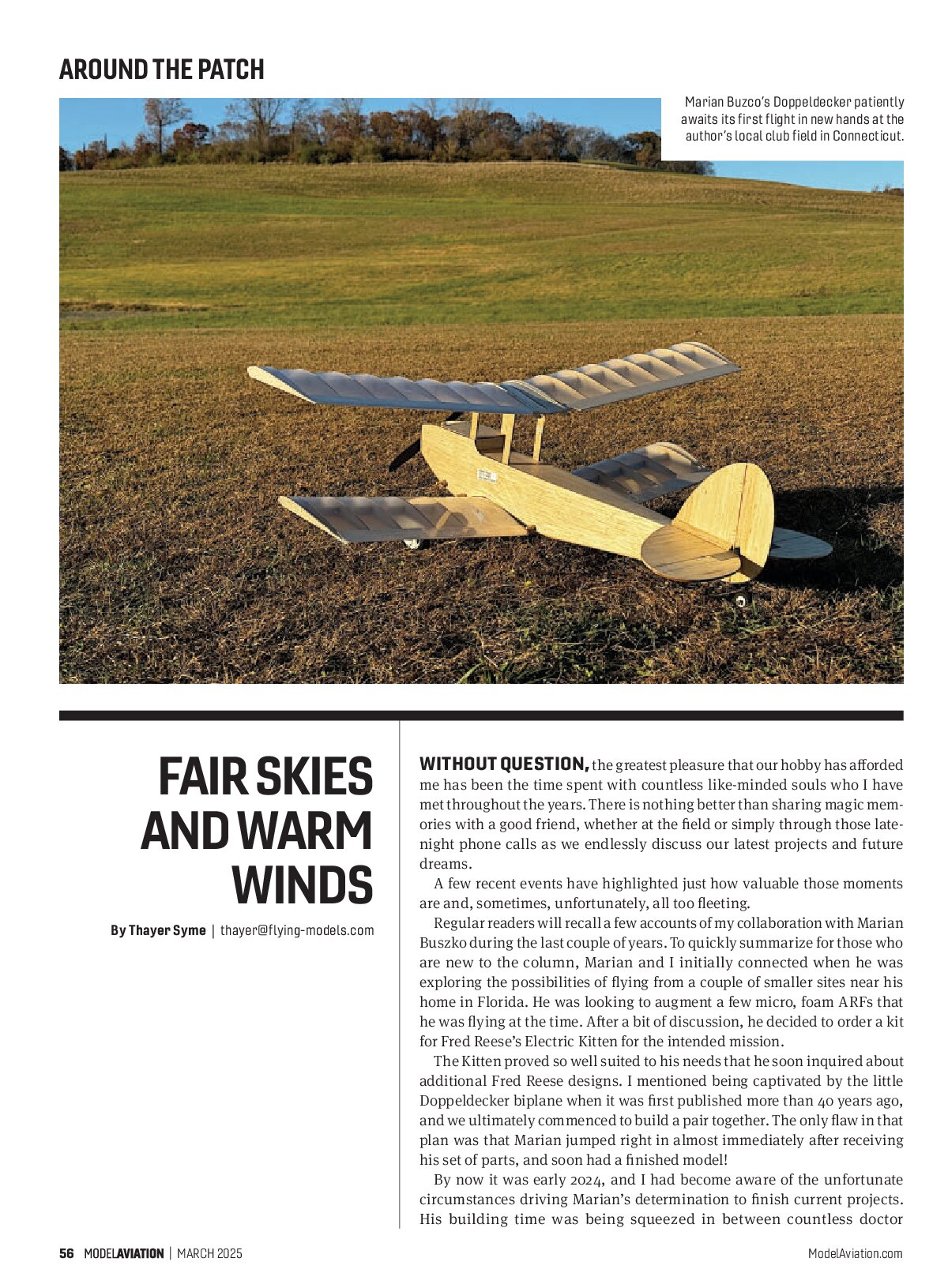
The Kitten proved so well suited to his needs that he soon inquired about additional Fred Reese designs. I mentioned being captivated by the little Doppeldecker biplane when it was first published more than 40 years ago, and we ultimately commenced to build a pair together. The only flaw in that plan was that Marian jumped right in almost immediately after receiving his set of parts, and soon had a finished model!
By now it was early 2024, and I had become aware of the unfortunate circumstances driving Marian’s determination to finish current projects. His building time was being squeezed in between countless doctor appointments, and he often cheerfully expressed how much better he felt when he was able to get to his workbench or go out to fly instead of constantly being poked and prodded.
The simple, little biplane proved to be an ideal project that he was able to shoehorn into his schedule. He regularly flew it throughout the end of the Florida winter and beyond.
With Marian and the Doppeldecker getting along so well as spring drew to a close, I was greatly surprised when he suggested boxing up the little biplane to send it my way. He wanted me to enjoy flying it as well, joking that my own first flight was not, shall we generously say, “imminent.”
Caught off guard by his offer, I insisted that he hang on to it and keep flying as much as weather and health allowed. He did just that and was able to get to the field a few more times as we stayed in touch through most of the summer.
Unfortunately, though, those proved to be his last flying sessions. Marian’s remaining time and energy were rapidly waning, and he missed his 70th birthday by just 10 minutes as August came to a close.
I am happy to report that his generous offer was ultimately realized. His little Doppeldecker has since found its way north to my workshop, arriving just in time for my own first flight as the wind abated on an unseasonably warm early November evening.
It had been my intention to leave Marian’s Doppeldecker exactly as it left his hands and simply just fly it going


forward. Unfortunately, that isn’t practical. My own first flight was conducted under the modeling equivalent of what full-scale aviation refers to as a “ferry permit.”
While I was able to coax it around the circuit at our local club field, there are a few items on the squawk list that I feel must be addressed. I will keep you all updated on my own “Doppeldecker Chronicles” going forward as I prepare to add it to my regular rotation.
Fair skies, Marian, and thank you for your generosity and friendship.
For those who are interested, Fred Reese’s Doppeldecker was originally published in the May 1981 Radio Control Modeler, and I can supply a short kit as detailed on the Flying Models Plans website. Spanning 32 inches, it was designed as a quick-building, small-field flyer and continues to suit that mission.
Fred’s prototype was powered with a Cox TD .09 engine and weighed 30 ounces with two-channel rudder and elevator control. Marian’s model is electric powered, and with its lighter equipment, it tips the scales at slightly less than 21 ounces.
Moving Forward and Backward
Marian’s passing has no doubt contributed to a recent spate of personal reflection and nostalgia, and I have since started looking through an ever-growing stack of favorite old plans that I have long set aside for “someday.”
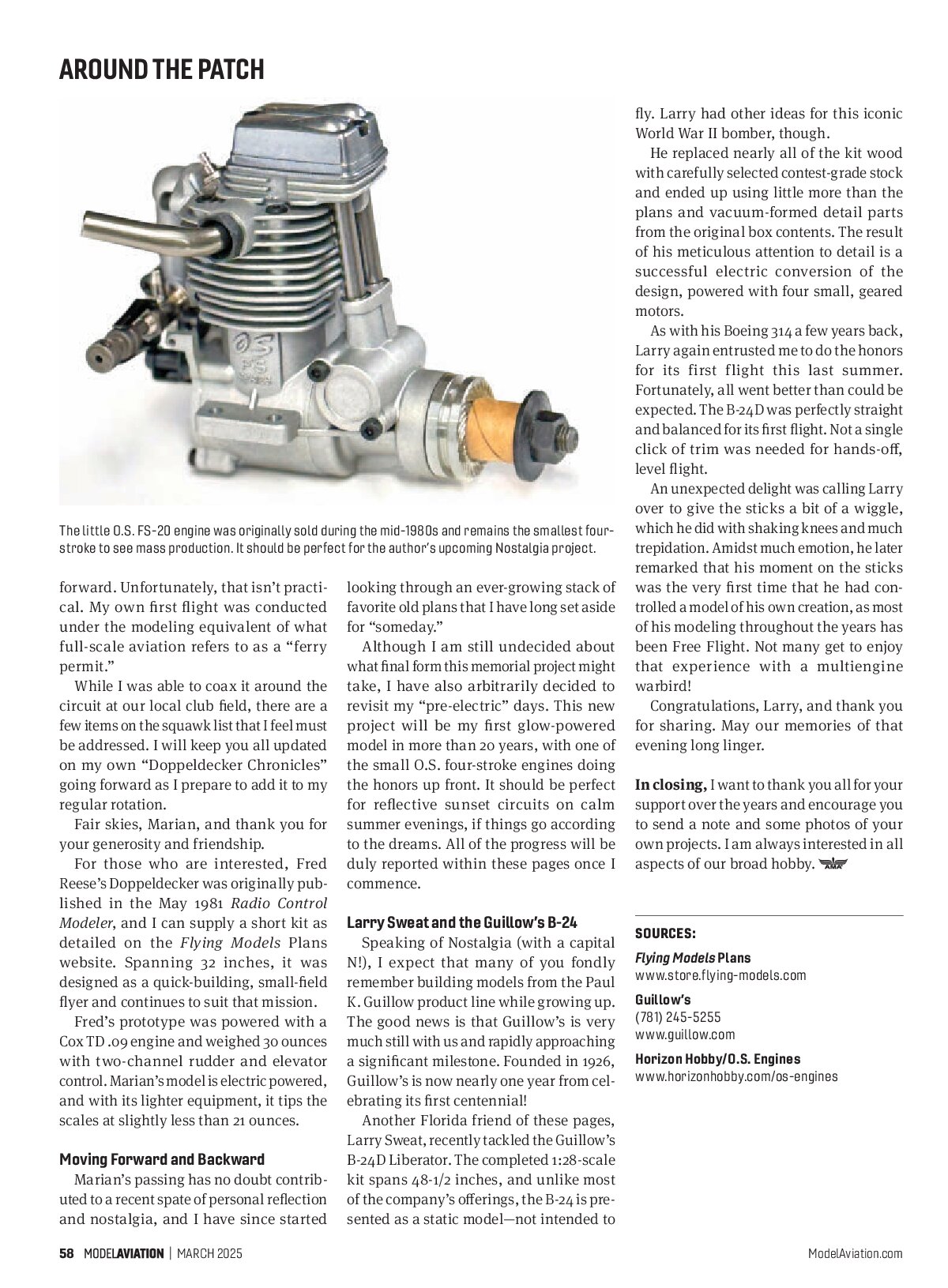
Although I am still undecided about what final form this memorial project might take, I have also arbitrarily decided to revisit my “pre-electric” days. This new project will be my first glow-powered model in more than 20 years, with one of the small O.S. four-stroke engines doing the honors up front. It should be perfect for reflective sunset circuits on calm summer evenings, if things go according to the dreams. All of the progress will be duly reported within these pages once I commence.
Larry Sweat and the Guillows’s B-24
Speaking of Nostalgia (with a capital N!), I expect that many of you fondly remember building models from the Paul K. Guillow product line while growing up. The good news is that Guillow’s is very much still with us and rapidly approaching a significant milestone. Founded in 1926, Guillow’s is now nearly one year from celebrating its first centennial!
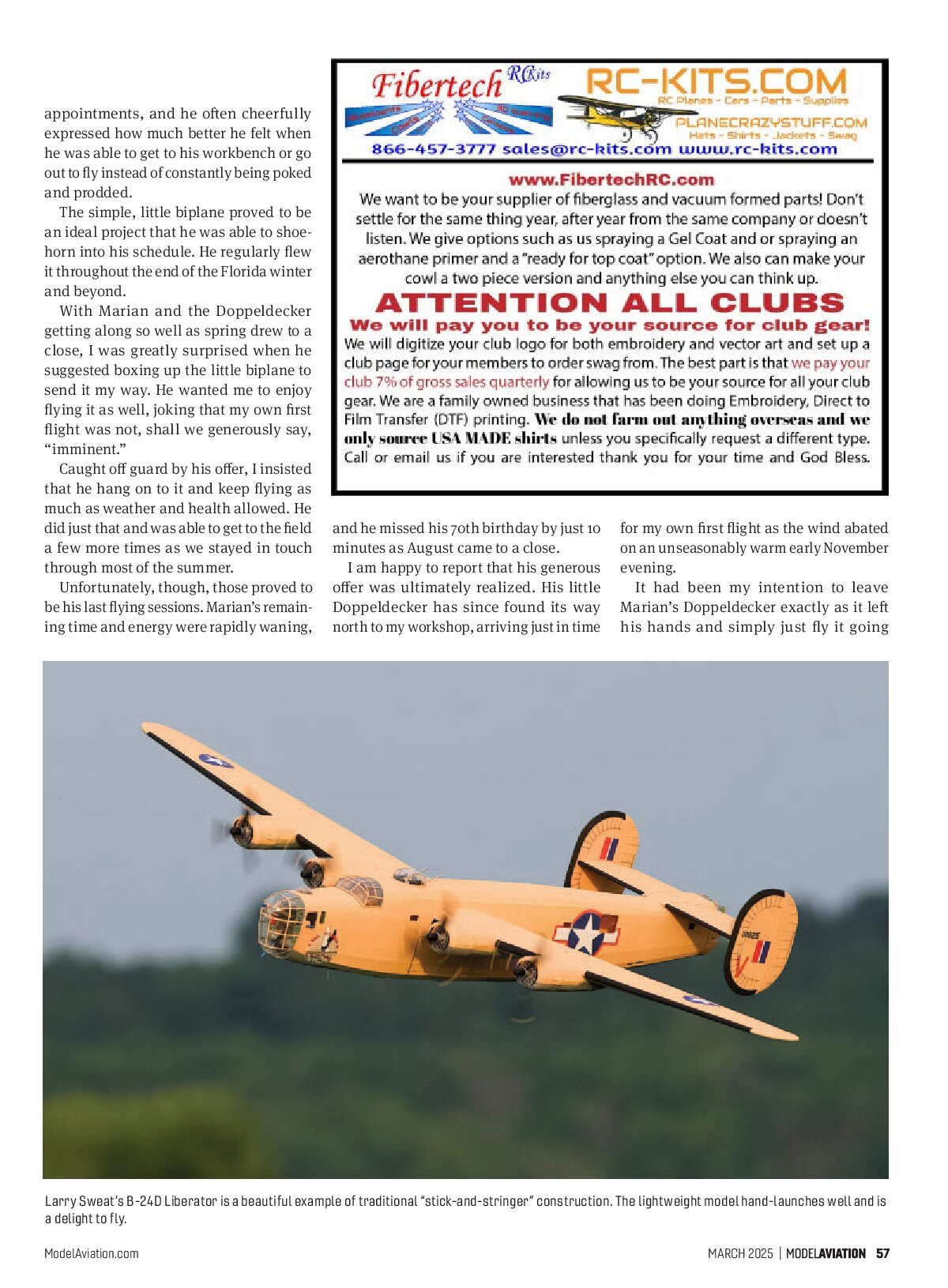
Another Florida friend of these pages, Larry Sweat, recently tackled the Guillow’s B-24D Liberator. He completed 1:28-scale kit spans 48-1/2 inches, and unlike most of the company’s offerings, the B-24 is presented as a static model—not intended to fly. Larry had other ideas for this iconic World War II bomber, though.
He replaced nearly all of the kit wood with carefully selected contest-grade stock and ended up using little more than the plans and vacuum-formed detail parts from the original box contents. The result of his meticulous attention to detail is a successful electric conversion of the design, powered with four small, geared motors.
As with his Boeing 314 a few years back, Larry again entrusted me to do the honors for its first flight this last summer. Fortunately, all went better than could be expected. The B-24D was perfectly straight and balanced for its first flight. Not a single click of trim was needed for hands-off, level flight.
An unexpected delight was calling Larry over to give the sticks a bit of a wiggle, which he did with shaking knees and much trepidation. Amidst much emotion, he later remarked that his moment on the sticks was the very first time that he had controlled a model of his own creation, as most of his modeling throughout the years has been Free Flight. Not many get to enjoy that experience with a multiengine warbird!
Congratulations, Larry, and thank you for sharing. May our memories of that evening long linger.
In closing, I want to thank you all for your support over the years and encourage you to send a note and some photos of your own projects. I am always interested in all aspects of our broad hobby.
SOURCES:
Flying Models Plans
www.store.flying-models.com
Guillow’s
(781) 245-5255
www.guillow.com
Horizon Hobby/O.S. Engines
www.horizonhobby.com/os-engines