FREAKS AND GEEKS, PART TWO
By Patrick Sherman
lucidity@roswellflighttestcrew.com

IF 15 YEARS in the drone business has taught me anything, it’s that when I exercise my considered judgment based on my education and experience and state firmly, “It is impossible for a small UAS (sUAS) to accomplish that task,” it will be accomplished by an sUAS, typically about an hour afterward.
In this issue, I’m picking up where I left off in my January 2025 column, highlighting the “freaks and geeks” that I encountered last September at the 2024 Commercial UAV Expo in Las Vegas, including one that can complete a task that I never would have dreamed possible: nondestructive testing (NDT) through direct, physical contact.
First, however, is a reminder: When I describe these aircraft as “freaks and geeks,” I mean it with the utmost enthusiasm, respect, and love. For a number of years, it seemed that sUAS development had fallen into a rut, with virtually every new aircraft adhering to a single design: the quadcopter. To be sure, it is a robust and capable aircraft type, but I miss the early days of the industry, when designers were willing to bet on unorthodox designs.
Voliro T
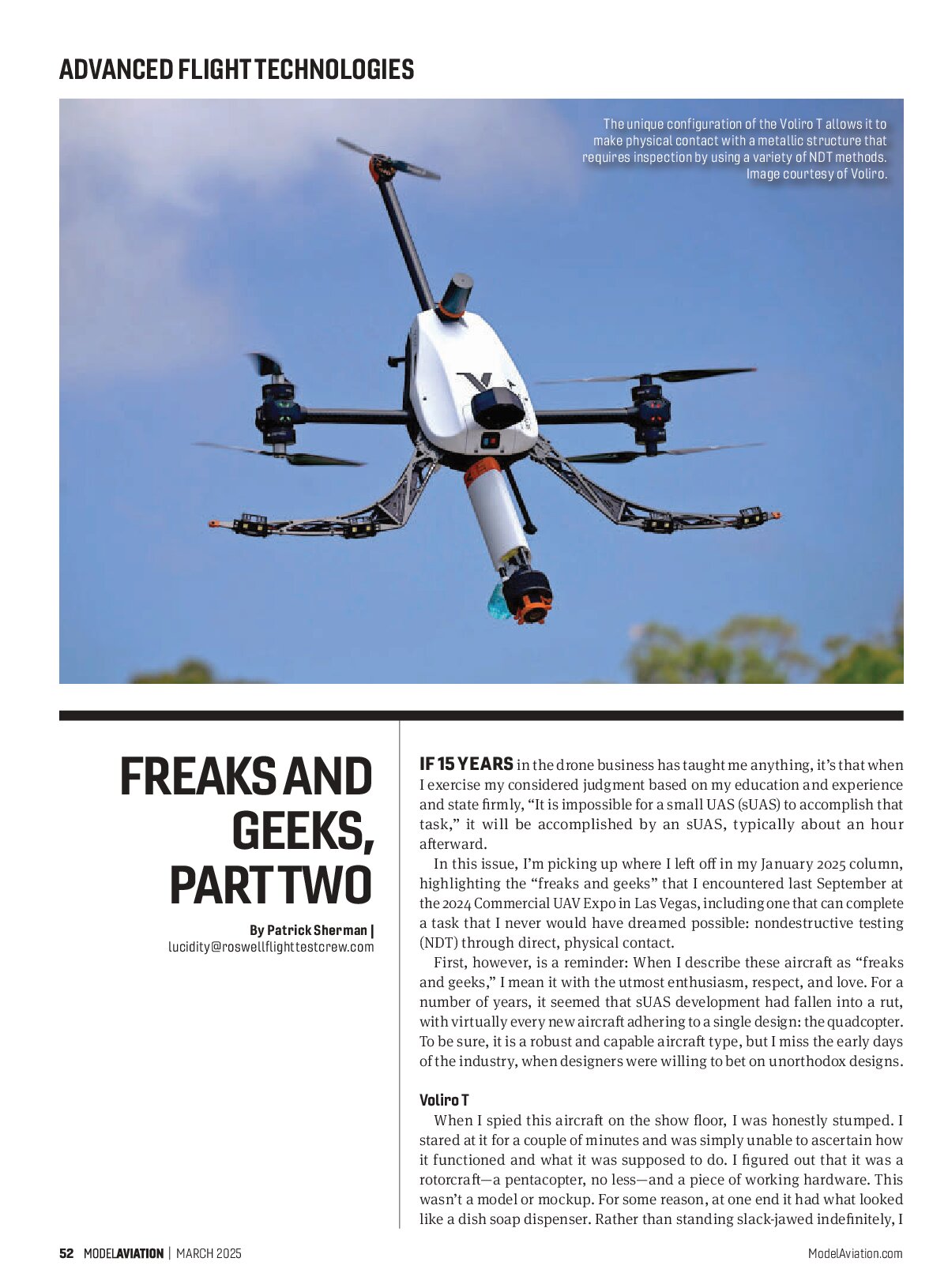
When I spied this aircraft on the show floor, I was honestly stumped. I stared at it for a couple of minutes and was simply unable to ascertain how it functioned and what it was supposed to do. I figured out that it was a rotorcraft—a pentacopter, no less—and a piece of working hardware. This wasn’t a model or mockup. For some reason, at one end it had what looked like a dish soap dispenser. Rather than standing slack-jawed indefinitely, I asked the man at the booth to explain it to me. He ended up being Johan Mlouka, the vice president for sales at Voliro.
“It’s a unique drone to be able to do contact-based inspections,” he said, “It’s kind of counterintuitive in the drone world. Normally, we teach you how to avoid obstacles, but with ours, you can go into full contact with the surface and measure the thickness of the material. It’s used a lot in industries like oil and gas, chemicals, maritime—any kind of industry where you need to measure the thickness of a metallic structure to ensure that the facility can continue to operate safely.”
This is known as NDT and, obviously, it has substantial advantages over what I can only assume would be referred to as “destructive testing,” such as drilling a hole in material and sticking a ruler inside. If it’s a pressure vessel containing a flammable gas that you need to keep your factory running, the appeal of NDT becomes obvious.
NDT has been done for decades in these same industries but by human inspectors using handheld sensors. On large-scale industrial facilities, such as flare stacks and rotary kilns, this involved climbing ladders, setting up scaffolding, or rappelling on ropes. Using an sUAS to accomplish this mission is safer, faster, and much less expensive.
The aircraft’s unique design was a function of its unique mission. As Johan pointed out to me, high-pressure pipes don’t only


a conventional, two-stick controller. “It’s actually quite easy to fly. It’s very stable,” said Johan. “The hardest part would be to go into physical contact with an object. For that, we have an autonomous function. Let’s say you’re roughly 30 inches from a surface. There is an automatic trigger, which will make the approach, allowing you to take the required measurements.”
The aircraft is capable of carrying a variety of NDT payloads and applying 3 kg of pressure to the test subject. Johan explained that what initially looked to me like dish soap is a gel that is applied when ultrasound is used to assess the integrity of the material under inspection.
SwissDrones SDO 50
When I was a child, I had a book that illustrated all of the different types of aircraft. This went beyond the basics, such as airplanes and helicopters, to all of the subvariants of each type. One that always stuck with me was a helicopter with two main rotors.
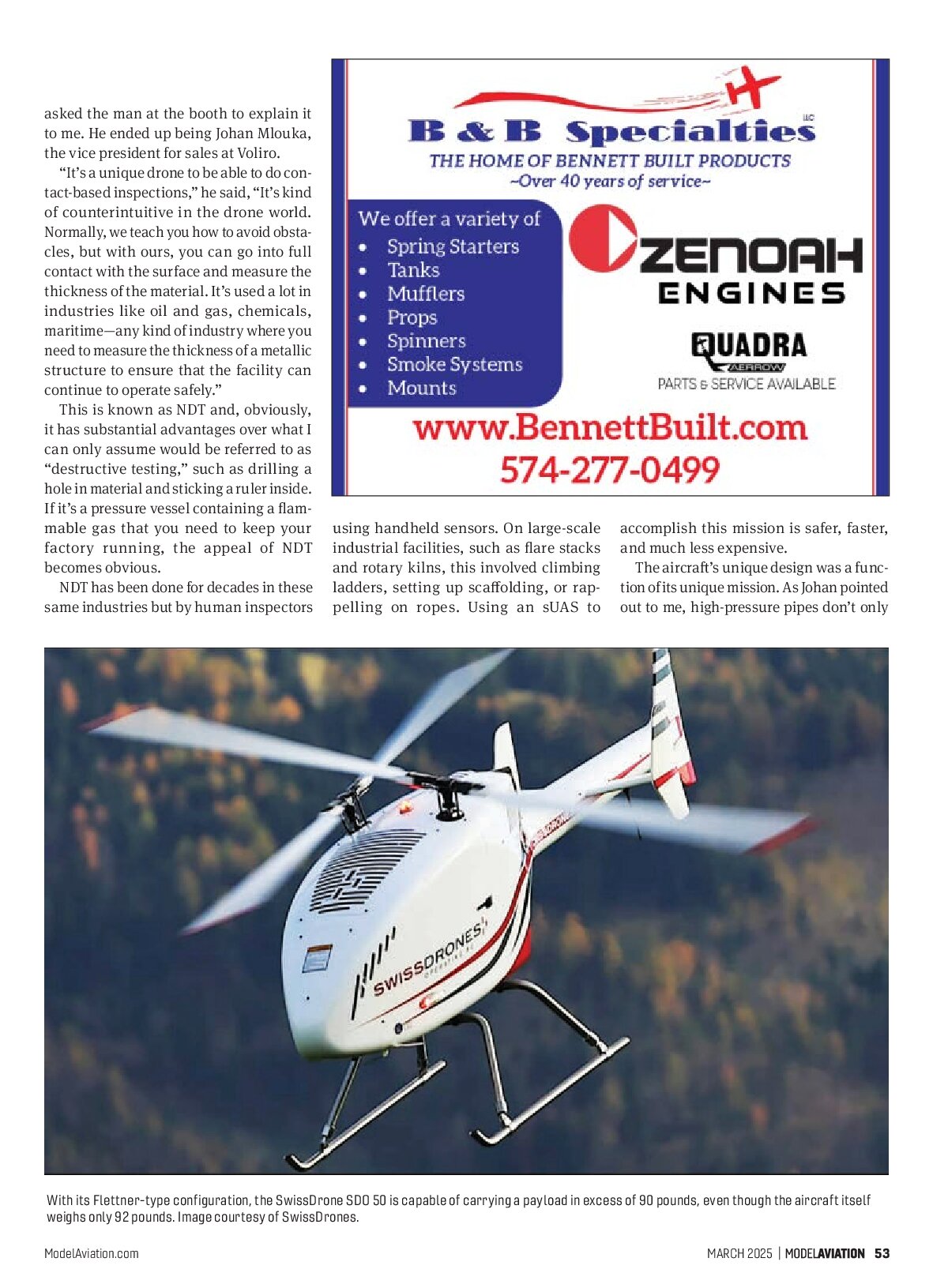
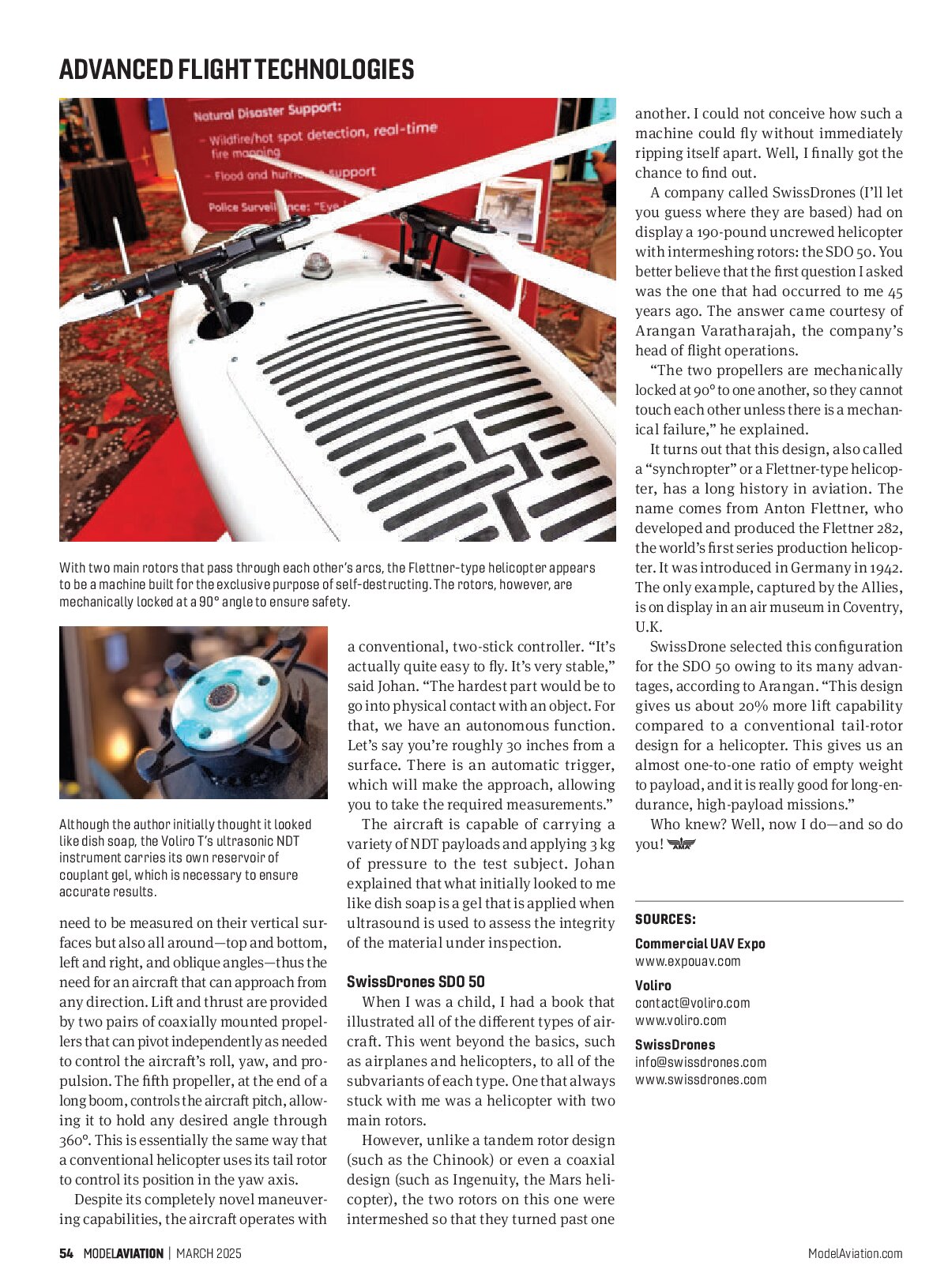
However, unlike a tandem rotor design (such as the Chinook) or even a coaxial design (such as Ingenuity, the Mars helicopter), the two rotors on this one were intermeshed so that they turned past one another. I could not conceive how such a machine could fly without immediately ripping itself apart. Well, I finally got the chance to find out.
A company called SwissDrones (I’ll let you guess where they are based) had on display a 190-pound uncrewed helicopter with intermeshing rotors: the SDO 50. You better believe that the first question I asked was the one that had occurred to me 45 years ago. The answer came courtesy of Arangan Varatharajah, the company’s head of flight operations.
“The two propellers are mechanically locked at 90° to one another, so they cannot touch each other unless there is a mechanical failure,” he explained.
It turns out that this design, also called a “synchropter” or a Flettner-type helicopter, has a long history in aviation. The name comes from Anton Flettner, who developed and produced the Flettner 282, the world’s first series production helicopter. It was introduced in Germany in 1942. The only example, captured by the Allies, is on display in an air museum in Coventry, U.K.
SwissDrone selected this configuration for the SDO 50 owing to its many advantages, according to Arangan. “This design gives us about 20% more lift capability compared to a conventional tail-rotor design for a helicopter. This gives us an almost one-to-one ratio of empty weight to payload, and it is really good for long-endurance, high-payload missions.”
Who knew? Well, now I do—and so do you!
need to be measured on their vertical surfaces but also all around—top and bottom, left and right, and oblique angles—thus the need for an aircraft that can approach from any direction. Lift and thrust are provided by two pairs of coaxially mounted propellers that can pivot independently as needed to control the aircraft’s roll, yaw, and propulsion. The fifth propeller, at the end of a long boom, controls the aircraft pitch, allowing it to hold any desired angle through 360°. This is essentially the same way that a conventional helicopter uses its tail rotor to control its position in the yaw axis.
Despite its completely novel maneuvering capabilities, the aircraft operates with
SOURCES:
Commercial UAV Expo
www.expouav.com
Voliro
contact@voliro.com
www.voliro.com
SwissDrones
info@swissdrones.com
www.swissdrones.com