RC HELICOPTERS

MAKING
ONE PART TO
CONVERT A
NITRO HELI TO
ELECTRIC
By James Wang | heleoditor@gmail.com
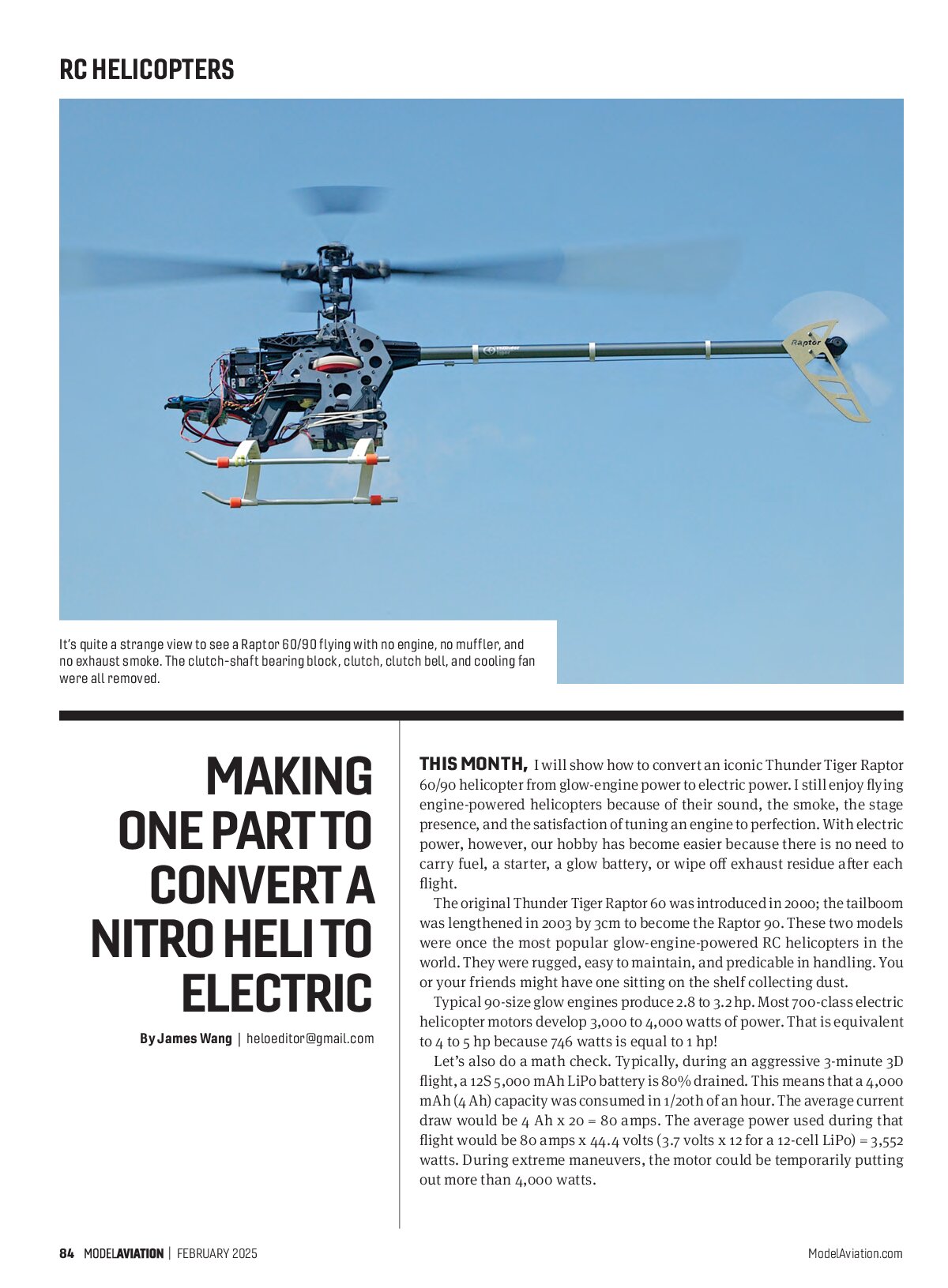
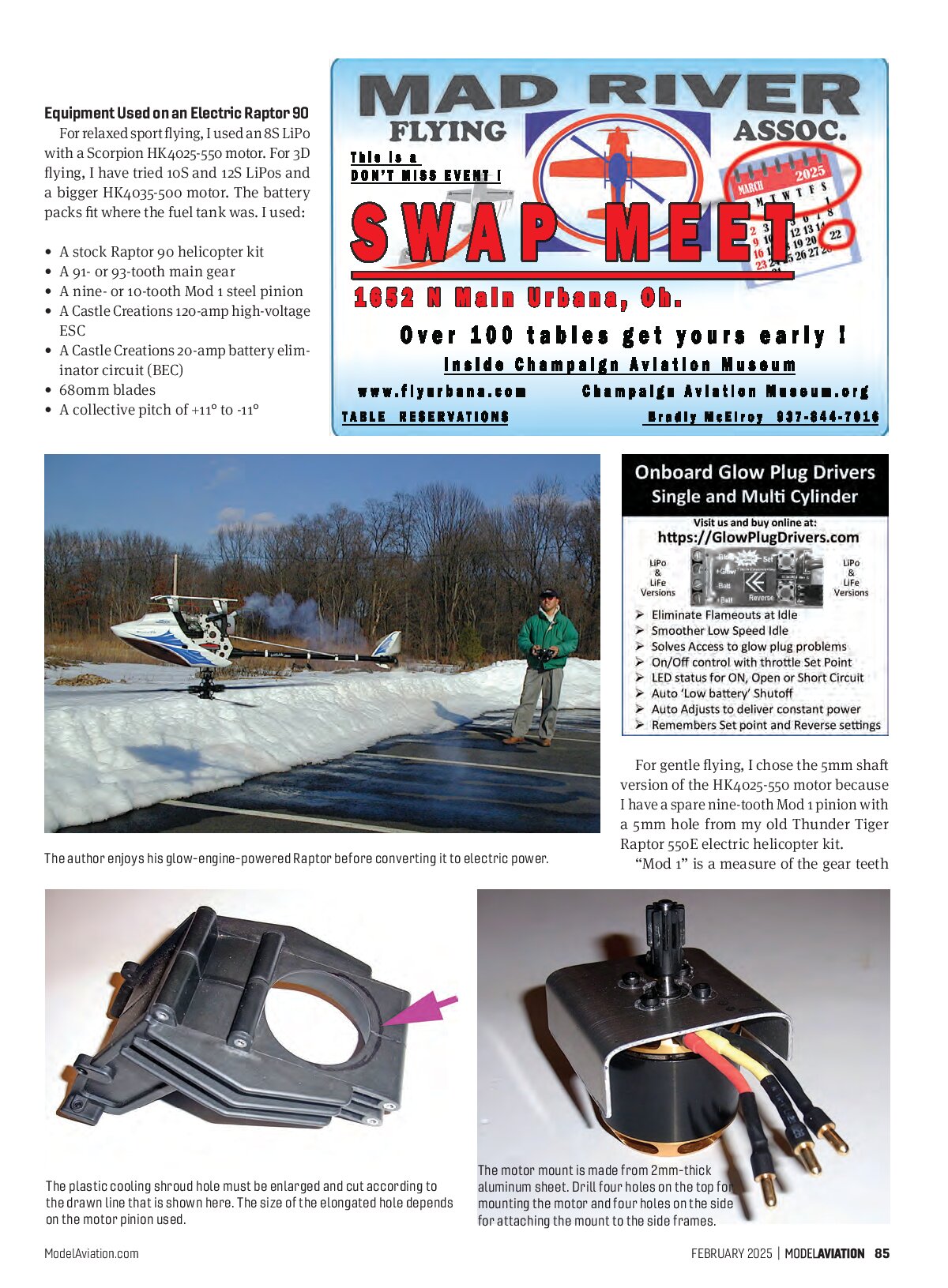
THIS MONTH, I will show how to convert an iconic Thunder Tiger Raptor 60/90 helicopter from glow-engine power to electric power. I still enjoy flying engine-powered helicopters because of their sound, the smoke, the stage presence, and the satisfaction of tuning an engine to perfection. With electric power, however, our hobby has become easier because there is no need to carry fuel, a starter, a glow battery, or wipe off exhaust residue after each flight.
The original Thunder Tiger Raptor 60 was introduced in 2000; the tailboom was lengthened in 2003 by 3cm to become the Raptor 90. These two models were once the most popular glow-engine-powered RC helicopters in the world. They were rugged, easy to maintain, and predictable in handling. You or your friends might have one sitting on the shelf collecting dust.
Typical 90-size glow engines produce 2.8 to 3.2hp. Most 700-class electric helicopter motors develop 3,000 to 4,000 watts of power. That is equivalent to 4 to 5 hp because 746 watts is equal to 1 hp!
Let’s also do a math check. Typically, during an aggressive 3-minute 3D flight, a 12S 5,000 mAh LiPo battery is 80% drained. This means that a 4,000 mAh (4 Ah) capacity was consumed in 1/20th of an hour. The average current draw would be 4 Ah x 20 = 80 amps. The average power used during that flight would be 80 amps x 44.4 volts (3.7 volts x 12 for a 12-cell LiPo) = 3,552 watts. During extreme maneuvers, the motor could be temporarily putting out more than 4,000 watts.
Equipment Used on an Electric Raptor 90
For relaxed sport flying, I used an 8S LiPo with a Scorpion HK4025-550 motor. For 3D flying, I used 10S and 12S LiPos and a bigger HK4035-500 motor. The battery packs fit where the fuel tank was. I used:
- A stock Raptor 90 helicopter kit
- A 91- or 93-tooth main gear
- A nine- or 10-tooth Mod 1 steel pinion
- A Castle Creations 120-amp high-voltage ESC
- A Castle Creations 20-amp battery eliminator circuit (BEC)
- 680mm blades
- A collective pitch of +11° to -11°

For gentle flying, I chose the 5mm shaft version of the HK4025-550 motor because I have a spare nine-tooth Mod 1 pinion with a 5mm hole from my old Thunder Tiger Raptor 550E electric helicopter kit. “Mod 1” is a measure of the gear teeth


RC HELICOPTERS

pitch. Raptor 30/50/60/90 main gears all use coarser Mod 1 teeth; many RC cars also use Mod 1 gears. The most time-consuming part of this project is searching on the internet for the Mod 1 pinion that you need.
For the main gear, I have tried a 93-tooth gray main gear from a Raptor 60 kit and a 91-tooth white main gear from a Raptor 90. For example, with a 91-tooth main gear and a 10-tooth pinion, the gear ratio is 9.1 to 1. It is preferable to have a gear ratio between 8 to 10 then to choose a motor Kv to give the desired rotor speed. The Kv rating for a brushless motor assumes that the motor is spinning freely without loading.
The following is the formula to estimate the rotor speed:
Main rotor rpm = nominal battery voltage (volts) x motor Kv (rpm per volt) ÷ gear ratio x headroom factor (to account for loading)
Here is an example using a 12S LiPo battery. The estimated main rotor rpm equals 44.4 volts x 500 Kv ÷ a 9.1 gear ratio x a headroom factor of 0.75 = 1,830 rpm. With a 10S LiPo, the Raptor 90 flies much like an average engine-powered Raptor 90. With a 12S LiPo, it really comes alive. You can use the ESC’s governor mode or program your own throttle curve. For example, program 0-45-70-90-100 for normal mode and 100-90-80-90-100 for idle-up mode.
In the April 2021 and February 2024 issues of Model Aviation, I described how to program the Castle Creations HV ESC and how to set the rotor speed.
This conversion project only requires you to fabricate a motor mount from a 2mm-thick aluminum sheet. The actual conversion process only took two evenings.
Have fun!


SOURCES:
International Radio Controlled Helicopter Association (IRCHA)
www.ircha.org