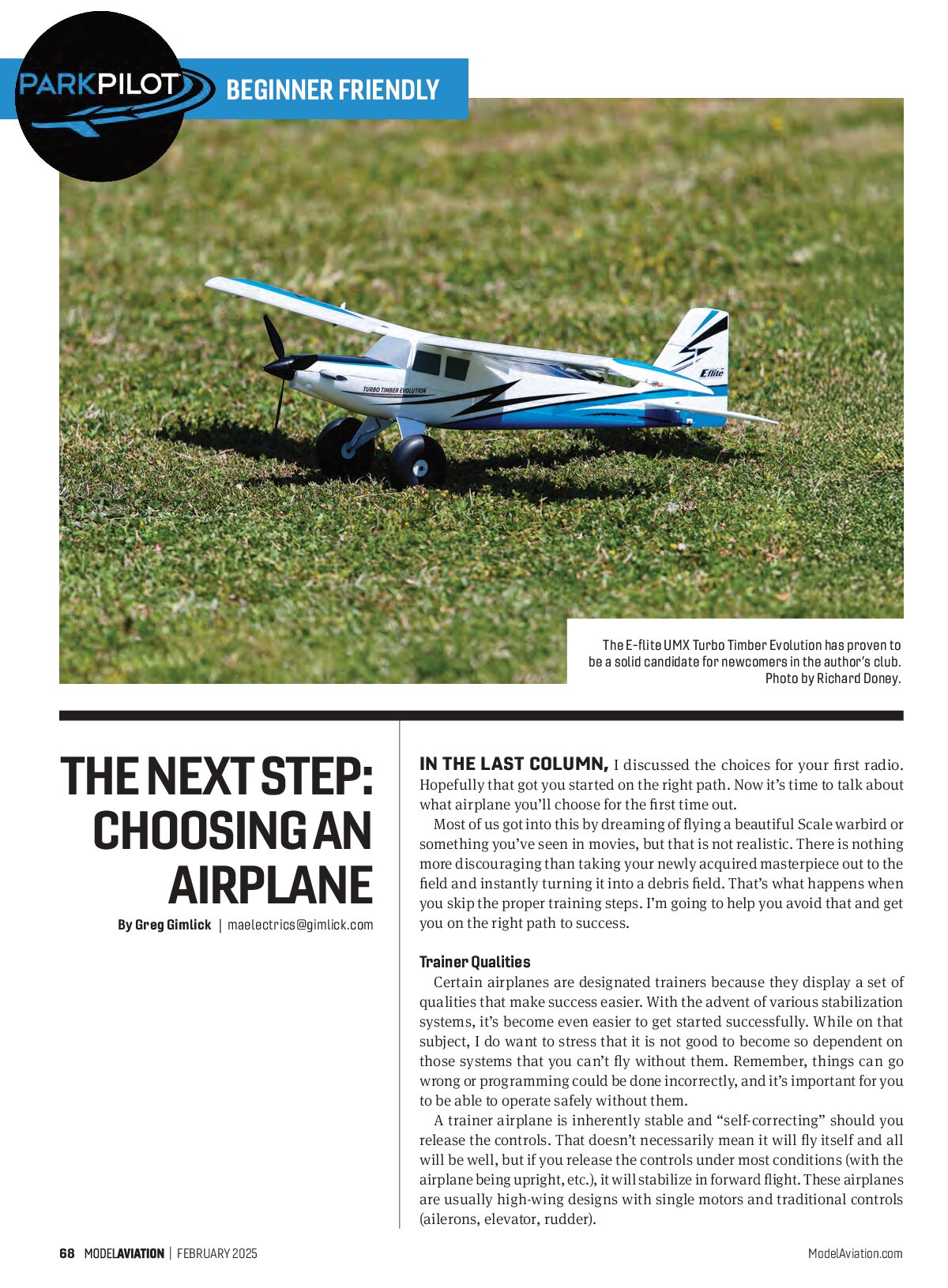
PARK PILOT BEGINNER FRIENDLY
THE NEXT STEP: CHOOSING AN AIRPLANE
By Greg Gimlick | ma electronics@gimlick.com

IN THE LAST COLUMN, I discussed the choices for your first radio. Hopefully that got you started on the right path. Now it’s time to talk about what airplane you’ll choose for the first time out.
Most of us got into this by dreaming of flying a beautiful Scale warbird or something you’ve seen in movies, but that is not realistic. There is nothing more discouraging than taking your newly acquired masterpiece out to the field and instantly turning it into a debris field. That’s what happens when you skip the proper training steps. I’m going to help you avoid that and get you on the right path to success.
Trainer Qualities
Certain airplanes are designated trainers because they display a set of qualities that make success easier. With the advent of various stabilization systems, it’s become even easier to get started successfully. While on that subject, I do want to stress that it is not good to become so dependent on those systems that you can’t fly without them. Remember, things can go wrong or programming could be done incorrectly, and it’s important for you to be able to operate safely without them.
A trainer airplane is inherently stable and “self-correcting” should you release the controls. That doesn’t necessarily mean it will fly itself and all will be well, but if you release the controls under most conditions (with the airplane being upright, etc.), it will stabilize in forward flight. These airplanes are usually high-wing designs with single motors and traditional controls (ailerons, elevator, rudder).

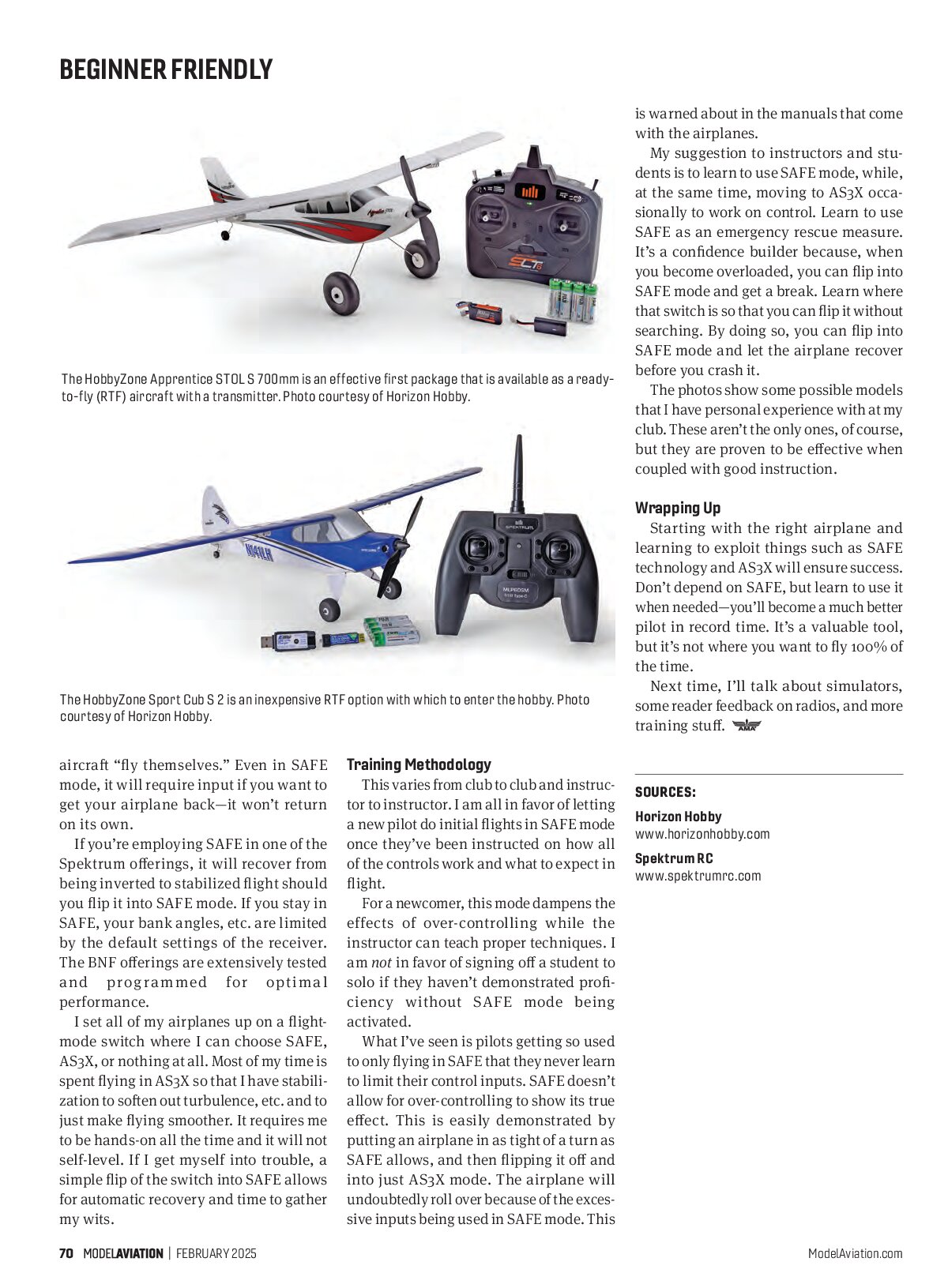
That said, several members of one of my clubs have successfully learned to fly on the E-flite UMX Ultrix that employs SAFE technology. Initially I argued against new fliers learning on this, but time has softened my view on it.
In SAFE, the airframe is incredibly stable and forgiving. Without SAFE and just using AS3X and different rates, it can be a wild aerobat. It’s about as unconventional of a trainer as an airplane could be, but a couple of members have taught themselves to fly without assistance (or very little).
SAFE, AS3X, and Nothing
These are the most often-seen stabilization systems at local fields, but there are other brands that operate in much the same way. I’m a big fan of stabilization and encourage people to use it. Disregard anyone who says that these

The E-flite UMX Ultrix is about as unconventional as they come when talking about trainers, but the author’s club has seen several members successfully learn to fly with this sturdy, little airplane.
BEGINNER FRIENDLY


is warned about in the manuals that come with the airplanes.
My suggestion to instructors and students is to learn to use SAFE mode, while, at the same time, moving to AS3X occasionally to work on control. Learn to use SAFE as an emergency rescue measure. It’s a confidence builder because, when you become overloaded, you can flip into SAFE mode and get a break. Learn where that switch is so that you can flip it without searching. By doing so, you can flip into SAFE mode and let the airplane recover before you crash it.
The photos show some possible models that I have personal experience with at my club. These aren’t the only ones, of course, but they are proven to be effective when coupled with good instruction.
aircraft “fly themselves.” Even in SAFE mode, it will require input if you want to get your airplane back—it won’t return on its own.
If you’re employing SAFE in one of the Spektrum offerings, it will recover from being inverted to stabilized flight should you flip it into SAFE mode. If you stay in SAFE, your bank angles, etc. are limited by the default settings of the receiver. The BNF offerings are extensively tested and programmed for optimal performance.
I set all of my airplanes up on a flight-mode switch where I can choose SAFE, AS3X, or nothing at all. Most of my time is spent flying in AS3X so that I have stabilization to soften out turbulence, etc. and to just make flying smoother. It requires me to be hands-on all the time and it will not self-level. If I get myself into trouble, a simple flip of the switch into SAFE allows for automatic recovery and time to gather my wits.
Training Methodology
This varies from club to club and instructor to instructor. I am all in favor of letting a new pilot do initial flights in SAFE mode once they’ve been instructed on how all of the controls work and what to expect in flight.
For a newcomer, this mode dampens the effects of over-controlling while the instructor can teach proper techniques. I am not in favor of signing off a student to solo if they haven’t demonstrated proficiency without SAFE mode being activated.
What I’ve seen is pilots getting so used to only flying in SAFE that they never learn to limit their control inputs. SAFE doesn’t allow for over-controlling to show its true effect. This is easily demonstrated by putting an airplane in as tight of a turn as SAFE allows, and then flipping it off and into just AS3X mode. The airplane will undoubtedly roll over because of the excessive inputs being used in SAFE mode. This is warned about in the manuals that come with the airplanes.
Wrapping Up
Starting with the right airplane and learning to exploit things such as SAFE technology and AS3X will ensure success. Don’t depend on SAFE, but learn to use it when needed—you’ll become a much better pilot in record time. It’s a valuable tool, but it’s not where you want to fly 100% of the time.
Next time, I’ll talk about simulators, some reader feedback on radios, and more training stuff.
SOURCES:
Horizon Hobby
www.horizonhobby.com
Spektrum RC
www.spektrumrc.com