How Clubs Can Succeed
By Grant Schulte
grantpschulte@gmail.com
Photos by the author and as noted
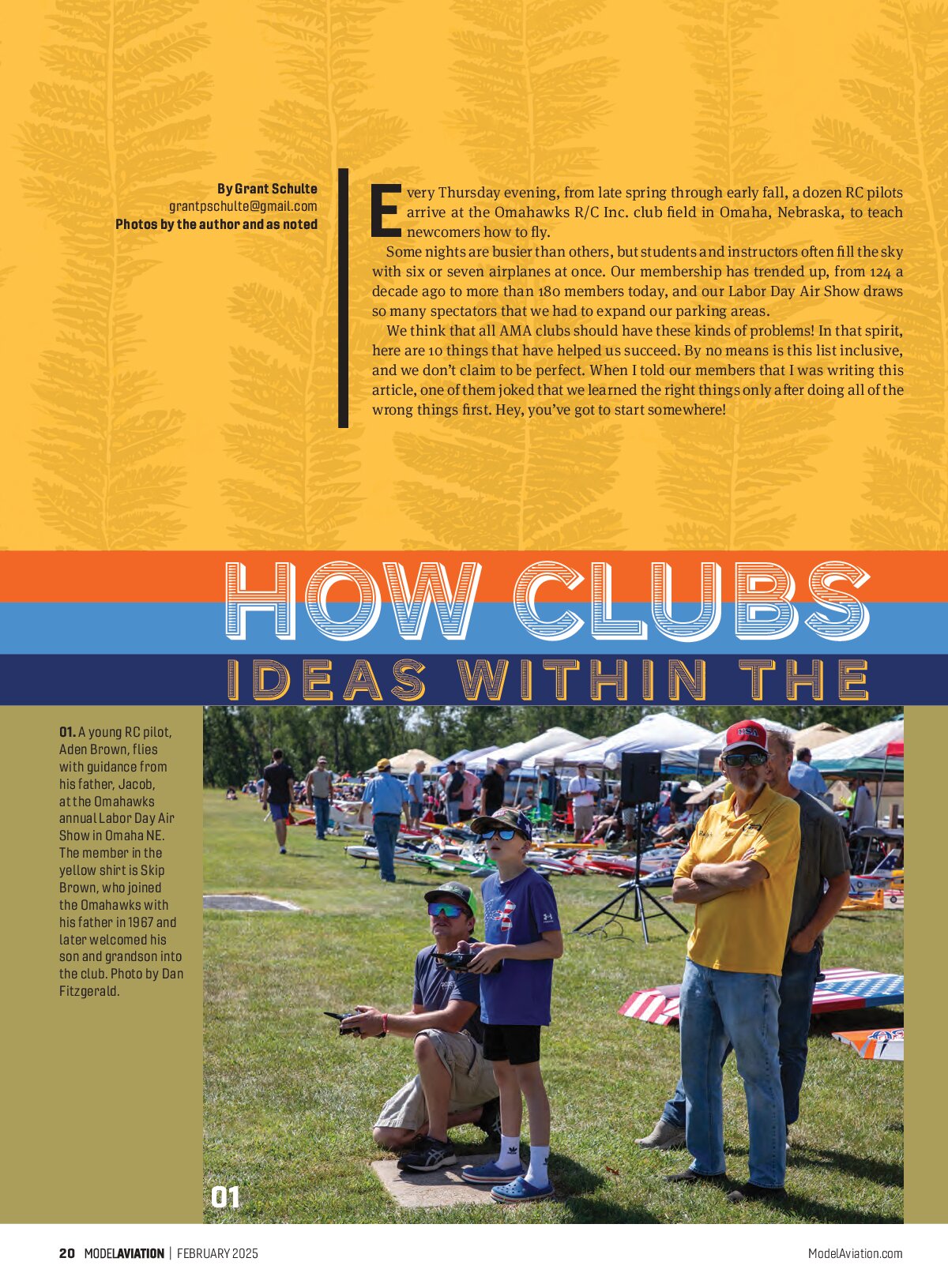
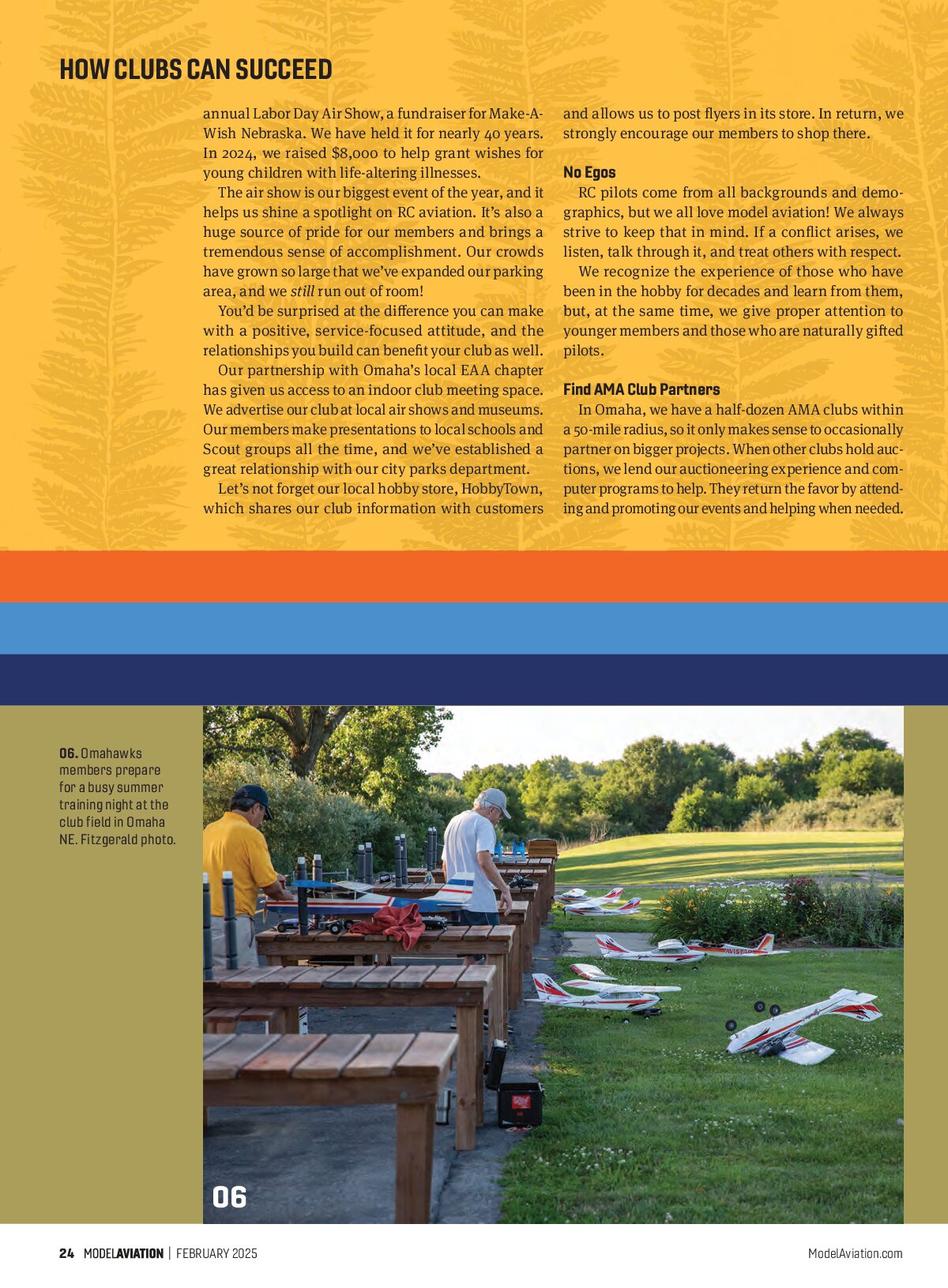
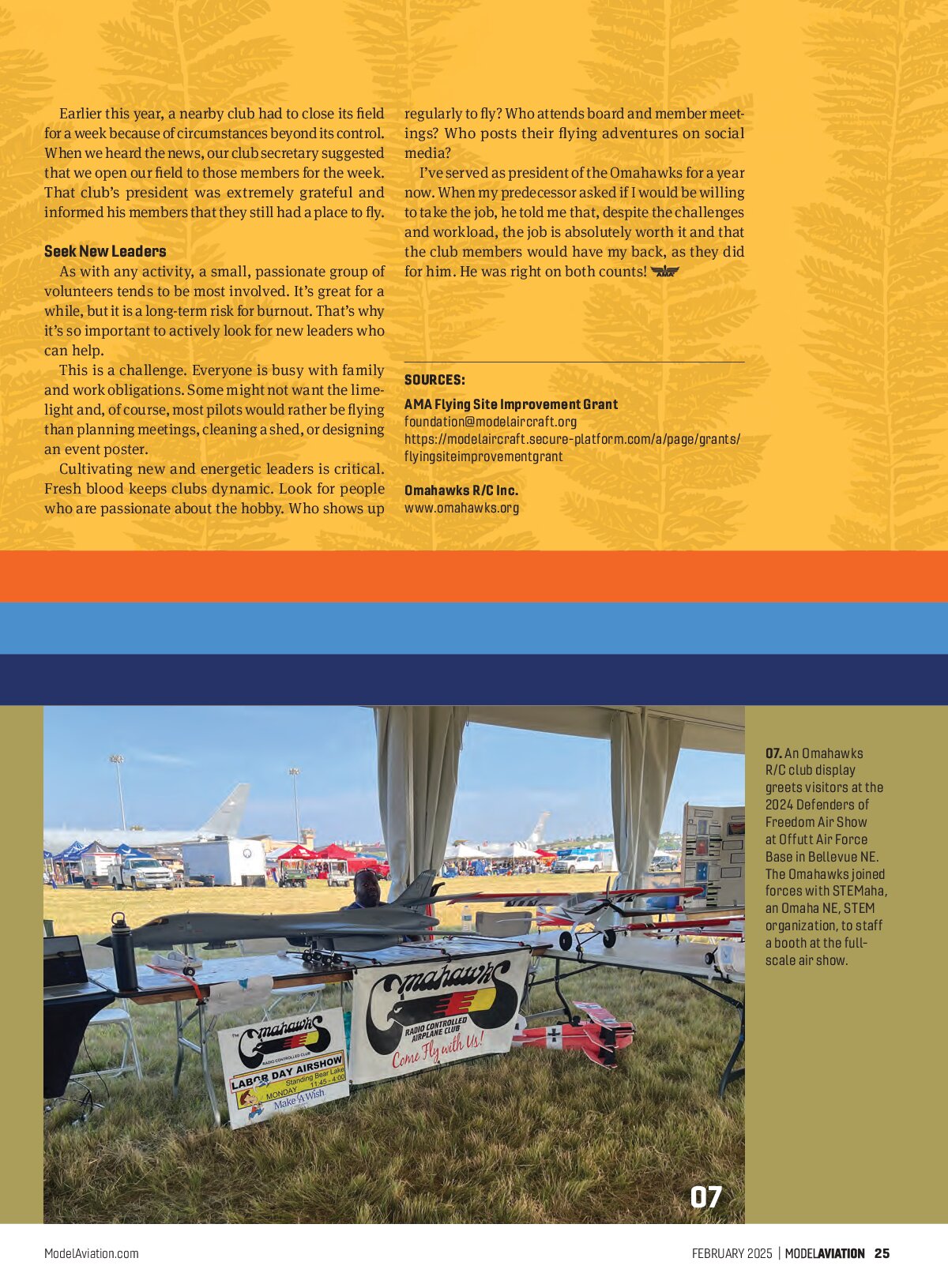
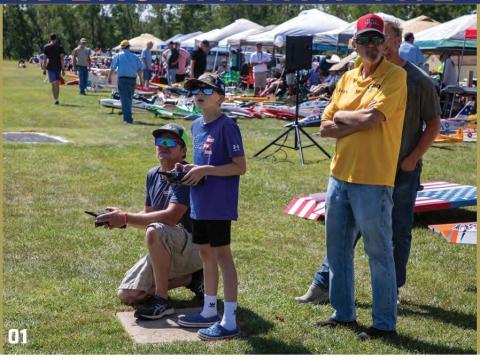
Every Thursday evening, from late spring through early fall, a dozen RC pilots arrive at the Omahawks R/C Inc. club field in Omaha, Nebraska, to teach newcomers how to fly.
Some nights are busier than others, but students and instructors often fill the sky with six or seven airplanes at once. Our membership has trended up, from 124 a decade ago to more than 180 members today, and our Labor Day Air Show draws so many spectators that we had to expand our parking areas.
We think that all AMA clubs should have these kinds of problems! In that spirit, here are 10 things that have helped us succeed. By no means is this list inclusive, and we don’t claim to be perfect. When I told our members that I was writing this article, one of them joked that we learned the right things only after doing all of the wrong things first. Hey, you’ve got to start somewhere!

Welcome Newcomers
If you’re new to RC flying, a club full of seasoned pilots can raise some intimidating questions. What if I crash? What should I buy, and how much does it cost? What if everyone is an arrogant jerk?
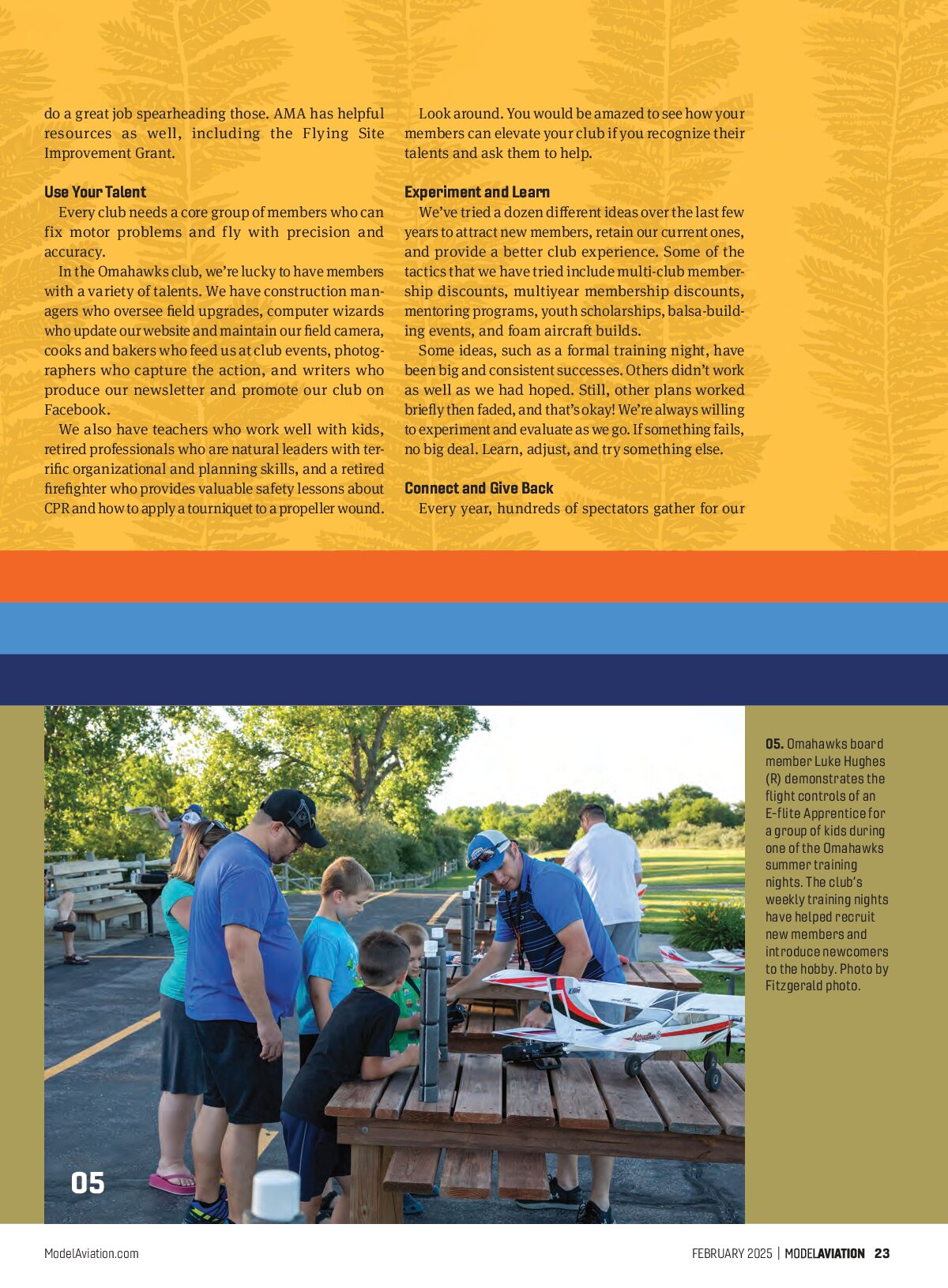
Our job is to remove those fears. Be friendly and approachable, answer questions, invite visitors to try a buddy-box flight, and make sure that the conversation is about them, their interests, their concerns, and their background.
For those who are reluctant, we do our best to lower the stakes. Yes, crashes happen, but we make it very clear that, as long as students are on a buddy box, our instructors will serve as a safety net.
We’ve invested in a few club airplanes—Apprentices, Timbers, and Avistars—to give visitors a taste of the hobby without having to commit. We also use a RealFlight simulator to teach the basic controls, and the simulator is a great place to put unruly kids who might distract others!
If a newcomer loves flying, awesome! If it’s not for them, that’s no big deal. We have zero interest in trying to pressure people into the hobby, and the distractions that many RC fliers bemoan, such as video games,


HOW CLUBS CAN SUCCEED
short attention spans, work, and other hobbies, are largely out of our hands. The best we can do is to show them—through our club atmosphere, enthusiasm, and willingness to help others—that RC aviation is inherently fun.
Keep It Simple
Unless someone asks, we don’t delve right away into all of the details about ESCs, the best transmitter to buy, or foamies versus glow power. We share the basic airplane controls—throttle, elevator, aileron, and rudder—and run a standard preflight check to demonstrate safe procedures. We then put them on a buddy box with an instructor and go flying! We want them to remember the heart-pumping thrill of flight as soon as possible, not the overwhelming litany of choices and technology.
Communicate
For a non-flier who’d like to learn more about the hobby, there’s no bigger turnoff than driving to a scheduled event only to find a locked gate and an empty field. That is why it is essential to frequently communicate.
If we are hosting events or gatherings that are canceled, we send word to all of the members and the public as early as we can. We communicate by email, newsletter, Facebook, and our club webpage, and we are exploring other options. When one of our members flies a cool aircraft, we shoot video and post snippets on our Facebook page. It is fairly easy and a great marketing opportunity.
Maintain Your Field
Clubs offer a lot of great, intangible benefits, but newcomers initially tend to care about one thing: a large, clean, safe area in which to fly.
Every year, usually before the spring flying season, we hold a field clean-up day. We wipe down our shed, kill weeds, sweep leaves and fallen branches, and blow debris off of our runway. Bigger maintenance projects are tougher, but we have a few people who

do a great job spearheading those. AMA has helpful resources as well, including the Flying Site Improvement Grant.
Look around. You would be amazed to see how your members can elevate your club if you recognize their talents and ask them to help.
Use Your Talent
Every club needs a core group of members who can fix motor problems and fly with precision and accuracy.
In the Omahawks club, we’re lucky to have members with a variety of talents. We have construction managers who oversee field upgrades, computer wizards who update our website and maintain our field camera, cooks and bakers who feed us at club events, photographers who capture the action, and writers who produce our newsletter and promote our club on Facebook.
We also have teachers who work well with kids, retired professionals who are natural leaders with terrific organizational and planning skills, and a retired firefighter who provides valuable safety lessons about CPR and how to apply a tourniquet to a propeller wound.
Experiment and Learn
We’ve tried a dozen different ideas over the last few years to attract new members, retain our current ones, and provide a better club experience. Some of the tactics that we have tried include multi-club membership discounts, multiyear membership discounts, mentoring programs, youth scholarships, balsa-building events, and foam aircraft builds.
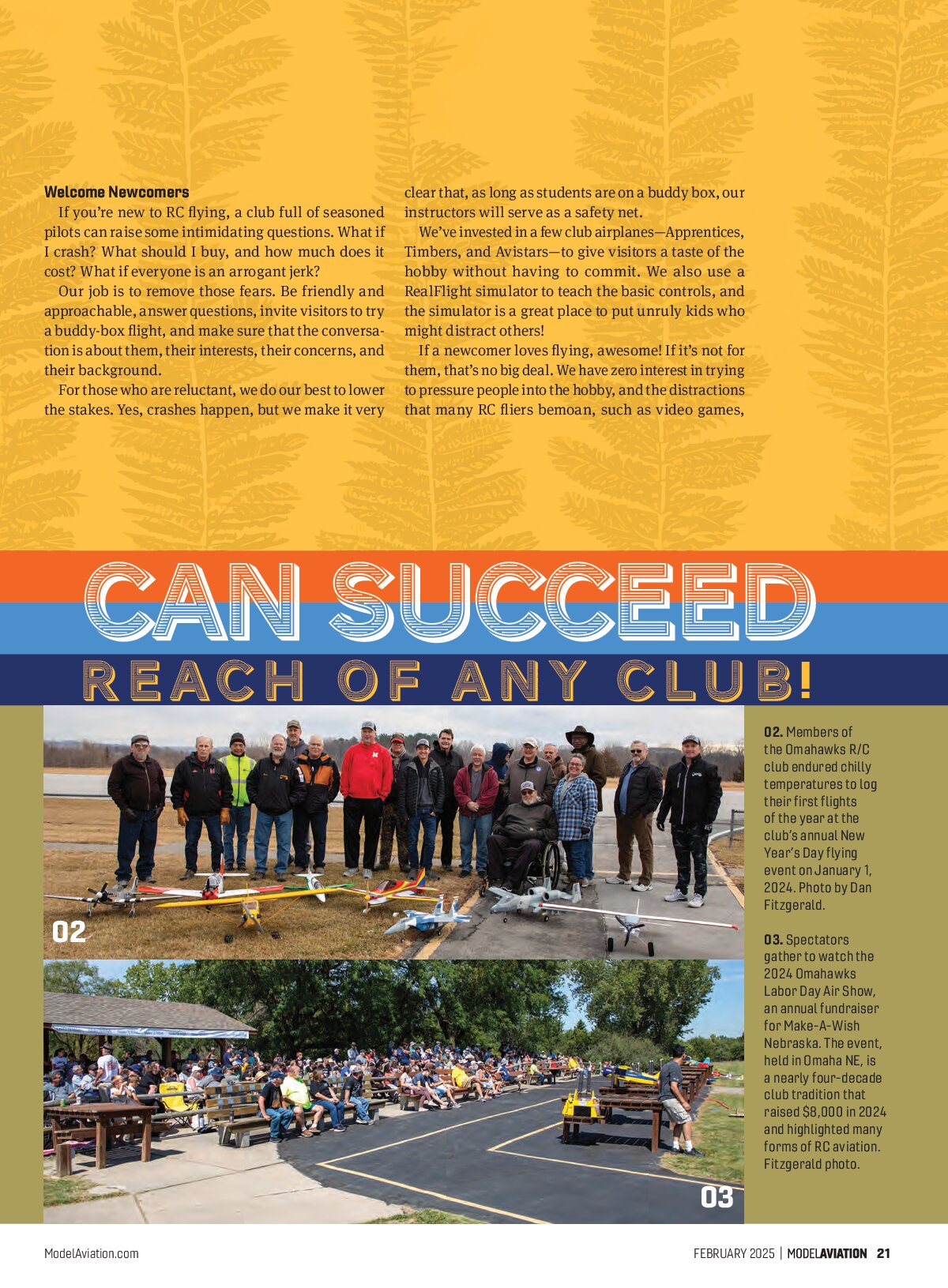
Some ideas, such as a formal training night, have been big and consistent successes. Others didn’t work as well as we had hoped. Still, other plans worked briefly then faded, and that’s okay! We’re always willing to experiment and evaluate as we go. If something fails, no big deal. Learn, adjust, and try something else.
Connect and Give Back
Every year, hundreds of spectators gather for our

HOW CLUBS CAN SUCCEED
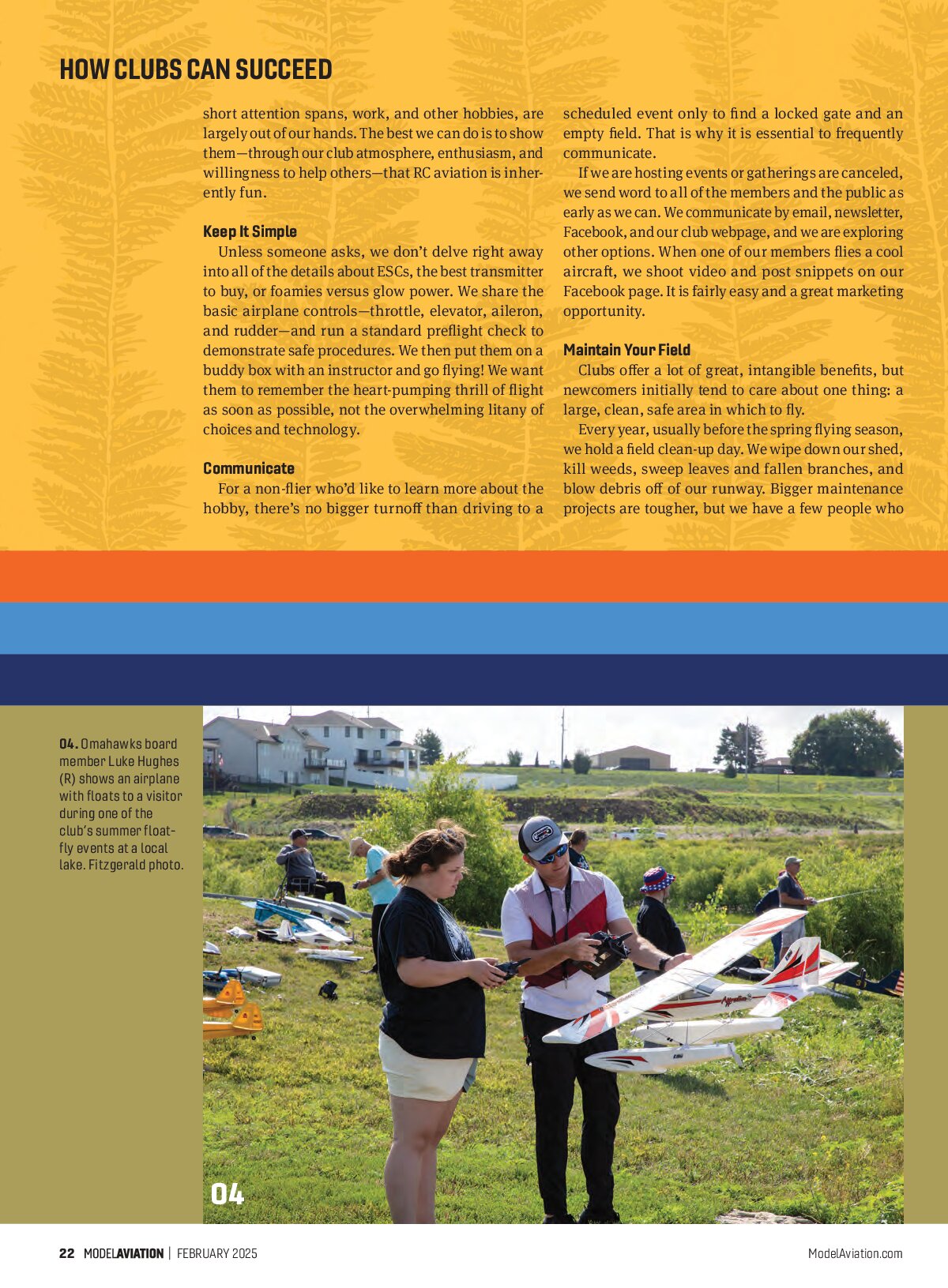
annual Labor Day Air Show, a fundraiser for Make-A-Wish Nebraska. We have held it for nearly 40 years. In 2024, we raised $8,000 to help grant wishes for young children with life-altering illnesses.
The air show is our biggest event of the year, and it helps us shine a spotlight on RC aviation. It’s also a huge source of pride for our members and brings a tremendous sense of accomplishment. Our crowds have grown so large that we’ve expanded our parking area, and we still run out of room!
You’d be surprised at the difference you can make with a positive, service-focused attitude, and the relationships you build can benefit your club as well.
Our partnership with Omaha’s local EAA chapter has given us access to an indoor club meeting space. We advertise our club at local air shows and museums. Our members make presentations to local schools and Scout groups all the time, and we’ve established a great relationship with our city parks department.
Let’s not forget our local hobby store, HobbyTown, which shares our club information with customers and allows us to post flyers in its store. In return, we strongly encourage our members to shop there.
No Egos
RC pilots come from all backgrounds and demographics, but we all love model aviation! We always strive to keep that in mind. If a conflict arises, we listen, talk through it, and treat others with respect.
We recognize the experience of those who have been in the hobby for decades and learn from them, but, at the same time, we give proper attention to younger members and those who are naturally gifted pilots.
Find AMA Club Partners
In Omaha, we have a half-dozen AMA clubs within a 50-mile radius, so it only makes sense to occasionally partner on bigger projects. When other clubs hold auctions, we lend our auctioneering experience and computer programs to help. They return the favor by attending and promoting our events and helping when needed.

Earlier this year, a nearby club had to close its field for a week because of circumstances beyond its control. When we heard the news, our club secretary suggested that we open our field to those members for the week. That club’s president was extremely grateful and informed his members that they still had a place to fly.
Seek New Leaders
As with any activity, a small, passionate group of volunteers tends to be most involved. It’s great for a while, but it is a long-term risk for burnout. That’s why it’s so important to actively look for new leaders who can help.
This is a challenge. Everyone is busy with family and work obligations. Some might not want the limelight and, of course, most pilots would rather be flying than planning meetings, cleaning a shed, or designing an event poster.
Cultivating new and energetic leaders is critical. Fresh blood keeps clubs dynamic. Look for people who are passionate about the hobby. Who shows up regularly to fly? Who attends board and member meetings? Who posts their flying adventures on social media?
I’ve served as president of the Omahawks for a year now. When my predecessor asked if I would be willing to take the job, he told me that, despite the challenges and workload, the job is absolutely worth it and that the club members would have my back, as they did for him. He was right on both counts!

SOURCES:
AMA Flying Site Improvement Grant
foundation@modelaircraft.org
https://modelaircraft.secure-platform.com/a/page/grants/flyingsiteimprovementgrant
Omahawks R/C Inc.
www.omahawks.org