FOCAL POINT
Interested in sharing your handiwork? Visit www.ModelAviation.com for submission guidelines.

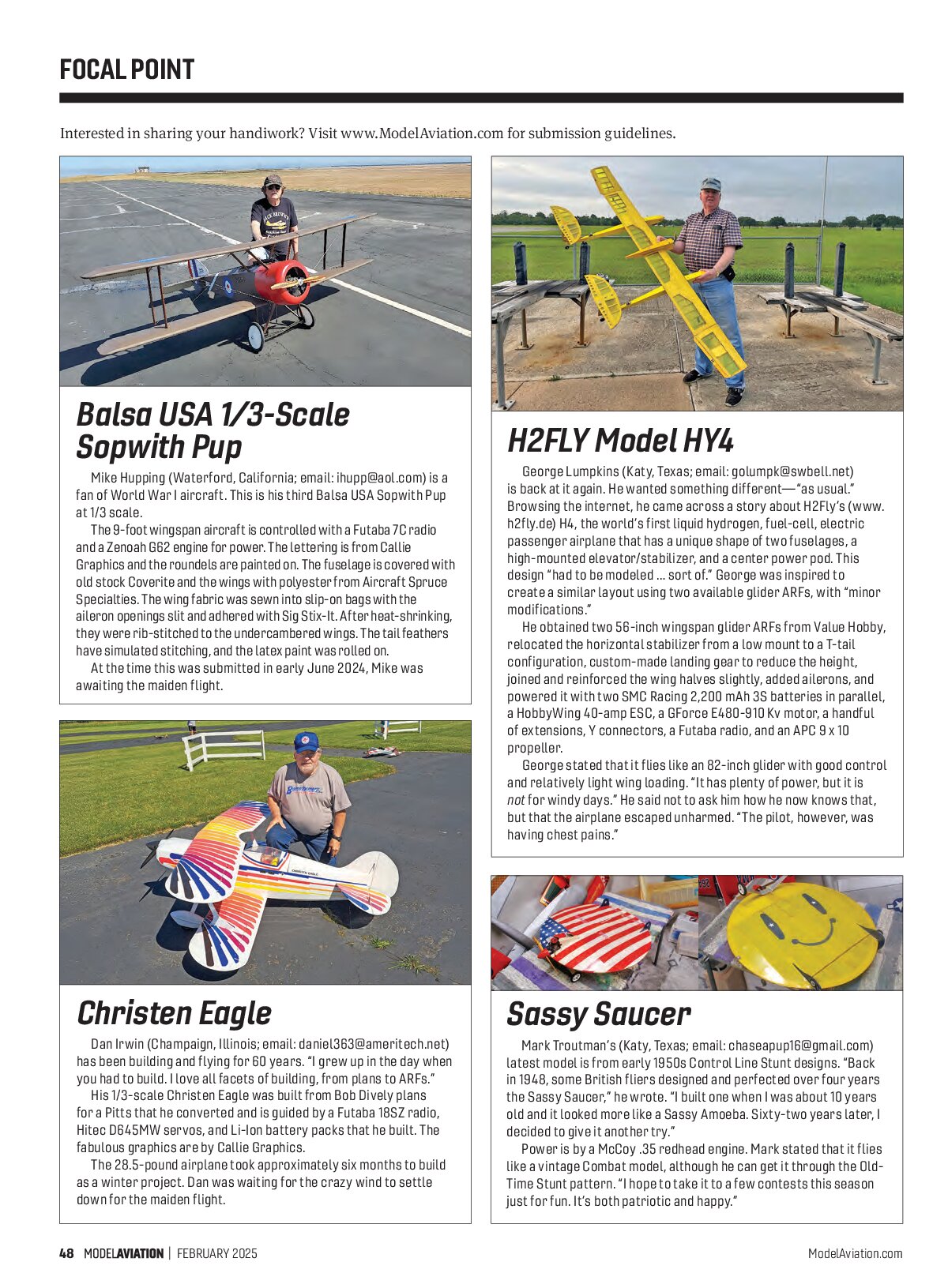
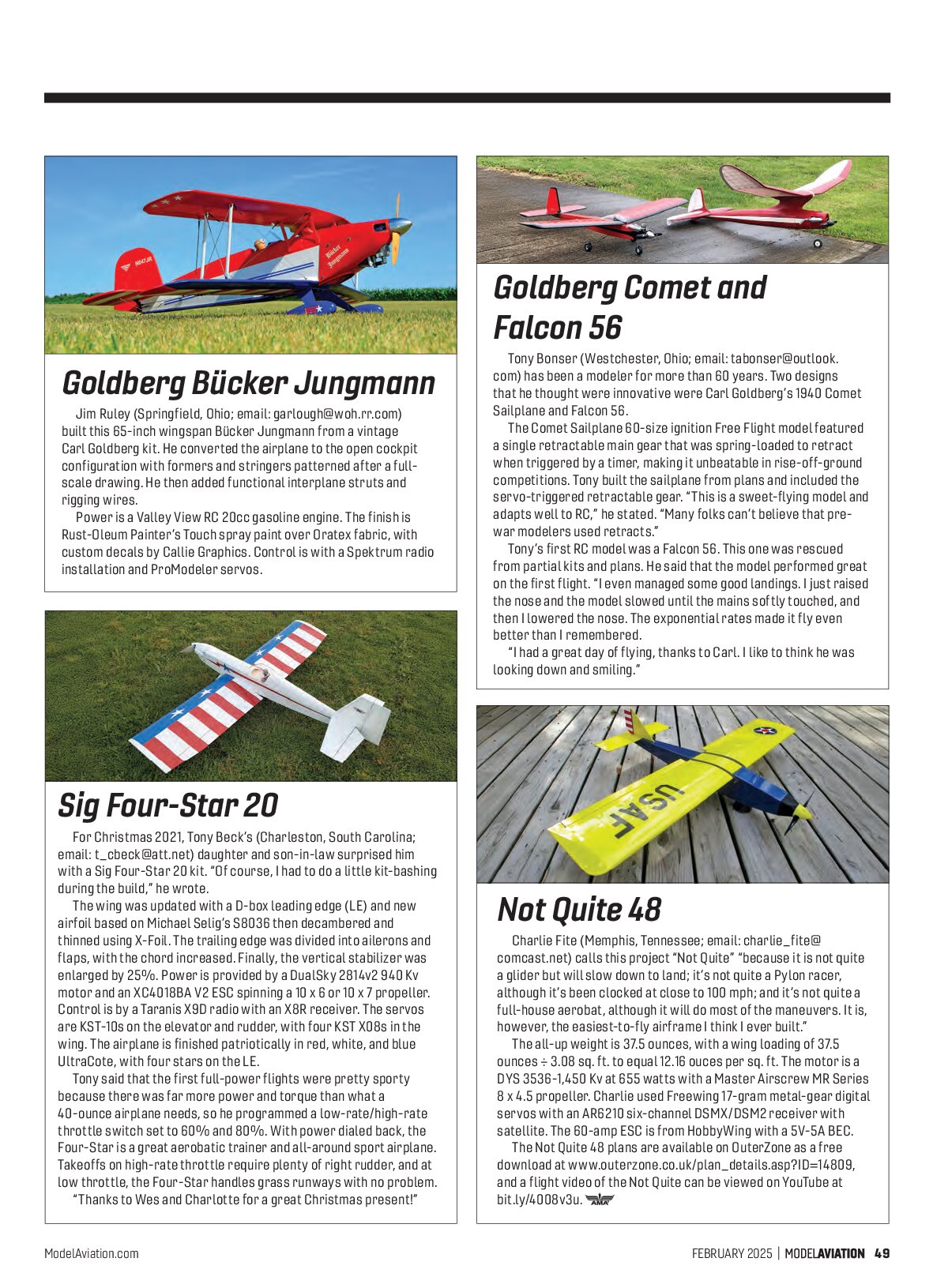
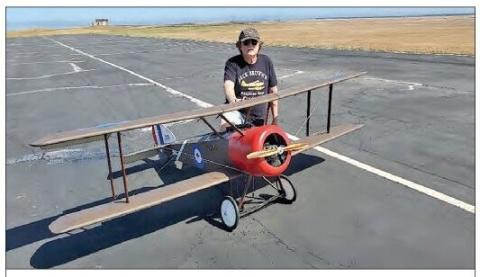
Balsa USA 1/3-Scale Sopwith Pup
Mike Hupping (Waterford, California; email: jhunn@aol.com) is a fan of World War I aircraft. This is his third Balsa USA Sopwith Pup at 1/3 scale.
The 9-foot wingspan aircraft is controlled with a Futaba 7C radio and a Zenoah G62 engine for power. The lettering is from Callie Graphics and the roundels are painted on. The fuselage is covered with old stock Coverite and the wings with polyester from Aircraft Spruce Specialties. The wing fabric was sewn into slip-on bags with the aileron openings slit and adhered with Sig Six-It. After heat-shrinking, they were rib-stitched to the undercambered wings. The tail feathers have simulated stitching, and the latex paint was rolled on.
At the time this was submitted in early June 2024, Mike was awaiting the maiden flight.

H2FLY Model HY4
George Lumpkins (Katy, Texas; email: golumpk@swbell.net) is back at it again. He wanted something different—“as usual.” Browsing the internet, he came across a story about H2FLY’s (www.h2fly.de) H4, the world’s first liquid hydrogen, fuel-cell, electric passenger airplane that has a unique shape of two fuselages, a high-mounted elevator/stabilizer, and a center power pod. This design “had to be modeled ... sort of.” George was inspired to create a similar layout using two available glider ARFs, with “minor modifications.”
He obtained two 56-inch wingspan glider ARFs from Value Hobby, relocated the horizontal stabilizer from a low mount to a T-tail configuration, custom-made landing gear to reduce the height, joined and reinforced the wing halves slightly, added ailerons, and powered it with two SMC Racing 2,200 mAh 3S batteries in parallel, a HobbyWing 40-amp ESC, a GForce E480-910 Kv motor, a handful of extensions, Y connectors, a Futaba radio, and an APC 9 x 10 propeller.
George stated that it flies like an 82-inch glider with good control and relatively light wing loading. “It has plenty of power, but it is not for windy days.” He said not to ask him how he knows that, but that the airplane escaped unharmed. “The pilot, however, was having chest pains.”

Christen Eagle
Dan Irwin (Champaign, Illinois; email: daniel363@ameritech.net) has been building and flying for 60 years. “I grew up in the day when you had to build. I love all facets of building, from plans to ARFs.” His 1/3-scale Christen Eagle was built from Bob Dively plans for a Pitts that he converted and is guided by a Futaba 18SZ radio, Hitec D645MW servos, and Li-Ion battery packs that he built. The fabulous graphics are by Callie Graphics.
The 28.5-pound airplane took approximately six months to build as a winter project. Dan was waiting for the crazy wind to settle down for the maiden flight.

Sassy Saucer
Mark Troutman’s (Katy, Texas; email: chaseapup16@gmail.com) latest model is from early 1950s Control Line Stunt designs. “Back in 1948, some British fliers designed and perfected over four years the Sassy Saucer,” he wrote. “I built one when I was about 10 years old and it looked more like a Sassy Amoeba. Sixty-two years later, I decided to give it another try.”
Power is by a McCoy .35 redhead engine. Mark stated that it flies like a vintage Combat model, although he can get it through the Old-Time Stunt pattern. “I hope to take it to a few contests this season just for fun. It’s both patriotic and happy.”
Goldberg Bücker Jungmann

Jim Ruley (Springfield, Ohio; email: garlough@woh.rr.com) built this 65-inch wingspan Bücker Jungmann from a vintage Carl Goldberg kit. He converted the airplane to the open cockpit configuration with formers and stringers patterned after a full-scale drawing. He then added functional interplane struts and rigging wires.
Power is a Valley View RC 20cc gasoline engine. The finish is Rust-Oleum Painter’s Touch spray paint over Oratex fabric, with custom decals by Callie Graphics. Control is with a Spektrum radio installation and ProModeler servos.
Sig Four-Star 20

For Christmas 2021, Tony Beck’s (Charleston, South Carolina; email: t.cbeck@att.net) daughter and son-in-law surprised him with a Sig Four-Star 20 kit. “Of course, I had to do a little kit-bashing during the build,” he wrote.
The wing was updated with a D-box leading edge (LE) and new airfoil based on Michael Selig’s S8036 then decambered and thinned using X-Foil. The trailing edge was divided into ailerons and flaps, with the chord increased. Finally, the vertical stabilizer was enlarged by 25%. Power is provided by a DualSky 2814v2 940 Kv motor and an XC4018BA V2 ESC spinning a 10 x 6 or 10 x 7 propeller. Control is by a Taranis X9D radio with an X8R receiver. The servos are KST-10s on the elevator and rudder, with four KST X08s in the wing. The airplane is finished patriotically in red, white, and blue UltraCote, with four stars on the LE.
Tony said that the first full-power flights were pretty sporty because there was far more power and torque than what a 40-ounce airplane needs, so he programmed a low-rate/high-rate throttle switch set to 60% and 80%. With power dialed back, the Four-Star is a great aerobatic trainer and all-around sport airplane. Takeoffs on high-rate throttle require plenty of right rudder, and at low throttle, the Four-Star handles grass runways with no problem.
“Thanks to Wes and Charlotte for a great Christmas present!”
Goldberg Comet and Falcon 56

Tony Bonser (Westchester, Ohio; email: tabonser@outlook.com) has been a modeler for more than 60 years. Two designs that he thought were innovative were Carl Goldberg’s 1940 Comet Sailplane and Falcon 56.
The Comet Sailplane 60-size ignition Free Flight model featured a single retractable main gear that was spring-loaded to retract when triggered by a timer, making it unbeatable in rise-off-ground competitions. Tony built the sailplane from plans and included the servo-triggered retractable gear. “This is a sweet-flying model and adapts well to RC,” he stated. “Many folks can’t believe that pre-war modelers used retracts.”
Tony’s first RC model was a Falcon 56. This one was rescued from partial kits and plans. He said that the model performed great on the first flight. “I even managed some good landings. I just raised the nose and the model slowed until the mains of softly touched, and then I lowered the nose. The exponential rates made it fly even better than I remembered.”
“I had a great day of flying, thanks to Carl. I like to think he was looking down and smiling.”
Not Quite 48

Charlie Fite (Memphis, Tennessee; email: charlie_fite@comcast.net) calls this project ‘Not Quite’ “because it is not quite a glider but will slow down to land; it’s not quite a Pylon racer, although it’s been clocked at close to 100 mph; and it’s not quite a full-house aerobat, although it will do most of the maneuvers. It is, however, the easiest-to-fly airframe I think I ever built.”
The all-up weight is 37.5 ounces, with a wing loading of 37.5 ounces ÷ 3.08 sq. ft. to equal 12.16 ounces per sq. ft. The motor is a DYS 3536-1,450 Kv at 655 watts with a Master Airscrew MR Series 8 x 4.5 propeller. Charlie used Freewing 17-gram metal-gear digital servos with an AR6210 six-channel DSMX/DSM2 receiver with satellite. The 60-amp ESC is from HobbyWing with a 5V-5A BEC.
The Not Quite 48 plans are available on OuterZone as a free download at www.outerzone.co.uk/plan_details.asp?ID=14809, and a flight video of the Not Quite can be viewed on YouTube at bit.ly/4008v3u.