
MAKING THE TRANSITION FROM SAFE TO CONVENTIONAL CONTROL
By Dave Scott | 1usrcfs@gmail.com

LIKE IT OR NOT, SAFE technology gyro stabilization is responsible for a record number of people becoming successful, independent solo pilots. However, when those who fly in SAFE mode wish to do more than gentle circuits, it must be switched off.
As to the theory that learning in SAFE mode instills bad habits (specifically, holding in the aileron during turns), in my experience, this is only a problem for reactive pilots who fly without any sort of plan. By definition, reactive pilots have to make a mistake before it even occurs to them that they made one. Therefore, reactive pilots tend to struggle with inconsistency and, as a result, struggle anytime changes are introduced.
I train people to make the transition from SAFE on a weekly basis and can assure you that learning conventional control techniques is no more challenging for a pilot who has been flying on SAFE versus someone completely new to the sport. The key is having the correct understanding of how the controls are applied in either case.
Crawl-Walk-Run
As many of you know, in the Beginner SAFE mode, bank and pitch are typically limited to no more than 30°, thereby limiting the airplane to mild maneuvering. Most significantly, the airplane returns to an upright, level attitude the instant the transmitter controls are returned to neutral.
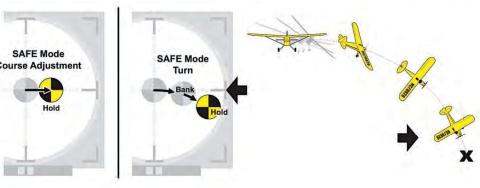
In SAFE mode, the airplane is essentially steered around the sky like a car. The pilot holds the aileron control stick in the direction that they want the airplane to go. The size of aileron that is applied determines the
degree of bank, and therefore, the size of the turn.
When the throttle is set for level flight, the stabilization technology will attempt to keep the turn level. That said, it is often necessary for the pilot to pull or hold in some up-elevator to maintain a perfectly level turn throughout.
To exit the turn, all you have to do is return the aileron control stick to neutral. The airplane will automatically return to wings-level and a straight line. Small course adjustments are performed by holding in a slight amount of left or right to steer to the desired heading, and then it’s neutralized.
Switching to Intermediate SAFE mode allows slightly steeper bank and pitch angle limits to enable more nimble maneuvering. The auto-level feature is no longer active; therefore, the airplane is flown with conventional control techniques that are similar to those that are used to fly most airplanes.
Experienced (or conventional) control mode removes any artificial bank or pitch limits. As such, the airplane will do whatever the pilot tells it to do, right or wrong.
The most important aspect of flying with conventional control is understanding that holding in the aileron will cause the bank to become increasingly steeper, ultimately resulting in the airplane entering a downward spiral when it’s held in too long.
Illustration 1 shows that, in Beginner SAFE mode, the airplane is steered around the sky like a car and returns to a level attitude the instant the pilot neutralizes the controls. However, when SAFE is switched off, pilots must avoid holding in the aileron or they will put the airplane into a spiral dive.
Turns are instead initiated with a smooth “in-out” aileron input—not held in! The size of the aileron input determines the size of the turn. For example, a smaller in-out input produces a shallower bank and a wider turn. A larger input produces a steeper bank and tighter turn. The turn is then sustained and kept level by holding in up-elevator throughout. When the pilot wishes to exit the turn, the elevator is taken out and opposite aileron is applied to return the wing to level.
Illustration 2 shows that when SAFE is turned off, turns are initiated by smoothly inputting aileron to establish a bank. The aileron is then returned to neutral and up-elevator is held in and adjusted to maintain and keep the turn level throughout. To exit turns, the elevator is neutralized and opposite aileron is applied to level the wing.

Illustration 2: When SAFE is turned off, turns are initiated by smoothly inputting aileron to establish a bank. The aileron is then returned to neutral, and up-elevator is held in and adjusted to maintain and keep the turn level throughout. To exit turns, the elevator is neutralized and opposite aileron is applied to level the wing.
FLIGHT SCHOOL
Widening or tightening turns is accomplished by inputting a smooth, small, in-out aileron bump, while continuing to hold in and adjust the elevator to keep the turn level.
A Smidge Will Do
Slight course adjustments are performed using a smooth, small bump of aileron to bank the wing slightly, thus causing the airplane to gradually drift in that direction. To return to a straight line, opposite aileron is required to return the wing to level.
As long as the aileron is not held in and the bank is only slight, the airplane will typically not lose altitude during minor course corrections. If the course correction is a bit more or the bump of aileron is a bit large, a small amount of elevator might be needed to keep the airplane from losing altitude.
If the pilot holds in the aileron and attempts to steer to a new heading, the bank will continue to steepen and cause the airplane to descend sharply, as well as cause a much greater course correction than what is needed. Therefore, as a rule, aileron bumps should be input one at a time. It’s better to make two separate bumps than to hold in the aileron!

In SAFE mode, climbs, level flight, and descents are primarily controlled using the throttle. For example, takeoffs are performed using more than half throttle and holding in some up-elevator to pull the airplane off of the ground. The higher throttle setting will cause the airplane to maintain a steady climb. The angle of the climb is then fine-tuned with the elevator. When the airplane has achieved the preferred altitude, the throttle is reduced to half throttle for level flight.
In Experienced mode, taking off entails advancing the throttle and steering with the rudder while holding in up-elevator until the airplane lifts off of the ground. After breaking ground, the elevator needs to be lessened and adjusted to maintain a gradual climbout.
Note that if significant elevator is held in after liftoff, the pilot risks putting the airplane into too steep of a climb and entering a stall. Establishing level flight and affecting altitude changes is done using a combination of throttle and elevator. Managing the descent to landing is also accomplished using a combination of throttle and elevator.
Visit my YouTube channel to watch a video that compares SAFE mode and conventional flying techniques. The link is listed in “Sources.”
In Closing
Veteran pilots who frown upon SAFE technology should consider that pilots who fly SAFE-mode-capable airplanes have the option to switch it on and off. When they are ready to make the switch, they can climb and turn off SAFE in order to practice conventional control then turn it back on for landing, with the airplane and their confidence still intact. It usually isn’t long before they perform a routine landing then suddenly realize that they forgot to turn SAFE back on! The soaring confidence that results is what then triggers the desire to want to take their RC flying to the next level!
Happy flying!
SOURCES:
Dave Scott/1st RC Flight School
YouTube
www.youtube.com/@1RCFlightSchool


