SAFETY COMES FIRST
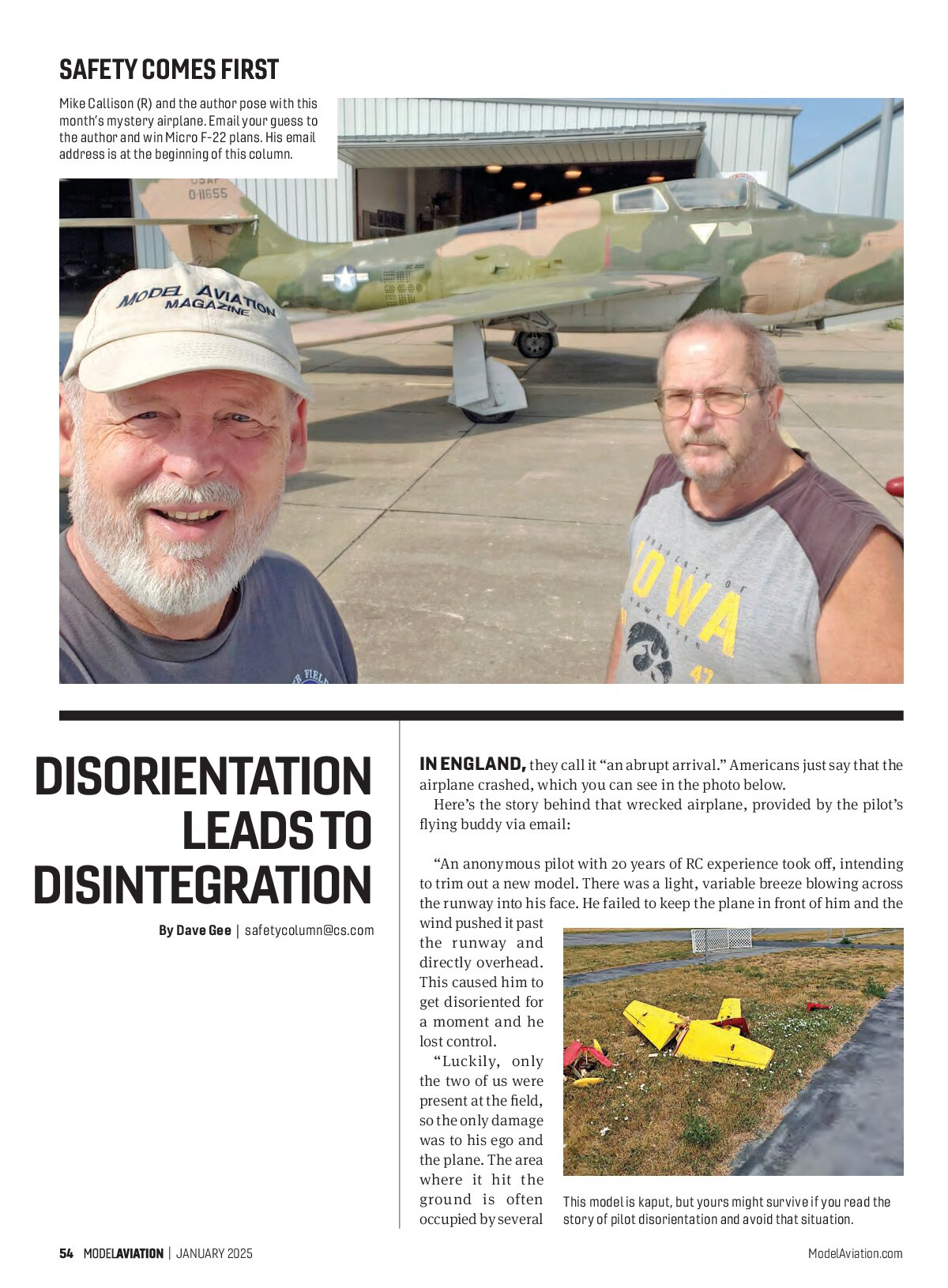
Mike Callison (R) and the author pose with this month’s mystery airplane. Email your guess to the author and win Micro F-22 plans. His email address is at the beginning of this column.

DISORIENTATION
LEADS TO
DISINTEGRATION
By Dave Gee | safetycolumn@cs.com
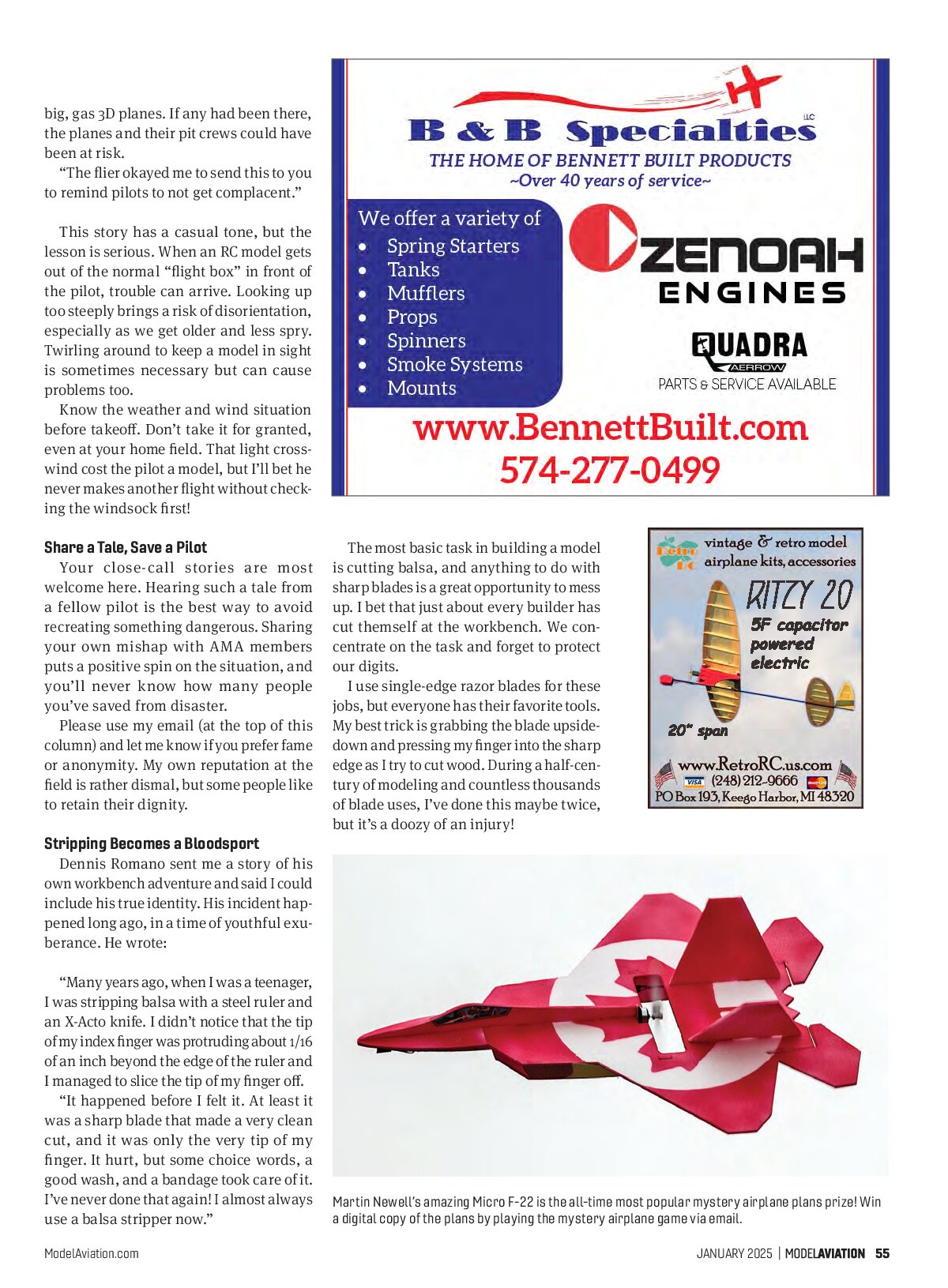
IN ENGLAND, they call it “an abrupt arrival.” Americans just say that the airplane crashed, which you can see in the photo below.
Here’s the story behind that wrecked airplane, provided by the pilot’s flying buddy via email:
“An anonymous pilot with 20 years of RC experience took off, intending to trim out a new model. There was a light, variable breeze blowing across the runway into his face. He failed to keep the plane in front of him and the wind pushed it past the runway and directly overhead. This caused him to get disoriented for a moment and he lost control.
“Luckily, only the two of us were present at the field, so the only damage was to his ego and the plane. The area where it hit the ground is often occupied by several

big, gas 3D planes. If any had been there, the planes and their pit crews could have been at risk.
“The flier okayed me to send this to you to remind pilots to not get complacent.”
This story has a casual tone, but the lesson is serious. When an RC model gets out of the normal “flight box” in front of the pilot, trouble can arrive. Looking up too steeply brings a risk of disorientation, especially as we get older and less spry. Twirling around to keep a model in sight is sometimes necessary but can cause problems too.
Know the weather and wind situation before takeoff. Don’t take it for granted, even at your home field. That light crosswind cost the pilot a model, but I’ll bet he never makes another flight without checking the windsock first!
Share a Tale, Save a Pilot
Your close-call stories are most welcome here. Hearing such a tale from a fellow pilot is the best way to avoid recreating something dangerous. Sharing your own mishap with AMA members puts a positive spin on the situation, and you’ll never know how many people you’ve saved from disaster.
Please use my email (at the top of this column) and let me know if you prefer fame or anonymity. My own reputation at the field is rather dismal, but some people like to retain their dignity.
Stripping Becomes a Bloodsport
Dennis Romano sent me a story of his own workbench adventure and said I could include his true identity. His incident happened long ago, in a time of youthful exuberance. He wrote:
“Many years ago, when I was a teenager, I was stripping balsa with a steel ruler and an X-Acto knife. I didn’t notice that the tip of my index finger was protruding about 1/16 of an inch beyond the edge of the ruler and I managed to slice the tip of my finger off.
“It happened before I felt it. At least it was a sharp blade that made a very clean cut, and it was only the very tip of my finger. It hurt, but some choice words, a good wash, and a bandage took care of it. I’ve never done that again! I almost always use a balsa stripper now.”
The most basic task in building a model is cutting balsa, and anything to do with sharp blades is a great opportunity to mess up. I bet that just about every builder has cut themself at the workbench. We concentrate on the task and forget to protect our digits.
I use single-edge razor blades for these jobs, but everyone has their favorite tools. My best trick is grabbing the blade upside-down and pressing my finger into the sharp edge as I try to cut wood. During a half-century of modeling and countless thousands of blade uses, I’ve done this maybe twice, but it’s a doozy of an injury!

SAFETY COMES FIRST
Please don’t replicate my foolish ways. Pay attention and build a safe routine for using tools—even the smallest ones.
Plug Plea
Speaking of small, if you run a “cottage industry” modeling business, or even if you own a huge operation, I’d be glad to plug any good safety-related products that you might have. Contact me and give some particulars about your item and how it will save fingers and/or lives. I’ll find a spot for it right here, where pilots are eager to learn about helpful gadgets.
Mystery Airplane Mysteries Demystified
Readers have asked for details about the mystery airplane game we play here. It features a photo of a full-scale aircraft and readers email me their guesses as to its identity. I read and enjoy every single email, but I sometimes respond in batches because of the sheer number of messages. It’s great to hear from readers!
Everyone receives digital prize plans for some obscure model, and the correct guessers get to brag about how smart they are. All of the puzzle photos are taken by me, and the prizes come from my own research and antique kit collection. The hardest one received only six responses. A poor choice on my part! Readers prefer intermediate-level challenges, which result in many hundreds of guesses.
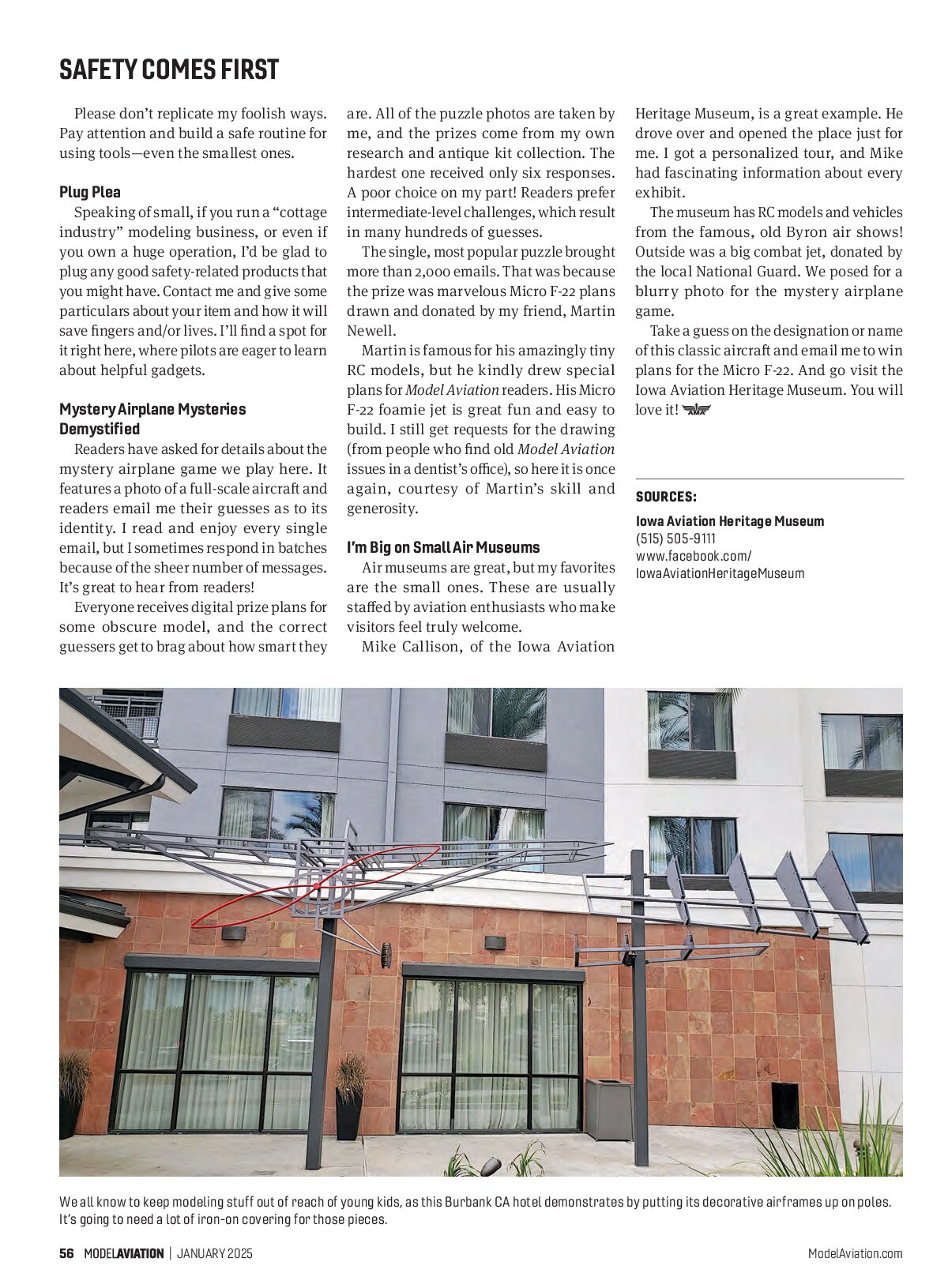
The single, most popular puzzle brought more than 2,000 emails. That was because the prize was marvelous Micro F-22 plans drawn and donated by my friend, Martin Newell.
Martin is famous for his amazingly tiny RC models, but he kindly drew special plans for Model Aviation readers. His Micro F-22 foamie jet is great fun and easy to build. I still get requests for the drawing (from people who find old Model Aviation issues in a dentist’s office), so here it is once again, courtesy of Martin’s skill and generosity.
I’m Big on Small Air Museums
Air museums are great, but my favorites are the small ones. These are usually staffed by aviation enthusiasts who make visitors feel truly welcome.
Mike Callison, of the Iowa Aviation Heritage Museum, is a great example. He drove over and opened the place just for me. I got a personalized tour, and Mike had fascinating information about every exhibit.
The museum has RC models and vehicles from the famous, old Byron air shows! Outside was a big combat jet, donated by the local National Guard. We posed for a blurry photo for the mystery airplane game.
Take a guess on the designation or name of this classic aircraft and email me to win plans for the Micro F-22. And go visit the Iowa Aviation Heritage Museum. You will love it!

SOURCES:
Iowa Aviation Heritage Museum
(515) 505-9111
www.facebook.com/
IowaAviationHeritageMuseum