RC AND CL SCALE AT THE F4 WORLD CHAMPIONSHIPS
By Stan Alexander | onawing4602@att.net

I WILL START OUT this year by looking at the winning models for which I have data on from the 2024 Fédération Aéronautique Internationale (FAI) F4 World Championships for Scale Model Aircraft. This includes both F4C and F4B models and, later, the F4H models. I don’t usually include Control Line (CL) Scale models in the column, but because I did static-judge these models and was the chief judge for static in F4H and F4B, I think it is appropriate. In future columns, I’ll include the models and competitors from the US in all classes.
F4B is back in international competition. Allen Goff, the USA FAI F4 Scale chairman, has worked close to four years to make changes in static rules and organize this event to promote CL Scale at the FAI level. F4B has the same static rules as F4H, which is nearer to our Sport Scale rules. The rules are simpler; the time limit on static judging is only 20 minutes per model, and they are judged at a 5-meter distance. You are only allowed five photos for static, so you want to choose them wisely. Trying to hide areas that you didn’t complete will only cause a reduction in scores.
Most modelers will include both sides of the full-scale aircraft, the top view, and the end view. Some have used a drone to obtain an accurate photo of the top view. Scale drawings are also a part of static judging, along with a declaration sheet that states what you did or didn’t do yourself.
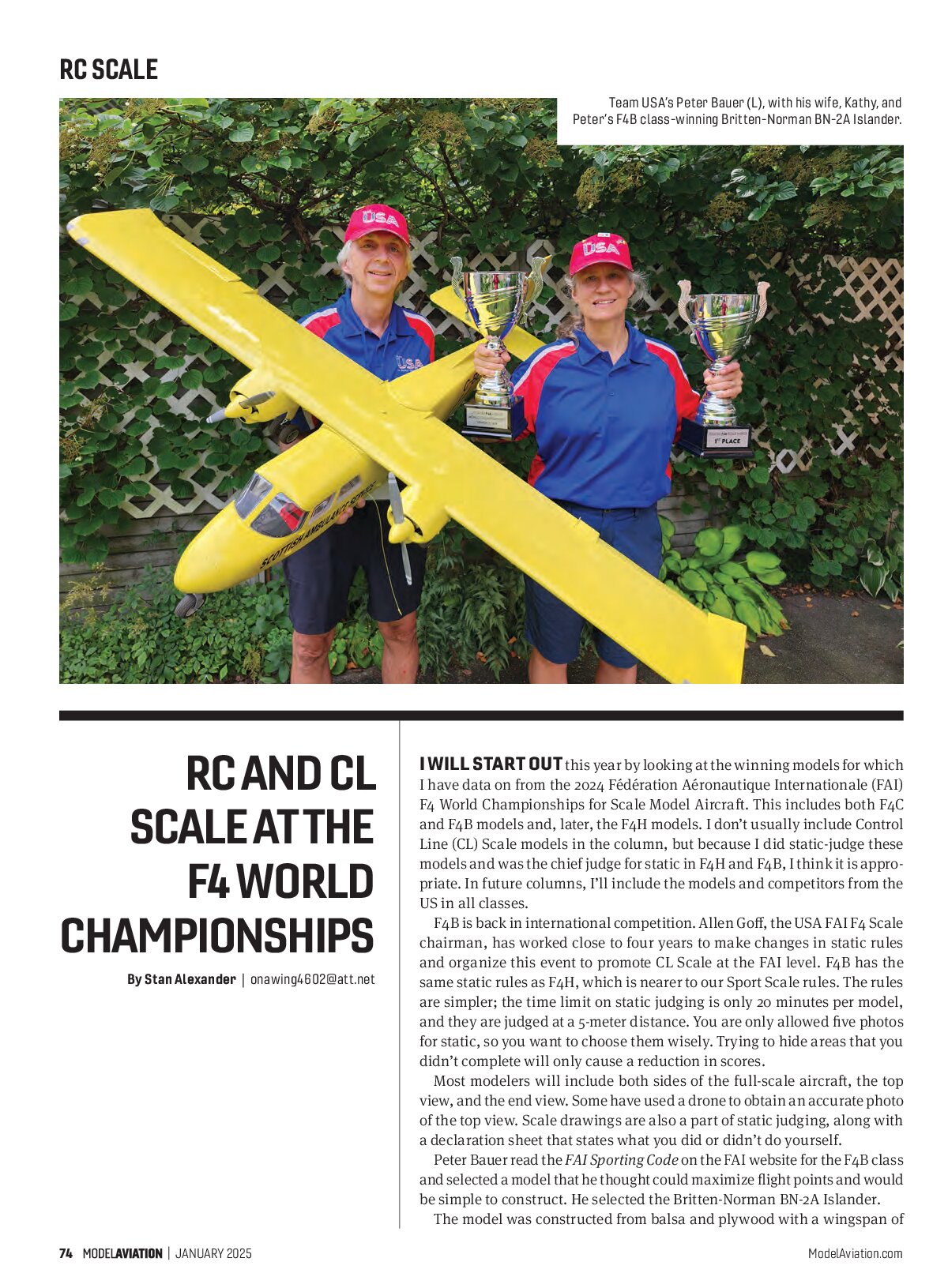
Peter Bauer read the FAI Sporting Code on the FAI website for the F4B class and selected a model that he thought could maximize flight points and would be simple to construct. He selected the Britten-Norman BN-2A Islander.
The model was constructed from balsa and plywood with a wingspan of
70 inches. He used Du-Bro spinners and wheels and Brodak control lines. The graphics came from Callie Graphics, and the paint is from Klass Kote. Power is from E-flite outrunner motors, E-flite brushless ESCs, and Spektrum batteries. Peter also used a Spektrum Smart Charger for the power systems. The throttles are controlled with an Airtronics 2.4 GHz radio system, as well as the flaps. Robart Manufacturing landing gear struts and components were also modified and used.
Peter finished first in the F4B class this year, with his wife, Kathy, calling for him. His flight scores helped to bring in the gold.
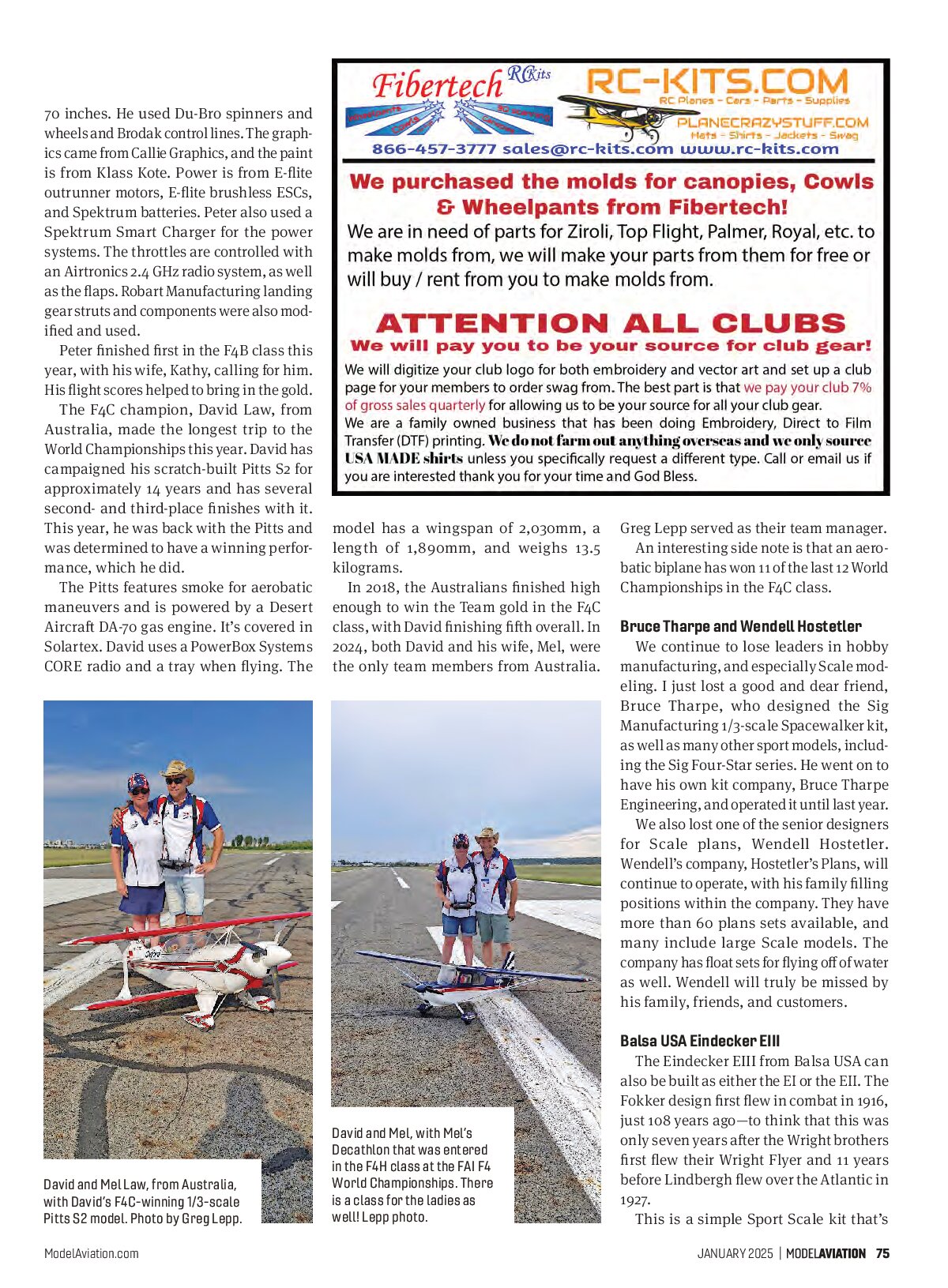
The F4C champion, David Law, from Australia, made the longest trip to the World Championships this year. David has campaigned his scratch-built Pitts S2 for approximately 14 years and has several second- and third-place finishes with it. This year, he was back with the Pitts and was determined to have a winning performance, which he did.
The Pitts features smoke for aerobatic maneuvers and is powered by a Desert Aircraft DA-70 gas engine. It’s covered in Solartex. David uses a PowerBox Systems CORE radio and a tray when flying.

model has a wingspan of 2,030mm, a length of 1,890mm, and weighs 13.5 kilograms.
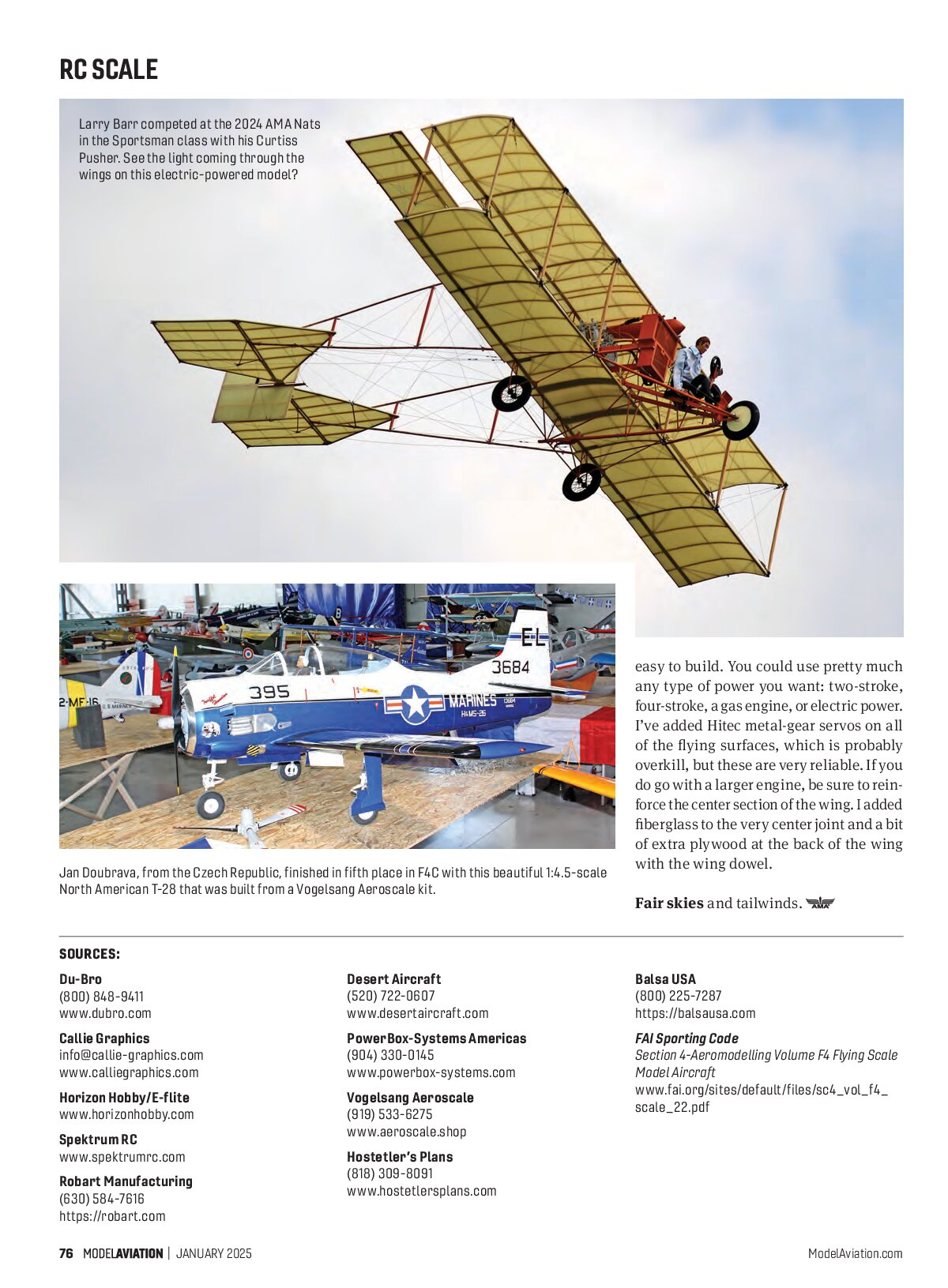
In 2018, the Australians finished high enough to win the Team gold in the F4C class, with David finishing fifth overall. In 2024, both David and his wife, Mel, were the only team members from Australia.

Greg Lepp served as their team manager. An interesting side note is that an aerobatic biplane has won 11 of the last 12 World Championships in the F4C class.
Bruce Tharpe and Wendell Hostetler
We continue to lose leaders in hobby manufacturing, and especially Scale modeling. I just lost a good and dear friend, Bruce Tharpe, who designed the Sig Manufacturing 1/3-scale Spacewalker kit, as well as many other sport models, including the Sig Four-Star series. He went on to have his own kit company, Bruce Tharpe Engineering, and operated it until last year.
We also lost one of the senior designers for Scale plans, Wendell Hostetler. Wendell’s company, Hostetler’s Plans, will continue to operate, with his family filling positions within the company. They have more than 60 plans sets available, and many include large Scale models. The company has float sets for flying off of water as well. Wendell will truly be missed by his family, friends, and customers.
Balsa USA Eindecker EIII
The Eindecker EIII from Balsa USA can also be built as either the EI or the EII. The Fokker design first flew in combat in 1916, just 108 years ago—to think that this was only seven years after the Wright brothers first flew their Wright Flyer and 11 years before Lindbergh flew over the Atlantic in 1927.
This is a simple Sport Scale kit that’s
RC SCALE


easy to build. You could use pretty much any type of power you want: two-stroke, four-stroke, a gas engine, or electric power. I’ve added Hitec metal-gear servos on all of the flying surfaces, which is probably overkill, but these are very reliable. If you do go with a larger engine, be sure to reinforce the center section of the wing. I added fiberglass to the very center joint and a bit of extra plywood at the back of the wing with the wing dowel.
Fair skies and tailwinds.
SOURCES:
Du-Bro
(800) 848-9411
www.dubro.com
Callie Graphics
info@callie-graphics.com
www.calliegraphics.com
Horizon Hobby/E-flite
www.horizonhobby.com
Spektrum RC
www.spektrumrc.com
Robart Manufacturing
(630) 584-7616
https://robart.com
Desert Aircraft
(520) 722-0607
www.desertaircraft.com
PowerBox-Systems Americas
(904) 330-0145
www.powerbox-systems.com
Vogelsang Aeroscale
(919) 533-6275
www.aeroscale.shop
Hostetler’s Plans
(818) 309-8091
www.hostetlersplans.com
Balsa USA
(800) 225-7287
https://balsausa.com
FAI Sporting Code
Section 4-Aeromodelling Volume F4 Flying Scale Model Aircraft
www.fai.org/sites/default/files/sc4_vol_f4_scale_22.pdf