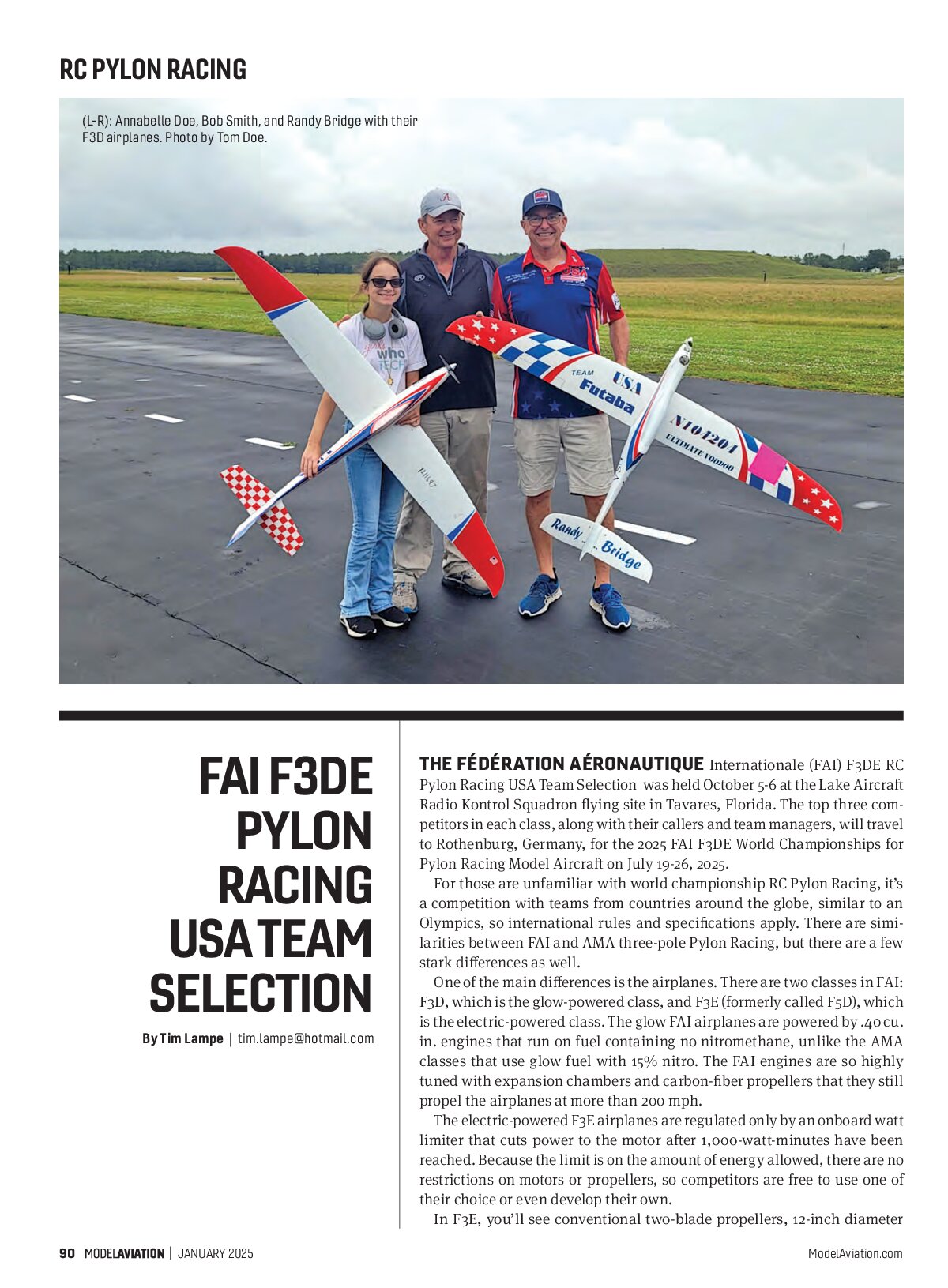
RC PYLON RACING

FAI F3DE
PYLON
RACING
USA TEAM
SELECTION
By Tim Lampe | tim.lampe@hotmail.com
THE FÉDÉRATION AÉRONAUTIQUE Internationale (FAI) F3DE RC Pylon Racing USA Team Selection was held October 5-6 at the Lake Aircraft Radio Kontrol Squadron flying site in Tavares, Florida. The top three competitors in each class, along with their callers and team managers, will travel to Rothenburg, Germany, for the 2025 FAI F3DE World Championships for Pylon Racing Model Aircraft on July 19-26, 2025.
For those unfamiliar with world championship RC Pylon Racing, it’s a competition with teams from countries around the globe, similar to an Olympics, so international rules and specifications apply. There are similarities between FAI and AMA three-pole Pylon Racing, but there are a few stark differences as well.
One of the main differences is the airplanes. There are two classes in FAI: F3D, which is the glow-powered class, and F3E (formerly called F5D), which is the electric-powered class. The glow FAI airplanes are powered by .40 cu. in. engines that run on fuel containing no nitromethane, unlike the AMA classes that use glow fuel with 15% nitro. The FAI engines are so highly tuned with expansion chambers and carbon-fiber propellers that they still propel the airplanes at more than 200 mph.
The electric-powered F3E airplanes are regulated only by an onboard watt limiter that cuts power to the motor after 1,000-watt-minutes have been reached. Because the limit is on the amount of energy allowed, there are no restrictions on motors or propellers, so competitors are free to use one of their choice or even develop their own.
In F3E, you’ll see conventional two-blade propellers, 12-inch diameter
folding “saw-type” propellers, and even single-blade propellers! The only other restrictions are wing loading and the battery voltage being limited to a 5S LiPo, so the sky is the limit in F3E, making it an extraordinarily scientific and technical category.
Both classes fly 10-lap heats with a 10% time penalty for a pylon cut and an automatic score of 200 if two pylons are cut.
Another main difference between AMA and FAI is the points format. Whereas AMA Pylon Racing is head-to-head heat racing with pilots competing directly against each other and earning more points the higher up in each heat they finish, FAI is strictly a time event where your time is your score, so if you finish in front of another pilot in a heat, it’s irrelevant because only the time matters.
At the end of the competition, the pilot with the lowest score is the winner. This means that AMA competition can be more dramatic because you actually have to cross the finish line before another competitor to maximize your points. I’ve said that FAI might be more “gentlemanly” because you’re racing the clock, not necessarily the other airplane. Of course, the other side of that coin is that there is usually more carnage in the upper classes of AMA Pylon Racing from airplanes flying at extremely high speeds, often wingtip to wingtip.
Without a doubt, however, the points are counted, FAI is the highest form of model airplane Pylon Racing. The top pilots are the best on the planet and have dedicated countless hours of practice and refinement throughout several years.
The FAI course could be compared to the AMA “long” course for Quarter 40. The AMA course is a bit longer from the two


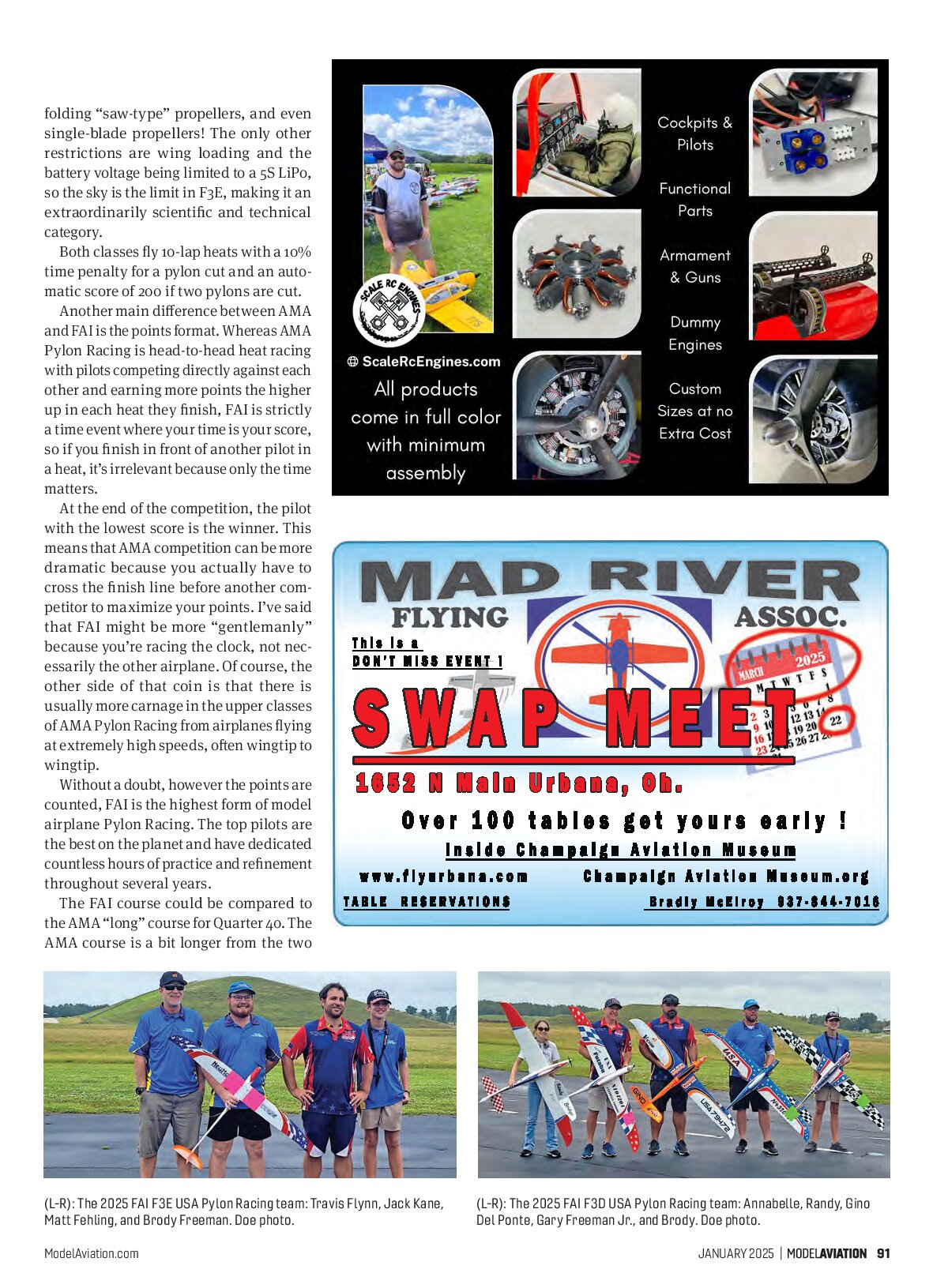
(L-R): The 2025 FAI F3E USA Pylon Racing team: Travis Flynn, Jack Kane, Matt Fehling, and Brody Freeman. Doe photo.
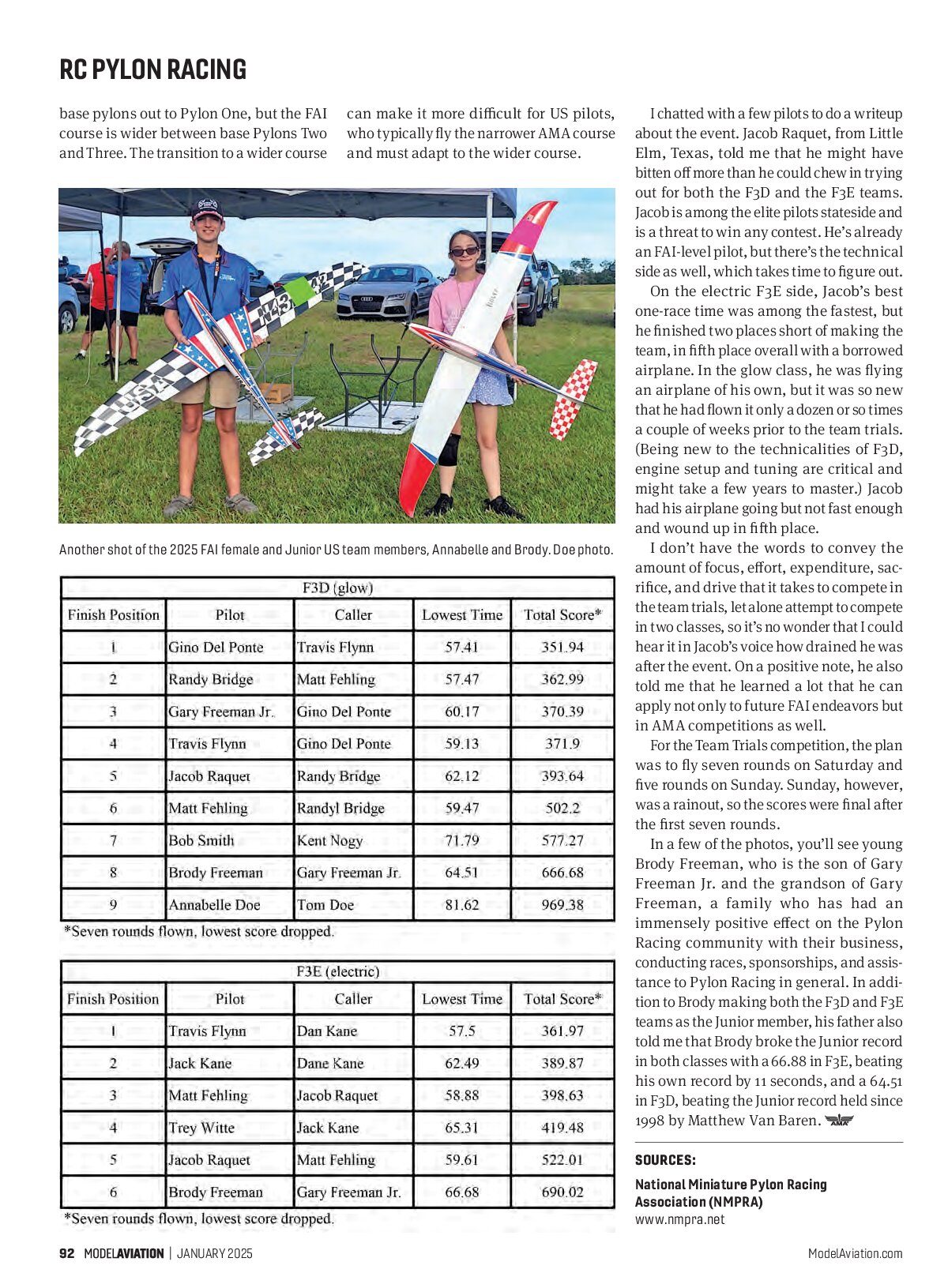
(L-R): The 2025 FAI F3D USA Pylon Racing team: Annabelle, Randy, Gino Del Ponte, Gary Freeman Jr., and Brody. Doe photo.
RC PYLON RACING
base pylons out to Pylon One, but the FAI course is wider between base Pylons Two and Three. The transition to a wider course can make it more difficult for US pilots, who typically fly the narrower AMA course and must adapt to the wider course.

Another shot of the 2025 FAI female and Junior US team members, Annabelle and Brody.
F3D (glow)
Finish Position | Pilot | Caller | Lowest Time | Total Score*
1 | Gino Del Ponte | Travis Flynn | 57.41 | 351.94
2 | Randy Bridge | Matt Fehling | 57.47 | 362.99
3 | Gary Freeman Jr. | Gino Del Ponte | 60.17 | 370.39
4 | Travis Flynn | Gino Del Ponte | 59.13 | 371.9
5 | Jacob Raquet | Randy Bridge | 62.12 | 393.64
6 | Matt Fehling | Randy Bridge | 59.47 | 502.2
7 | Bob Smith | Kent Nogy | 71.79 | 577.27
8 | Brody Freeman | Gary Freeman Jr. | 64.51 | 666.68
9 | Annabelle Doe | Tom Doe | 81.62 | 969.38
*Seven rounds flown, lowest score dropped.
F3E (electric)
Finish Position | Pilot | Caller | Lowest Time | Total Score*
1 | Travis Flynn | Dan Kane | 57.5 | 361.97
2 | Jack Kane | Dane Kane | 62.49 | 389.87
3 | Matt Fehling | Jacob Raquet | 58.88 | 398.63
4 | Trey Witte | Jack Kane | 65.31 | 419.48
5 | Jacob Raquet | Matt Fehling | 59.61 | 522.01
6 | Brody Freeman | Gary Freeman Jr. | 66.68 | 690.02
*Seven rounds flown, lowest score dropped.
I chatted with a few pilots to do a writeup about the event. Jacob Raquet, from Little Elm, Texas, told me that he might have bitten off more than he could chew in trying out for both the F3D and the F3E teams. Jacob is among the elite pilots stateside and is a threat to win any contest. He’s already an FAI-level pilot, but there’s the technical side as well, which takes time to figure out.
On the electric F3E side, Jacob’s best one-race time was among the fastest, but he finished two places short of making the team, in fifth place overall with a borrowed airplane. In the glow class, he was flying an airplane of his own, but it was so new that he had flown it only a dozen or so times (a couple of weeks prior to the team trials). (Being new to the technicalities of F3D, engine setup and tuning are critical and might take a few years to master.) Jacob had his airplane going but not fast enough and wound up in fifth place.
I don’t have the words to convey the amount of focus, effort, expenditure, sacrifice, and drive that it takes to compete in the team trials, let alone attempt to compete in two classes, so it’s no wonder that I could hear it in Jacob’s voice how drained he was after the event. On a positive note, he also told me that he learned a lot that he can apply not only to future FAI endeavors but in AMA competitions as well.
For the Team Trials competition, the plan was to fly seven rounds on Saturday and five rounds on Sunday. Sunday, however, was a rainout, so the scores were final after the first seven rounds.
In a few of the photos, you’ll see young Brody Freeman, who is the son of Gary Freeman Jr. and the grandson of Gary Freeman, a family who has had an immensely positive effect on the Pylon Racing community with their business, conducting races, sponsorships, and assistance to Pylon Racing in general. In addition to Brody making both the F3D and F3E teams as the Junior member, his father also told me that Brody broke the Junior record in both classes with a 66.88 in F3E, beating his own record by 11 seconds, and a 64.51 in F3D, beating the Junior record held since 1998 by Matthew Van Baren.
SOURCES:
National Miniature Pylon Racing Association (NMPRA)
www.nmpra.net