WHY INSTALL A GYRO?
By Jim Hiller | jetmodeler@earthlink.net

WHY SHOULD I want to complicate my flying with the use of a gyro? That’s a pretty straightforward question. The market is flooded with a lot of options for available gyro units. How do you decide whether you should take the jump into using one in your model airplane?
Let’s start with the basic question of why you should install a gyro. My first thought is that it helps handle turbulence on windy days, particularly on a model with a light wing loading, such as a Cub-style airplane. Yes, a Cub can be greatly improved with the installation of a gyro to allow you to enjoy flying, even when the wind starts blowing.
What about jets? That question comes in the form of multiple answers, depending on what jet you are flying and what improvements you are looking to make. Let’s start with Scale jets, particularly the early 1940s and 1950s jets with swept wings, where the aerodynamics were developing as these aircraft were being designed—their handling reflects that.
The most often encountered problem happens in slow flight as the angle of attack increases. They wing rock or Dutch roll, but they tend to rock the wing in the roll on final, which is particularly prevalent on windy days with turbulence. This is caused by a lack of yaw stability. The airplane actually sways back and forth in yaw, with the swept leading edge (LE) acting like dihedral and rolling the airplane back and forth. An old-timer’s rule of thumb is that 5° of LE sweep is equivalent to 1° of dihedral when it comes to a rudder-inducing roll. Many of these early jets have 30° to 45° of wing sweep.
Sport jets can also benefit from a gyro to stop the inertia of the heavy wing when rolling. They tend not to stop instantly from a high roll rate. Today’s
modern 3D propeller airplanes with extremely light wing construction, combined with fast servos, will stop from rapid rolls very quickly—not so with composite-wing jets that are combined with heavy, retractable landing gear that is located out in the wing. Inertia is our enemy. A gyro, especially if heading lock is used on the roll axis, will, when properly set up and adjusted, stop rolling as fast and as crisp as any 3D propeller airplane. This is why I enjoy a gyro in sport jets.
The available selection of gyros is extensive, from those built in with the receiver to those built into the power distribution panel to those as a separate unit, all at different price ranges and associated performance capabilities.
When flying Spektrum-brand systems, a good starter setup for a simple aircraft is the AS3X series of receivers. I have them in some smaller sport propeller aircraft. It’s a very good way to develop your skills for setting up a gyro and learning the proper techniques for adjusting gyro gain settings for optimal performance. These AS3X receivers are not high-performance gyros for high-speed airplanes, but they are great at developing an understanding of the use of gyros and realizing the benefits of one at a reasonable cost.
Bill Beach Fall Jet Classic
On to some current news, the Bill Beach Fall Jet Classic for 2024 had just finished as I wrote this column. The event, held at the Rosewood RC Flyers field in Rosewood, Indiana, on October 2-5, maxed out the pilot limit this year—the field was full of some awesome jets, and vendors brought out their latest products. The weather was calm and comfortable all week, allowing for a lot of flights and good times.
Rob Lynch, of BVM Jets, brought the new F-4 Phantom and flew it hard. It’s a really great-looking jet. Interesting items in the company’s display booth included the well-set-up, 5-gallon system for fuel or smoke oil. The BVM product line provides so many wonderful solutions to our everyday jet-flying needs. They fly jets a lot, and the

RC JETS

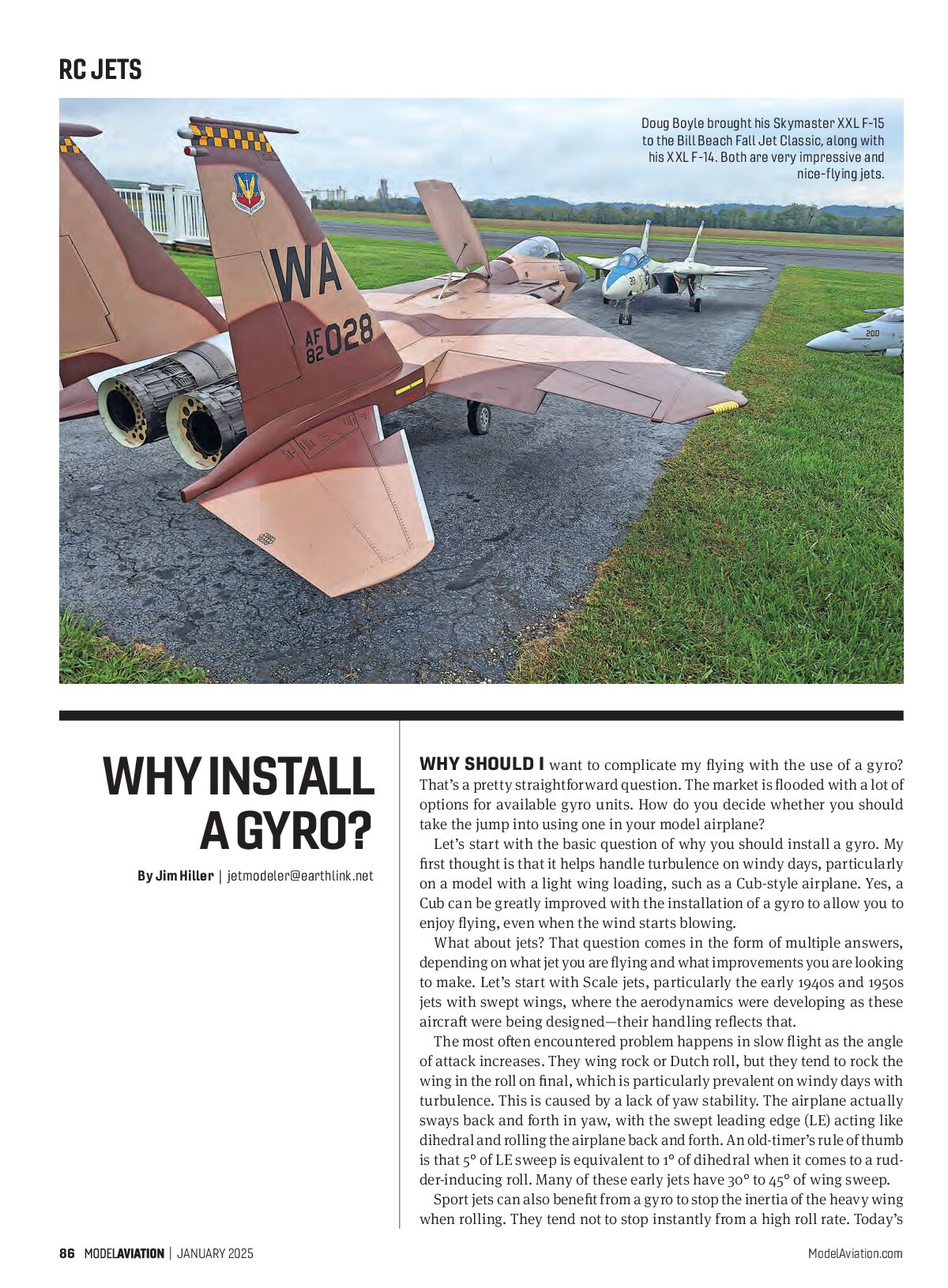
was powered with two 260-size turbines—big models take big power. For display, Doug also had his Skymaster XXL F-14, one of two on the field, which is another very large jet of a 134-inch length.
This event has grown to fill the Rosewood RC Flyers’ Bill Beach Field to a maximum capacity, so if you’re going to attend in 2025, register early.
product lines reflect the engineering and experience efforts.
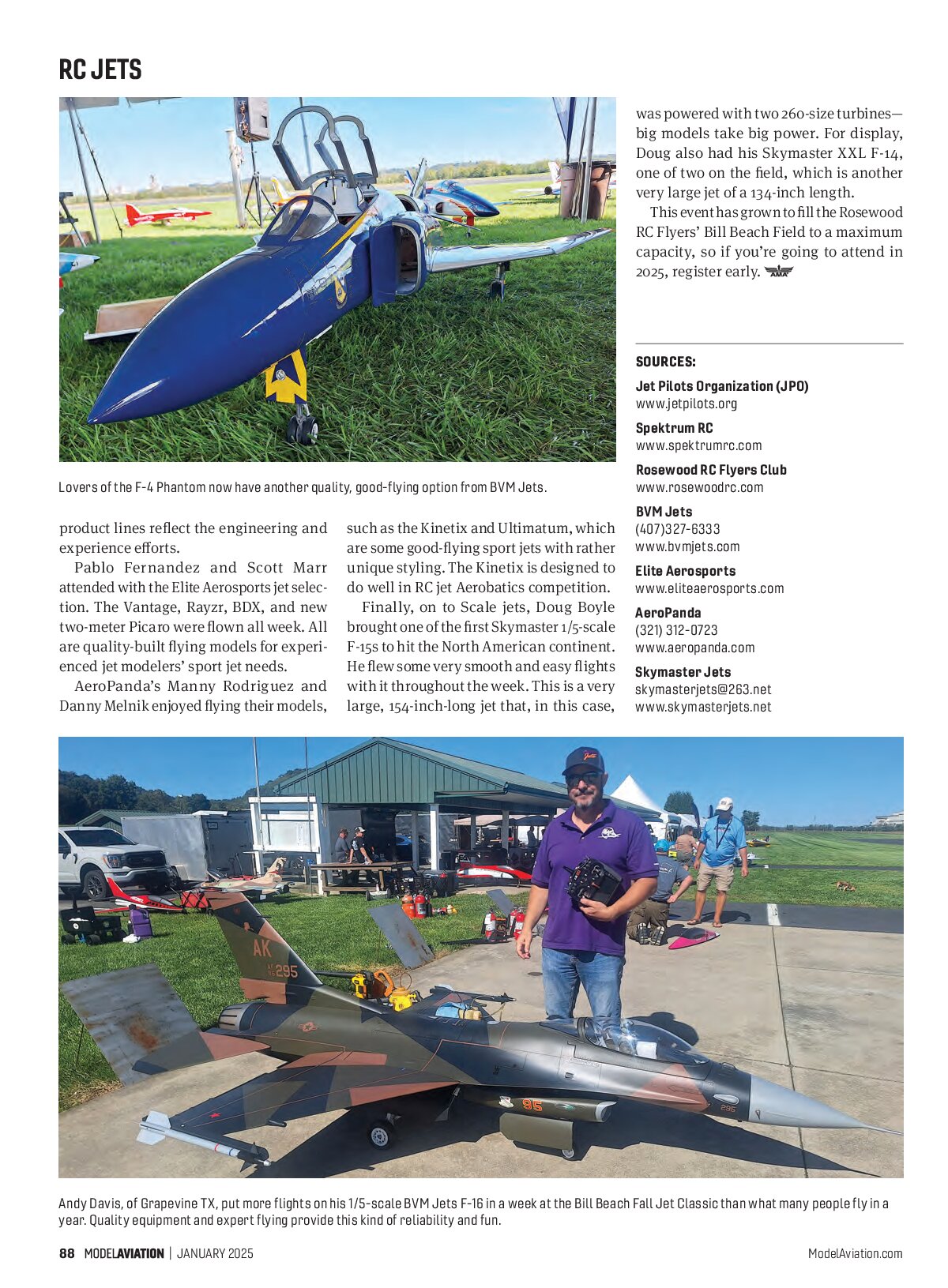
Pablo Fernandez and Scott Marr attended with the Elite Aerosports jet selection. The Vantage, Rayzr, BDX, and new two-meter Picare were flown all week. All are quality-built flying models for experienced jet modelers’ sport jet needs.
AeroPanda’s Manny Rodriguez and Danny Melnik enjoyed flying their models, such as the Kinetix and Ultimatum, which are some good-flying sport jets with rather unique styling. The Kinetix is designed to do well in RC jet Aerobatics competition.
Finally, on to Scale jets, Doug Boyle brought one of the first Skymaster 1/5-scale F-15s to hit the North American continent. He flew some very smooth and easy flights with it throughout the week. This is a very large, 154-inch-long jet that, in this case,

SOURCES:
Jet Pilots Organization (JPO)
www.jetpilots.org
Spektrum RC
www.spektrumrc.com
Rosewood RC Flyers Club
www.rosewoodrc.com
BVM Jets
(407)327-6333
www.bvmjets.com
Elite Aerosports
www.eliteaerosports.com
AeroPanda
(321) 312-0723
www.aeropanda.com
Skymaster Jets
skymasterjets@263.net
www.skymasterjets.net