FOCAL POINT
Interested in sharing your handiwork? Visit www.ModelAviation.com for submission guidelines.

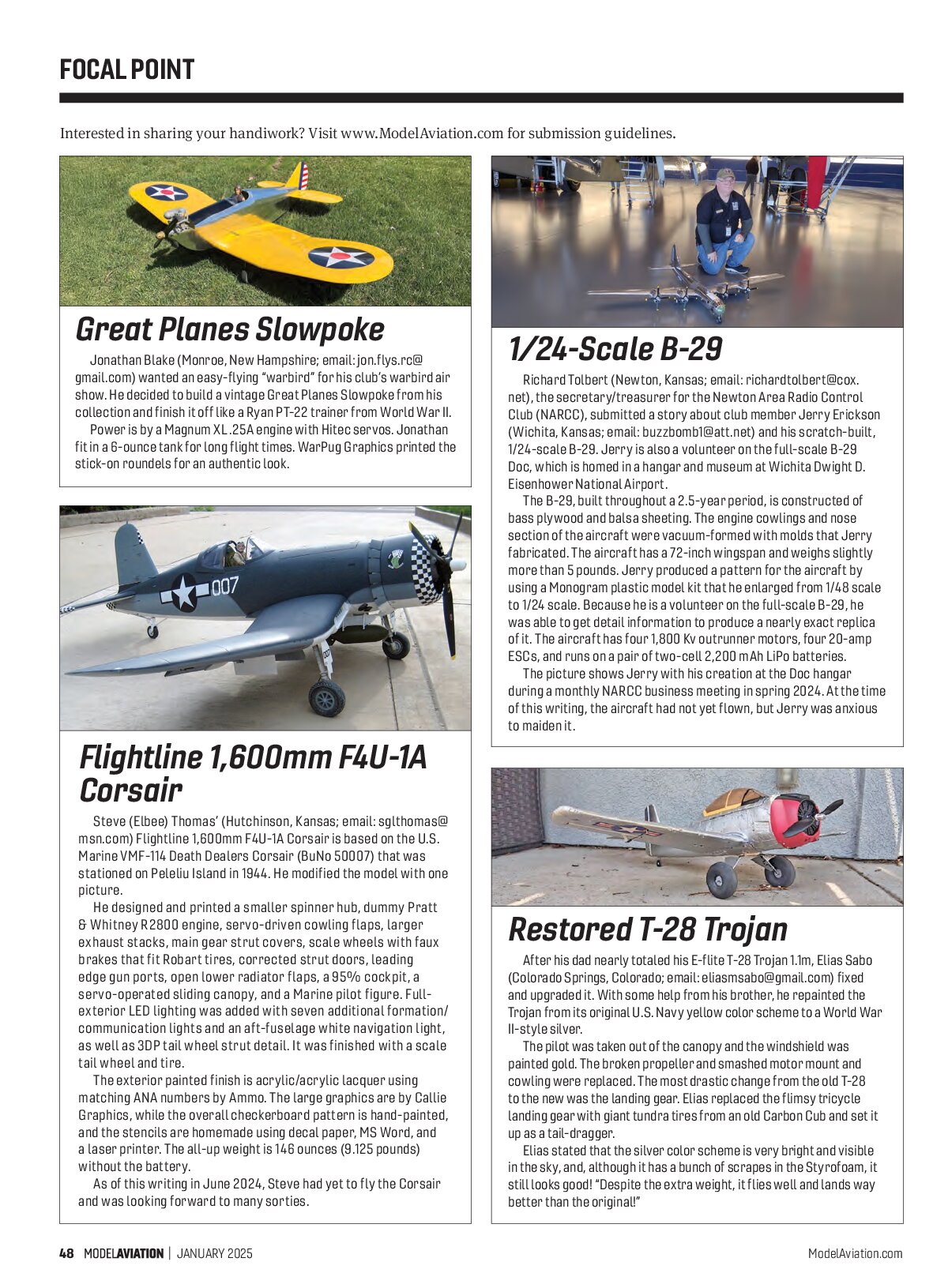
Great Planes Slowpoke
Jonathan Blake (Monroe, New Hampshire; email: jon.flys.rc@gmail.com) wanted an easy-flying “warbird” for his club’s warbird air show. He decided to build a vintage Great Planes Slowpoke from his collection and finish it off like a Ryan PT-22 trainer from World War II.
Power is by a Magnum XL .25A engine with Hitec servos. Jonathan fit in a 6-ounce tank for long flight times. WarPug Graphics printed the stick-on roundels for an authentic look.

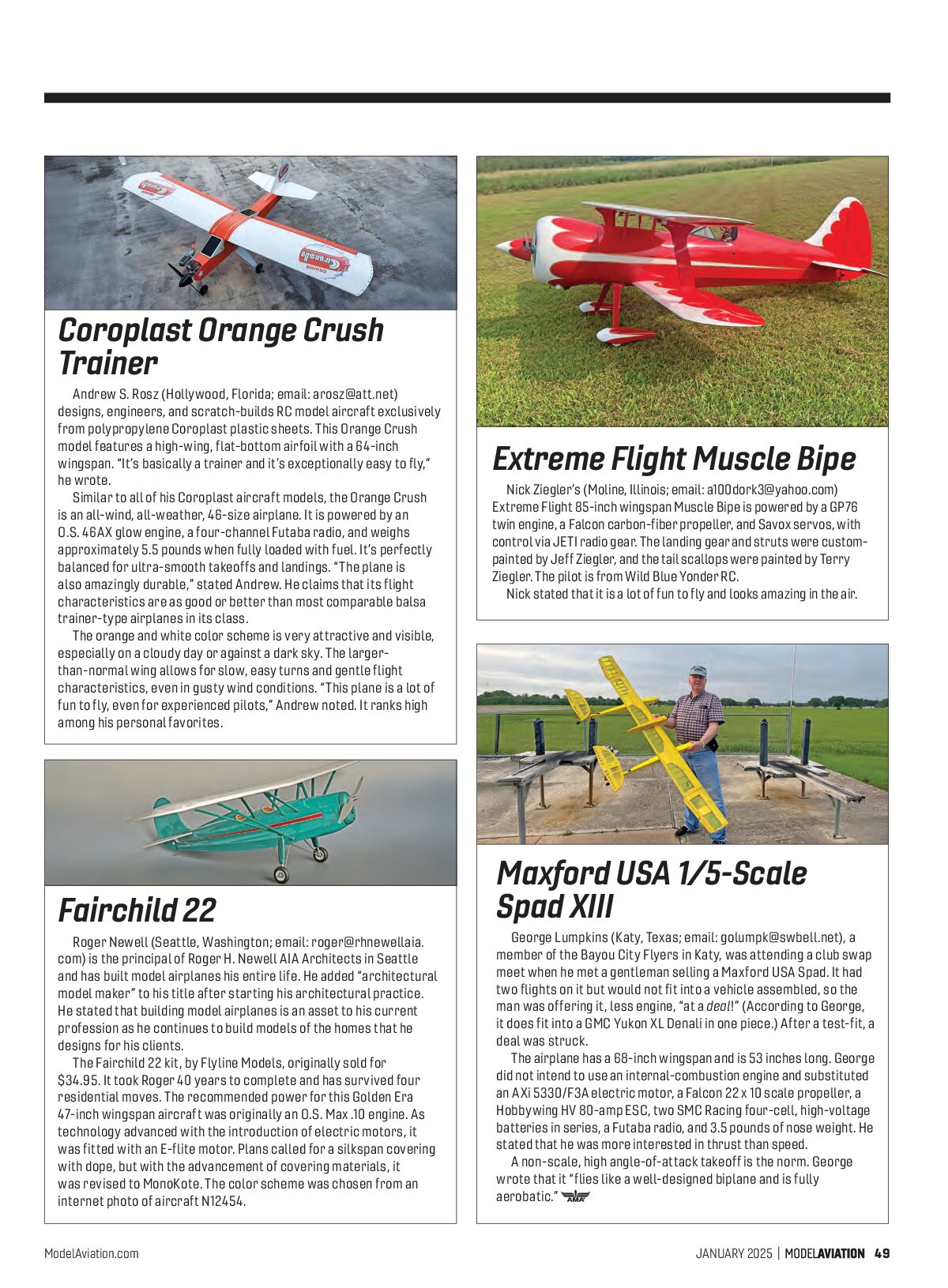
1/24-Scale B-29
Richard Tolbert (Newton, Kansas; email: richardtolbert@cox.net), the secretary/treasurer for the Newton Area Radio Control Club (NARCC), submitted a story about club member Jerry Erickson (Wichita, Kansas; email: buzzbomb61@att.net) and his scratch-built, 1/24-scale B-29. Jerry is also a volunteer on the full-scale B-29 Doc, which is homed in a hangar and museum at Wichita Dwight D. Eisenhower National Airport.
The B-29, built throughout a 2.5-year period, is constructed of bass plywood and balsa sheeting. The engine cowlings and nose section of the aircraft were vacuum-formed with molds that Jerry fabricated. The aircraft has a 72-inch wingspan and weighs slightly more than 5 pounds. Jerry produced a pattern for the aircraft by using a Monogram plastic model kit that he enlarged from 1/48 scale to 1/24 scale. Because he is a volunteer on the full-scale B-29, he was able to get detail information to produce a nearly exact replica of it. The aircraft has four 1,800 Kv outrunner motors, four 20-amp ESCs, and runs on a pair of two-cell 2,200 mAh LiPo batteries.
The picture shows Jerry with his creation at the Doc hangar during a monthly NARCC business meeting in spring 2024. At the time of this writing, the aircraft had not yet flown, but Jerry was anxious to maiden it.

Flightline 1,600mm F4U-1A Corsair
Steve (Elbee) Thomas’ (Hutchinson, Kansas; email: sglthomas@msn.com) Flightline 1,600mm F4U-1A Corsair is based on the U.S. Marine VMF-114 Death Dealers Corsair (BuNo 50007) that was stationed on Peleliu Island in 1944. He modified the model with one picture.
He designed and printed a smaller spinner hub, dummy Pratt & Whitney R2800 engine, servo-driven cowling flaps, larger exhaust stacks, main gear strut covers, scale wheels with faux brakes that fit Robart tires, corrected strut doors, leading edge gun ports, open lower radiator flaps, a 95% cockpit, a servo-operated sliding canopy, and a Marine pilot figure. Full-exterior LED lighting was added with seven additional formation/communication lights and an aft-fuselage white navigation light, as well as 3D tail wheel strut detail. It was finished with a scale tail wheel and tire.
The exterior painted finish is acrylic/acrylic lacquer using matching ANA numbers by Ammo. The large graphics are by Callie Graphics, while the overall checkerboard pattern is hand-painted, and the stencils are homemade using decal paper, MS Word, and a laser printer. The all-up weight is 146 ounces (9.125 pounds) without the battery.
As of this writing in June 2024, Steve had yet to fly the Corsair and was looking forward to many sorties.

Restored T-28 Trojan
After his dad nearly totaled his E-flite T-28 Trojan 1.1m, Elias Sabo (Colorado Springs, Colorado; email: eliamsabo@gmail.com) fixed and upgraded it. With some help from his brother, he repainted the Trojan from its original U.S. Navy yellow color scheme to a World War II-style silver.
The pilot was taken out of the canopy and the windshield was painted gold. The broken propeller and smashed motor mount and cowling were replaced. The most drastic change from the old T-28 to the new was the landing gear. Elias replaced the flimsy tricycle landing gear with giant tundra tires from an old Carbon Cub and set it up as a tail-dragger.
Elias stated that the silver color scheme is very bright and visible in the sky, and, although it has a bunch of scrapes in the Styrofoam, it still looks good! “Despite the extra weight, it flies well and lands way better than the original!”

Coroplast Orange Crush Trainer
Andrew S. Rosz (Hollywood, Florida; email: arosz@att.net) designs, engineers, and scratch-builds RC model aircraft exclusively from polypropylene Coroplast plastic sheets. This Orange Crush model features a high-wing, flat-bottom airfoil with a 64-inch wingspan. “It’s basically a trainer and it’s exceptionally easy to fly,” he wrote.
Similar to all of his Coroplast aircraft models, the Orange Crush is an all-wind, all-weather, 46-size airplane. It is powered by an O.S. 46AX glow engine, a four-channel Futaba radio, and weighs approximately 5.5 pounds when fully loaded with fuel. It’s perfectly balanced for ultra-smooth takeoffs and landings. “The plane is also amazingly durable,” stated Andrew. He claims that its flight characteristics are as good or better than most comparable balsa trainer-type airplanes in its class.
The orange and white color scheme is very attractive and visible, especially on a cloudy day or against a dark sky. The larger-than-normal wing allows for slow, easy turns and gentle flight characteristics, even in gusty wind conditions. “This plane is a lot of fun to fly, even for experienced pilots,” Andrew noted. It ranks high among his personal favorites.

Extreme Flight Muscle Bipe
Nick Ziegler’s (Moline, Illinois; email: a100dork3@yahoo.com) Extreme Flight 85-inch wingspan Muscle Bipe is powered by a GP76 twin engine, a Falcon carbon-fiber propeller, and Savox servos, with control via JETI radio gear. The landing gear and struts were custom-painted by Jeff Ziegler, and the tail scallops were painted by Terry Ziegler. The pilot is from Wild Blue Wonder RC.
Nick stated that it is a lot of fun to fly and looks amazing in the air.

Fairchild 22
Roger Newell (Seattle, Washington; email: roger@rhnewellaia.com) is the principal of Roger H. Newell AIA Architects in Seattle and has built model airplanes his entire life. He added “architectural model maker” to his title after starting his architectural practice. He stated that building model airplanes is an asset to his current profession as he continues to build models of the homes that he designs for his clients.
The Fairchild 22 kit, by Flyline Models, originally sold for $34.95. It took Roger 40 years to complete and has survived four residential moves. The recommended power for this Golden Era 47-inch wingspan aircraft was originally a U.S. Max .10 engine. As technology advanced with the introduction of electric motors, it was fitted with an E-flite motor. Plans called for a silkspan covering with dope, but with the advancement of covering materials, it was revised to Monokote. The color scheme was chosen from an internet photo of aircraft N12454.

Maxford USA 1/5-Scale Spad XIII
George Lumpkins (Katy, Texas; email: golumpk@swbell.net), a member of the Bayou City Flyers in Katy, was attending a club swap meet when he met a gentleman selling a Maxford USA Spad. It had two flights on it but would not fit into a vehicle assembled, so the man was offering it, less engine, “at a deal!” (According to George, it does fit into a GMC Yukon XL Denali in one piece.) After a test-fit, a deal was struck.
The airplane has a 68-inch wingspan and is 53 inches long. George did not intend to use an internal-combustion engine and substituted an AXi 5330/F3A electric motor, a Falcon 22 x 10 scale propeller, a Hobbywing HV 80-amp ESC, two SMC Racing four-cell, high-voltage batteries in series, a Futaba radio, and 3.5 pounds of nose weight. He stated that he was more interested in thrust than speed.
A non-scale, high angle-of-attack takeoff is the norm. George wrote that it “flies like a well-designed biplane and is fully aerobatic.”