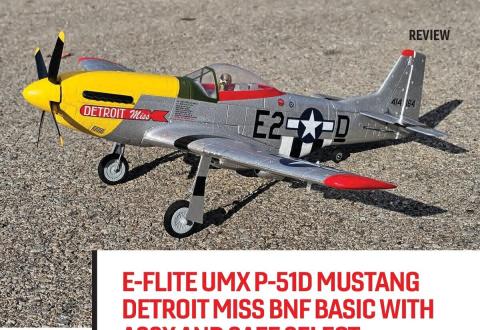

E-FLITE UMX P-51D MUSTANG DETROIT MISS BNF BASIC WITH AS3X AND SAFE SELECT
A small warbird with colors that make it easier to see
By Jay Smith | jays@modelaircraft.org

THE P-51D MUSTANG and the Piper Cub are likely the most widely known aircraft in aeromodelling. For anyone who is unfamiliar with this World War II and Korean War fighter, the P-51D Mustang is known for its range that allowed it to assist in escorting bombers and its maneuverability. The P-51 was also used as a ground attack aircraft.
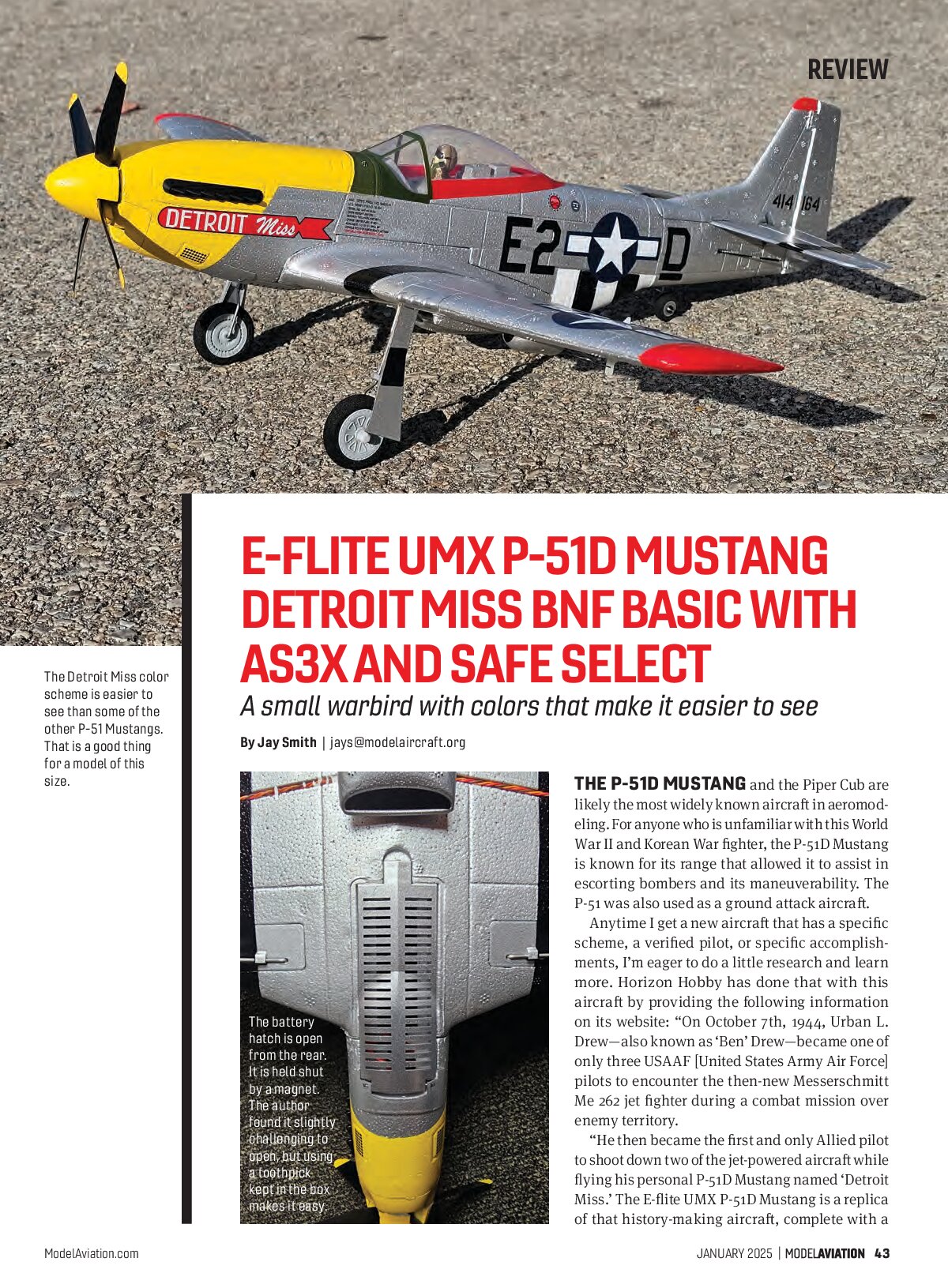
Anytime I get a new aircraft that has a specific scheme, a verified pilot, or specific accomplishments, I’m eager to do a little research and learn more. Horizon Hobby has done that with this aircraft by providing the following information on its website: “On October 7th, 1944, Urban L. Drew—also known as ‘Ben’ Drew—became one of only three USAAF [United States Army Air Force] pilots to encounter the then-new Messerschmitt Me 262 jet fighter during a combat mission over enemy territory.
“He then became the first and only Allied pilot to shoot down two of the jet-powered aircraft while flying his personal P-51D Mustang named ‘Detroit Miss.’ The E-flite UMX P-51D Mustang is a replica of that history-making aircraft, complete with a
At a Glance
Specifications
Model type: Semiscale
Skill level: Intermediate
Wingspan: 19.4 inches
Length: 17.3 inches
Weight: 3.95 ounces with 3S 300 mAh LiPo battery
Radio: Six-channel radio recommended
Construction: EPO foam
Price: $149.99
Pluses
- Motor and ESC are 2S and 3S compatible.
- Paint scheme is easier to see than some other P-51 Mustangs.
- Steerable tailwheel.
- Telemetry available with compatible Spektrum transmitters.
- Removable main gear and tailwheel.
Manufacturer/Distributor
E-flite/Horizon Hobby
www.e-flite.com

variety of scale details, impressive handling, and outstanding performance.”
Inside the Box
Similar to the previous UMX aircraft that came before it, the P-51D Mustang comes in a box that works great to store and transport it safely. Inside of the box, you will find the Mustang, a small piece of hook-and-loop material for your battery, and a 19-page manual.
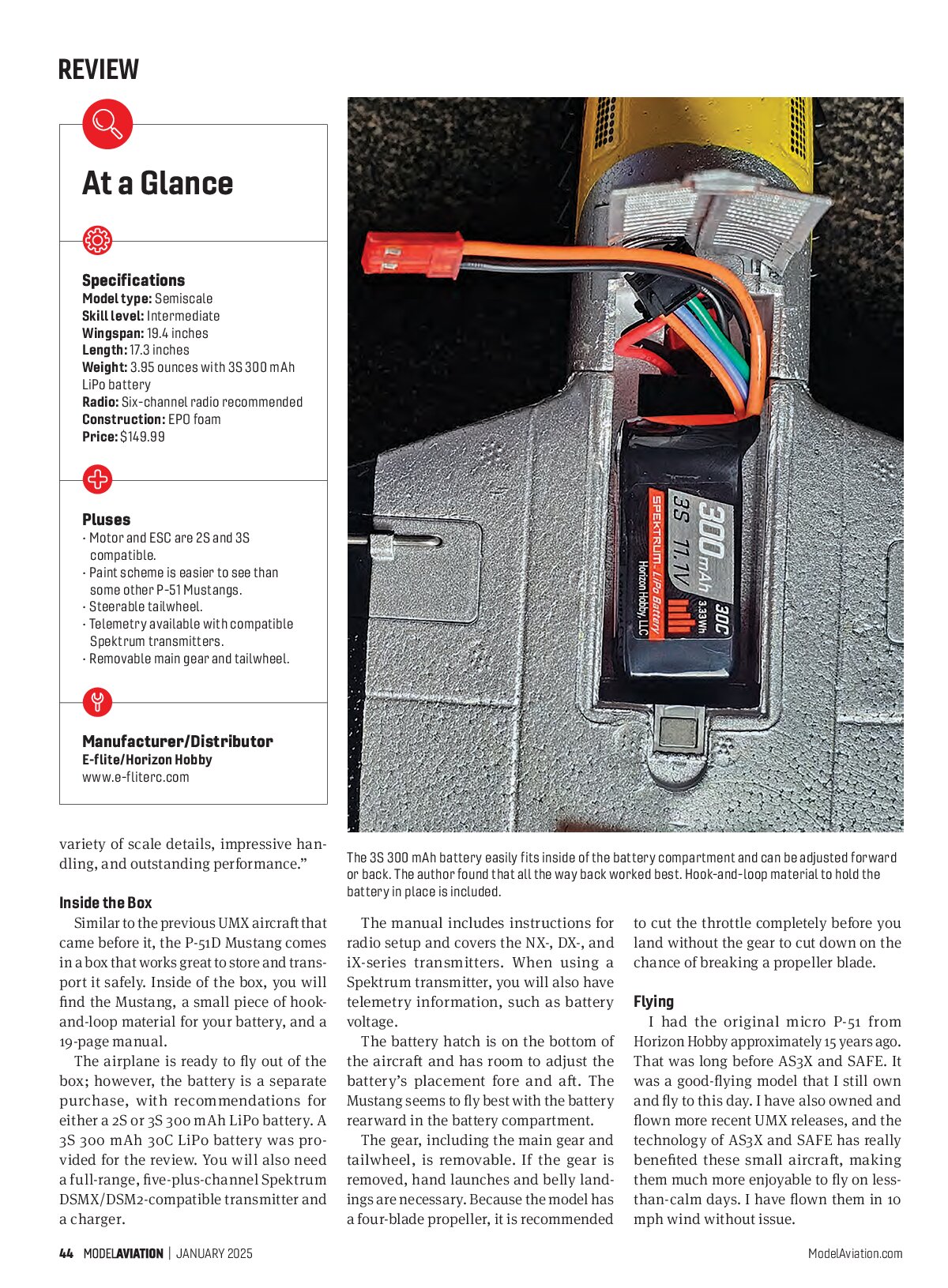
The airplane is ready to fly out of the box; however, the battery is a separate purchase, with recommendations for either a 2S or 3S 300 mAh LiPo battery. A 3S 300 mAh 30C LiPo battery was provided for the review. You will also need a full-range, five-plus-channel Spektrum DSMX/DSM2-compatible transmitter and a charger.
The manual includes instructions for radio setup and covers the NX-, DX-, and iX-series transmitters. When using a Spektrum transmitter, you will also have telemetry information, such as battery voltage.
The battery hatch is on the bottom of the aircraft and has room to adjust the battery’s placement fore and aft. The Mustang seems to fly best with the battery rearward in the battery compartment.
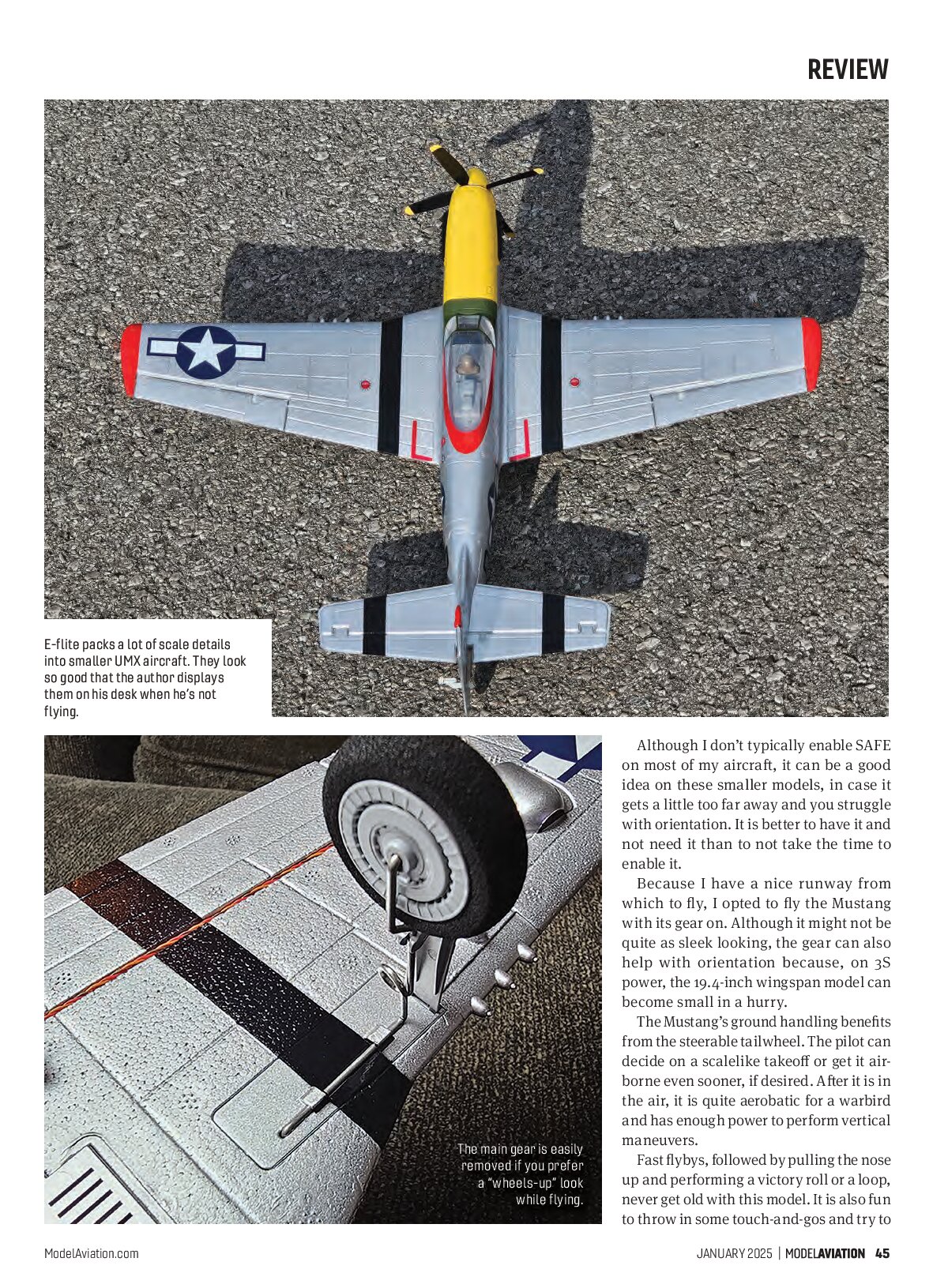
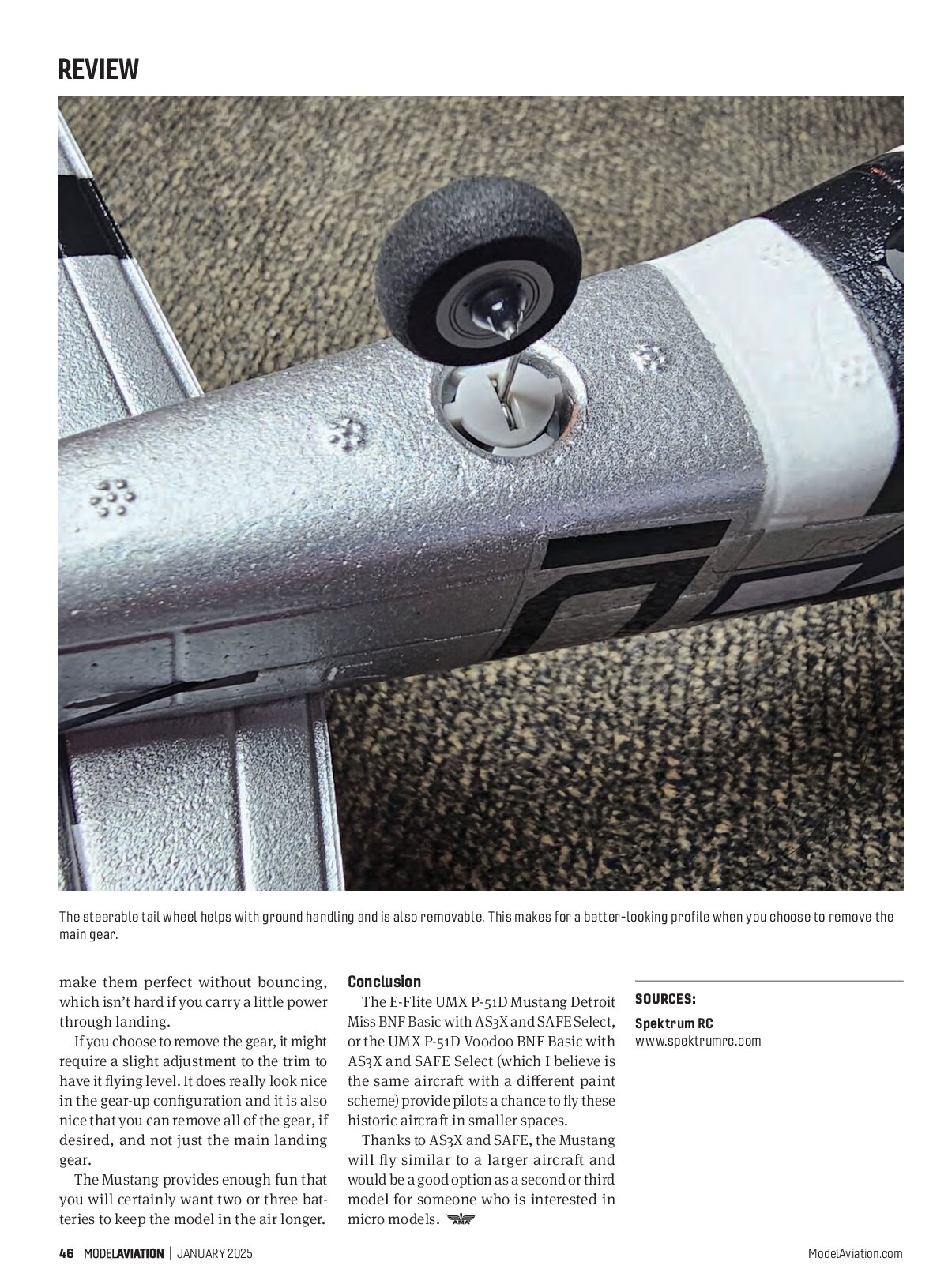
The gear, including the main gear and tailwheel, is removable. If the gear is removed, hand launches and belly landings are necessary. Because the model has a four-blade propeller, it is recommended to cut the throttle completely before you land without the gear to cut down on the chance of breaking a propeller blade.
Flying
I had the original micro P-51 from Horizon Hobby approximately 15 years ago. That was long before AS3X and SAFE. It was a good-flying model that I still own and fly to this day. I have also owned and flown more recent UMX releases, and the technology of AS3X and SAFE has really benefited these small aircraft, making them much more enjoyable to fly on less-than-calm days. I have flown them in 10 mph wind without issue.


Although I don’t typically enable SAFE on most of my aircraft, it can be a good idea on these smaller models, in case it gets a little too far away and you struggle with orientation. It is better to have it and not need it than to not take the time to enable it.
Because I have a nice runway from which to fly, I opted to fly the Mustang with its gear on. Although it might not be quite as sleek looking, the gear can also help with orientation because, on 3S power, the 19.4-inch wingspan model can become small in a hurry.
The Mustang’s ground handling benefits from the steerable tailwheel. The pilot can decide on a scalelike takeoff or get it airborne even sooner, if desired. After it is in the air, it is quite aerobatic for a warbird and has enough power to perform vertical maneuvers.
Fast flybys, followed by pulling the nose up and performing a victory roll or a loop, never get old with this model. It is also fun to throw in some touch-and-gos and try to

make them perfect without bouncing, which isn’t hard if you carry a little power through landing.
If you choose to remove the gear, it might require a slight adjustment to the trim to have it flying level. It does really look nice in the gear-up configuration and it is also nice that you can remove all of the gear, if desired, and not just the main landing gear.
The Mustang provides enough fun that you will certainly want two or three batteries to keep the model in the air longer.
Conclusion
The E-Flite UMX P-51D Mustang Detroit Miss BNF Basic with AS3X and SAFE Select, or the UMX P-51D Voodoo BNF Basic with AS3X and SAFE Select (which I believe is the same aircraft with a different paint scheme) provide pilots a chance to fly these historic aircraft in smaller spaces.
Thanks to AS3X and SAFE, the Mustang will fly similar to a larger aircraft and would be a good option as a second or third model for someone who is interested in micro models.
SOURCES:
Spektrum RC
www.spektrumrc.com