AROUND THE PATCH
INSPIRING
MODEL
STORIES
By Thayer Syme | thayer@flying-models.com

AS WE RING in the new year with most of the holiday hullabaloo now behind us—or at least nearly so—many will soon try to carve out some workbench time for a new project. Toward that end, I have a few models and their stories to share, in hopes of offering some inspiration. Let’s jump in, shall we?
Many of you know Rob Caso through his numerous articles that have appeared in the RC press for the last 20 years or so. He is also well known for his meticulously crafted Scale models. Rob’s all-time favorite aircraft is the Fieseler Storch, and he is currently working on a new 1:6-scale version of his own design that looks for all the world like its full-scale counterpart.
As an example, Rob has constructed the fuselage of this new effort almost entirely of carbon-fiber tube, matching the full-scale construction with only a few minor concessions to the realities of our smaller models. While not yet flying as of this writing, he expects to have the Storch ready for its closeup by this spring. I’ve included a teaser photo of the cockpit area in this column. You can see more of its construction and glean much of his techniques from a build thread he is maintaining on the RCScalebuilder.com (RCSB) forums. It is well-illustrated and definitely worth a read.
RCSB is a vibrant Scale modeling resource with a dedicated membership and supportive information exchange. This community is suitable for anyone who is genuinely interested in RC Scale building, regardless of experience level. While RCSB isn’t free, you can “try it on” with a free basic membership, and then decide whether you want to opt for the full experience at $25 a year.
Be sure to read the FAQs on the RCSB website. It gives a much better explanation of the business philosophy than I can squeeze into these few words. I will say, however, that I greatly appreciate the members’ willingness to share their vast amount of knowledge of both models and their full-scale prototypes.
Those who do register with the site can find Rob’s Fieseler Storch from the home-page by clicking on “Community” in the top tab bar, and then searching for the phrase “Sixth Scale Fieseler Storch.”
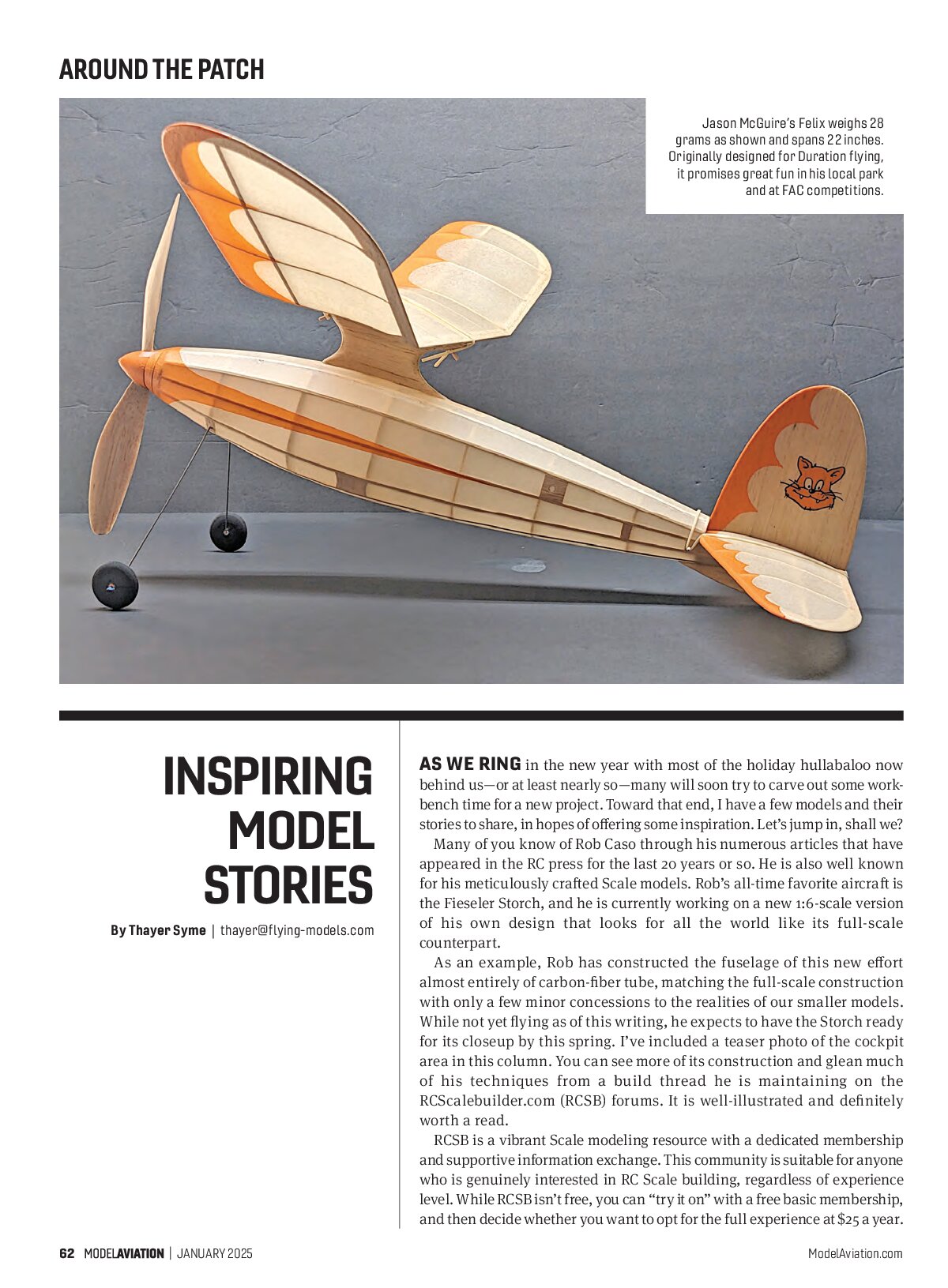
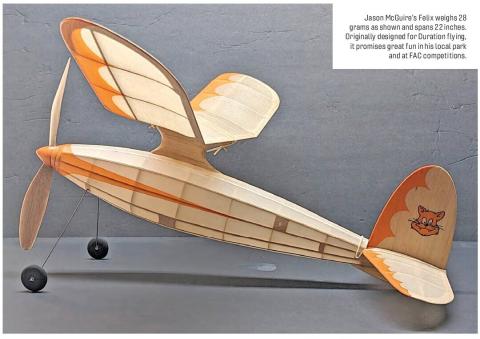
On the other side of the workbench bell curve is Jason McGuire’s gorgeous rendition of Albert E. Hatfull’s 22-inch Felix Parasol Free-Flight design from 1939. This lovely stick-and-tissue Old-Timer promises to be just the ticket for some rubber-powered sport flying fun and should also hold its own in Flying Aces Club (FAC) competition with a spot of buoyant air.
Readers of “a certain age” might well recall Albert as a prolific English designer for Keil Kraft and, later, other U.K. manufacturers as well. He originally drew the Felix in 1939 when he was just 12 or 13 years old, and it still flies every bit as well as it did some 85 years ago. I’ve got one nearly ready to cover myself and look forward to flying it soon. Laser-cut rib and former short kits will be available from the Flying Models Plans Service as soon as I confirm its success.
Next up is a quick note from Marty Kocman to close us out this month. You might recall Marty’s finely crafted Peck-Polymers ezR.O.G. rubber model from my November 2023 column. At that time, I mentioned that Marty usually builds midsize and larger internal-combustion-powered Scale RC models, such as World War I and other vintage-era subjects. Well, this month, we have one of his larger projects, and while not Scale, it was clearly inspired by the biplanes of yesteryear. His lightly edited note follows:
“First of all, I want to tell you how surprised I was to see a picture and description of my ezR.O.G. in the AMA magazine. I certainly wasn’t expecting that, but thanks! By the way, I’ve really enjoyed that little model!”
“The pictures of Marian’s Doppeldecker in your recent articles remind me of Fred Reese’s Golden Oldie biplane. While smaller, Fred’s 32-inch Doppeldecker design is close to his larger Golden Oldie. I have built two versions of the latter, one with the floats that Fred designed for it and the other with landing gear strictly for


AROUND THE PATCH
flying at the field. The float plane was built in the ’90s and has 187 flights on it to date. Both are great flyers.”
The original Golden Oldie spanned 56 inches and called for a 40- to 45-size four-stroke engine. I believe Marty opted for the slightly larger O.S. FS-56 for a bit more performance, especially on floats.
For those who prefer a more-compact version, Fred Reese also designed the 39-inch wingspan Golden Oldie 20 for smaller 20- to 30-size four-stroke engines. Plans for both versions are available from the AMA and Flying Models plans services, and suitable O.S. and Saito engines are still available from Horizon Hobby. They also often turn up at swap meets, so keep your eyes peeled!
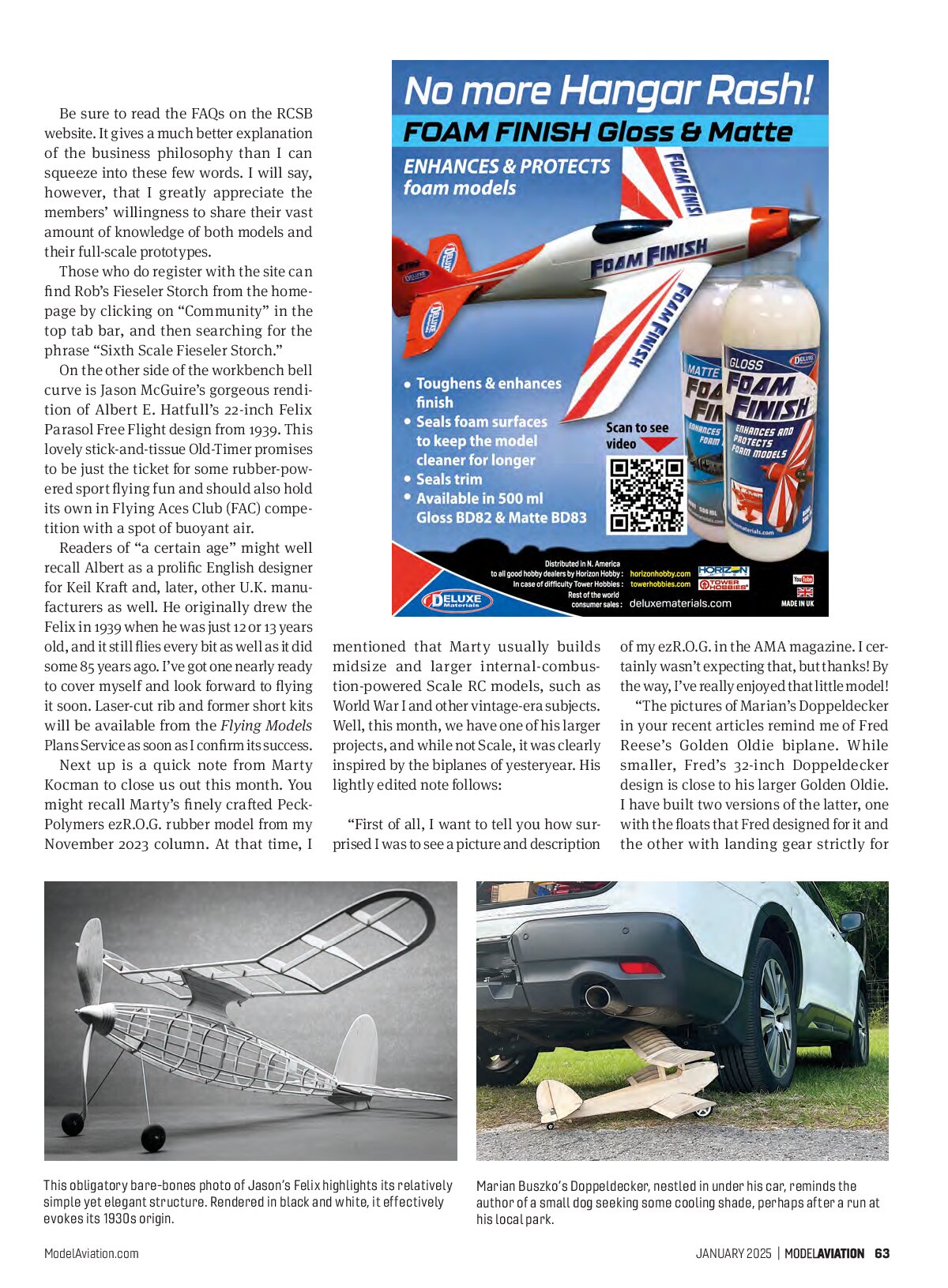
With the power pulled back and its ever-dependable O.S. four-stroke engine ticking over, Marty Kocman’s Golden Oldie prepares to alight on a local lake on a calm afternoon.

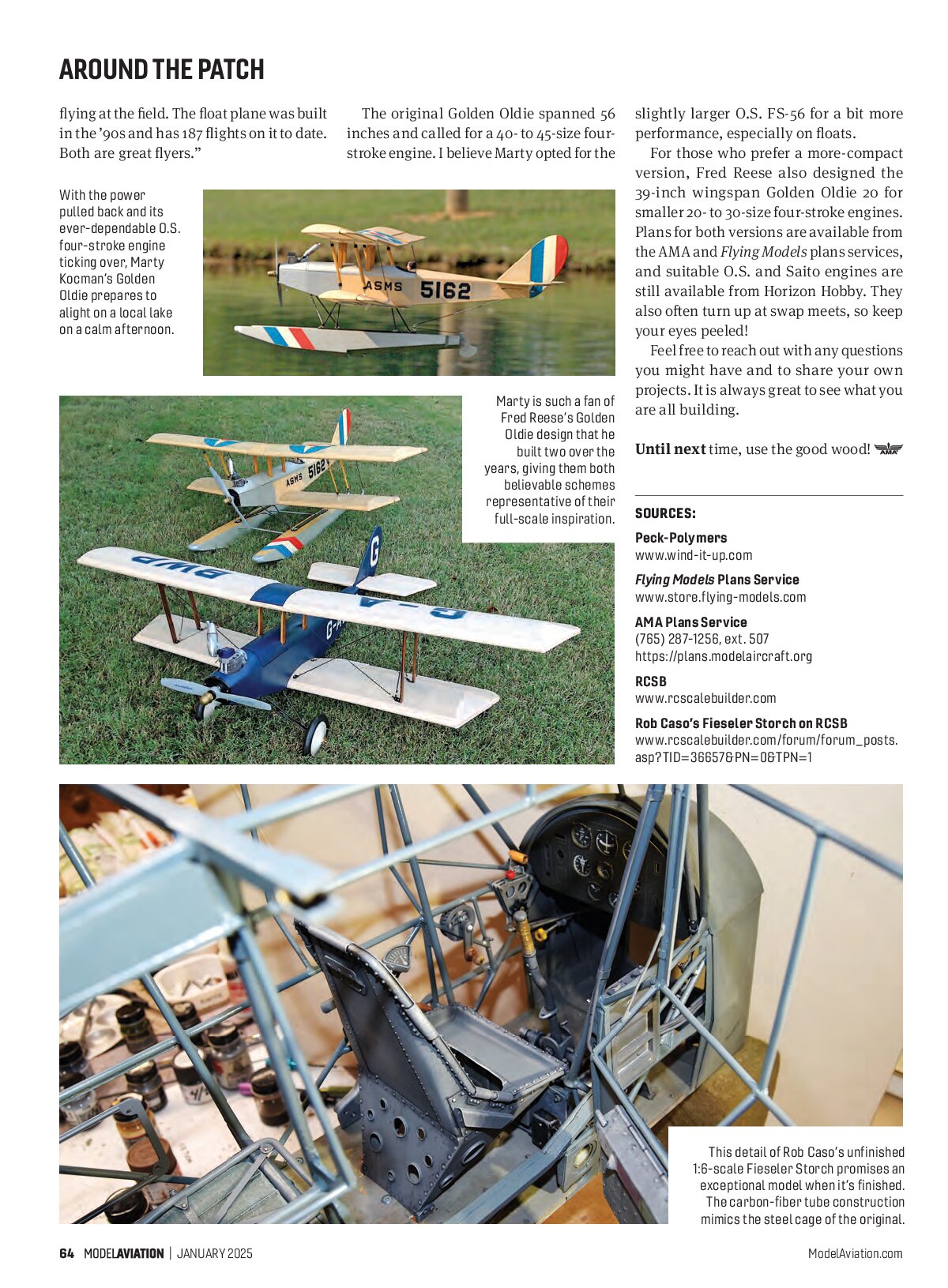
Marty is such a fan of Fred Reese’s Golden Oldie design that he built two over the years, giving them both believable schemes representative of their full-scale inspiration.

Feel free to reach out with any questions you might have and to share your own projects. It is always great to see what you are all building.
Until next time, use the good wood!

SOURCES:
Peck-Polymers
www.wind-it-up.com
Flying Models Plans Service
www.store.flying-models.com
AMA Plans Service
(765) 287-1256, ext. 507
https://plans.modelaircraft.org
Rob Caso’s Fieseler Storch on RCSB
www.rcscalebuilder.com/forum/forum_posts.asp?TID=36657&PN=0&TPN=1