ADVANCED FLIGHT TECHNOLOGIES

FREAKS AND GEEKS, PART ONE
By Patrick Sherman
lucidity@roswellflighttestcrew.com
AFTER ITS EXUBERANT early days, driven by dreamers and hobbyists rather than the cold calculations of corporate balance sheets, sUAS design settled into a bland, predictable norm—quadcoptors, or maybe a hexacopter, if you got lucky.
Well, after attending the Commercial UAV Expo in Las Vegas late in 2024, I’ve got some good news! The geeks are back, baby—and they are letting their freak flags fly high and proud! So much so, in fact, that I’m going to dedicate not one but two columns to the strange and wonderful things I saw at the show.
Just so that we’re clear on this one point, when I describe these systems and their developers as “freaks” and “geeks,” I mean it with the greatest possible admiration and respect. Our community only makes meaningful progress when we go beyond conventional thinking. In short, these are my people!
The Flying Propeller
This first example comes courtesy of Angel Aerial Systems, a US-based company that is developing aircraft for first responders, where being able to hover on station for extended periods of time is critical to mission success. The company’s solution to this problem is like nothing I’ve ever seen before—so much so that I’m not even sure how to describe it. It’s clearly a rotorcraft, but beyond that, I’m at a loss to deliver any further characterization using conventional aircraft taxonomy. In my own mind, I refer to it as “the flying propeller.”
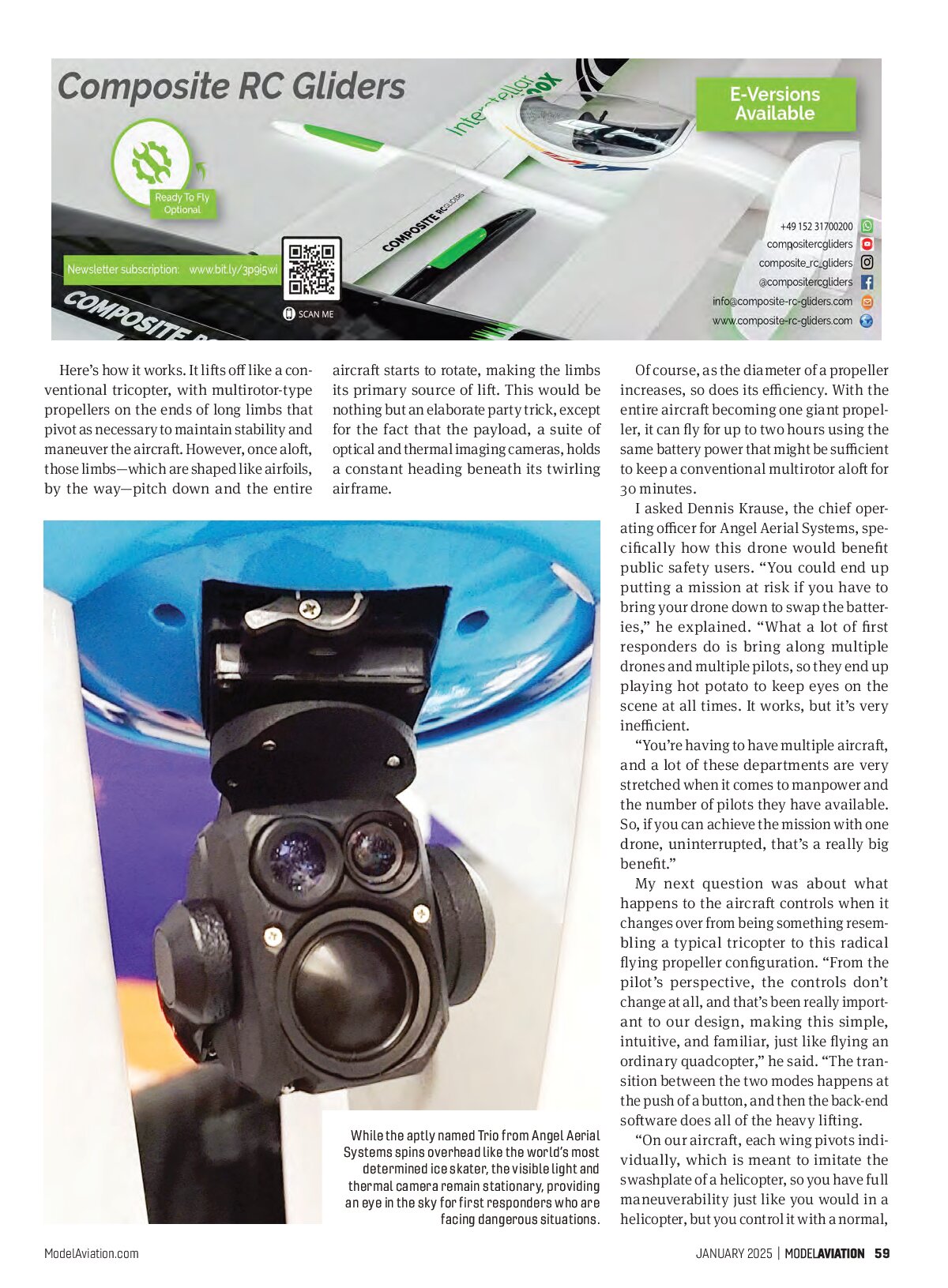
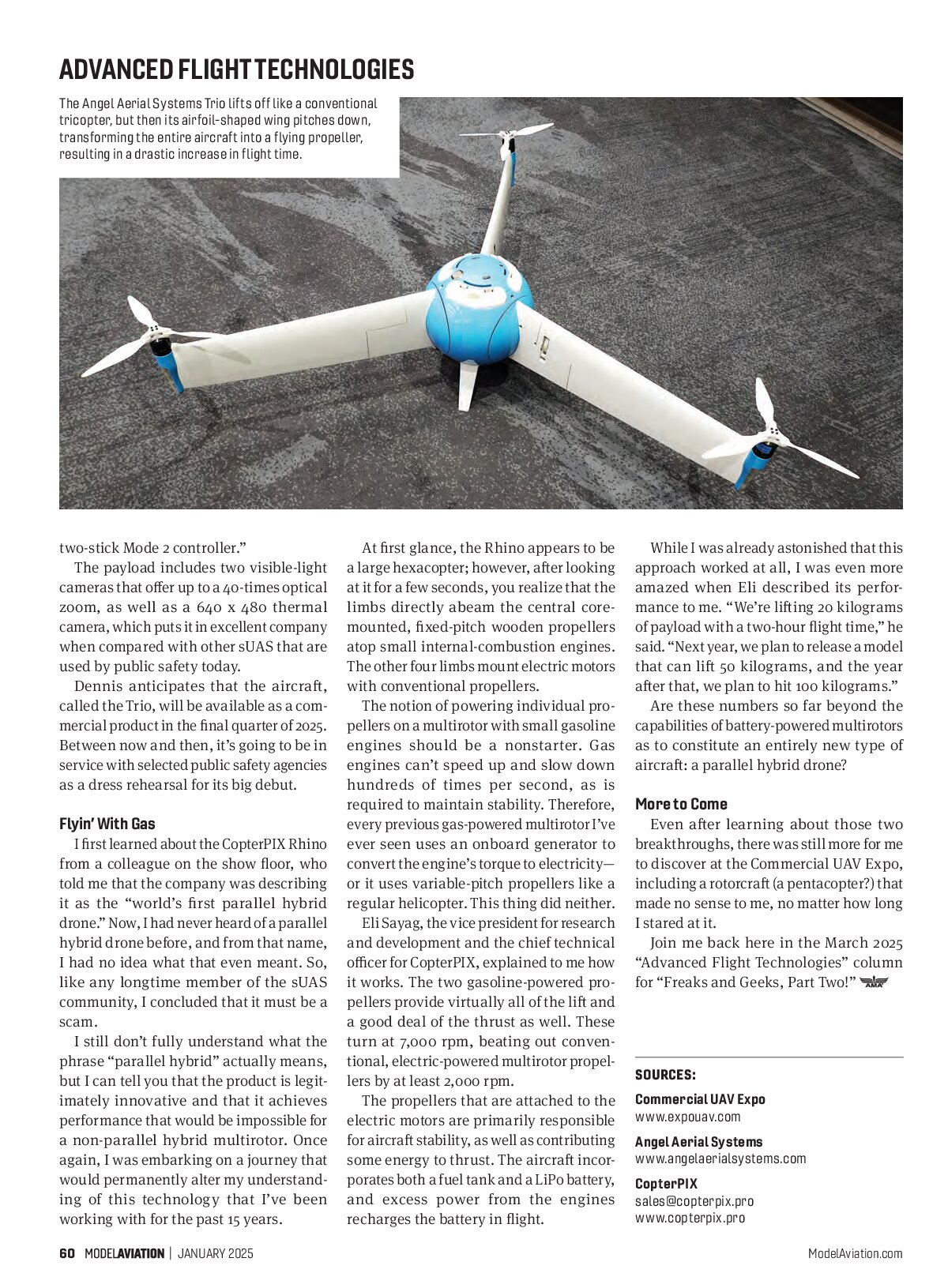
Here’s how it works. It lifts off like a conventional tricopter, with multirotor-type propellers on the ends of long limbs that pivot as necessary to maintain stability and maneuver the aircraft. However, once aloft, those limbs—which are shaped like airfoils, by the way—pitch down and the entire aircraft starts to rotate, making the limbs its primary source of lift. This would be nothing but an elaborate party trick, except for the fact that the payload, a suite of optical and thermal imaging cameras, holds a constant heading beneath its twirling airframe.

Of course, as the diameter of a propeller increases, so does its efficiency. With the entire aircraft becoming one giant propeller, it can fly for up to two hours using the same battery power that might be sufficient to keep a conventional multirotor aloft for 30 minutes.
I asked Dennis Krause, the chief operating officer for Angel Aerial Systems, specifically how this drone would benefit public safety users. “You could end up putting a mission at risk if you have to bring your drone down to swap the batteries,” he explained. “What a lot of first responders do is bring along multiple drones and multiple pilots, so they end up playing hot potato to keep eyes on the scene at all times. It works, but it’s very inefficient.
“You’re having to have multiple aircraft, and a lot of these departments are very stretched when it comes to manpower and the number of pilots they have available. So, if you can achieve the mission with one drone, uninterrupted, that’s a really big benefit.”
My next question was about what happens to the aircraft controls when it changes over from being something resembling a typical tricopter to this radical flying propeller configuration. “From the pilot’s perspective, the controls don’t change at all, and that’s been really important to our design, making this simple, intuitive, and familiar, just like flying an ordinary quadcopter,” he said. “The transition between the two modes happens at the push of a button, and then the back-end software does all of the heavy lifting.
“On our aircraft, each wing pivots individually, which is meant to imitate the swashplate of a helicopter, so you have full maneuverability just like you would in a helicopter, but you control it with a normal,
ADVANCED FLIGHT TECHNOLOGIES
The Angel Aerial Systems Trio lifts off like a conventional tricopter, but then its airfoil-shaped wing pitches down, transforming the entire aircraft into a flying propeller, resulting in a drastic increase in flight time.

two-stick Mode 2 controller.”
The payload includes two visible-light cameras that offer up to a 40-times optical zoom, as well as a 640 x 480 thermal camera, which puts it in excellent company when compared with other sUAS that are used by public safety today.
Dennis anticipates that the aircraft, called the Trio, will be available as a commercial product in the fall quarter of 2025. Between now and then, it’s going to be in service with selected public safety agencies as a dress rehearsal for its big debut.
Flyin’ With Gas
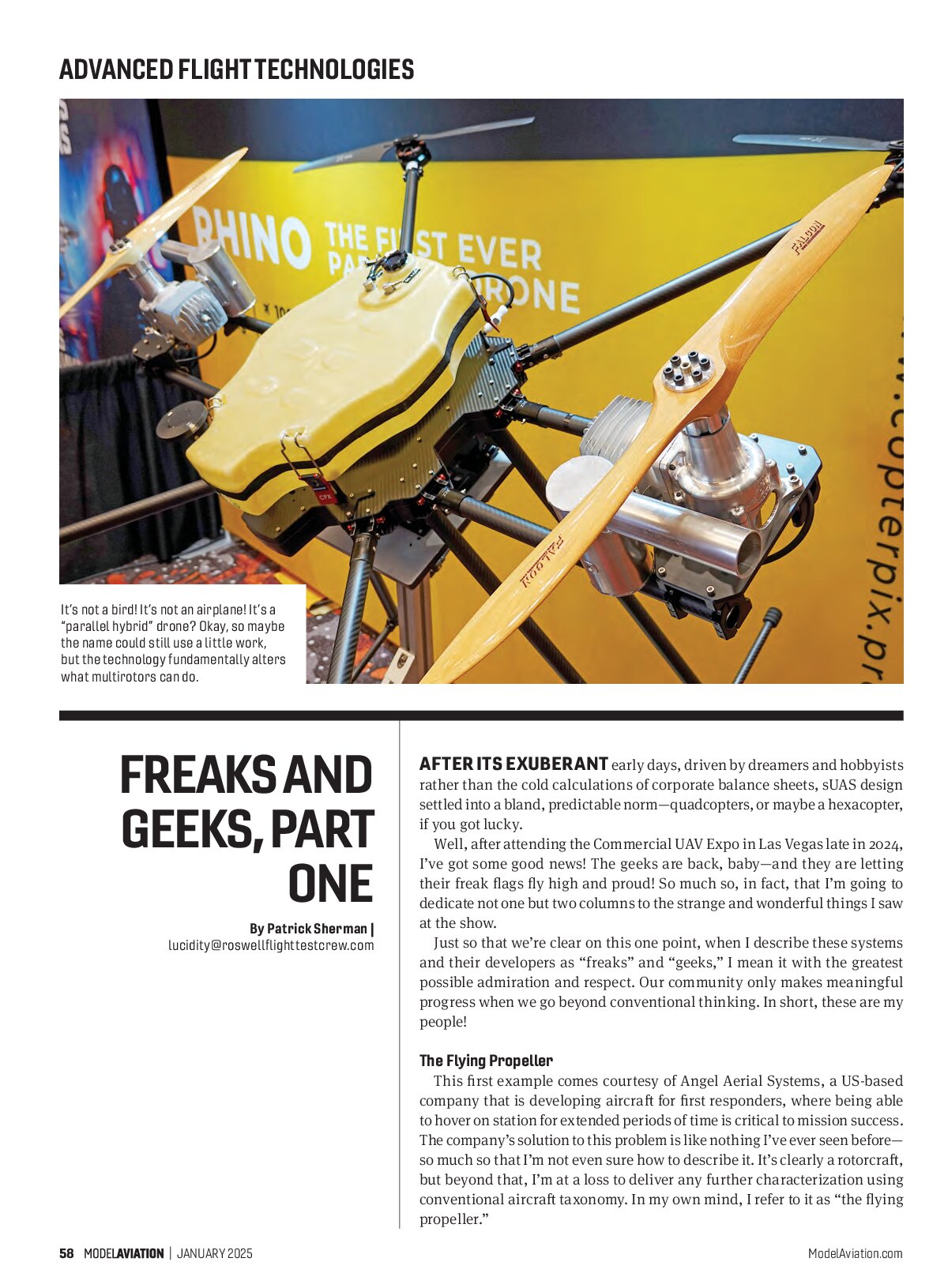
I first learned about the CopterPIX Rhino from a colleague on the show floor, who told me that the company was describing it as the “world’s first parallel hybrid drone.” Now, I had never heard of a parallel hybrid drone before, and from that name, I had no idea what that even meant. So, like any longtime member of the SUAS community, I concluded that it must be a scam.
I still don’t fully understand what the phrase “parallel hybrid” actually means, but I can tell you that the product is legitimately innovative and that it achieves performance that would be impossible for a non-parallel hybrid multirotor. Once again, I was embarking on a journey that would permanently alter my understanding of this technology that I’ve been working with for the past 15 years.
At first glance, the Rhino appears to be a large hexacopter; however, after looking at it for a few seconds, you realize that the limbs directly abeam the central core-mounted, fixed-pitch wooden propellers atop small internal-combustion engines. The other four limbs mount electric motors with conventional propellers.
The notion of powering individual propellers on a multirotor with small gasoline engines should be a nonstarter. Gas engines can’t speed up and slow down hundreds of times per second, as is required to maintain stability. Therefore, every previous gas-powered multirotor I’ve ever seen uses an onboard generator to convert the engine’s torque to electricity—or it uses variable-pitch propellers like a regular helicopter. This thing did neither.
Eli Sayag, the vice president for research and development and the chief technical officer for CopterPIX, explained to me how it works. The two gasoline-powered propellers provide virtually all of the lift and a good deal of the thrust as well. These turn at 7,000 rpm, beating out conventional, electric-powered multirotor propellers by at least 2,000 rpm.
The propellers that are attached to the electric motors are primarily responsible for aircraft stability, as well as contributing some energy to thrust. The aircraft incorporates both a fuel tank and a LiPo battery, and excess power from the engines recharges the battery in flight.
While I was already astonished that this approach worked at all, I was even more amazed when Eli described its performance to me. “We’re lifting 20 kilograms of payload with a two-hour flight time,” he said. “Next year, we plan to release a model that can lift 50 kilograms, and the year after that, we plan to hit 100 kilograms.”
Are these numbers so far beyond the capabilities of battery-powered multirotors as to constitute an entirely new type of aircraft: a parallel hybrid drone?
More to Come
Even after learning about those two breakthroughs, there was still more for me to discover at the Commercial UAV Expo, including a rotorcraft (a pentacopter?) that made no sense to me, no matter how long I stared at it.
Join me back here in the March 2025 “Advanced Flight Technologies” column for “Freaks and Geeks, Part Two!”
SOURCES:
Commercial UAV Expo
www.expouav.com
Angel Aerial Systems
www.angelaerialsystems.com
CopterPIX
sales@copterpix.pro
www.copterpix.pro