TOKYO ECHO MODEL AIRPLANE
Photos provided by Vince Cahill | cahill_vince@yahoo.com
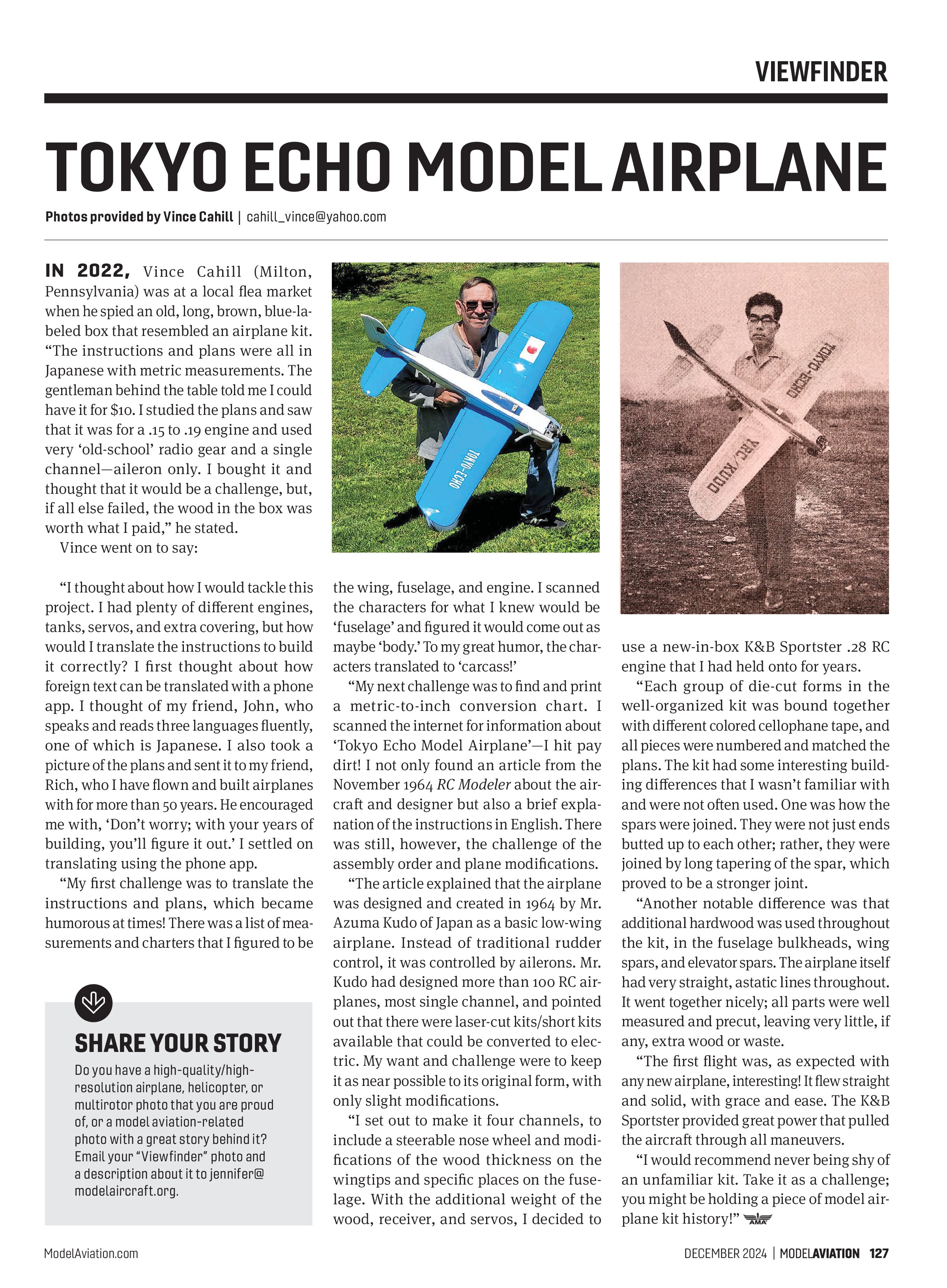
IN 2022, Vince Cahill (Milton, Pennsylvania) was at a local flea market when he spied an old, long, brown, blue-labeled box that resembled an airplane kit. “The instructions and plans were all in Japanese with metric measurements. The gentleman behind the table told me I could have it for $10. I studied the plans and saw that it was for a .15 to .19 engine and used very ‘old-school’ radio gear and a single channel—aileron only. I bought it and thought that it would be a challenge, but, if all else failed, the wood in the box was worth what I paid,” he stated.
Vince went on to say:
“I thought about how I would tackle this project. I had plenty of different engines, tanks, servos, and extra covering, but how would I translate the instructions to build it correctly? I first thought about how foreign text can be translated with a phone app. I thought of my friend, John, who speaks and reads three languages fluently, one of which is Japanese. I also took a picture of the plans and sent it to my friend, Rich, who I have flown and built airplanes with for more than 50 years. He encouraged me with, ‘Don’t worry; with your years of building, you’ll figure it out.’ I settled on translating using the phone app.
“My first challenge was to translate the instructions and plans, which became humorous at times! There was a list of measurements and charters that I figured to be
SHARE YOUR STORY
Do you have a high-quality/high-resolution airplane, helicopter, or multirotor photo that you are proud of, or a model aviation-related photo with a great story behind it?
Email your “Viewfinder” photo and a description about it to jennifer@modelaircraft.org.
the wing, fuselage, and engine. I scanned the characters for what I knew would be ‘fuselage’ and figured it would come out as maybe ‘body.’ To my great humor, the characters translated to ‘carcass!’
“My next challenge was to find and print a metric-to-inch conversion chart. I scanned the internet for information about ‘Tokyo Echo Model Airplane’—I hit pay dirt! I not only found an article from the November 1964 RC Modeler about the aircraft and designer but also a brief explanation of the instructions in English. There was still, however, the challenge of the assembly order and plane modifications.
“The article explained that the airplane was designed and created in 1964 by Mr. Azuma Kudo of Japan as a basic low-wing airplane. Instead of traditional rudder control, it was controlled by ailerons. Mr. Kudo had designed more than 100 RC airplanes, most single channel, and pointed out that there were laser-cut kits/short kits available that could be converted to electric. My want and challenge were to keep it as near possible to its original form, with only slight modifications.
“I set out to make it four channels, to include a steerable nose wheel and modifications of the wood thickness on the wingtips and specific places on the fuselage. With the additional weight of the wood, receiver, and servos, I decided to
use a new-in-box K&B Sportster .28 RC engine that I had held onto for years.
“Each group of die-cut forms in the well-organized kit was bound together with different colored cellophane tape, and all pieces were numbered and matched the plans. The kit had some interesting building differences that I wasn’t familiar with and were not often used. One was how the spars were joined. They were not just ends butted up to each other; rather, they were joined by long tapering of the spar, which proved to be a stronger joint.
“Another notable difference was that additional hardwood was used throughout the kit, in the fuselage bulkheads, wing spars, and elevator spars. The airplane itself had very straight, astatical lines throughout. It went together nicely; all parts were well measured and precut, leaving very little, if any, extra wood or waste.
“The first flight was, as expected with any new airplane, interesting! It flew straight and solid, with grace and ease. The K&B Sportster provided great power that pulled the aircraft through all maneuvers.
“I would recommend never being shy of an unfamiliar kit. Take it as a challenge; you might be holding a piece of model airplane kit history!”