SMALL-FIELD FLYING

A FFKIND OF
DAY
By Pat Tritle | patscustommodels@gmail.com
FALL IS, without a doubt, the best time of the year for flying, whether it’s RC, Free Flight (FF), or any combination thereof. Temperatures are cooling and the spring wind is finally starting to settle down, making conditions for small-field flying ideal. With the spring and summer being exceptionally windy, good flying days this season in the Desert Southwest were few and far between, so it’s nice to be getting back in the groove.
A couple of weeks ago, I met a gentleman, Gregg Goris, who was flying a rubber-powered, single-channel RC model that he had built up using bits and pieces from other models. After a couple of “tweaks,” the model flew beautifully, which got me thinking about how much fun you can actually have when “old” meets “new.”
I have a project in the works in that realm, but for now, I’ll keep that on hand for a future column. Gregg has also designed and built a number of rubber-powered FF pushers. Some are simple all-sheet balsa designs, while others are built up and tissue covered.
A short time later, Gregg and I got together for a terrific morning of flying. He had several FF models on hand, and the three FF models I brought were nestled in among a couple of RC aircraft as well. As it turned out, the RC models never left the safety of the truck. It was a FF day like none we’ve seen for quite some time.
The air was so still that, flight after flight, we were logging 60-(sometimes)-plus-second flights and landing within a few feet of the launch point. For flying on a relatively small field, it just doesn’t get any better than that.

Reader Submissions
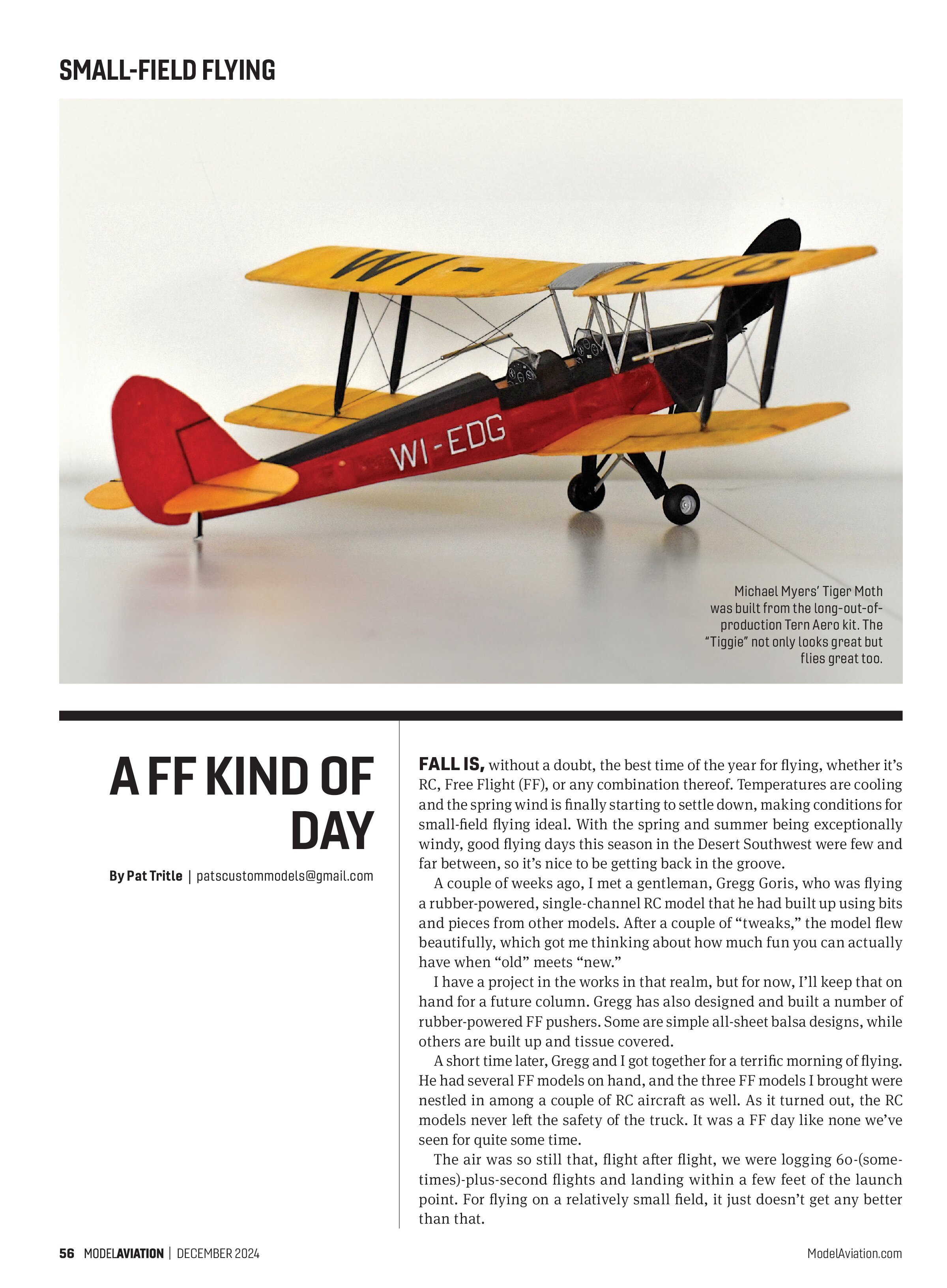
As long as I’m in the FF realm, Michael Myers has taken a break from the larger RC builds to work up a 17-inch wingspan Tiger Moth that he built from the long-out-of-production Tern Aero kit. Michael didn’t mention whether the color scheme is scale or not, but either way, the “Tiggie” looks great and is reported to be a terrific and very scalelike flyer.
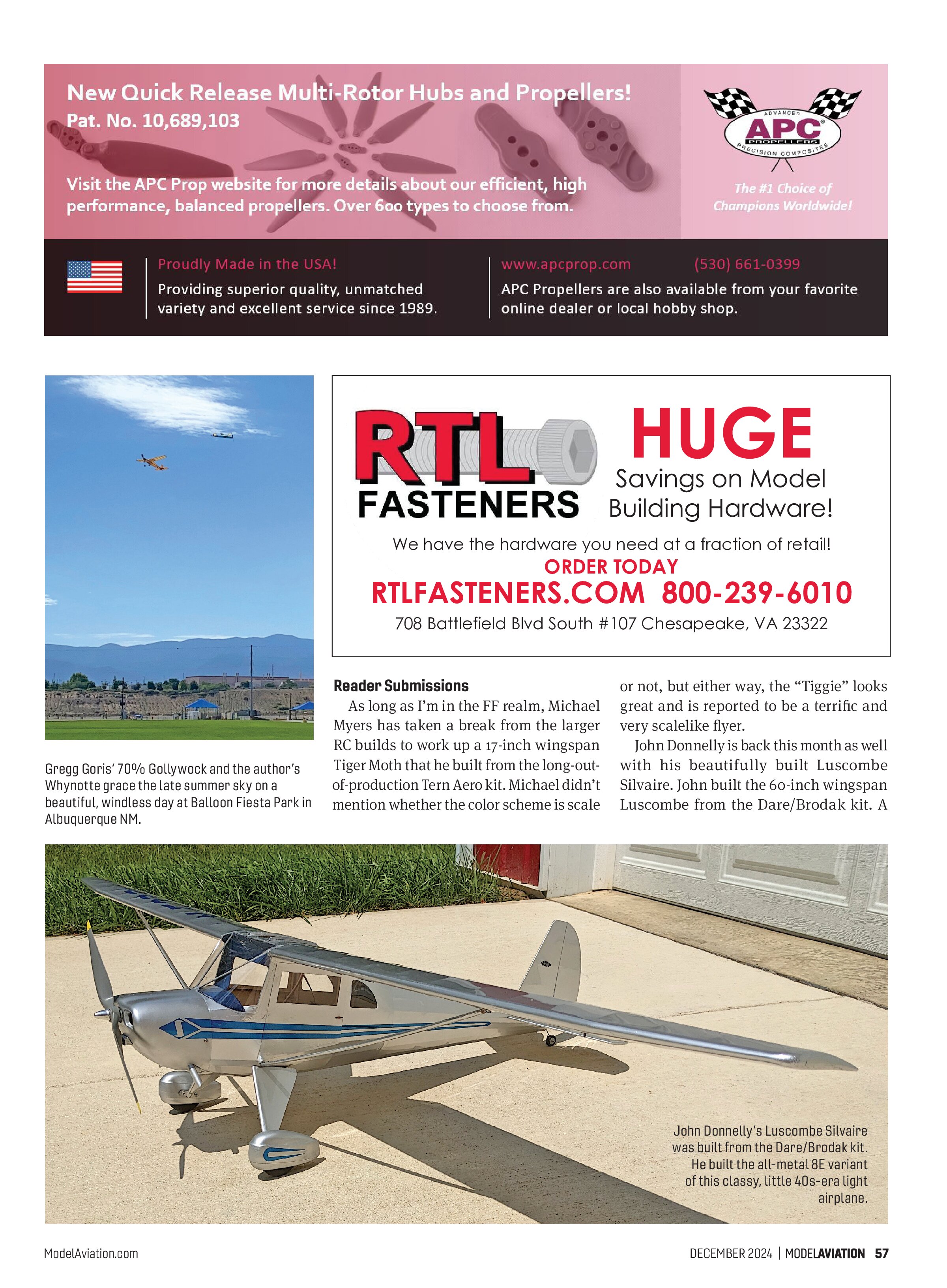
John Donnelly is back this month as well with his beautifully built Luscombe Silvaire. John built the 60-inch wingspan Luscombe from the Dare/Brodak kit. A


Suppo 2217/9 outrunner motor with a ZTW Mantis Slim 20-amp ESC, an APC 11 x 5.5E propeller, and a 2,200 mAh 3S LiPo battery provide consistent 15-minute flights.
Nine-gram servos are used to control the rudder and elevator, and a pair of 6-gram servos control the ailerons. The model is covered with silver ParkLite. John reports that the Luscombe is a solid, steady flyer “with no bad habits.”
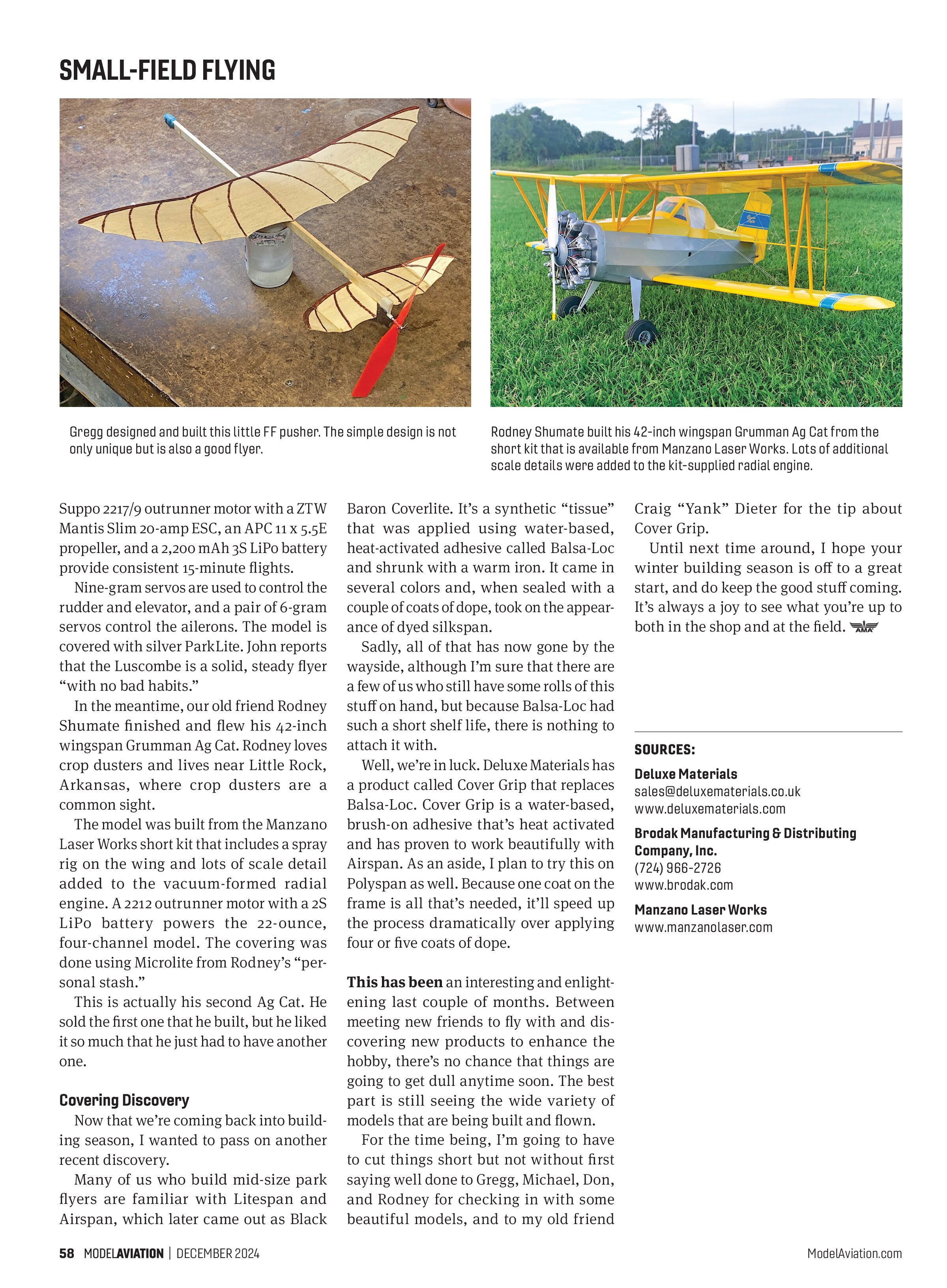
In the meantime, our old friend Rodney Shumate finished and flew his 42-inch wingspan Grumman Ag Cat. Rodney loves crop dusters and lives near Little Rock, Arkansas, where crop dusters are a common sight.
The model was built from the Manzano Laser Works short kit that includes a spray rig on the wing and lots of scale detail added to the vacuum-formed radial engine. A 2212 outrunner motor with a 2S LiPo battery powers the 22-ounce, four-channel model. The covering was done using Microlite from Rodney’s “personal stash.”
This is actually his second Ag Cat. He sold the first one that he built, but he liked it so much that he just had to have another one.
Covering Discovery
Now that we’re coming back into building season, I wanted to pass on another recent discovery.
Many of us who build mid-size park flyers are familiar with Litespan and Airspan, which later came out as Black Baron Coverlite. It’s a synthetic “tissue” that was applied using water-based, heat-activated adhesive called Balsa-Loc and shrunk with a warm iron. It came in several colors and, when sealed with a couple of coats of dope, took on the appearance of dyed silkspan.
Sadly, all of that has now gone by the wayside, although I’m sure that there are a few of us who still have some rolls of this stuff on hand, but because Balsa-Loc had such a short shelf life, there is nothing to attach it with.
Well, we’re in luck. Deluxe Materials has a product called Cover Grip that replaces Balsa-Loc. Cover Grip is a water-based, brush-on adhesive that’s heat activated and has proven to work beautifully with Airspan. As an aside, I plan to try this on Polyspan as well. Because one coat on the frame is all that’s needed, it’ll speed up the process dramatically over applying four or five coats of dope.
This has been an interesting and enlightening last couple of months. Between meeting new friends to fly with and discovering new products to enhance the hobby, there’s no chance that things are going to get dull anytime soon. The best part is still seeing the wide variety of models that are being built and flown.
For the time being, I’m going to have to cut things short but not without first saying well done to Gregg, Michael, Don, and Rodney for checking in with some beautiful models, and to my old friend Craig “Yank” Dieter for the tip about Cover Grip.
Until next time around, I hope your winter building season is off to a great start, and do keep the good stuff coming. It’s always a joy to see what you’re up to both in the shop and at the field.
Sources:
Deluxe Materials
sales@deluxematerials.co.uk
www.deluxematerials.com
Brodak Manufacturing & Distributing Company, Inc.
(724) 966-2726
www.brodak.com
Manzano Laser Works
www.manzanolaser.com