CONVERTING CHILDHOOD FAVORITE GLIDERS TO RC
By Tim Bailiff | casurfish@aol.com

IN MY EXPERIENCE, even the more difficult-to-find balsa airplanes from my childhood are still available. It might take a little time and online searching, but they are out there. And when they are found, converting those wonderful, little aircraft to RC has provided me with many hours of enjoyment—it can do so for you as well.
Once again, I invite you to join me on this RC journey and share in the fun.
Das Dawn Patrol
In my previous column, I wrote about my little Bye-Plane conversion. I enjoyed flying that airplane so much that I wanted to do more with it. Such was the inspiration for this next fun RC conversion.
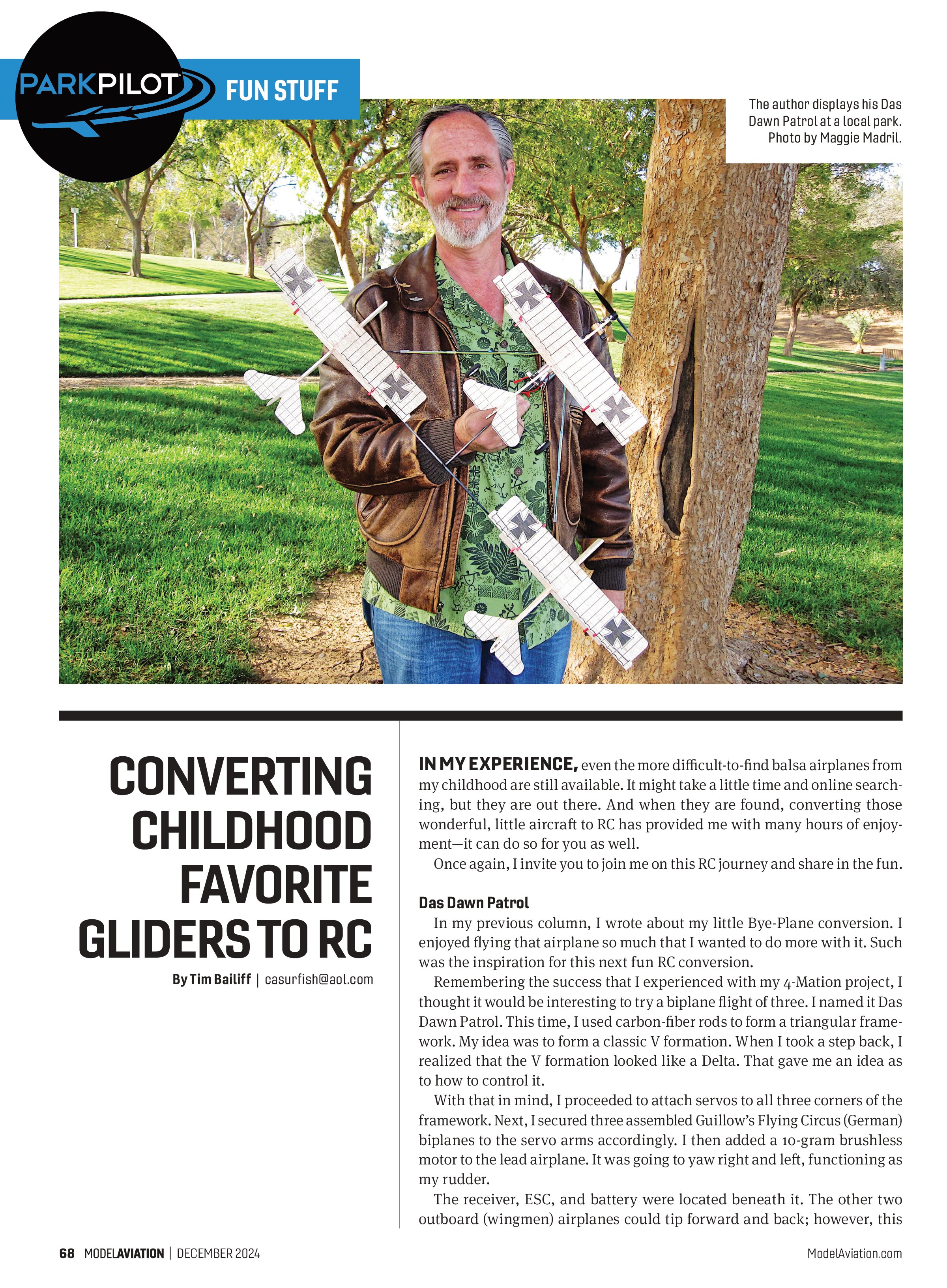
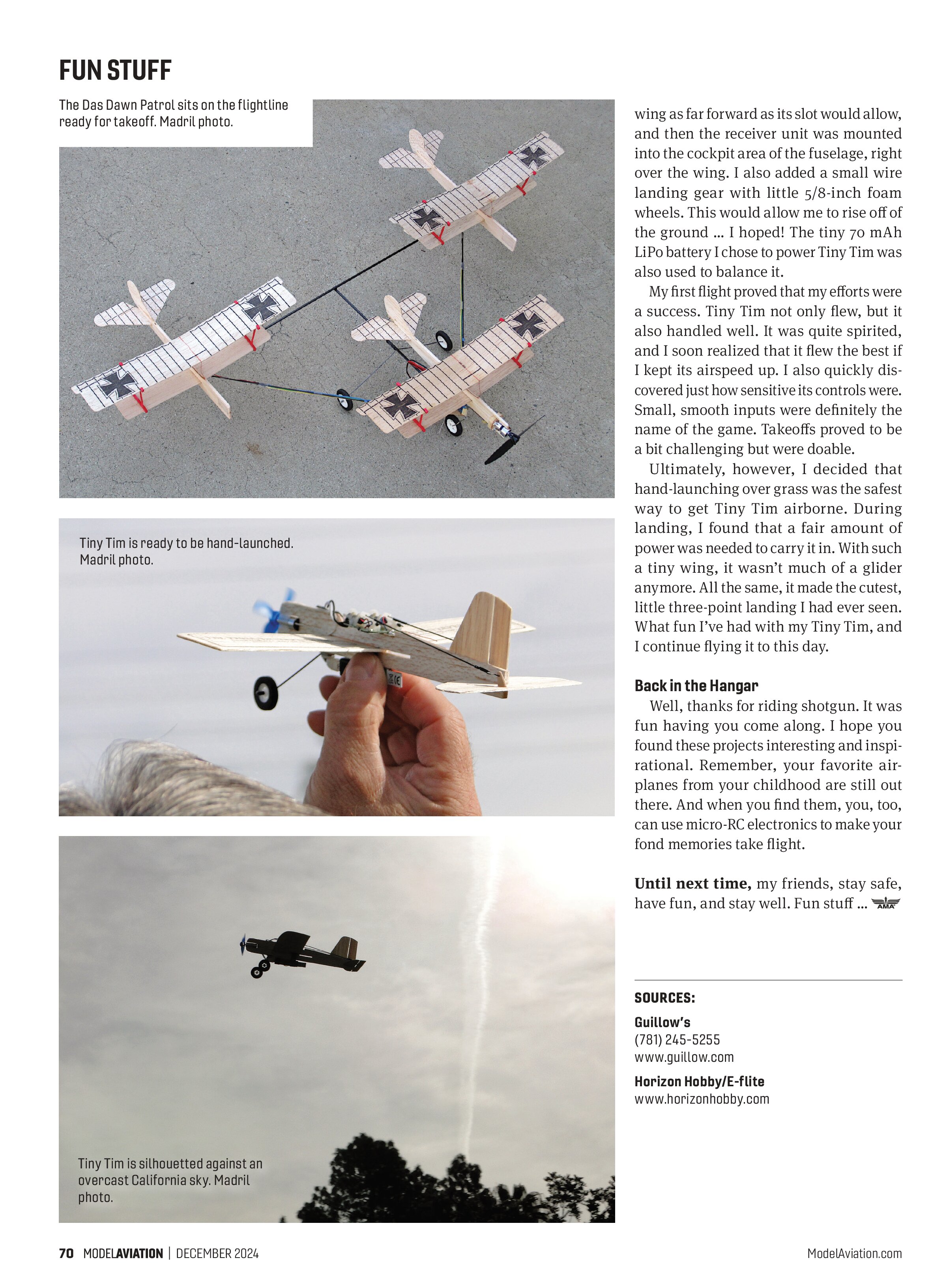
Remembering the success that I experienced with my 4-Mation project, I thought it would be interesting to try a biplane flight of three. I named it Das Dawn Patrol. This time, I used carbon-fiber rods to form a triangular framework. My idea was to form a classic V formation. When I took a step back, I realized that the V formation looked like a Delta. That gave me an idea as to how to control it.
With that in mind, I proceeded to attach servos to all three corners of the framework. Next, I secured three assembled Guillows’s Flying Circus (German) biplanes to the servo arms accordingly. I then added a 10-gram brushless motor to the lead airplane. It was going to yaw right and left, functioning as my rudder.
The receiver, ESC, and battery were located beneath it. The other two outboard (wingmen) airplanes could tip forward and back; however, this time they would function as both ailerons and elevators ... aka elevons—or maybe in this case, planerons?
After adding tricycle gear with a steerable nosewheel, my build was complete. All I needed to finish my project was to program my transmitter using the Delta function. Hey, that was easy ...
On the day of its maiden flight, I had some reservations. Up-elevator meant that the two rear biplanes tilted down. Since they provided 2/3 of the lift, how would that actually play out in the air? I’d soon have my answer.
This time, I was flying at my RC club’s flying site. With a slight headwind, I held my breath and gave the little aircraft full throttle. As it accelerated forward, I slowly gave it up-elevator and waited to see what would happen.
Wow ... it took off smoothly and was climbing just fine! In the air, “up-elevator” caused the entire framework to tilt up, which was perfect. As the formation got to altitude, I throttled back and checked the rest of the controls. That’s when things got dicey!
The aileron function was so sensitive that it went from right knife-edge to left knife-edge instantly. Yikes! I quickly performed an emergency “off-field” landing in the grass. After retrieving my airplane, I reset my dual rates to 50% and prepared to try again. Well, the second flight proved it was still overly sensitive. I was, however, able to turn and fly my Das Dawn Patrol back toward the runway. Unfortunately, I landed short, and this time, stuff broke.
At home, I carefully repaired and reassessed my Das Dawn Patrol. I reset my dual rates again to an even lower 30%, plus I mixed my rudder function with my ailerons. Well, the third time was the charm. Das Dawn Patrol was finally controllable and fun to fly. The landing approach required lots of power; however, unlike before, a safe, controlled landing was made—on the runway this time! Yay!
Tiny Tim
Tiny Tim was built during the Christmas season, thus the name. The actual model glider that I used was a free promotional “giveaway” acquired at one of our city’s holiday events. I recognized it as a Guillows’ Glider #25-1. Once again, I couldn’t resist the opportunity to see whether I could convert this little gem to RC. With only a 7-3/4-inch wingspan, I knew it would be a challenge, but that just made it all the more fun to try.
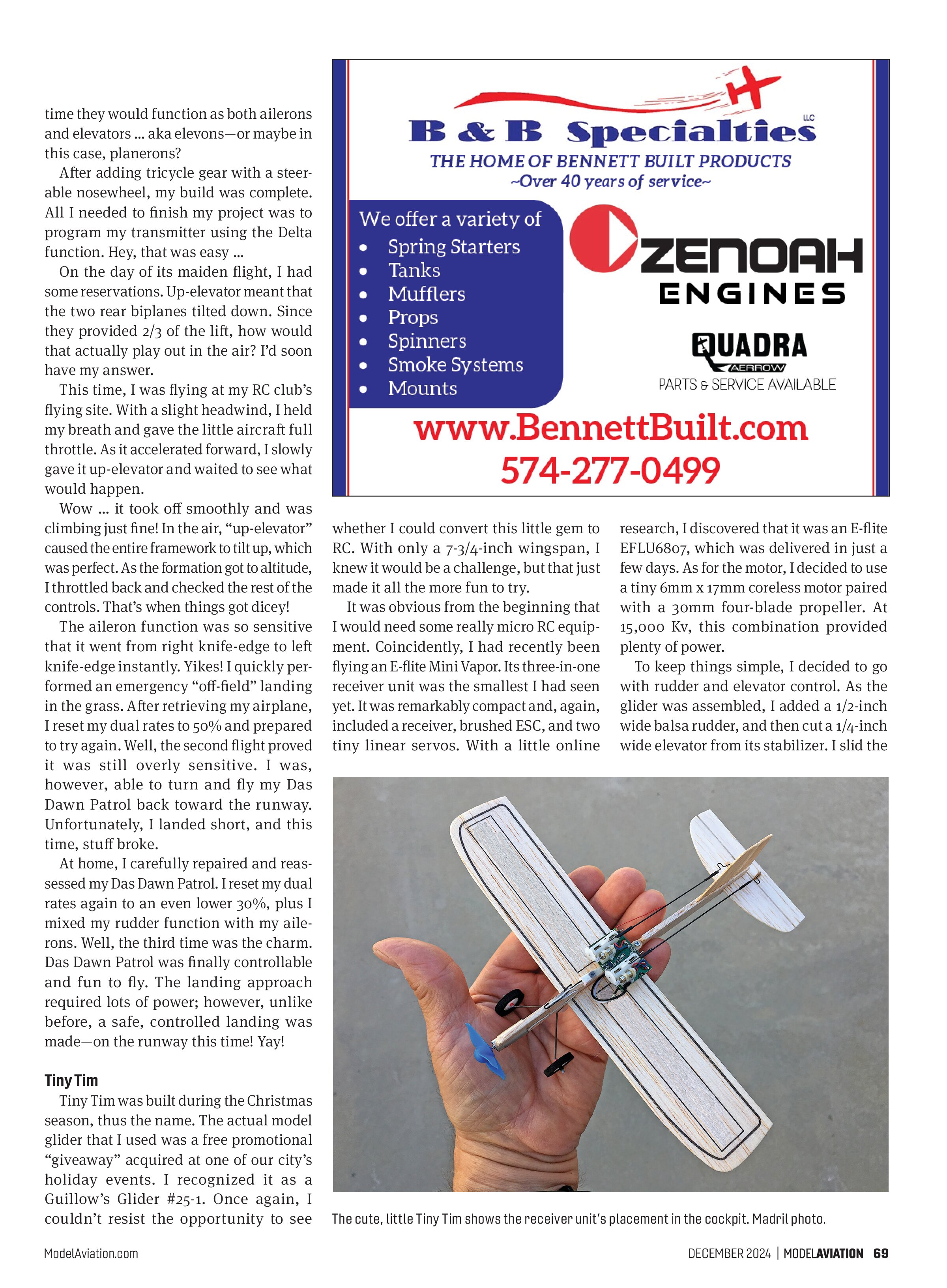
It was obvious from the beginning that I would need some really micro RC equipment. Coincidently, I had recently been flying an E-flite Mini Vapor. Its three-in-one receiver unit was the smallest I had seen yet. It was remarkably compact and, again, included a receiver, brushed ESC, and two tiny linear servos. With a little online research, I discovered that it was an E-flite EFLU6807, which was delivered in just a few days. As for the motor, I decided to use a tiny 6mm x 17mm coreless motor paired with a 30mm four-blade propeller. At 15,000 Kv, this combination provided plenty of power.
To keep things simple, I decided to go with rudder and elevator control. As the glider was assembled, I added a 1/2-inch wide balsa rudder, and then cut a 1/4-inch wide elevator from its stabilizer. I slid the


wing as far forward as its slot would allow, and then the receiver unit was mounted into the cockpit area of the fuselage, right over the wing. I also added a small wire landing gear with little 5/8-inch foam wheels. This would allow me to rise off of the ground ... I hoped! The tiny 70 mAh LiPo battery I chose to power Tiny Tim was also used to balance it.
My first flight proved that my efforts were a success. Tiny Tim not only flew, but it also handled well. It was quite spirited, and I soon realized that it flew the best if I kept its airspeed up. I also quickly discovered just how sensitive its controls were. Small, smooth inputs were definitely the name of the game. Takeoffs proved to be a bit challenging but were doable.
Ultimately, however, I decided that hand-launching over grass was the safest way to get Tiny Tim airborne. During landing, I found that a fair amount of power was needed to carry it in. With such a tiny wing, it wasn’t much of a glider anymore. All the same, it made the cutest, little three-point landing I had ever seen. What fun I’ve had with my Tiny Tim, and I continue flying it to this day.
Back in the Hangar
Well, thanks for riding shotgun. It was fun having you come along. I hope you found these projects interesting and inspirational. Remember, your favorite airplanes from your childhood are still out there. And when you find them, you, too, can use micro-RC electronics to make your fond memories take flight.
Until next time, my friends, stay safe, have fun, and stay well. Fun stuff ...
SOURCES:
Guillow’s
(781) 245-5255
www.guillow.com
Horizon Hobby/E-flite
www.horizonhobby.com