OLD-TIMERS

WARTIME MODELING
By Bob Angel | samrcflier@verizon.net
WORLD WAR II affected most everyone’s lives to some degree, including that of model builders and fliers. Many modelers joined or were drafted into military services. Others worked in critical aviation-based jobs that were often draft exempt. The average age of modelers was younger then, so many of us were still in school.
More than half of the boys in our large grade school built model airplanes at the time, and we often brought these to school as a sort of “show and tell.” The models most chosen were usually well-known fighter types and a few bombers. There were no nearby model clubs, and our meager supplies came from a 10¢ store that didn’t carry model magazines.
We were in complete ignorance of balance and trim procedures, so our efforts normally ended up as display types rather than flyers. When we showed them on the playground, those with the fewest wrinkles in the covering earned a “neat” response from the audience. Many models ended up in a blaze of glory after being set afire and launched from a second- or third-story window. I theorize that many of us stuck with modeling because we didn’t want to see all those years of intense learning go to waste.
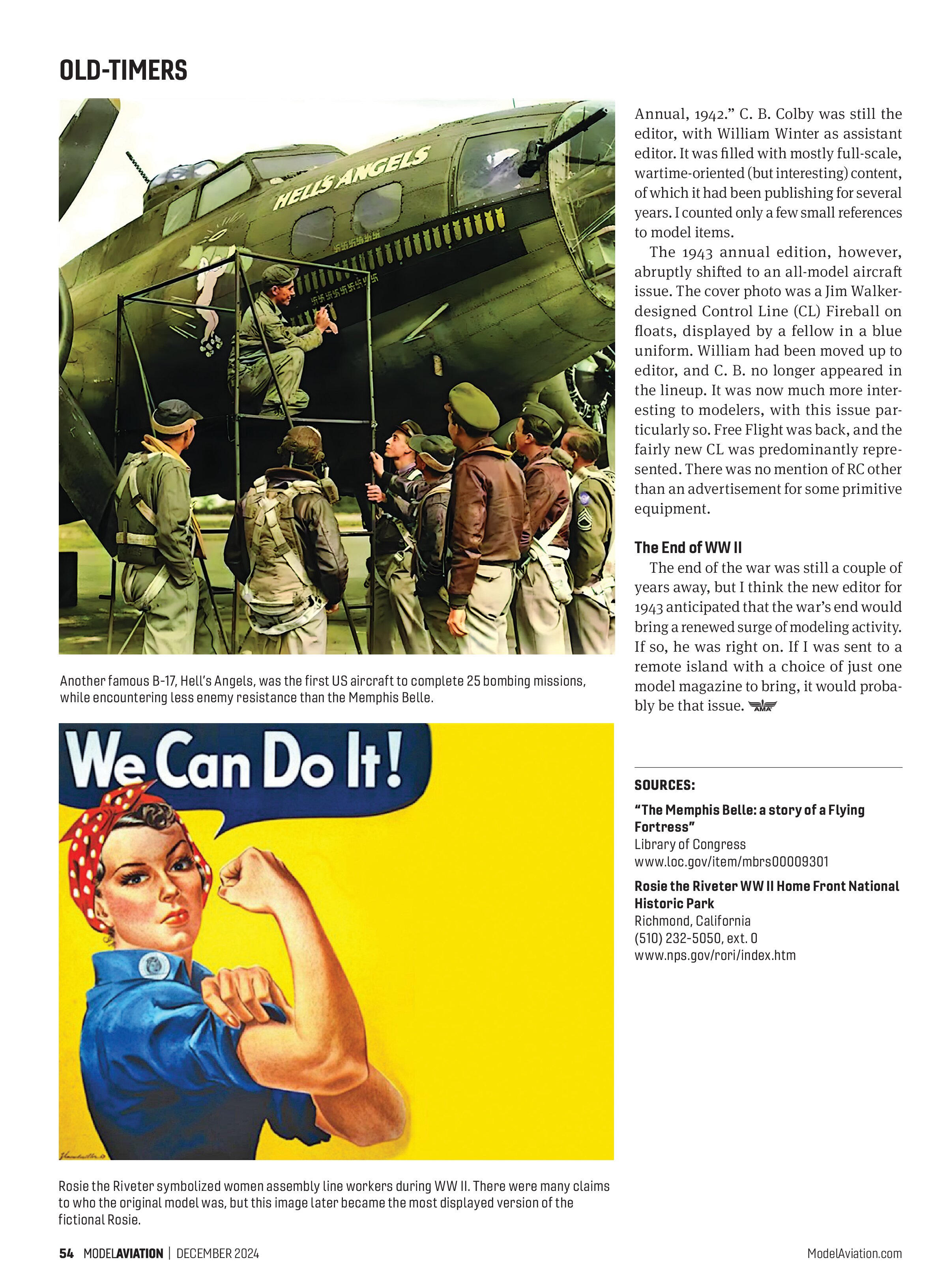
As more men joined or were drafted into service, they left job openings that needed to be filled at a time when even more jobs were being added to construct and transport weapons and equipment that supported the war. Women moved into the workplace in numbers that were never before seen to fill the vacancies. School-age youngsters sometimes joined other volunteers in constructing solid, recognition models used to train service personnel to recognize friendly versus enemy aircraft.
The war began officially in Europe in 1939 and ended in 1945. The US was involved early in supplying arms to our allies and preparing for war, but we didn’t formally declare and go to war until late 1941 after first being attacked at Pearl Harbor. Shortages of “nonessential” goods and services for domestic use became quickly widespread, including things such as automobiles, gasoline, tires, household goods, appliances, and even many kinds of food.
Supply Shortages
Model building supplies were also affected. One of the earlier and most notable shortages was balsa wood, which was needed in huge amounts for life rafts. The government quickly bought up existing balsa supplies from modeling wholesalers, as well as from offshore growers who weren’t accustomed to supplying in such volumes. Model engine production was halted as machine shops large and small were given government contracts for arms and support equipment. Many metals were also in short supply.
Great Britain and other overseas allies were more severely affected before, during, and after the war. They adopted much of our model designs, know-how, and equipment while they caught up during the recovery period. They used diesel model engines in greater numbers than we did in the US. Some of that was probably because nitromethane was needed in the newer glow fuels, while it was less available overseas.
US model building and flying struggled but still persisted as kit makers adapted by using alternate materials, such as smaller-size hardwood in place of balsa sheets and sticks, and by redesigning to include cardboard in place of wood. Joe Ott’s model kits led this field by employing “Ott-o-formers” of thick cardboard for fuselage formers to replace balsa sheet material. Most kits were rubber powered, containing one long rubber band of mediocre quality. Still, that rubber band was useful for keeping a deck of cards stored together if you’d lost its box.
Some of my school friends’ fathers were drafted into military service. Our house was lucky because my dad was exempt; he was assembling the then-very-secret Norden bombsights at the Crosley Company in Cincinnati, Ohio. His job later triggered an interesting move to the West Coast right in the middle of the war.
A more urgent need arose for Norden technicians to overhaul directors (aiming devices) for large naval guns at the Puget Sound Naval Shipyard in Bremerton, Washington. The big guns shared gyroscopes and other mechanical and electronic parts with the Norden bombsights. A military request was issued for Norden technicians to volunteer to relocate and work at the shipyard. Dad was the first volunteer and was sent by train immediately, while Mom and I stayed behind a month or so until the school year finished.
Dad was satisfied with the job and conditions, and he contacted a fellow employee from Crosley, convincing him to transfer as well. The government was leaner and more efficient then, so they arranged and paid for our household goods relocation with minimum red tape. Right after school was out, they paired us to travel with the other volunteer and wife, who owned a car. He was given extra gasoline ration stamps to make the trip.
We were allotted a week or more for travel, at a time when few other cars were on the road. It was an interesting trip through the Wild West, with which I had been acquainted only through western movies.
1943 Air Trails Annual
Air Trails was one of the most enduring magazines for a number of years, but it had a chameleon-like habit of making name and content changes fairly often. In addition to monthly issues, it also ran an annual edition for several years between 1938 to 1969, but about a half dozen of those were missing during the run.
The 1941 annual edition was titled Air Progress, with a subtitle of “Air Trails Annual, 1941.” It had a fighter aircraft on the cover, continuing its wartime coverage of full-scale aircraft. Just four of its 96 pages were devoted to very simple models, from making a paper glider to an advanced, rubber-powered stick model.
The 1942 annual edition was titled as above, with a similar subtitle of “Air Trails


Annual, 1942.” C. B. Colby was still the editor, with William Winter as assistant editor. It was filled with mostly full-scale, wartime-oriented (but interesting) content, of which it had been publishing for several years. I counted only a few small references to model items.
The 1943 annual edition, however, abruptly shifted to an all-model aircraft issue. The cover photo was a Jim Walker-designed Control Line (CL) Fireball on floats, displayed by a fellow in a blue uniform. William had been moved up to editor, and C. B. no longer appeared in the lineup. It was now much more interesting to modelers, with this issue particularly so. Free Flight was back, and the fairly new CL was predominantly represented. There was no mention of RC other than an advertisement for some primitive equipment.
The End of WW II
The end of the war was still a couple of years away, but I think the new editor for 1943 anticipated that the war’s end would bring a renewed surge of modeling activity. If so, he was right on. If I was sent to a remote island with a choice of just one model magazine to bring, it would probably be that issue.
SOURCES:
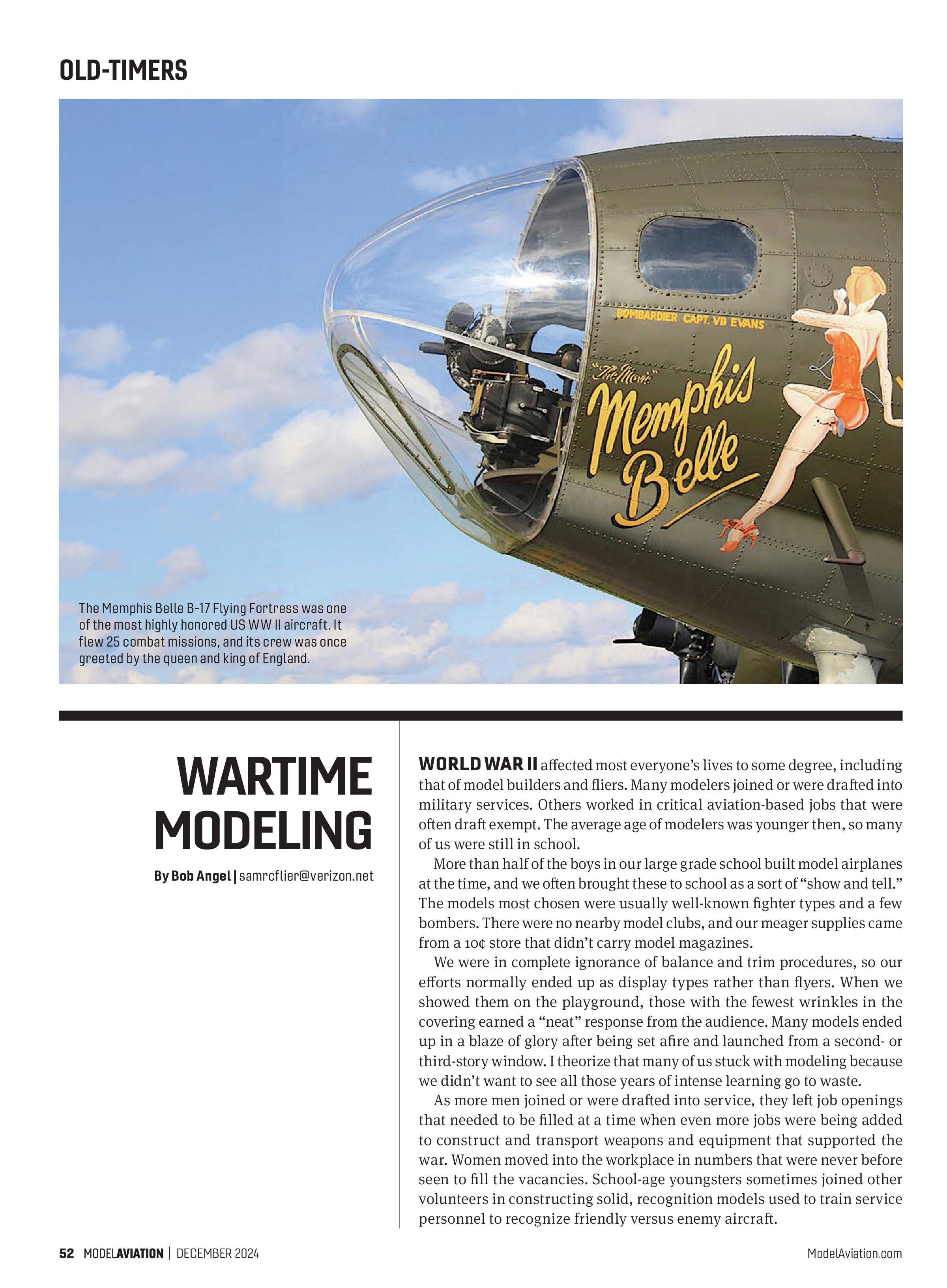
“The Memphis Belle: a story of a Flying Fortress”
Library of Congress
www.loc.gov/item/mbrs00009301
Rosie the Riveter WW II Home Front National Historic Park
Richmond, California
(510) 232-5050, ext. 0
www.nps.gov/rori/index.htm