FOCAL POINT
Interested in sharing your handiwork? Visit www.ModelAviation.com for submission guidelines.
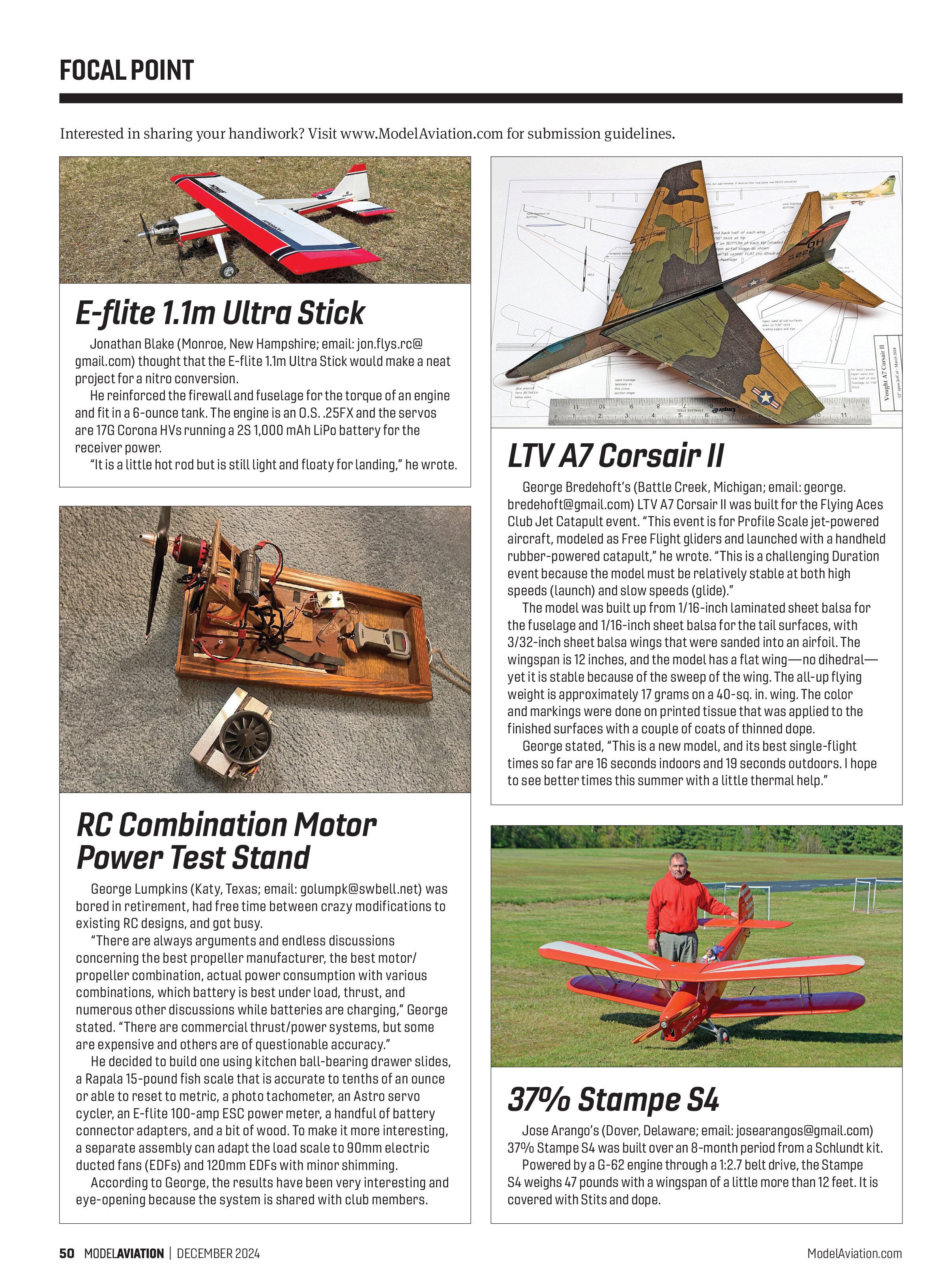
E-flite 1.1m Ultra Stick
Jonathan Blake (Monroe, New Hampshire; email: jon.flys.rc@gmail.com) thought that the E-flite 1.1m Ultra Stick would make a neat project for a nitro conversion.
He reinforced the firewall and fuselage for the torque of an engine and fit in a 6-ounce tank. The engine is an O.S. .25FX and the servos are 17G Corona HVs running a 2S 1,000 mAh LiPo battery for the receiver power.
“It is a little hot rod but is still light and floaty for landing,” he wrote.

RC Combination Motor-Power Test Stand
George Lumpkins (Katy, Texas; email: golumpk@swbell.net) was bored in retirement, had free time between crazy modifications to existing RC designs, and got busy.
“There are always arguments and endless discussions concerning the best propeller manufacturer, the best motor/propeller combination, actual power consumption with various combinations, which battery is best under load, thrust, and numerous other discussions while batteries are charging,” George stated. “There are commercial thrust/power systems, but some are expensive and others are of questionable accuracy.”
He decided to build one using kitchen ball-bearing drawer slides, a Rapala 15-pound fish scale that is accurate to tenths of an ounce or able to reset to metric, a photo tachometer, an Astro servo cycler, an E-flite 100-amp ESC power meter, a handful of battery connector adapters, and a bit of wood. To make it more interesting, a separate assembly can adapt the load scale to 90mm electric ducted fans (EDFs) and 120mm EDFs with minor shimming.
According to George, the results have been very interesting and eye-opening because the system is shared with club members.

LTV A7 Corsair II
George Bredehoft’s (Battle Creek, Michigan; email: george.bredehoft@gmail.com) LTV A7 Corsair II was built for the Flying Aces Club Jet Catapult event. “This event is for Profile Scale jet-powered aircraft, modeled as Free Flight gliders and launched with a handheld rubber-powered catapult,” he wrote. “This is a challenging Duration event because the model must be relatively stable at both high speeds (launch) and slow speeds (glide).”
The model was built up from 1/16-inch laminated sheet balsa for the fuselage and 1/16-inch sheet balsa for the tail surfaces, with 3/32-inch sheet balsa wings that were sanded into an airfoil. The wingspan is 12 inches, and the model has a flat wing—no dihedral—yet it is stable because of the sweep of the wing. The all-up flying weight is approximately 17 grams on a 40-sq. in. wing. The color and markings were done on printed tissue that was applied to the finished surfaces with a couple of coats of thinned dope.
George stated, “This is a new model, and its best single-flight times so far are 16 seconds indoors and 19 seconds outdoors. I hope to see better times this summer with a little thermal help.”

37% Stampe S4
Jose Arango’s (Dover, Delaware; email: josearangos@gmail.com) 37% Stampe S4 was built over an 8-month period from a Schlundt kit. Powered by a G-62 engine through a 1:2.7 belt drive, the Stampe S4 weighs 47 pounds with a wingspan of a little more than 12 feet. It is covered with Stits and dope.

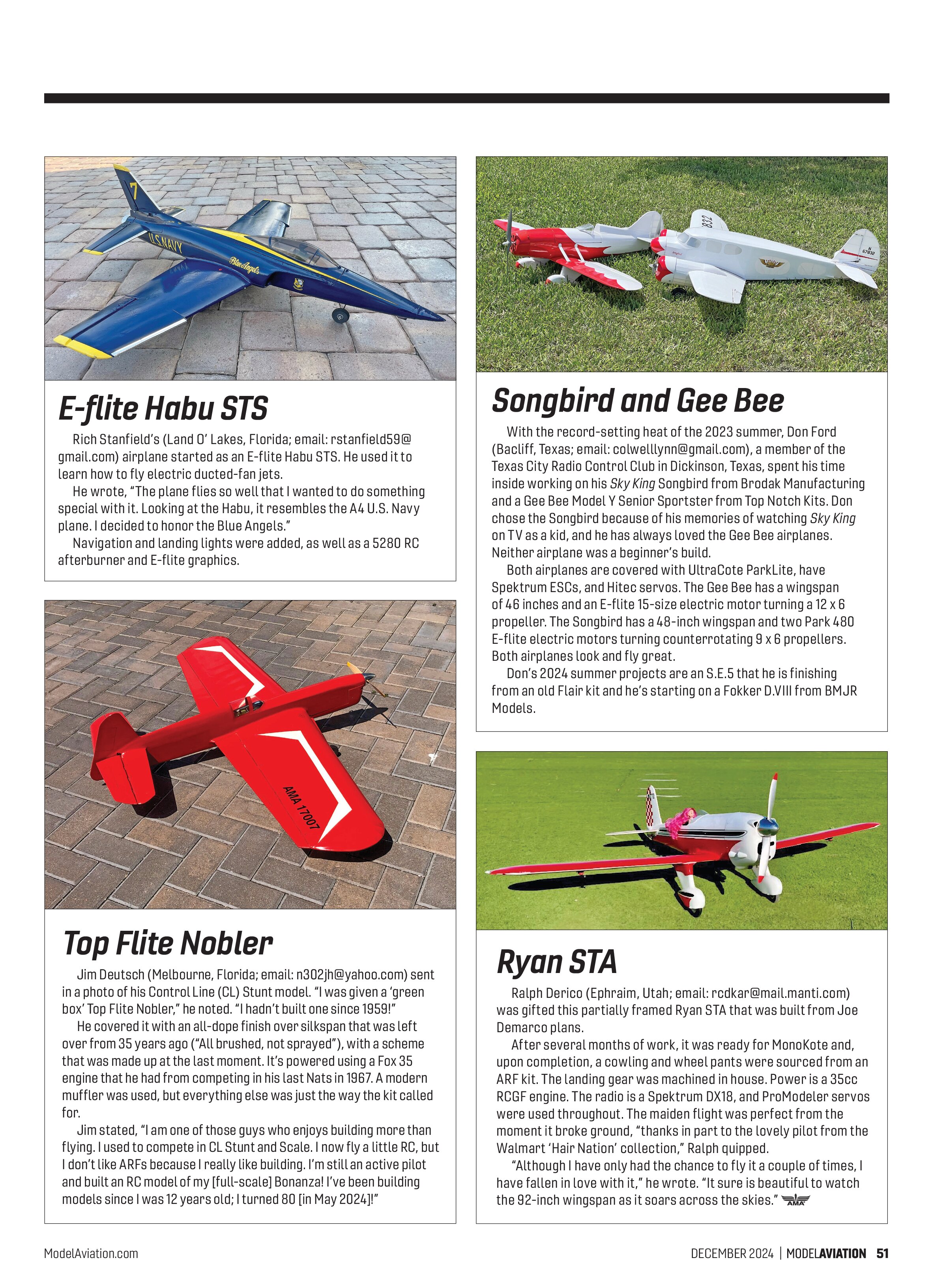
E-flite Habu STS
Rich Stanfield’s (Land O’ Lakes, Florida; email: rstanfield59@gmail.com) airplane started as an E-flite Habu STS. He used it to learn how to fly electric ducted-fan jets.
He wrote, “The plane flies so well that I wanted to do something special with it. Looking at the Habu, it resembles the A4 U.S. Navy plane. I decided to honor the Blue Angels.”
Navigation and landing lights were added, as well as a 5280 RC afterburner and E-flite graphics.

Top Flite Nobler
Jim Deutsch (Melbourne, Florida; email: n302jh@yahoo.com) sent in a photo of his Control Line (CL) Stunt model. “I was given a ‘green box Top Flite Nobler,’ he noted. ‘I hadn’t built one since 1959!’
He covered it with an all-dope finish over silkspan that was left over from 35 years ago (“All brushed, not sprayed”), with a scheme that was made up at the last moment. It’s powered using a Fox 35 engine that he had from competing in his last Nats in 1967. A modern muffler was used, but everything else was just the way the kit called for.
Jim stated, “I am one of those guys who enjoys building more than flying. I used to compete in CL Stunt and Scale. I now fly a little RC, but I don’t like ARFs because I really like building. I’m still an active pilot and built an RC model of my [full-scale] Bonanza! I’ve been building models since I was 12 years old; I turned 80 [in May 2024]!”

Songbird and Gee Bee
With the record-setting heat of the 2023 summer, Don Ford (Bacliff, Texas; email: colwellynn@gmail.com), a member of the Texas City Radio Control Club in Dickinson, Texas, spent his time inside working on his Sky King Songbird from Brodak Manufacturing and a Gee Bee Model Y Senior Sportster from Top Notch Kits. Don chose the Songbird because of his memories of watching Sky King on TV as a kid, and he has always loved the Gee Bee airplanes. Neither airplane was a beginner’s build.
Both airplanes are covered with UltraCote ParkLite, have Spektrum ESCs, and Hitec servos. The Gee Bee has a wingspan of 46 inches and an E-flite 15-size electric motor turning a 12 x 6 propeller. The Songbird has a 48-inch wingspan and two Park 480 E-flite electric motors turning counterrotating 9 x 6 propellers. Both airplanes look and fly great.
Don’s 2024 summer projects are an S.E.5 that he is finishing from an old Flair kit and he’s starting on a Fokker D.VIII from BMJR Models.

Ryan STA
Ralph Derico (Ephraim, Utah; email: rcdkar@mail.manti.com) was gifted this partially framed Ryan STA that was built from Joe Demarco plans.
After several months of work, it was ready for MonKote and, upon completion, a cowling and wheel pants were sourced from an ARF kit. The landing gear was machined in house. Power is a 35cc RCGF engine. The radio is a Spektrum DX18, and ProModeler servos were used throughout. The maiden flight was perfect from the moment it broke ground, “thanks in part to the lovely pilot from the Walmart ‘Hair Nation’ collection,” Ralph quipped.
“Although I have only had the chance to fly it a couple of times, I have fallen in love with it,” he wrote. “It sure is beautiful to watch the 92-inch wingspan as it soars across the skies.”