FLIGHT SCHOOL

GETTING A “FEEL” FOR STALLS
By Dave Scott | 1usrcfs@gmail.com
I RECENTLY POSTED a question online asking, “How do you know when an airplane is approaching a stall?” Nearly all answered that they know when the controls become mushy and/or a wingtip drops. Technically, those answers are incorrect. Mushy controls or a dropped wing are indications that the airplane has already entered a stall!
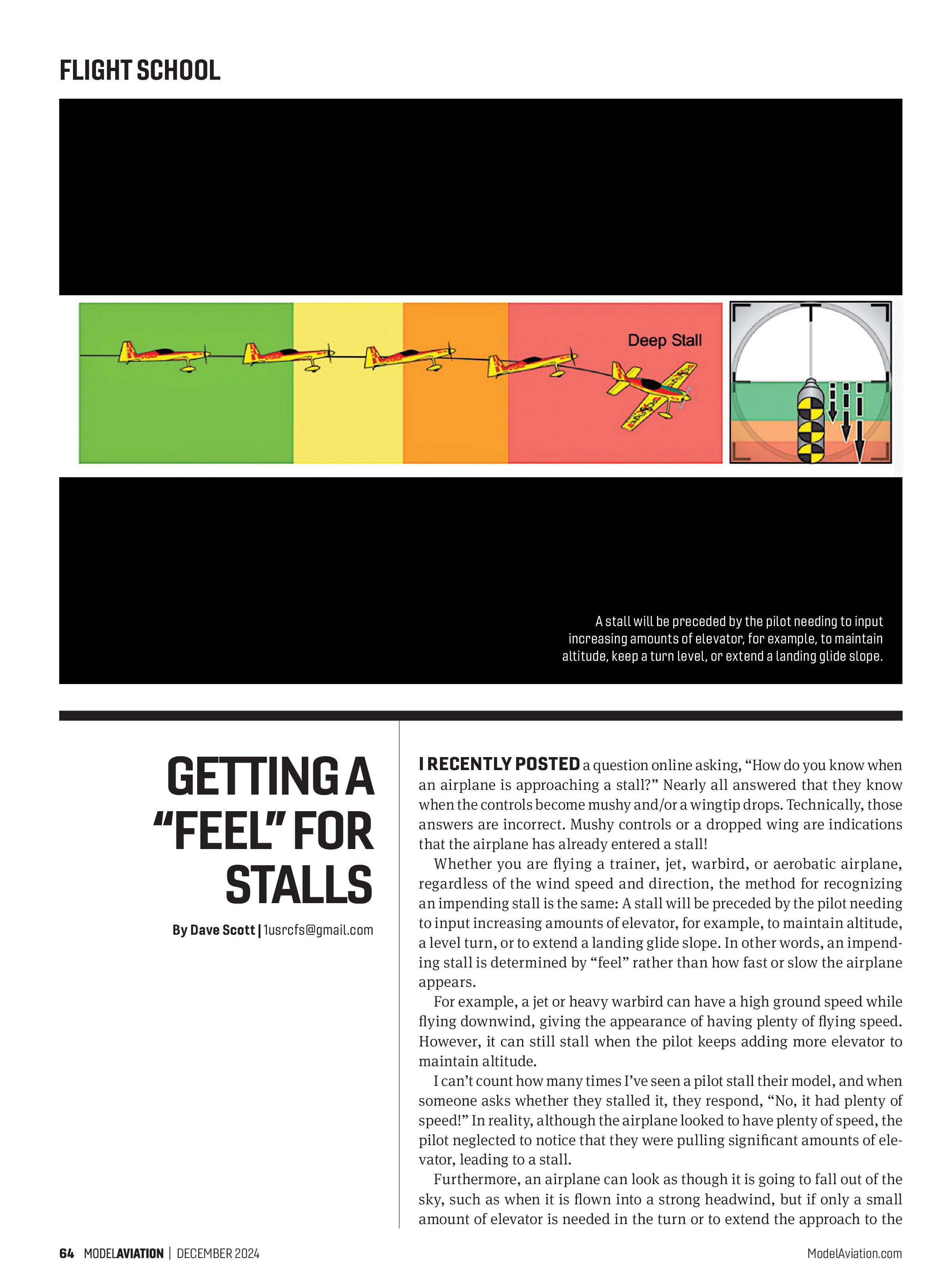
Whether you are flying a trainer, jet, warbird, or aerobatic airplane, regardless of the wind speed and direction, the method for recognizing an impending stall is the same: A stall will be preceded by the pilot needing to input increasing amounts of elevator, for example, to maintain altitude, keep a turn level, or extend a landing glide slope. In other words, an impending stall is determined by “feel” rather than how fast or slow the airplane appears.
For example, a jet or heavy warbird can have a high ground speed while flying downwind, giving the appearance of having plenty of flying speed. However, it can still stall when the pilot keeps adding more elevator to maintain altitude.
I can’t count how many times I’ve seen a pilot stall their model, and when someone asks whether they stalled it, they respond, “No, it had plenty of speed!” In reality, although the airplane looked to have plenty of speed, the pilot neglected to notice that they were pulling significant amounts of elevator, leading to a stall.
Furthermore, an airplane can look as though it is going to fall out of the sky, such as when it is flown into a strong headwind, but if only a small amount of elevator is needed in the turn or to extend the approach to the runway, the airplane has plenty of flying speed. Adding power would not be necessary.
In addition, there are numerous orientations where speed is not easy to judge, such as when the airplane is flying directly away or at the pilot. Therefore, “elevator feel” is the principle way to determine when the airplane is flying too slowly.
The first step after becoming aware that increasing amounts of elevator are needed to maintain altitude or extend a glide slope is to reduce the elevator, thereby lowering the nose and the wing’s angle of attack and preventing entrance into a deep stall. If there is not enough altitude to lower the nose, you’ll also have to add more power.
Note that controlling the landing approach slope (on low rates) with varying elevator inputs between 1/4 and 1/2 is normal. As long as the airplane is not continuing to require increasing amounts of elevator, it has plenty of flying speed. Adding power is not necessary.
Speed Kills Models
Here’s the problem: Before most RC pilots even fly a new model, they hear in their club or online about the certain doom and destruction that will occur if they stall. Consequently, many RC pilots bring their

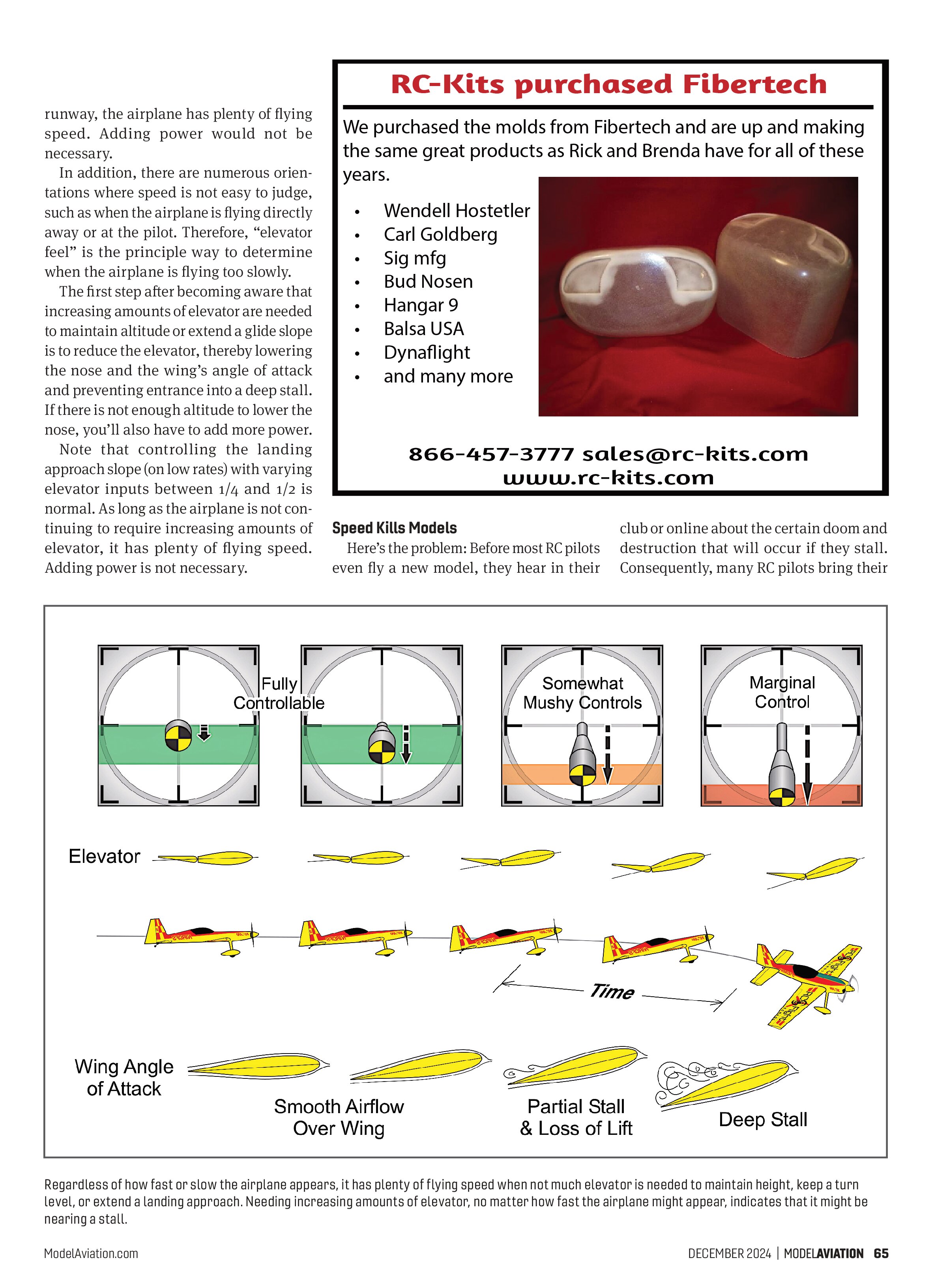
Regardless of how fast or slow the airplane appears, it has plenty of flying speed when not much elevator is needed to maintain height, keep a turn level, or extend a landing approach. Needing increasing amounts of elevator, no matter how fast the airplane might appear, indicates that it might be nearing a stall.
Believe it or not, proficient fliers aim to touch down at the minimum controllable airspeed. Doing so makes it easier to control the touchdown location and minimizes the rollout. It also helps to ensure that when the airplane touches down, it is done flying and stays on the ground (even if the flare is less than perfect or it hits a bump on the runway). Touching down at a slower speed also tends to be easier on the landing gear.
For all of those reasons, during full-scale flight training, student pilots practice slow flight and learn the characteristics leading up to and during a stall before ever attempting an actual landing. RC pilots would also be wise to get some height and to practice flying slow to find out what the airplane feels like leading up to and during a stall.
I've Got a Good Feeling
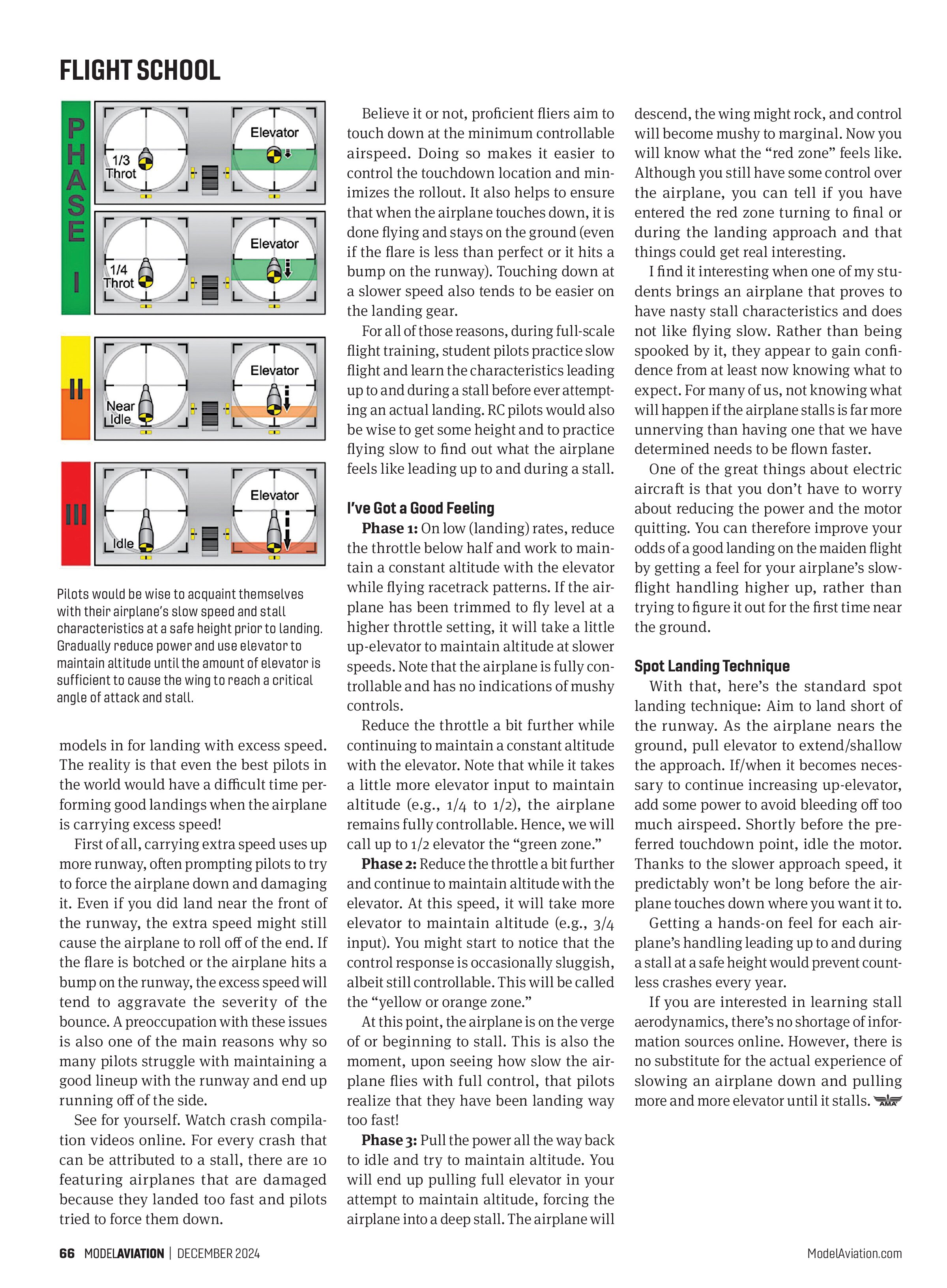
Phase 1: On low (landing) rates, reduce the throttle below half and work to maintain a constant altitude with the elevator while flying racetrack patterns. If the airplane has been trimmed to fly level at a higher throttle setting, it will take a little up-elevator to maintain altitude at slower speeds. Note that the airplane is fully controllable and has no indications of mushy controls.
Reduce the throttle a bit further while continuing to maintain a constant altitude with the elevator. Note that while it takes a little more elevator input to maintain altitude (e.g., 1/4 to 1/2), the airplane remains fully controllable. Hence, we will call up to 1/2 elevator the “green zone.”
Phase 2: Reduce the throttle a bit further and continue to maintain altitude with the elevator. At this speed, it will take more elevator to maintain altitude (e.g., 3/4 input). You might start to notice that the control response is occasionally sluggish, albeit still controllable. This will be called the “yellow or orange zone.”
At this point, the airplane is on the verge of or beginning to stall. This is also the moment, upon seeing how slow the airplane flies with full control, that pilots realize that they have been landing way too fast!
Phase 3: Pull the power all the way back to idle and try to maintain altitude. You will end up pulling full elevator in your attempt to maintain altitude, forcing the airplane into a deep stall. The airplane will descend, the wing might rock, and control will become mushy to marginal. Now you will know what the “red zone” feels like.
Although you still have some control over the airplane, you can tell if you have entered the red zone turning to final or during the landing approach and that things could get real interesting.
I find it interesting when one of my students brings an airplane that proves to have nasty stall characteristics and does not like flying slow. Rather than being spooked by it, they appear to gain confidence from at least now knowing what to expect. For many of us, not knowing what will happen if the airplane stalls is far more unnerving than having one that we have determined needs to be flown faster.
One of the great things about electric aircraft is that you don’t have to worry about reducing the power and the motor quitting. You can therefore improve your odds of a good landing on the maiden flight by getting a feel for your airplane’s slow-flight handling higher up, rather than trying to figure it out for the first time near the ground.
Spot Landing Technique
With that, here’s the standard spot landing technique: Aim to land short of the runway. As the airplane nears the ground, pull elevator to extend/shallow the approach. If/when it becomes necessary to continue increasing up-elevator, add some power to avoid bleeding off too much airspeed. Shortly before the preferred touchdown point, idle the motor. Thanks to the slower approach speed, it predictably won’t be long before the airplane touches down where you want it to.
Getting a hands-on feel for each airplane’s handling leading up to and during a stall at a safe height would prevent countless crashes every year.
If you are interested in learning stall aerodynamics, there’s no shortage of information sources online. However, there is no substitute for the actual experience of slowing an airplane down and pulling more and more elevator until it stalls.
Pilots would be wise to acquaint themselves with their airplane’s slow speed and stall characteristics at a safe height prior to landing. Gradually reduce power and use elevator to maintain altitude until the amount of elevator is sufficient to cause the wing to reach a critical angle of attack and stall.
models in for landing with excess speed. The reality is that even the best pilots in the world would have a difficult time performing good landings when the airplane is carrying excess speed!
First of all, carrying extra speed uses up more runway, often prompting pilots to try to force the airplane down and damaging it. Even if you did land near the front of the runway, the extra speed might still cause the airplane to roll off of the end. If the flare is botched or the airplane hits a bump on the runway, the excess speed will tend to aggravate the severity of the bounce. A preoccupation with these issues is also one of the main reasons why so many pilots struggle with maintaining a good lineup with the runway and end up running off of the side.
See for yourself. Watch crash compilation videos online. For every crash that can be attributed to a stall, there are 10 featuring airplanes that are damaged because they landed too fast and pilots tried to force them down.