CAUTIONARY TALES
By Terry Dunn | terrydunn74@gmail.com

MOST OF US are pretty good at learning from our own experiences. It is a little tougher to take lessons from incidents that we merely see or hear about. With that in mind, I will present two stories that I hope we can all learn from.
Keep It Moving
I recently heard about a modeler who had a brushless motor overheat and seize while he was bench-testing the power system in his model. He proclaimed his good fortune of finding the problem on the ground rather than in the air. Sure, issues that are encountered at home are much easier to deal with than an in-flight emergency. The irony of the situation, however, is that the failure was probably because of his testing method rather than faulty equipment.
This pilot’s plan for testing the power system was to secure the model in place and run the motor at full throttle until the battery was depleted. I can understand why many people would find that to be an intuitive approach. It’s like you’re simulating the power demands of an entire flight but while it is shackled safely on the ground ... right?
Well, no. The truth of the matter is that static-testing an electric power system will often put a significantly higher load on the components than what they would experience in flight. As the protagonist of this story discovered, that difference could be enough to cause a failure.
The first issue is that the motor has to work harder to spin the propeller when the airplane is fixed in place. Some people like to say that the propeller generates lift because it is spinning the tiny airfoil of the propeller blades. Others say that a propeller accelerates the air that it encounters. Whatever viewpoint you subscribe to, the result is the same. It requires more power to spin the propeller on a static airplane than it does while the airplane is moving forward.
Depending on the specifics, a power system might pull 10% additional current (amps) or more during static testing versus in flight. Generally speaking, the faster a model is, the bigger the difference is between static and dynamic amperage. Because none of our power systems are 100% efficient, that also means that they will produce more heat during static runs.
An additional concern with prolonged static runs is that the components receive

less airflow for cooling. The propwash alone is not always adequate to keep things cool. This is especially true if you are using a spinner, dummy engine, or other garnish that restricts airflow.
Let’s summarize the effects of prolonged static runups. You are pushing your power system harder, producing more heat, and providing less cooling. When you add those elements together, it is easier to understand the potential problems that might arise.
When You Have to, You Have To
There are still multiple reasons to perform a static power check. It is always a good idea to verify that your power system is operating properly before takeoff. Or maybe you want to take a wattmeter reading or perform a vibration check. You

should absolutely do those things. Just keep it short.
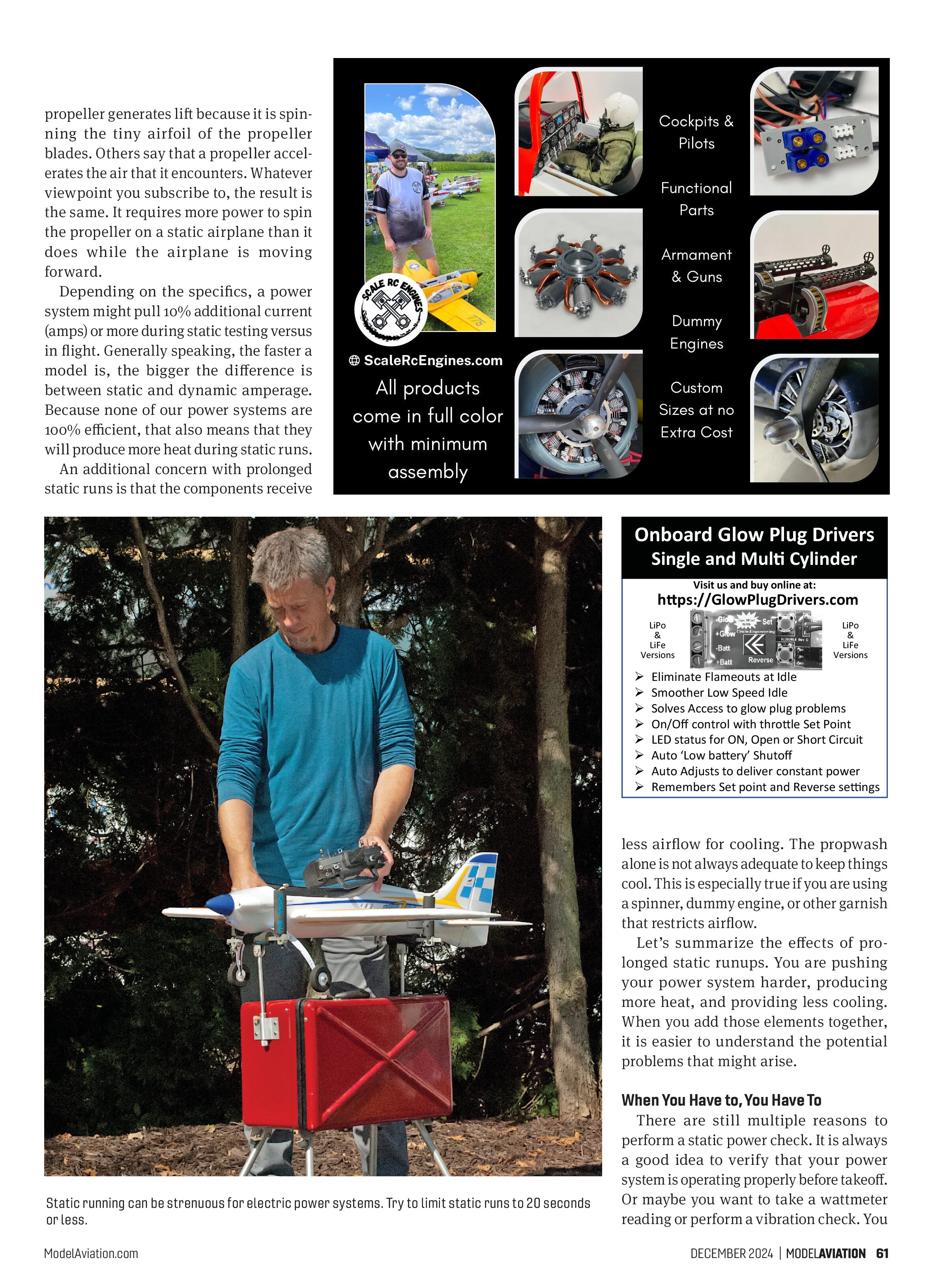
I always recommend that you set up your power systems so that all components operate within the manufacturers’ specifications during the rigor of static-testing. However, those specifications are based on the components having adequate cooling. That rarely happens while the airplane is anchored to the ground. My advice is to limit static runups to 20 seconds or less. If you need more time, run a second test after you have allowed the components to cool for a few minutes.
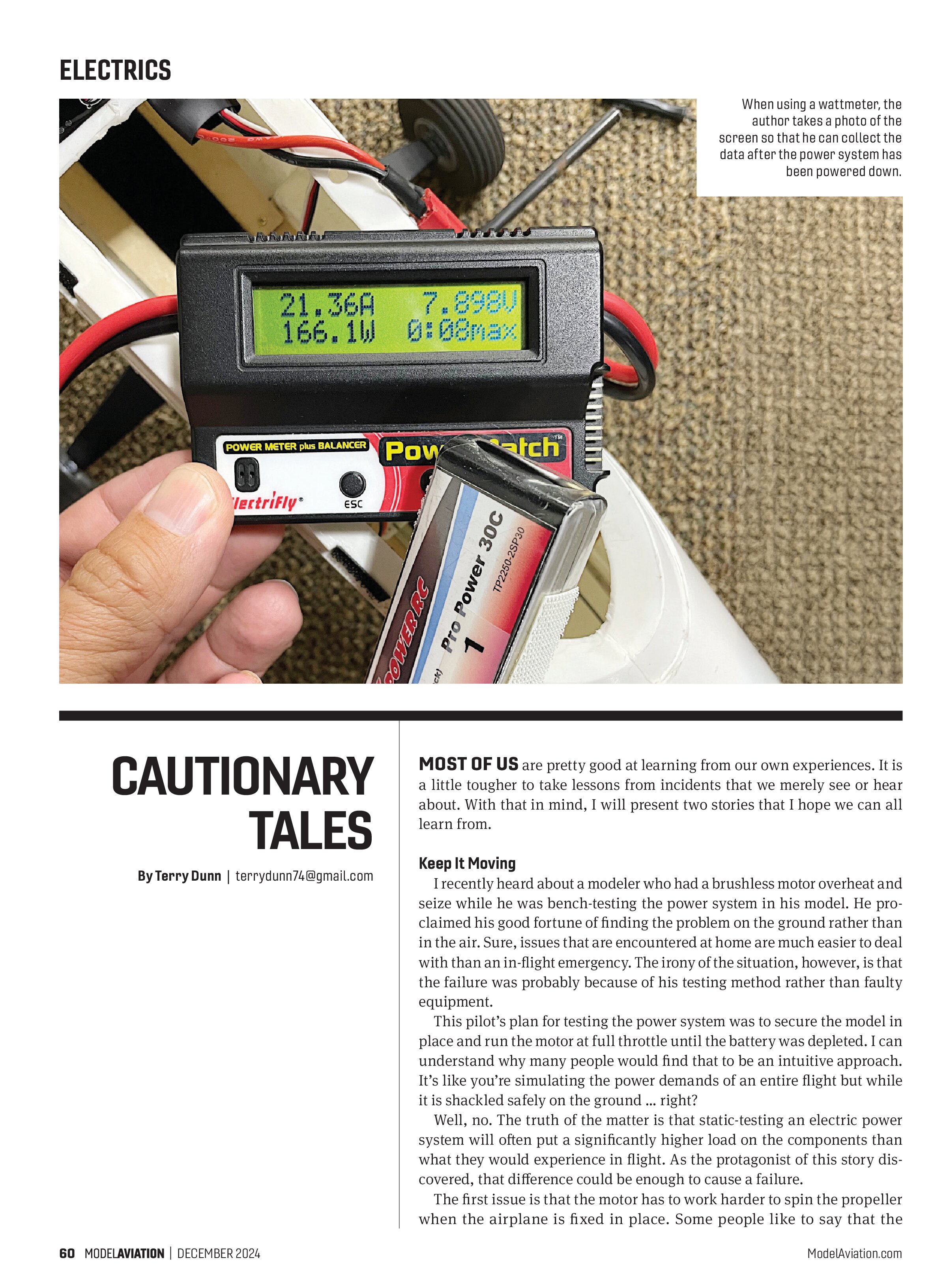
It can sometimes be difficult to record a wattmeter reading inside of 20 seconds. There is a lot going on and you have to be very safety conscious. It helps to have the model secured in place with a tie-down anchor, a starting bench, or another person. You do not want to be burdened with securing the model while also trying to manage the transmitter and read the wattmeter.
My Great Planes PowerMatch Wattmeter (now discontinued) has a setting that displays the maximum power value from a test. That allows me to run the motor for only a few seconds. I can then disarm the model before writing down the wattmeter values. For my other wattmeters, I keep my phone handy and take a photo of the wattmeter screen during the runup. This helps me keep the static test short and sweet.
Close Call
A friend of mine recently had a scary incident while charging a LiPo battery in his basement workshop. I will let him describe what happened in his own words.
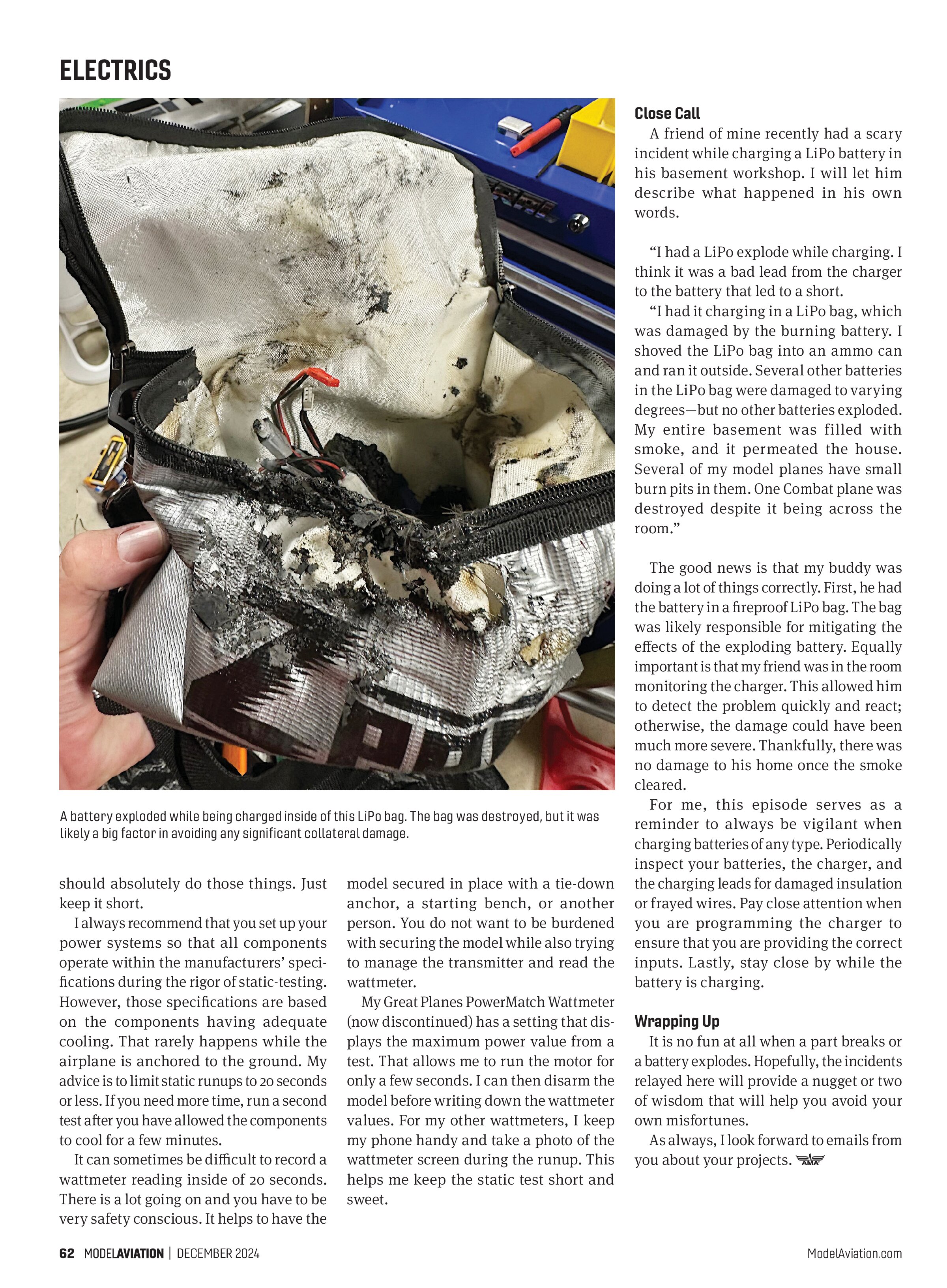
“I had a LiPo explode while charging. I think it was a bad lead from the charger to the battery that led to a short.
“I had it charging in a LiPo bag, which was damaged by the burning battery. I shoved the LiPo bag into an ammo can and ran it outside. Several other batteries in the LiPo bag were damaged to varying degrees—but no other batteries exploded. My entire basement was filled with smoke, and it permeated the house. Several of my model planes have small burn pits in them. One Combat plane was destroyed despite it being across the room.”
The good news is that my buddy was doing a lot of things correctly. First, he had the battery in a fireproof LiPo bag. The bag was likely responsible for mitigating the effects of the exploding battery. Equally important is that my friend was in the room monitoring the charger. This allowed him to detect the problem quickly and react; otherwise, the damage could have been much more severe. Thankfully, there was no damage to his home once the smoke cleared.
For me, this episode serves as a reminder to always be vigilant when charging batteries of any type. Periodically inspect your batteries, the charger, and the charging leads for damaged insulation or frayed wires. Pay close attention when you are programming the charger to ensure that you are providing the correct inputs. Lastly, stay close by while the battery is charging.
Wrapping Up
It is no fun at all when a part breaks or a battery explodes. Hopefully, the incidents relayed here will provide a nugget or two of wisdom that will help you avoid your own misfortunes.
As always, I look forward to emails from you about your projects.