BATTERY CARE AND SAFETY
By Gwen Mathis, AMA Education Development Coordinator | gwenm@modelaircraft.org
IF YOU LIVE in a place that gets cold during the winter, you probably know how dangerous low temperatures can be for your batteries. If you’ve never noticed this before, pay close attention to your cellphone battery the next time it’s outside in cold weather. You will be able to observe how quickly the battery level drops.
The effect that cold temperatures have on batteries can be summed up with a simple explanation: Cold temperatures increase the internal resistance of batteries and lower their capacity. Cold batteries produce less power than usual, experience slower chemical reactions, and are unable to retain their regular charge.
Is there anything that you can do to keep your batteries safe and healthy? There are, in fact, many things!
Note: This article discusses care for LiPo batteries. If you are handling a different battery type, we recommend doing careful research about specific storage, charging, discharging, and maintenance.
Safe Storage
Batteries need to be stored in temperatures between 40° and 70°F. Temperatures that are too cold or too hot can damage them. Batteries temporarily lose capacity in freezing temperatures, but the temporary capacity loss leads to reduced long-term storage as well. It is important to keep batteries away from areas with direct, constant sunlight and hot surfaces, such as car hoods on hot summer days.
You must be extremely careful with where you store your batteries. You can’t just toss them in a toolbox or your pocket. Batteries should also be stored in a fire-safe bag or nonflammable container. These containers should not have sharp objects that could pierce the battery packaging.
Safe Charging and Discharging
You do not want to store your batteries at charge levels of 100% or 0%. The ideal storage charge level is 50%. It is important to know the nominal storage voltage per cell when storing your batteries. Each battery cell should be stored at a charge voltage of roughly 3.8 volts. A 2S LiPo battery would be stored at 7.6 volts, a 3S LiPo battery would be stored at 11.4 volts, and so on.
When charging batteries, it is important to closely monitor them. In the unlikely event that one catches on fire, do not attempt to put the fire out using water. You will need to use a Class D fire extinguisher because common household extinguishers are unable to control fires caused by LiPos. If a Class D fire extinguisher is unavailable, throwing sand onto the fire can help calm it.
Use High-Quality Batteries
High-quality batteries might be more expensive, but they’re also more reliable. Low-quality batteries typically require more upkeep and expenses, which can really add up over time. Although they might cost more up front, high-quality batteries can save you more time and money over their lifetime.
Safe Disposal
No matter how well you maintain your batteries, they will eventually reach the end of their lifetime. Some signs to dispose of your batteries include puffiness, losing 20% of their capacity, and/or if they’re no longer able to hold a charge.
Before disposing of your battery, you should discharge it. After discharging the battery, submerge it in saltwater for two weeks. If the battery is damaged or puffy, do not discharge it; skip straight to submerging the battery in salt water. When the battery has been submerged for two weeks, you can dispose of it.
When it is time to dispose of batteries, a simple option is to recycle them through a free battery recycling program called Call2Recycle. There are more than 16,000 public drop-off sites throughout the nation, all of which can be found on the Call2Recycle website (www.call2recycle.org) or by calling (877) 273-2925.
When handling damaged batteries, make sure to use personal protective equipment, such as gloves and safety glasses. If a damaged battery leaks onto your skin, immediately wash your hands with soap and water. If any battery leakage gets in your eyes, immediately flush them and seek medical attention.
Conclusion
Batteries are very useful. We use them to drive in our cars, send texts, and fly our favorite model airplanes. Modelers and non-modelers alike rely heavily on batteries. Cold weather can damage them, but well-maintained, clean, high-quality batteries are able to prevent capacity loss and retain their regular charge.
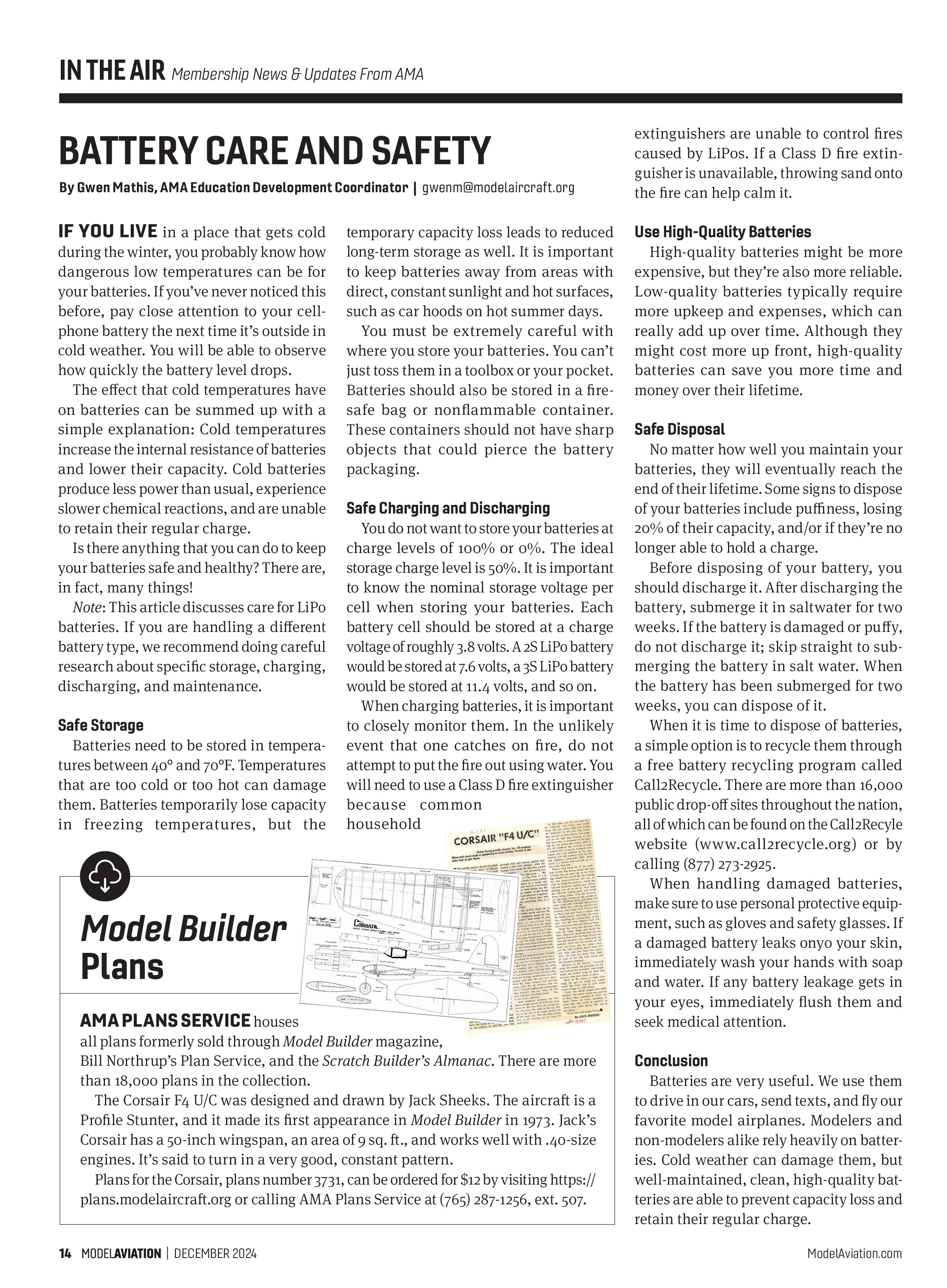
Model Builder Plans
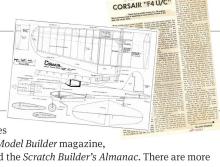
AMA PLANS SERVICE houses all plans formerly sold through Model Builder magazine, Bill Northrup’s Plan Service, and the Scratch Builder’s Almanac. There are more than 18,000 plans in the collection.
The Corsair F4 U/C was designed and drawn by Jack Sheeks. The aircraft is a Profile Stunter, and it made its first appearance in Model Builder in 1973. Jack’s Corsair has a 50-inch wingspan, an area of 9 sq. ft., and works well with .40-size engines. It’s said to turn in a very good, constant pattern.
Plans for the Corsair, plans number 3731, can be ordered for $12 by visiting https://plans.modelaircraft.org or calling AMA Plans Service at (765) 287-1256, ext. 507.
TAKE FLIGHT AS A TORCHBEARER
By Abby Wilson, AMA Foundation Communications Specialist
THE AMA FOUNDATION has been a cornerstone in supporting AMA’s mission since its establishment in 2013. Through a variety of programs and donations, it has made significant strides in advancing the hobby and inspiring the next generation of aviators. In the final quarter of 2024, the AMA Foundation has created new ways to thank dedicated monthly donors, known as Torchbearers.
The AMA Foundation relies heavily on donations from people across the country. In particular, the Torchbearer Program creates a reliable stream of donations on which it can depend. Torchbearers embody the spirit of leadership and commitment to the hobby. In recognition of their dedication, these 68 donors receive exclusive monthly content, a welcome package with Torchbearer-themed items, such as a magnet, and community-building opportunities.
Through the generosity of Torchbearers and thousands of other donors, the AMA Foundation runs many programs in support of AMA’s mission, including the National Model Aviation Museum, scholarships, and grants.
One of the key programs supported by the AMA Foundation is the National Model Aviation Museum, which houses one of the largest collections of model aviation artifacts in the world. The museum not only preserves the rich history of model aviation, but it also serves as an educational resource for visitors of all ages. The AMA Foundation’s support has helped the museum receive grants such as the Save America’s Treasures Grant, which financed the addition of a digitizing specialist and the purchase of scanning equipment so that unique aviation history preserved in prints, negatives, and slides is not lost to time.
In addition to the museum, the AMA Foundation provides scholarships to students and grants to clubs to assist with flying site improvements and rebuilding after natural disasters, as well as to exposing the community to the hobby. The AMA Foundation’s commitment to education and community support is evident in the $1.44 million awarded in scholarships since 1970 and the $1.03 million awarded in grants for flying site improvements and disaster relief.
These are only a few of the programs that Torchbearers support when they pledge to give monthly. The AMA Foundation remains dedicated to promoting the hobby of model aeronautics and could not do so without the continued generosity of donors such as you. With continued support, model aviation will continue to thrive for generations to come.
Will you pick up the torch and become the 70th Torchbearer, or even the 100th? Now through December 31, 2024, if you become a Torchbearer or increase your monthly pledge, you will receive a free commemorative challenge coin in appreciation.
WENDELL HOSTETLER (1928–2024)
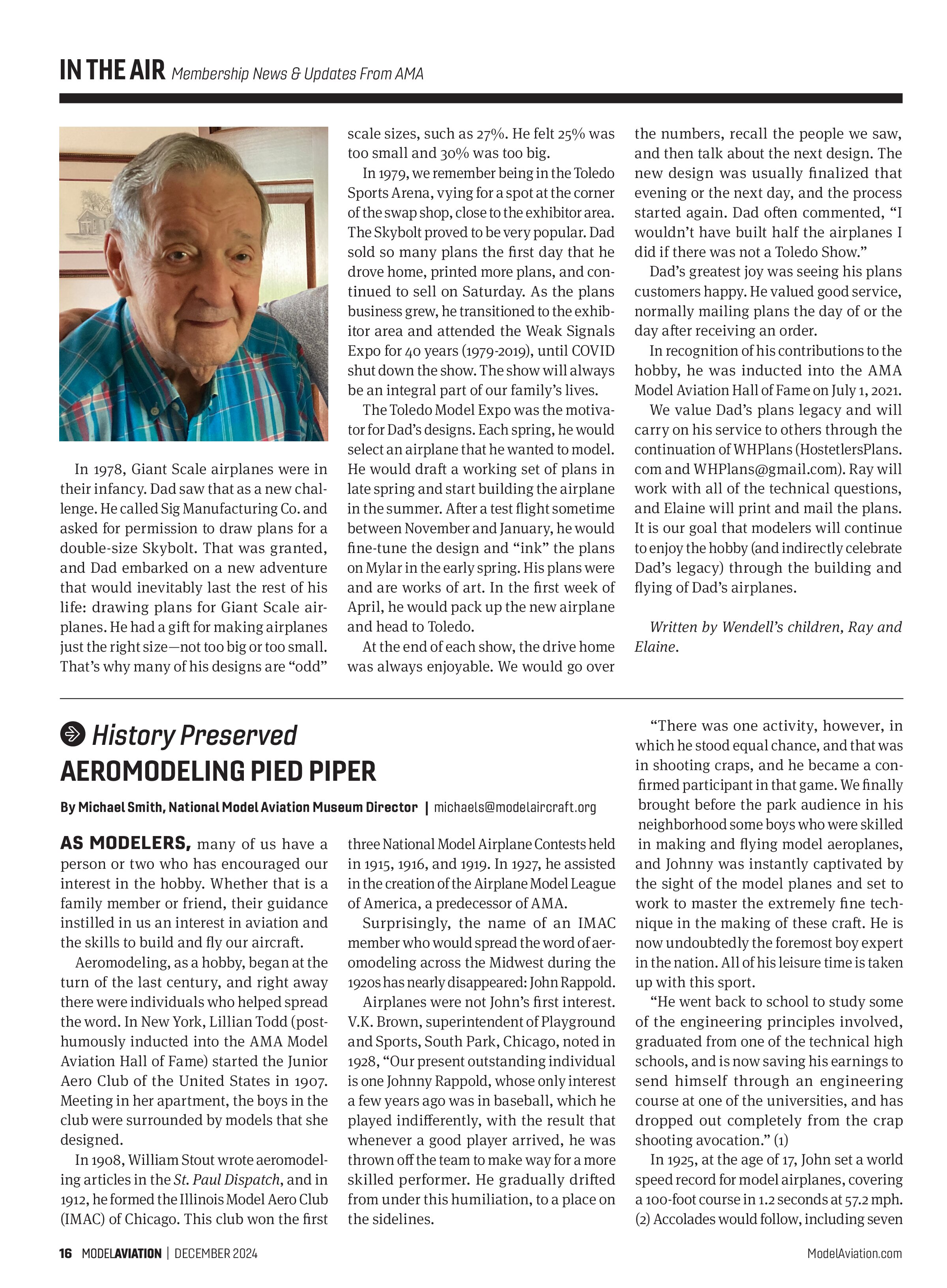
LOOKING THROUGH the latest issue of Model Aviation magazine, Dad often commented, “Look at the number of people who have taken their final flight,” knowing he would soon be on that list. He took his final flight on September 4, 2024.
Wendell was born, raised, and lived his life in Orrville, Ohio. He studied at Goshen College (Goshen, Indiana) and graduated from Kent State University (Kent, Ohio), using his degree to teach industrial arts classes at Rittman Public Schools and then at Central Christian High School (Kidron, Ohio), where he also served in administrative roles for 10 years. He earned a master’s degree in school administration at the University of Akron.
Wendell was an active member of Smithville Mennonite Church. He served as an elder and Sunday school teacher, and he made the church the cornerstone of his life.
He was a skilled draftsman and was an active part of the community, drawing plans for local businesses and residential houses, including his own. He founded Apex Strings as a designer and builder of violins, cellos, and violas. As a woodworker, he designed and built grandfather, grandmother, and schoolmaster clocks, cribs, cradles, and furniture.
Dad’s entire life was immersed in the hobby. He began his love of airplanes and flying at an early age. Before being married, he’d take Mom to the flying field, where she would pretend to show interest but be supportive. She showed that support for over 71 years of their married life. (Their anniversary was on February 14, 2024.)
Dad always liked a new challenge. After flying “conventional” model airplanes (Multi-Bug, Taurus, Miss Behaving, Sig Citabria), he bought a Kavan Jet Ranger in the fall of 1973 and took on the challenge of helicopters. When his son, Ray, came home from college, there was a beautiful helicopter sitting on the bench. This piqued Ray’s interest, and father and son flew helicopters from 1973 to 1978. (Ray went on to become a full-scale helicopter pilot and currently flies a Falcon 2000 corporate jet.)


In 1978, Giant Scale airplanes were in their infancy. Dad saw that as a new challenge. He called Sig Manufacturing Co. and asked for permission to draw plans for a double-size Skybolt. That was granted, and Dad embarked on a new adventure that would inevitably last the rest of his life: drawing plans for Giant Scale airplanes. He had a gift for making airplanes just the right size—not too big or too small. That’s why many of his designs are “odd” scale sizes, such as 27%. He felt 25% was too small and 30% was too big.
In 1979, we remember being in the Toledo Sports Arena, vying for a spot at the corner of the swap shop, close to the exhibitor area. The Skybolt proved to be very popular. Dad sold so many plans the first day that he drove home, printed more plans, and continued to sell on Saturday. As the plans business grew, he transitioned to the exhibitor area and attended the Weak Signals Expo for 40 years (1979-2019), until COVID shut down the show. The show will always be an integral part of our family’s lives.
The Toledo Model Expo was the motivator for Dad’s designs. Each spring, he would select an airplane that he wanted to model. He would draft a working set of plans in late spring and start building the airplane in the summer. After a test flight sometime between November and January, he would fine-tune the design and “ink” the plans on Mylar in the early spring. His plans were and are works of art. In the first week of April, he would pack up the new airplane and head to Toledo.
At the end of each show, the drive home was always enjoyable. We would go over the numbers, recall the people we saw, and then talk about the next design. The new design was usually finalized that evening or the next day, and the process started again. Dad often commented, “I wouldn’t have built half the airplanes I did if there was not a Toledo Show.”
Dad’s greatest joy was seeing his plans customers happy. He valued good service, normally mailing plans the day of or the day after receiving an order.
In recognition of his contributions to the hobby, he was inducted into the AMA Model Aviation Hall of Fame on July 1, 2021.
We value Dad’s plans legacy and will carry on his service to others through the continuation of WHPlans (HostetlersPlans.com and WHPlans@gmail.com). Ray will work with all of the technical questions, and Elaine will print and mail the plans. It is our goal that modelers will continue to enjoy the hobby (and indirectly celebrate Dad’s legacy) through the building and flying of Dad’s airplanes.
Written by Wendell’s children, Ray and Elaine.