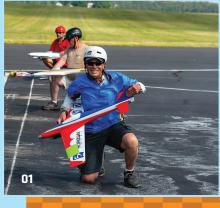
2024 NMPRA Q-40 Championship Race
Successes, camaraderie, and friendships
By Tim Lampe
tim.lampe@hotmail.com
Photos by Ronald Brodersen

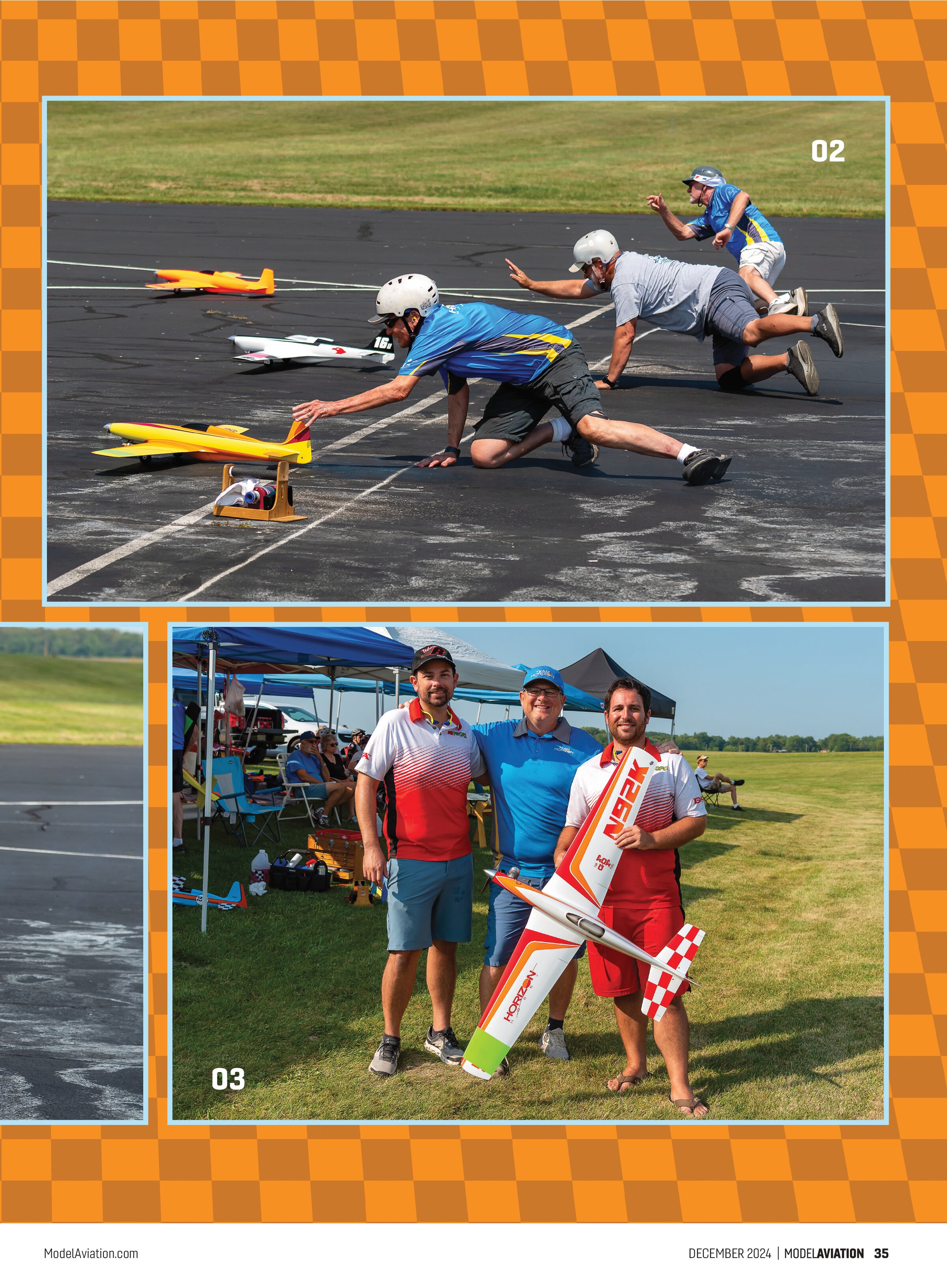
There were 52 entrants and 52 stories of personal success, failure, exuberance, or disappointment at the 2024 National Miniature Pylon Racing Association (NMPRA) Quarter 40 (Q-40) Championship Race at AMA’s International Aeromodeling Center (IAC) in Muncie, Indiana.
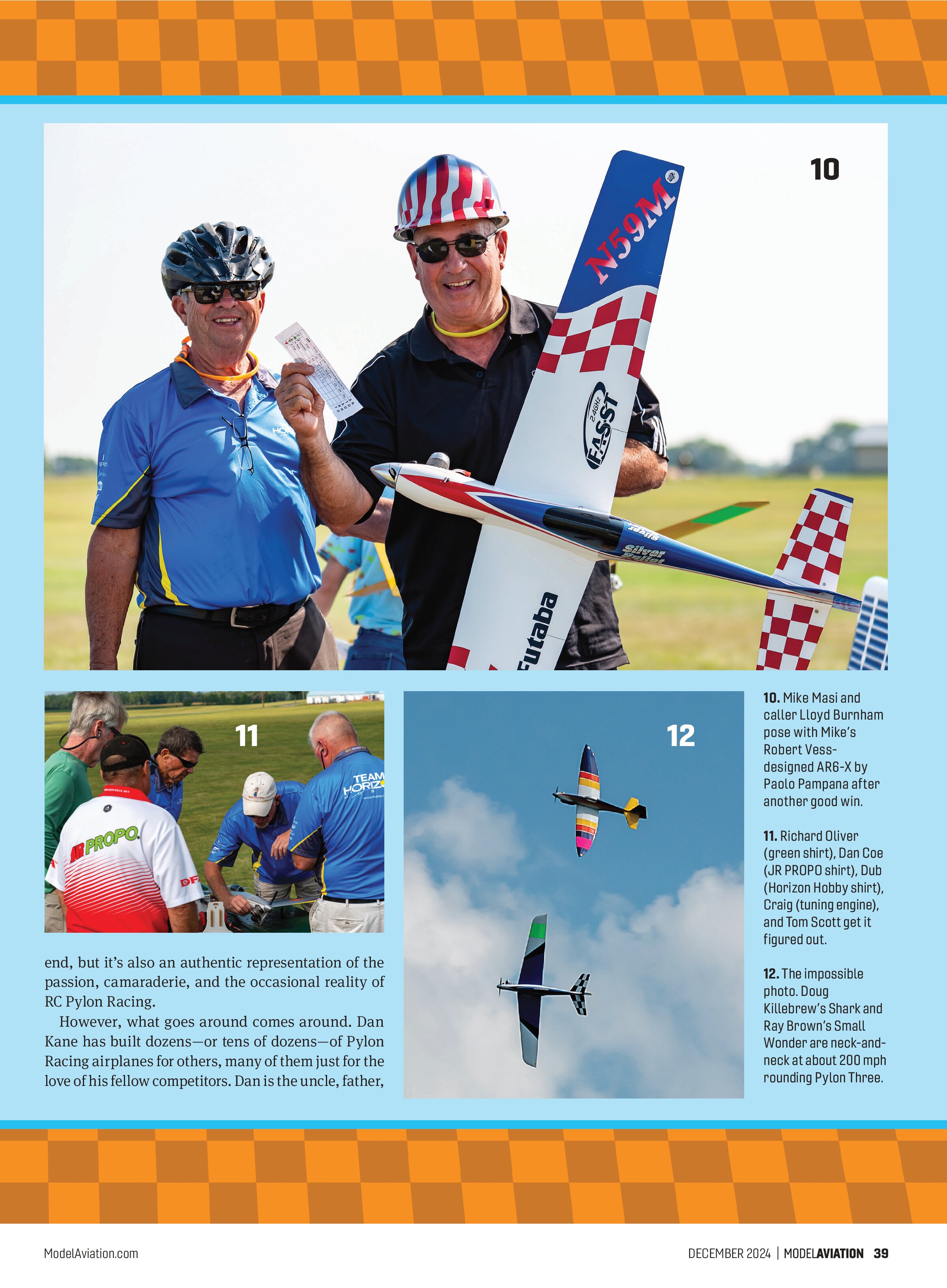
One of the successful stories was that of Mike Masi, from Stamford, Connecticut, and his caller, Lloyd Burnham, from South Windsor, Connecticut. Strong competitors, such as Mike, can always be a serious threat—not from luck but from skill, preparation, and hard work.
Mike was fast all weekend, and it was a thing of beauty to watch him click off the wins as the rounds tallied up. You could just stand back, watch him fly, and say, “Wow!” I asked Mike how he was getting it done. He credited his friend,


Joe Tropea, another competitor, for helping him with his engine setup, and Lloyd for good calling and teamwork. The same went for many other Pylon Racers. Mike also mentioned the Pylon Racing community at large for its continued help and support throughout the years.


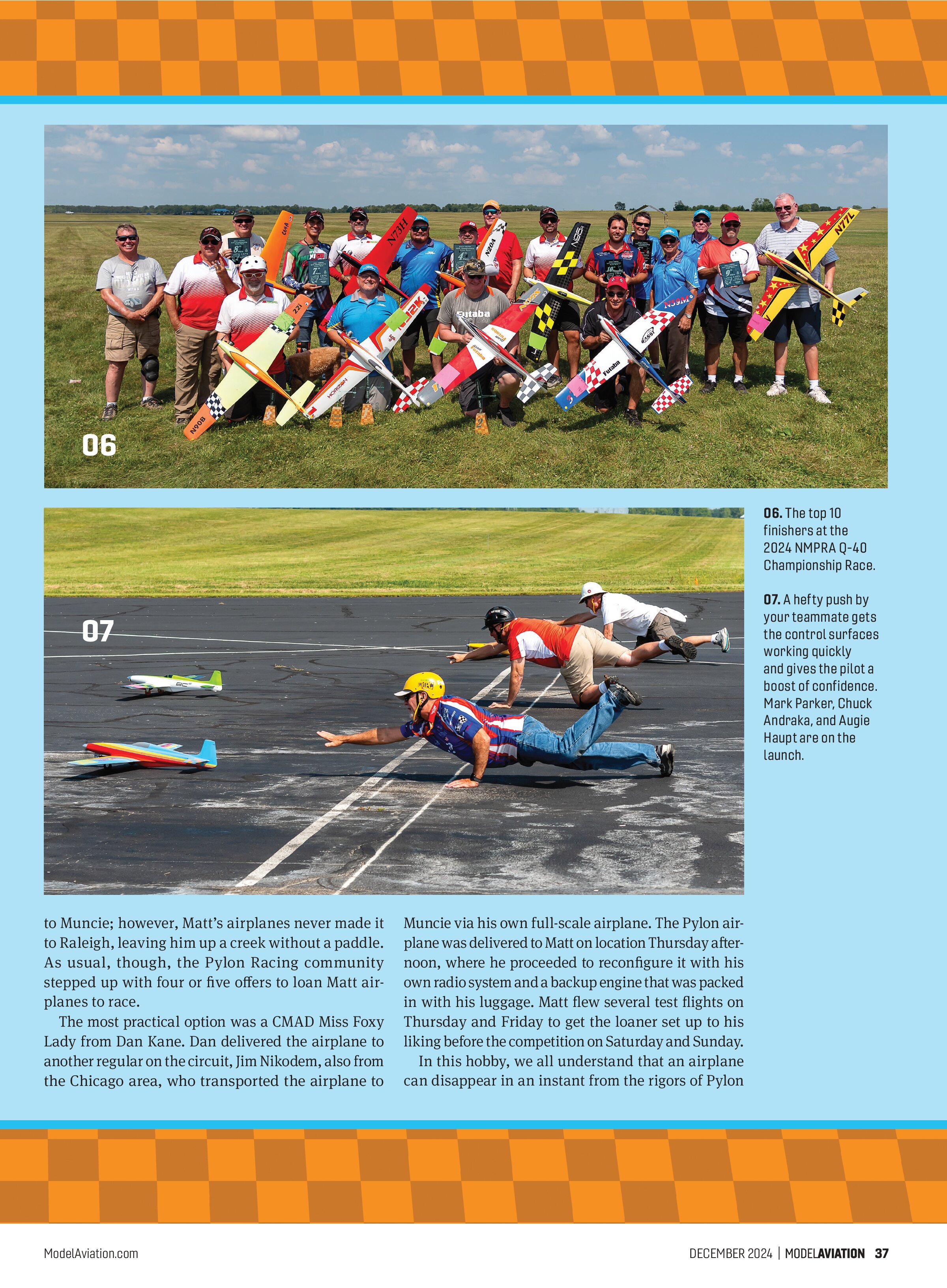
At the end of eight rounds of regulation flights, Mike was in a four-way tie for third place with Dub Jett, Mario Aboumrad, and Richard Beers. Dub decided not to risk his airplane for one last race and bowed out of the flyoff, so Richard, Mario, and Mike battled for third, fourth, and fifth overall. Richard took the win, with Mario and Mike trailing in fourth and fifth places, respectively.
Mike didn’t come away with the overall win or the win in the flyoff, but a strong fifth place and the eighth-fastest low time overall is a feat to be proud of, especially when you factor in the stiff competition, everything else that goes into a demanding couple of days of preparation, and two more days of a Q-40 Championship Race.
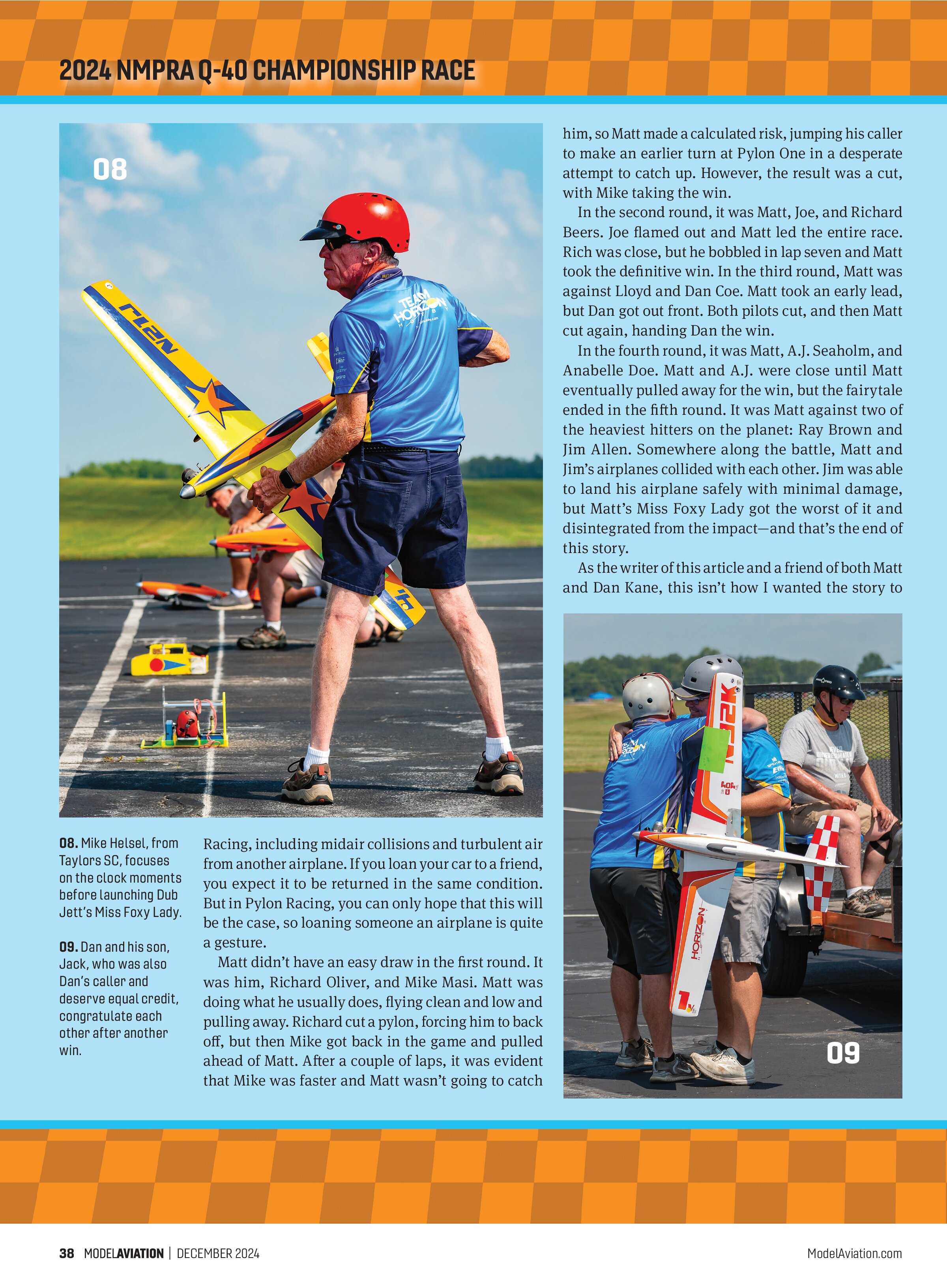
Matt Fehling, who must be considered an elite pilot, had shipped his two Robert Vess-designed Paolo Racing AR6-Xs from his home in Fort Lauderdale, Florida, to Raleigh, North Carolina, where he works four days per week as a lead engineer for Delta Airlines. The plan was to retrieve the airplanes in Raleigh and check them as luggage for the flight to Indianapolis before making the final drive to Muncie; however, Matt’s airplanes never made it to Raleigh, leaving him up a creek without a paddle. As usual, though, the Pylon Racing community stepped up with four or five offers to loan Matt airplanes to race.
The most practical option was a CMAD Miss Foxy Lady from Dan Kane. Dan delivered the airplane to another regular on the circuit, Jim Nikodem, also from the Chicago area, who transported the airplane to Muncie via his own full-scale airplane. The Pylon airplane was delivered to Matt on location Thursday afternoon, where he proceeded to reconfigure it with his own radio system and a backup engine that was packed in with his luggage. Matt flew several test flights on Thursday and Friday to get the loaner set up to his liking before the competition on Saturday and Sunday.
In this hobby, we all understand that an airplane can disappear in an instant from the rigors of Pylon


Racing, including midair collisions and turbulent air from another airplane. If you loan your car to a friend, you expect it to be returned in the same condition. But in Pylon Racing, you can only hope that this will be the case, so loaning someone an airplane is quite a gesture.
Matt didn’t have an easy draw in the first round. It was him, Richard Oliver, and Mike Masi. Matt was doing what he usually does, flying clean and low and pulling away. Richard cut a pylon, forcing him to back off, but then Mike got back in the game and pulled ahead of Matt. After a couple of laps, it was evident that Mike was faster and Matt wasn’t going to catch
him, so Matt made a calculated risk, jumping his caller to make an earlier turn at Pylon One in a desperate attempt to catch up. However, the result was a cut, with Mike taking the win.
In the second round, it was Matt, Joe, and Richard Beers. Joe flamed out and Matt led the entire race. Rich was close, but he bobbled in lap seven and Matt took the definitive win. In the third round, Matt was against Lloyd and Dan Coe. Matt took an early lead, but Dan got out front. Both pilots cut, and then Matt cut again, handing Dan the win.
In the fourth round, it was Matt, A.J. Seaholm, and Anabelle Doe. Matt and A.J. were close until Matt eventually pulled away for the win, but the fairytale ended in the fifth round. It was Matt against two of the heaviest hitters on the planet: Ray Brown and Jim Allen. Somewhere along the battle, Matt and Jim’s airplanes collided with each other. Jim was able to land his airplane safely with minimal damage, but Matt’s Miss Foxy Lady got the worst of it and disintegrated from the impact—and that’s the end of this story.
As the writer of this article and a friend of both Matt and Dan Kane, this isn’t how I wanted the story to

end, but it’s also an authentic representation of the passion, camaraderie, and the occasional reality of RC Pylon Racing.
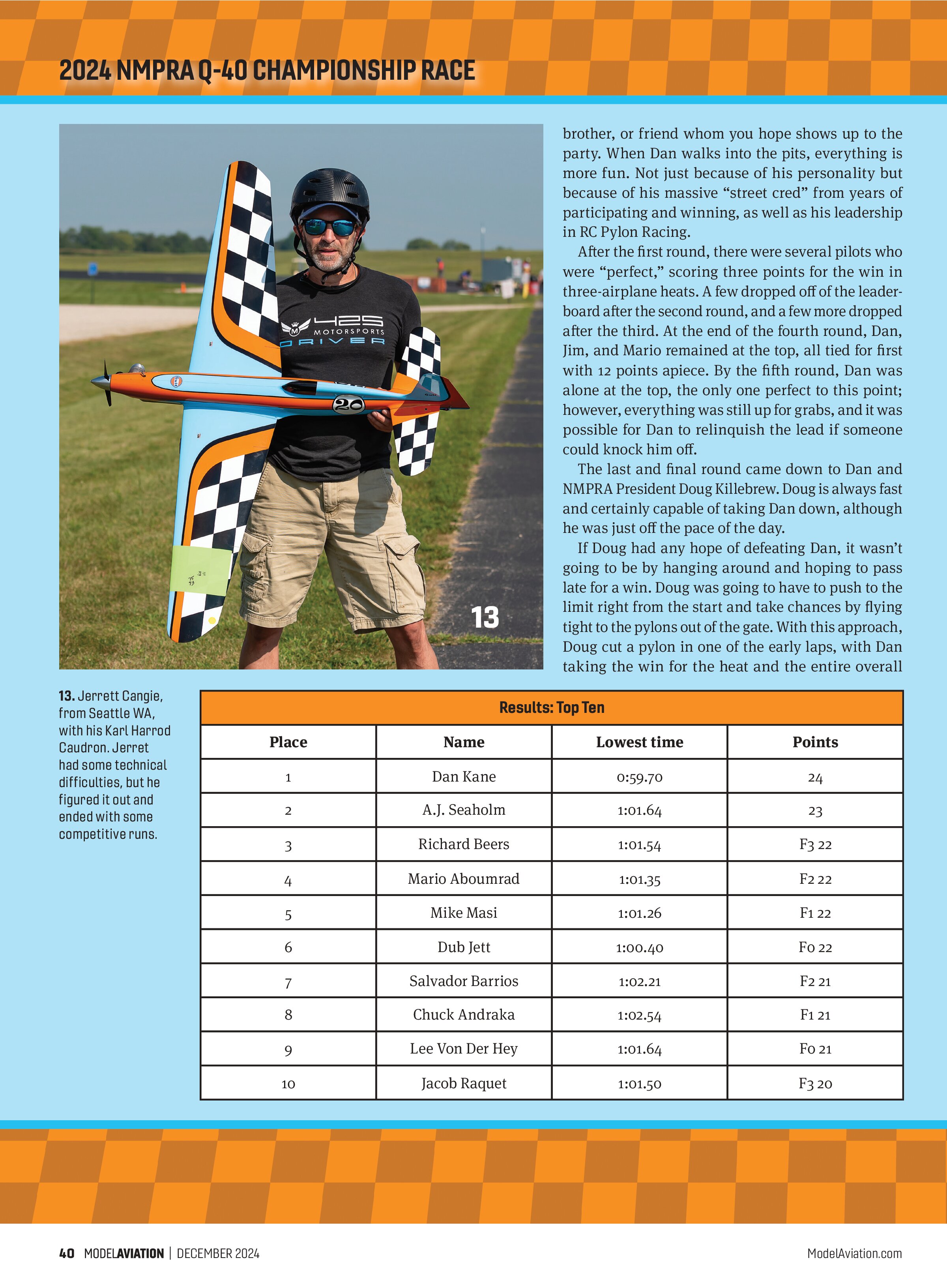
However, what goes around comes around. Dan Kane has built dozens—or tens of dozens—of Pylon Racing airplanes for others, many of them just for the love of his fellow competitors. Dan is the uncle, father,


After the first round, there were several pilots who were “perfect,” scoring three points for the win in three-airplane heats. A few dropped off of the leaderboard after the second round, and a few more dropped after the third. At the end of the fourth round, Dan, Jim, and Mario remained at the top, all tied for first with 12 points apiece. By the fifth round, Dan was alone at the top, the only one perfect to this point; however, everything was still up for grabs, and it was possible for Dan to relinquish the lead if someone could knock him off.
The last and final round came down to Dan and NMPRA President Doug Killebrew. Doug is always fast and certainly capable of taking Dan down, although he was just off the pace of the day.
If Doug had any hope of defeating Dan, it wasn’t going to be by hanging around and hoping to pass late for a win. Doug was going to have to push to the limit right from the start and take chances by flying tight to the pylons out of the gate. With this approach, Doug cut a pylon in one of the early laps, with Dan taking the win for the heat and the entire overall contest. It was a double win for Dan, he also earned the coveted Fast Time award with the fastest single-heat time of 59.70 seconds—the only person to fly below 1 minute the entire event!
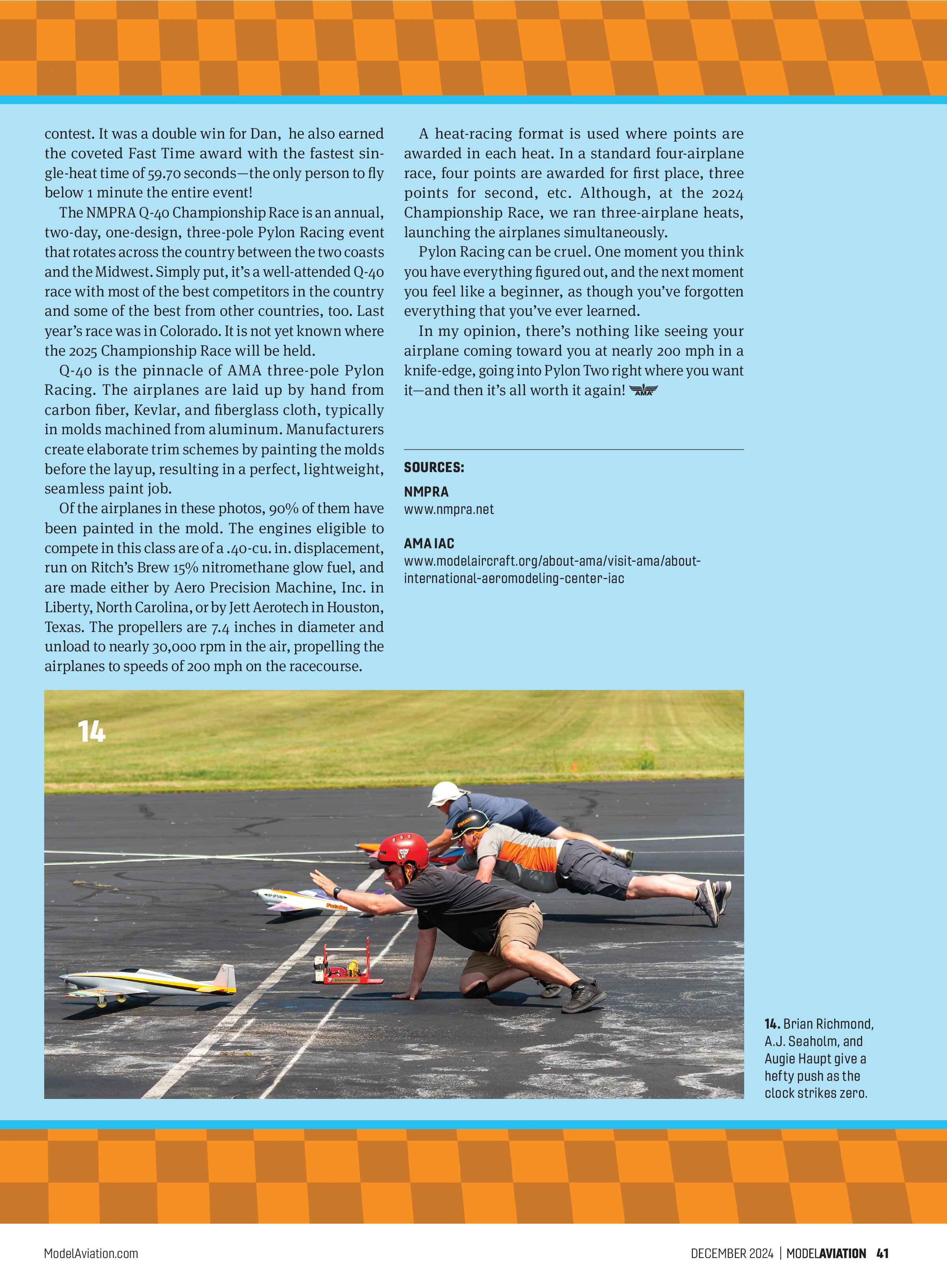
The NMPRA Q-40 Championship Race is an annual, two-day, one-design, three-pole Pylon Racing event that rotates across the country between the two coasts and the Midwest. Simply put, it’s a well-attended Q-40 race with most of the best competitors in the country and some of the best from other countries, too. Last year’s race was in Colorado. It is not yet known where the 2025 Championship Race will be held.
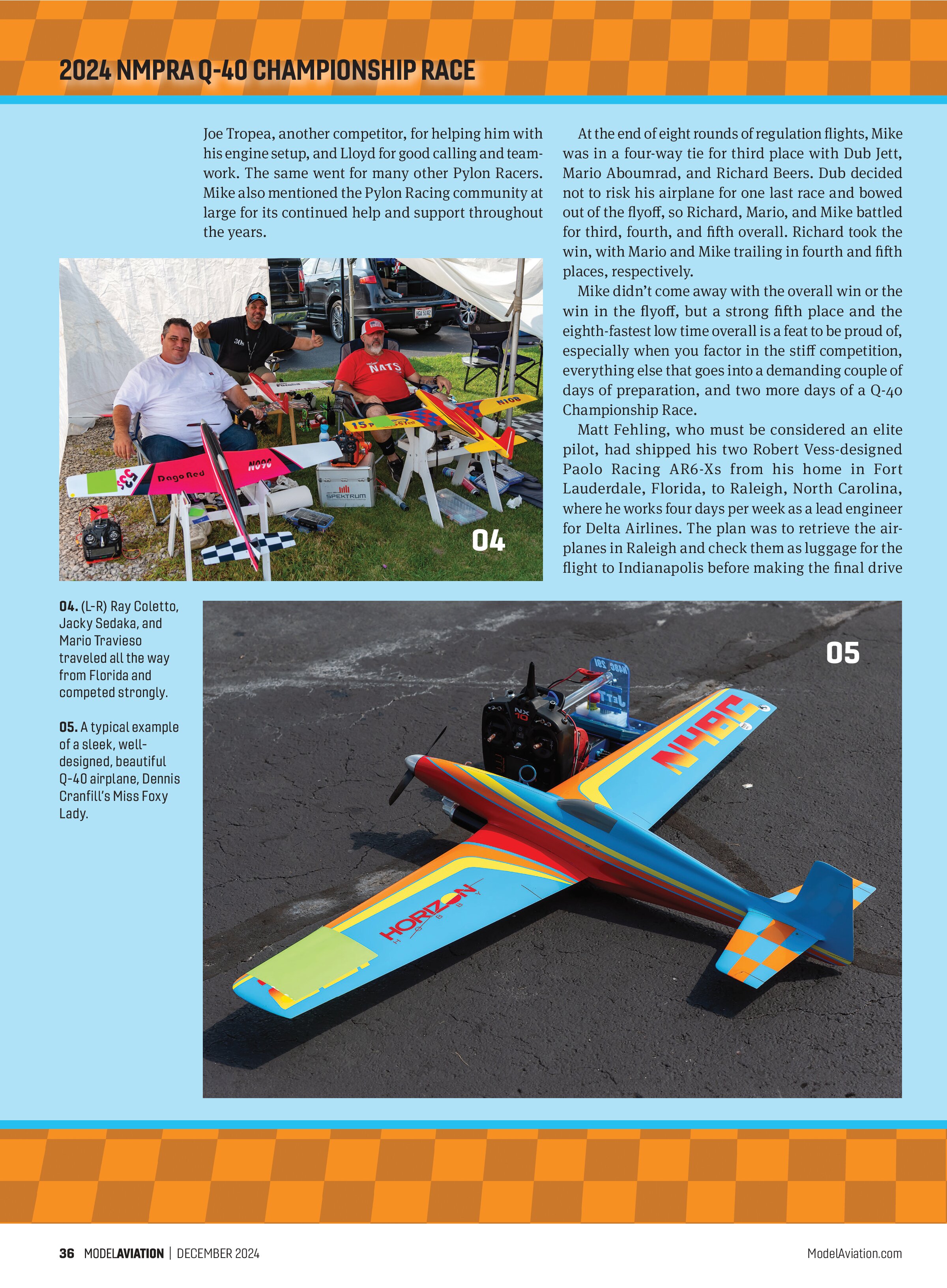
Q-40 is the pinnacle of AMA three-pole Pylon Racing. The airplanes are laid up by hand from carbon fiber, Kevlar, and fiberglass cloth, typically in molds machined from aluminum. Manufacturers create elaborate trim schemes by painting the molds before the layup, resulting in a perfect, lightweight, seamless paint job.
Of the airplanes in these photos, 90% of them have been painted in the mold. The engines eligible to compete in this class are of a .40-cu. in. displacement, run on Ritch’s Brew 15% nitromethane glow fuel, and are made either by Aero Precision Machine, Inc. in Liberty, North Carolina, or by Jett Aerotech in Houston, Texas. The propellers are 7.4 inches in diameter and unload to nearly 30,000 rpm in the air, propelling the airplanes to speeds of 200 mph on the racecourse.
Results: Top Ten
PlaceNameLowest timePoints1Dan Kane0:59.70242A.J. Seaholm1:01.64233Richard Beers1:01.54F₃ 224Mario Aboumrad1:01.35F₂ 225Mike Masi1:01.26F₁ 226Dub Jett1:00.40F₀ 227Salvador Barrios1:02.21F₂ 218Chuck Andraka1:02.54F₁ 219Lee Von Der Hey1:01.64F₀ 2110Jacob Raquet1:01.50F₃ 20A heat-racing format is used where points are awarded in each heat. In a standard four-airplane race, four points are awarded for first place, three points for second, etc. Although, at the 2024 Championship Race, we ran three-airplane heats, launching the airplanes simultaneously.
Pylon Racing can be cruel. One moment you think you have everything figured out, and the next moment you feel like a beginner, as though you’ve forgotten everything that you’ve ever learned.
In my opinion, there’s nothing like seeing your airplane coming toward you at nearly 200 mph in a knife-edge, going into Pylon Two right where you want it—and then it’s all worth it again!
SOURCES:
NMPRA
www.nmpra.net
AMA IAC
www.modelaircraft.org/about-ama/visit-ama/about-international-aeromodeli...