RC PYLON RACING
TOM SCOTT
AND CMAD
RACING
By Tim Lampe | tim.lampe@hotmail.com
IN ADDITION to being a tough draw on the racecourse, Tom Scott is the owner/operator of CMAD (Chinese Made American Designed) Racing composite RC Pylon Racing airplanes out of Cincinnati, Ohio. To learn the history of CMAD Racing, I spent some time on a video chat with Tom and Dan Kane, who has worked with Tom for years designing and developing some of the best Pylon Racing airplanes in the world.
I wasn’t able to go all the way back to the main source, Will Naemura, but as best as I can reckon, Will was the owner of Adrenaline Products, LLC, the US distributor of Iwata paint guns. Will was also a competitor on a world championship level in Control Line Speed and had interests in composite sailplanes and Pylon Racing.
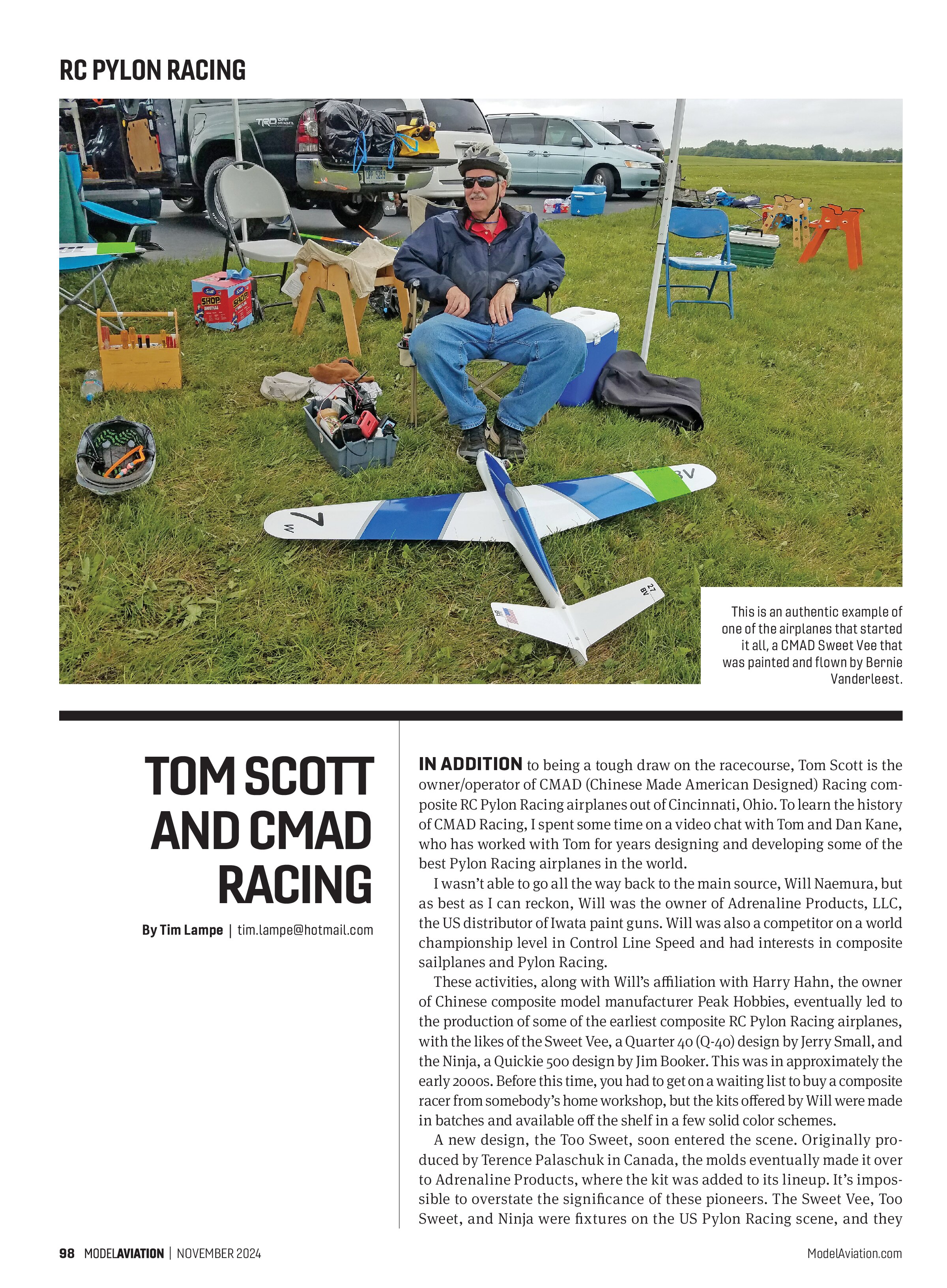
These activities, along with Will’s affiliation with Harry Hahn, the owner of Chinese composite model manufacturer Peak Hobbies, eventually led to the production of some of the earliest composite RC Pylon Racing airplanes, with the likes of the Sweet Vee, a Quarter 40 (Q-40) design by Jerry Small, and the Ninja, a Quickie 500 design by Jim Booker. This was in approximately the early 2000s. Before this time, you had to get on a waiting list to buy a composite racer from somebody’s home workshop, but the kits offered by Will were made in batches and available off the shelf in a few solid color schemes.
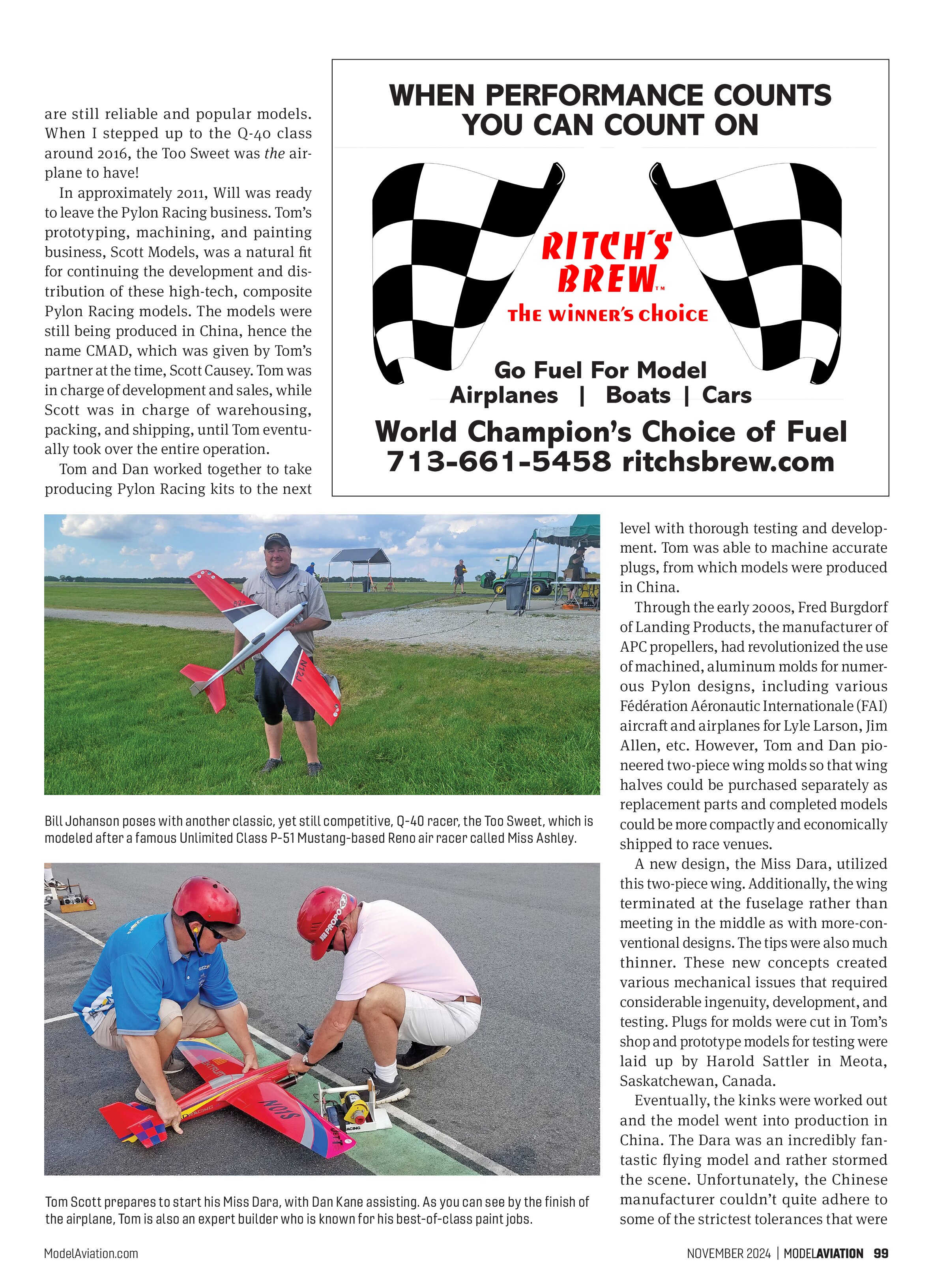
A new design, the Too Sweet, soon entered the scene. Originally produced by Terence Palaschuk in Canada, the molds eventually made it over to Adrenaline Products, where the kit was added to its lineup. It’s impossible to overstate the significance of these pioneers. The Sweet Vee, Too Sweet, and Ninja were fixtures on the US Pylon Racing scene, and they are still reliable and popular models. When I stepped up to the Q-40 class around 2016, the Too Sweet was the airplane to have!
In approximately 2011, Will was ready to leave the Pylon Racing business. Tom’s prototyping, machining, and painting business, Scott Models, was a natural fit for continuing the development and distribution of these high-tech, composite Pylon Racing models. The models were still being produced in China, hence the name CMAD, which was given by Tom’s partner at the time, Scott Causey. Tom was in charge of development and sales, while Scott was in charge of warehousing, packing, and shipping, until Tom eventually took over the entire operation.
Tom and Dan worked together to take producing Pylon Racing kits to the next level with thorough testing and development. Tom was able to machine accurate plugs, from which models were produced in China.

Through the early 2000s, Fred Burgdorf of Landing Products, the manufacturer of APC propellers, had revolutionized the use of machined, aluminum molds for numerous Pylon designs, including various Fédération Aéronautique Internationale (FAI) aircraft and airplanes for Lyle Larson, Jim Allen, etc. However, Tom and Dan pioneered two-piece wing molds so that wing halves could be purchased separately as replacement parts and completed models could be more compactly and economically shipped to race venues.

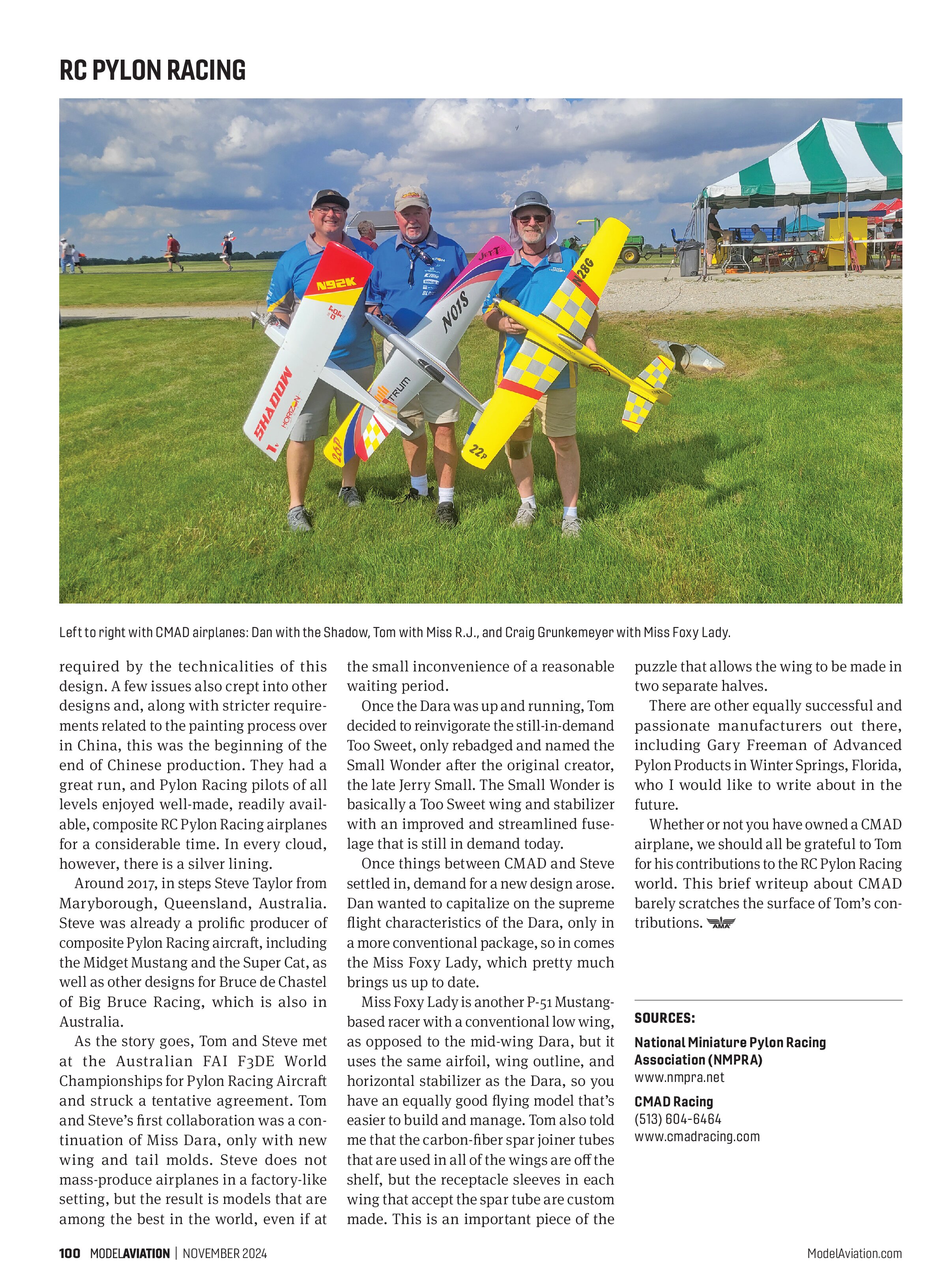
A new design, the Miss Dara, utilized this two-piece wing. Additionally, the wing terminated at the fuselage rather than meeting in the middle as with more-conventional designs. The tips were also much thinner. These new concepts created various mechanical issues that required considerable ingenuity, development, and testing. Plugs for molds were cut in Tom’s shop and prototype models for testing were laid up by Harold Sattler in Meota, Saskatchewan, Canada.

Eventually, the kinks were worked out and the model went into production in China. The Dara was an incredibly fantastic flying model and rather stormed the scene. Unfortunately, the Chinese manufacturer couldn’t quite adhere to some of the strictest tolerances that were
required by the technicalities of this design. A few issues also crept into other designs and, along with stricter requirements related to the painting process over in China, this was the beginning of the end of Chinese production. They had a great run, and Pylon Racing pilots of all levels enjoyed well-made, readily available, composite RC Pylon Racing airplanes for a considerable time. In every cloud, however, there is a silver lining.
Around 2017, in steps Steve Taylor from Maryborough, Queensland, Australia. Steve was already a prolific producer of composite Pylon Racing aircraft, including the Midget Mustang and the Super Cat, as well as other designs for Bruce de Chastel of Big Bruce Racing, which is also in Australia.
As the story goes, Tom and Steve met at the Australian FAI F3DE World Championships for Pylon Racing Aircraft and struck a tentative agreement. Tom and Steve’s first collaboration was a continuation of Miss Dara, only with new wing and tail molds. Steve does not mass-produce airplanes in a factory-like setting, but the result is models that are among the best in the world, even if at
the small inconvenience of a reasonable waiting period.
Once the Dara was up and running, Tom decided to reinvigorate the still-in-demand Too Sweet, only rebadged and named the Small Wonder after the original creator, the late Jerry Small. The Small Wonder is basically a Too Sweet wing and stabilizer with an improved and streamlined fuselage that is still in demand today.
Once things between CMAD and Steve settled in, demand for a new design arose. Dan wanted to capitalize on the supreme flight characteristics of the Dara, only in a more conventional package, so in comes the Miss Foxy Lady, which pretty much brings us up to date.
Miss Foxy Lady is another P-51 Mustang-based racer with a conventional low wing, as opposed to the mid-wing Dara, but it uses the same airfoil, wing outline, and horizontal stabilizer as the Dara, so you have an equally good flying model that’s easier to build and manage. Tom also told me that the carbon-fiber spar joiner tubes that are used in all of the wings are off the shelf, but the receptacle sleeves in each wing that accept the spar tube are custom made. This is an important piece of the puzzle that allows the wing to be made in two separate halves.
There are other equally successful and passionate manufacturers out there, including Gary Freeman of Advanced Pylon Products in Winter Springs, Florida, who I would like to write about in the future.
Whether or not you have owned a CMAD airplane, we should all be grateful to Tom for his contributions to the RC Pylon Racing world. This brief writeup about CMAD barely scratches the surface of Tom’s contributions.

National Miniature Pylon Racing Association (NMPRA)
www.nmpra.net
CMAD Racing
(513) 604-6464
www.cmadracing.com