RC AEROBATICS

2024 RC AEROBATICS NATS
By Justin Wells | justinwells@mac.com
THIS YEAR, I had the pleasure of attending the 2024 RC Aerobatics (Pattern) Nats as a nonflying participant, and I really enjoyed myself. This gave me time to be able to watch all of the classes of flying, look at equipment, airframes, and even catch up with some longtime friends.
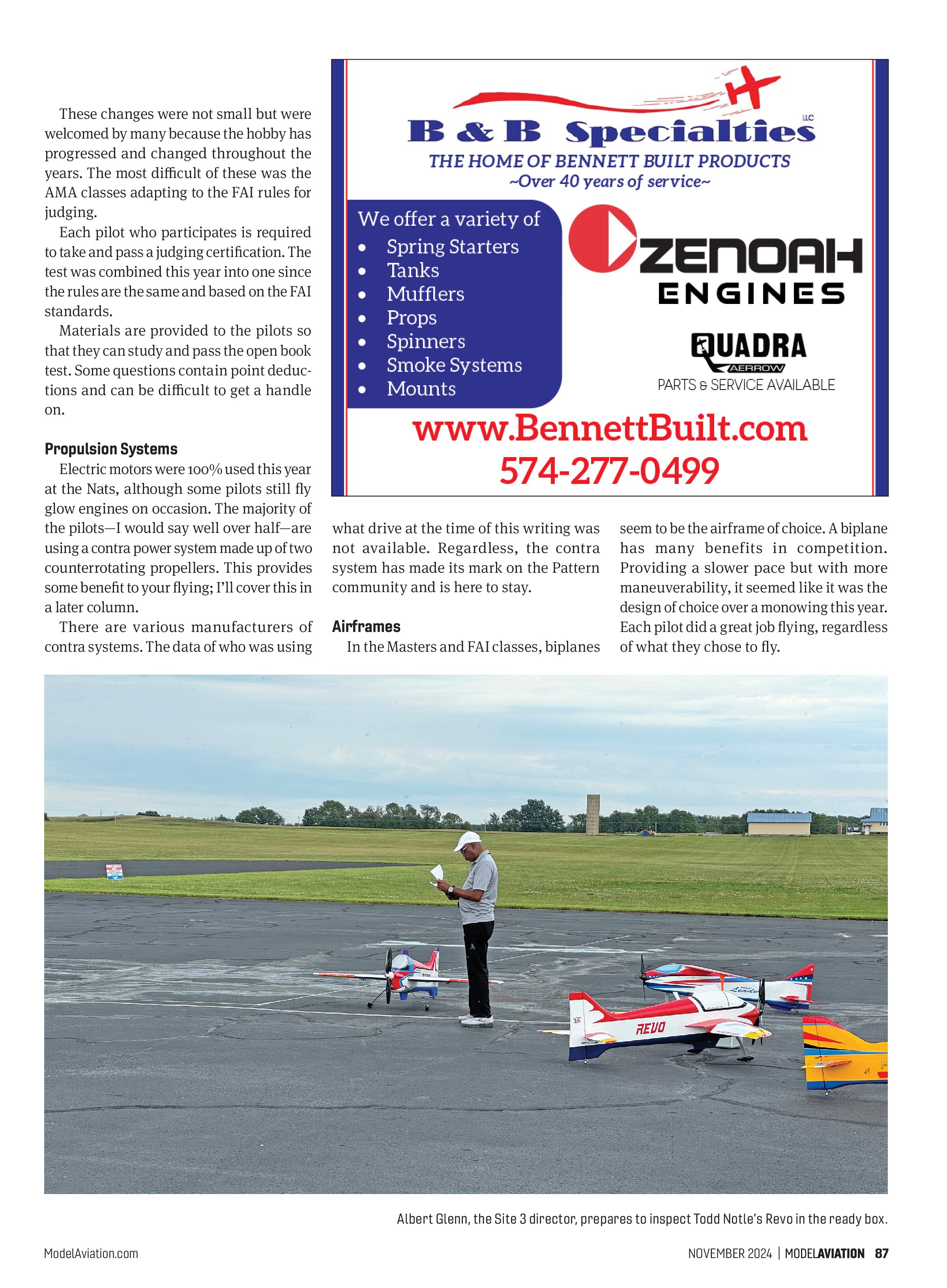
The Nats was held at AMA’s International Aeromodeling Center (IAC) in Muncie, Indiana. The event was well planned and run by a team made up of Jerry Budd, Bob Kane, Rusty Dose, Jesse Symmes, Don Ramsey, Mark Hunt, John Carter, and Peter VanHuesden. The site directors were Tim Jesky, Albert Glenn, and Joe Winterrowed.
As with most Nats, it takes a large team to make it happen. The weather didn’t cooperate as much as everyone liked, but all rounds were flown into the finals, and Team USA was selected for the 2025 Fédération Aéronautique Internationale (FAI) F3A World Championships for Aerobatic Model Aircraft, which will take place at the IAC in Muncie.
The following are a few welcome changes that were historical for this year’s Nats:
- The AMA Masters class flew the FAI P sequence.
- The AMA Advanced class flew the FAI A sequence.
- The overall weight limit of aircraft was raised to 5,500 grams (in alignment with the FAI).
- Glow aircraft were weighed with a full tank of fuel.
- The National Society of Radio Controlled Aerobatics (NSRCA) opted to adapt the FAI rules for the AMA classes.
These changes were not small but were welcomed by many because the hobby has progressed and changed throughout the years. The most difficult of these was the AMA classes adapting to the FAI rules for judging.
Each pilot who participates is required to take and pass a judging certification. The test was combined this year into one since the rules are the same and based on the FAI standards.
Materials are provided to the pilots so that they can study and pass the open book test. Some questions contain point deductions and can be difficult to get a handle on.
Propulsion Systems
Electric motors were 100% used this year at the Nats, although some pilots still fly glow engines on occasion. The majority of the pilots—I would say well over half—are using a contra power system made up of two counterrotating propellers. This provides some benefit to your flying; I’ll cover this in a later column.
There are various manufacturers of contra systems. The data of who was using what drive at the time of this writing was not available. Regardless, the contra system has made its mark on the Pattern community and is here to stay.
Airframes
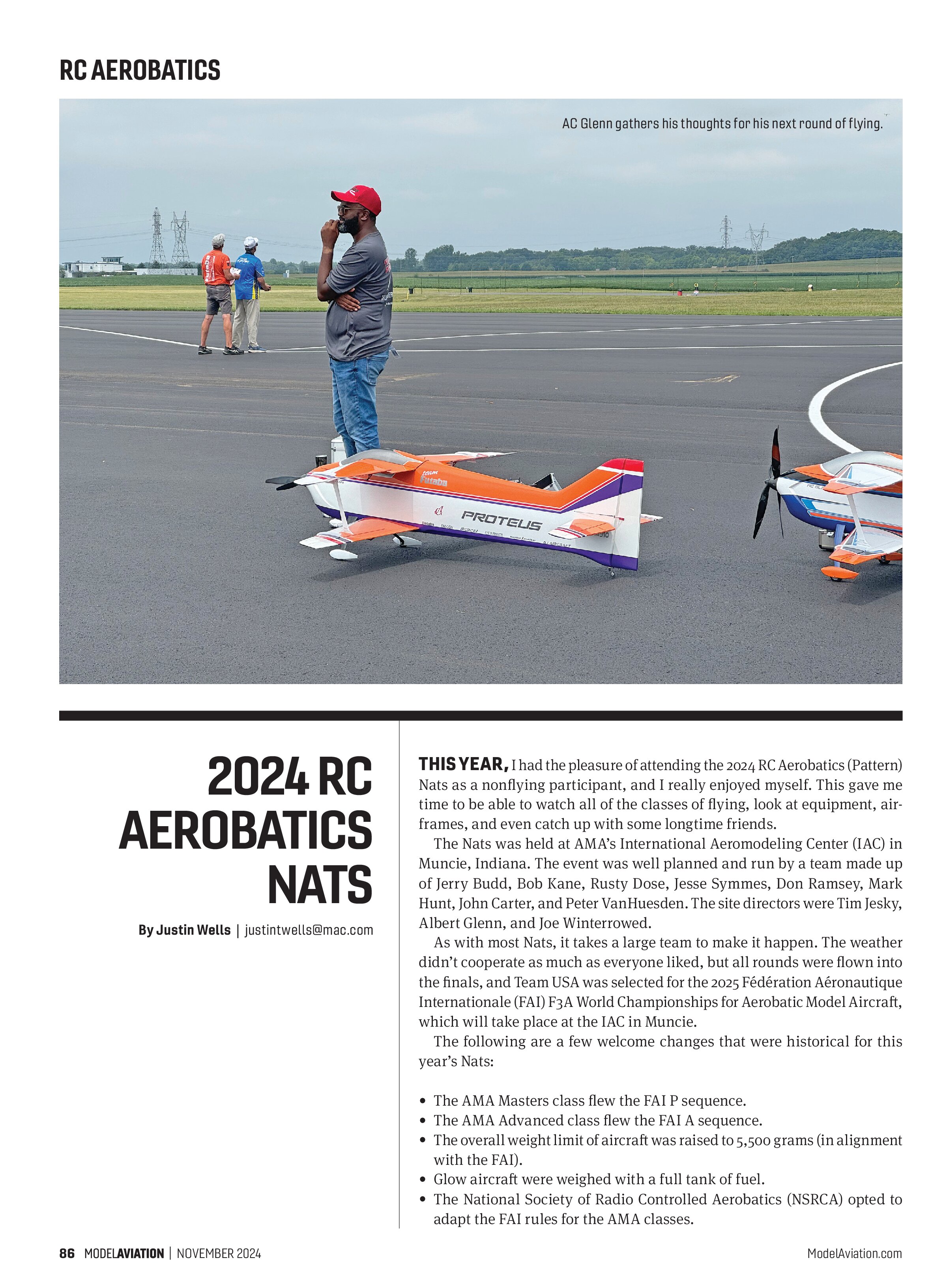
In the Masters and FAI classes, biplanes seem to be the airframe of choice. A biplane has many benefits in competition. Providing a slower pace but with more maneuverability, it seemed like it was the design of choice over a monowing this year. Each pilot did a great job flying, regardless of what they chose to fly.


National Champions for 2024
- Daniel Hiller, Sportsman
- Stephen Faster, Intermediate
- Joe Lachowski, Advanced
- Dave Lockhart, Masters
- Andrew Jesky, FAI F3A
FAI F3A Team USA 2025
- Andrew Jesky
- Jason Shulman
- Peter Collinson
- Alternate: Brett Wickizer
You can view the final scores per pilot on the NSRCA website, listed in “Sources.”
Until next time!
SOURCES:
NSRCA
www.nsrca.us
AMA RC Aerobatics Nats Results
www.nsrca.us/documents/nationals/2024/Day2/contestResults.xml