Mid-America Electric Flies


By Don Belfort
dbelfort@cinci.rr.com
Photos by the author
As written by Mark Twain, “Reports of my death have been greatly exaggerated.” This surely applies to the 40th anniversary of the Mid-America Electric Flies, commonly known as Mid-Am. I have had the pleasure of attending the event continuously since 1993.
I received a phone call from Model Aviation Executive Editor Jay Smith the day before leaving for this year’s Mid-Am, asking me whether I had heard that this would be the last year of the event, and would I be interested in covering it? I told Jay that I had no idea that the event was ending, and it would be an honor to cover the final gathering.
During my airplane loading and the four-hour drive to Mid-Am, which is slightly past Ann Arbor in Northville Township, Michigan, I thought of all of the great people and models that I had seen at past events and how, throughout the years, it had a family-reunion feel, which would really be missed.
Upon arriving Friday afternoon, I immediately approached co-Contest Directors Keith Shaw and Ken Meyers with my event coverage intentions. They welcomed the coverage, but said that they have no plans of retiring the event as long as they are still standing! That was great news!
Ken reported a different problem on Friday that affected all of us. With great flying conditions that day, President Biden had scheduled a rally in Detroit, which necessitated a temporary flight restriction of RC models.
The Mid-Am Turns 40!


The fliers gathered under tents and reviewed a box of 1960s and ’70s radio equipment that had been donated to Keith. He explained the digital proportional development timeline, which had a very rich history in the area, and then it was time to head to dinner.
We returned to the field Saturday morning, greeted with perfect flying conditions, and began unloading our models. A quick safety note: As hard as we try to carefully load and pack our models, transporting them is a common cause of damage. I found that the pull-pull control post had come loose from the rudder of my Jim Ryan Bearcat when I removed it from my car.
The repair was simple, but missing it could have been catastrophic. Always preflight your aircraft!
The models at Mid-Am were diverse, ranging from 30-year-old models to 3D-printed micro models. Ken puts on the Not Conventional Materials (NCM) event, which has an all-up, last-down format with easy-to-follow rules to bring in more competitors. Charging power was available at the registration tent, which was great for the pilots and prevented any dead car batteries.
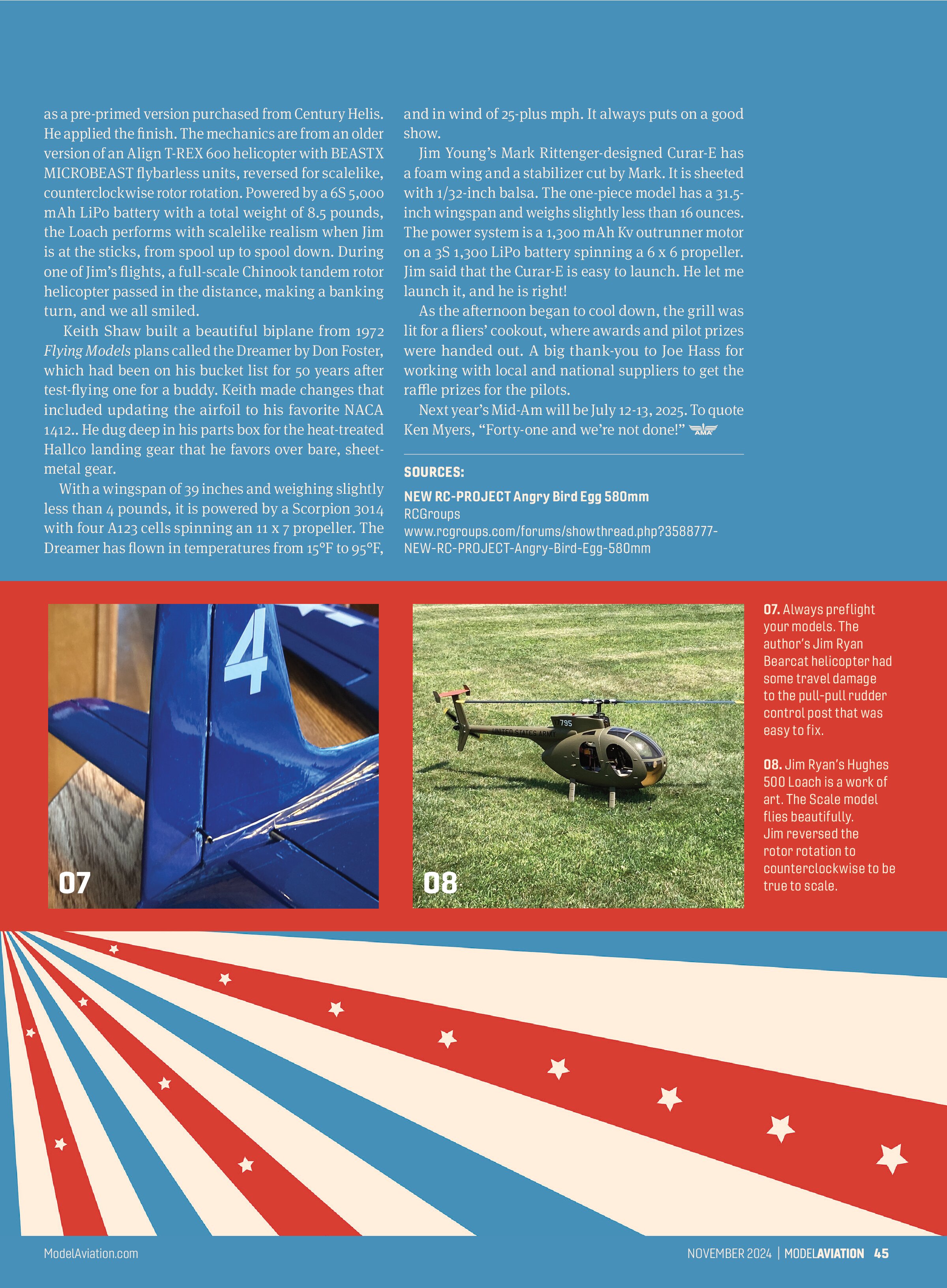
Wyck Livingston made the trip from Texas to expertly fly his Legend Hobbies L-4. It is nicely detailed with its flat, olive-drab covering and it’s powered by an E-flite Power 90 motor on an 8S 5,000 mAh LiPo battery.
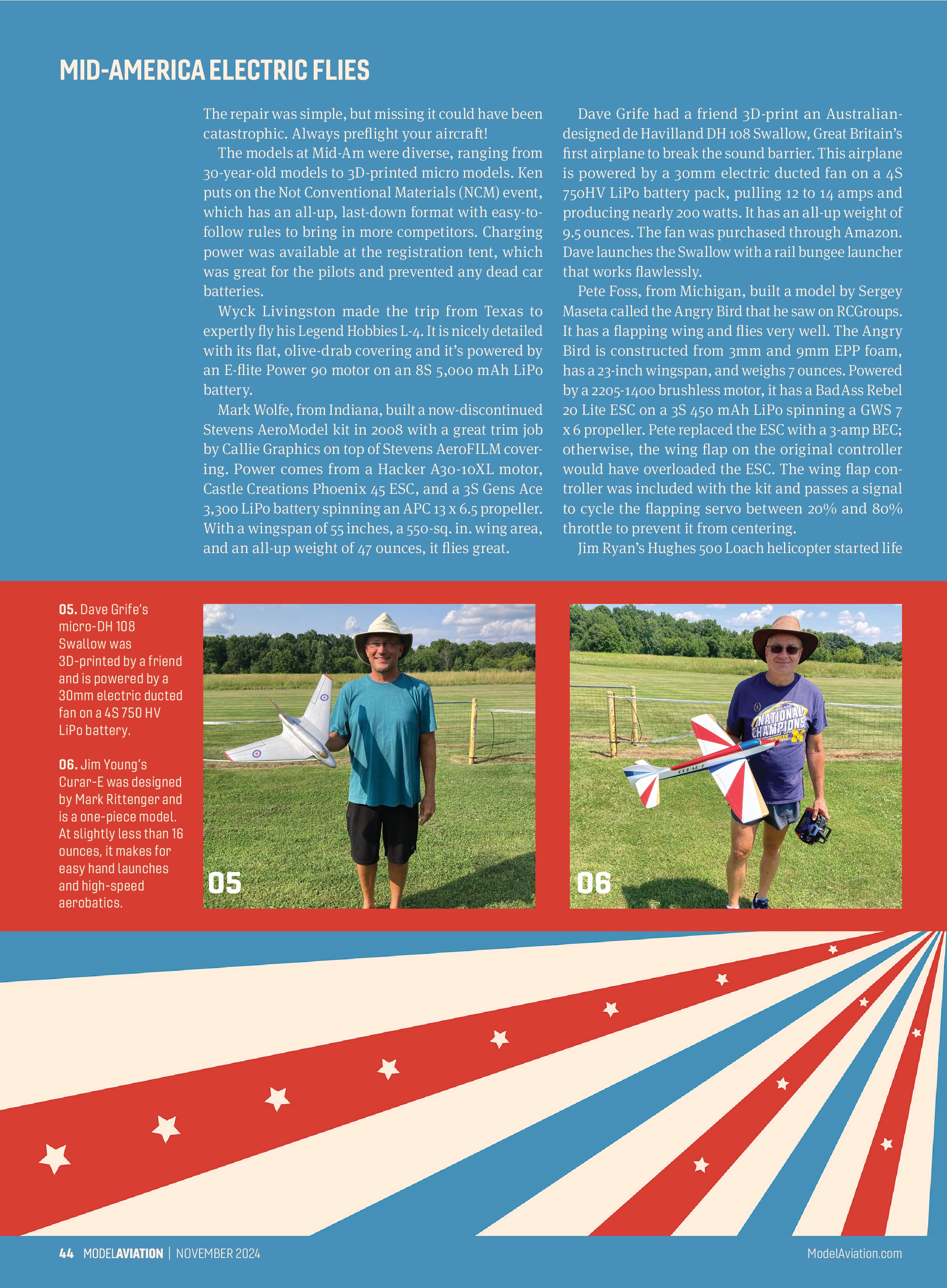
Mark Wolfe, from Indiana, built a now-discontinued Stevens AeroModel kit in 2008 with a great trim job by Callie Graphics on top of Stevens AeroFILM covering. Power comes from a Hacker A30-10XL motor, Castle Creations Phoenix 45 ESC, and a 3S Gens Ace 3,300 LiPo battery spinning an APC 13 x 6.5 propeller. With a wingspan of 55 inches, a 550-sq. in. wing area, and an all-up weight of 47 ounces, it flies great.


Dave Grife had a friend 3D-print an Australian-designed de Havilland DH 108 Swallow, Great Britain’s first airplane to break the sound barrier. This airplane is powered by a 30mm electric ducted fan on a 4S 750HV LiPo battery pack, pulling 12 to 14 amps and producing nearly 200 watts. It has an all-up weight of 9.5 ounces. The fan was purchased through Amazon. Dave launches the Swallow with a rail bungee launcher that works flawlessly.
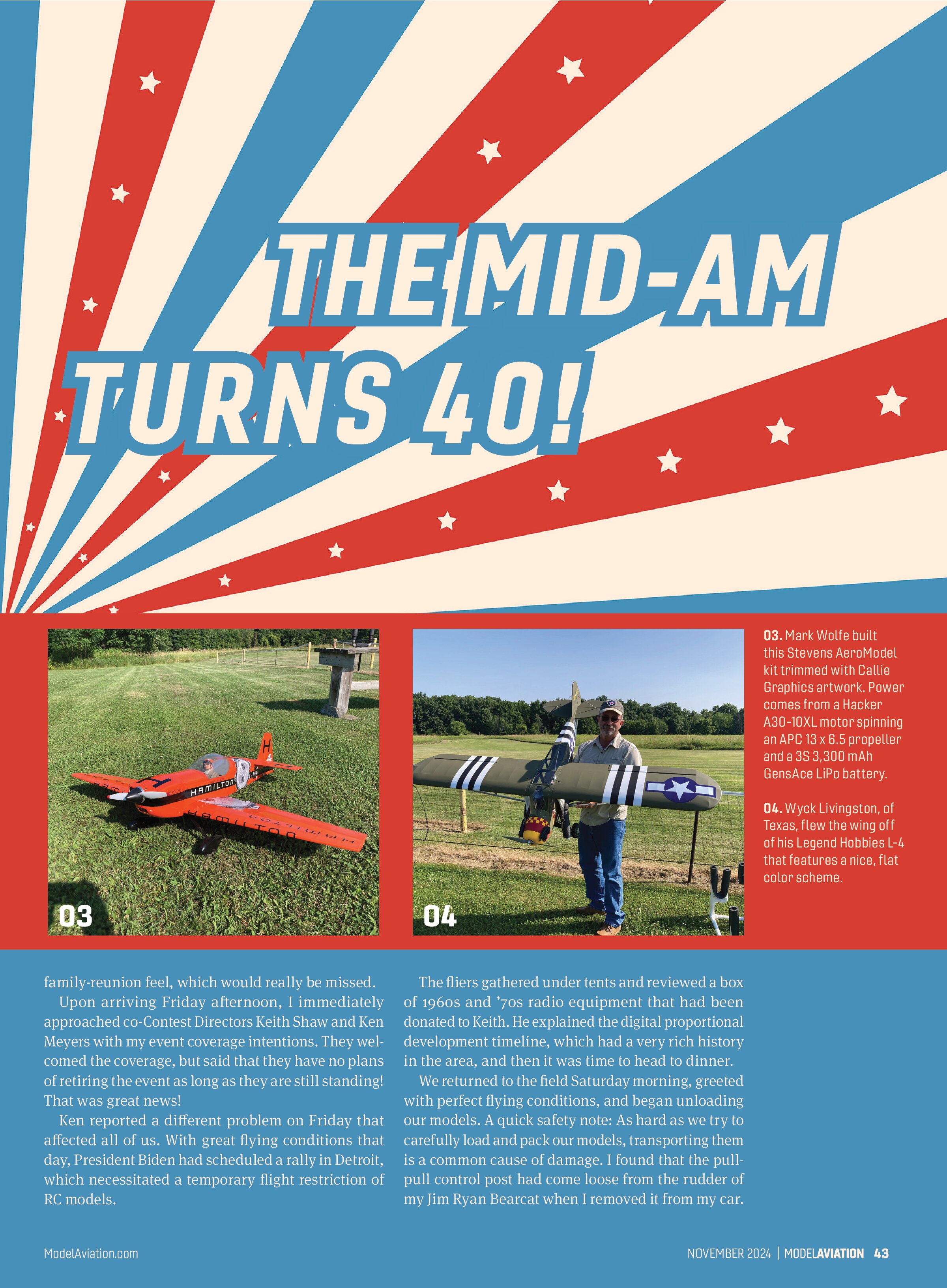
Pete Foss, from Michigan, built a model by Sergey Maseta called the Angry Bird that he saw on RCGroups. It has a flapping wing and flies very well. The Angry Bird is constructed from 3mm and 9mm EPP foam, has a 23-inch wingspan, and weighs 7 ounces. Powered by a 2205-1400 brushless motor, it has a BadAss Rebel 20 Lite ESC on a 3S 450 mAh LiPo spinning a GWS 7 x 6 propeller. Pete replaced the ESC with a 3-amp BEC; otherwise, the wing flap on the original controller would have overloaded the ESC. The wing flap controller was included with the kit and passes a signal to cycle the flapping servo between 20% and 80% throttle to prevent it from centering.
Jim Ryan’s Hughes 500 Loach helicopter started life as a pre-primed version purchased from Century Helis. He applied the finish. The mechanics are from an older version of an Align T-REX 600 helicopter with BEASTX MICROBEAST flybarless units, reversed for scalelike, counterclockwise rotor rotation. Powered by a 6S 5,000 mAh LiPo battery with a total weight of 8.5 pounds, the Loach performs with scalelike realism when Jim is at the sticks, from spool up to spool down. During one of Jim’s flights, a full-scale Chinook tandem rotor helicopter passed in the distance, making a banking turn, and we all smiled.
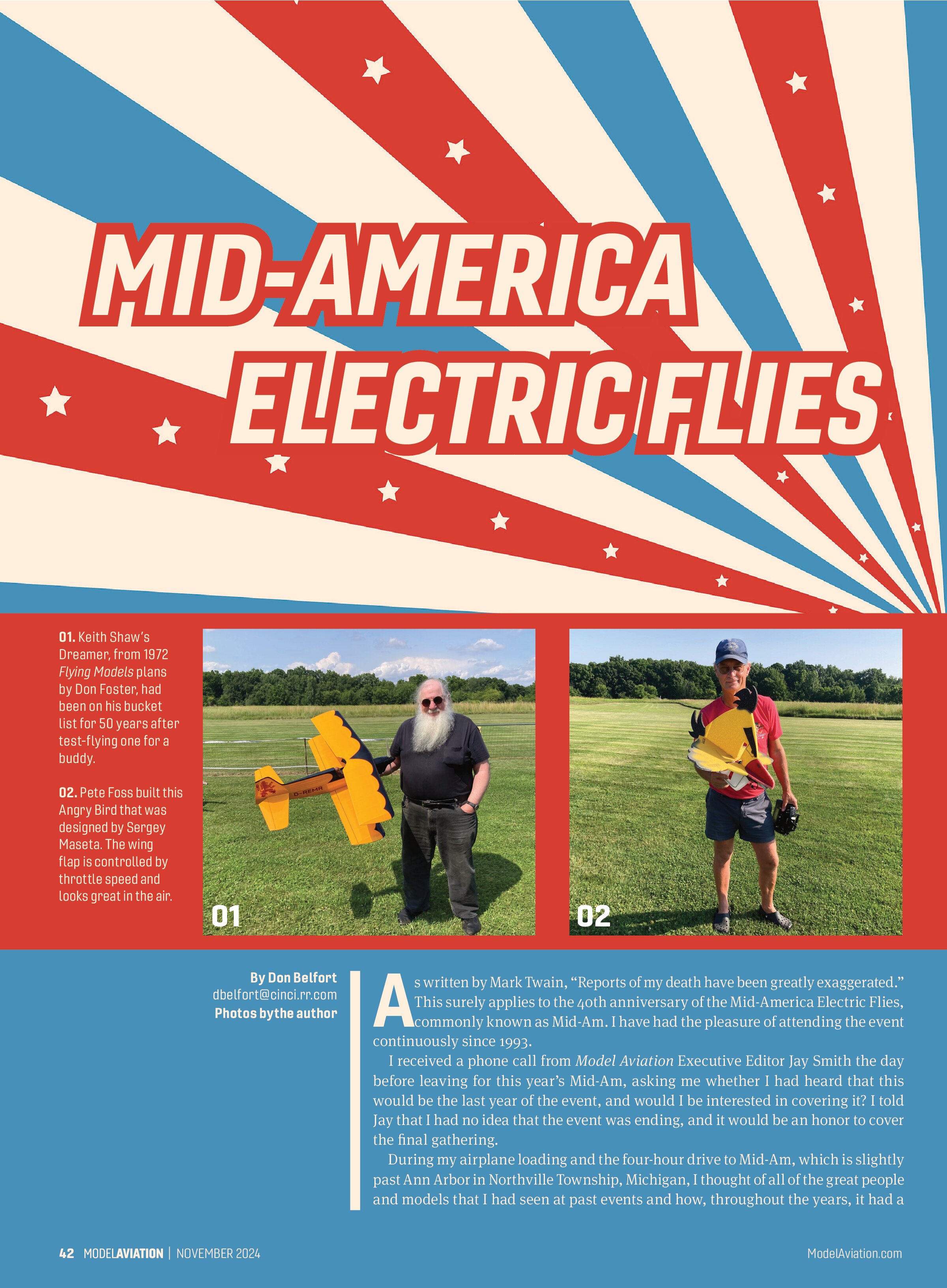
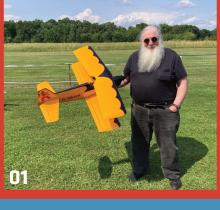
Keith Shaw built a beautiful biplane from 1972 Flying Models plans called the Dreamer by Don Foster, which had been on his bucket list for 50 years after test-flying one for a buddy. Keith made changes that included updating the airfoil to his favorite NACA 1412. He dug deep in his parts box for the heat-treated Hallco landing gear that he favors over bare, sheet-metal gear.
With a wingspan of 39 inches and weighing slightly less than 4 pounds, it is powered by a Scorpion 3014 with four A123 cells spinning an 11 x 7 propeller. The Dreamer has flown in temperatures from 15°F to 95°F, and in wind of 25-plus mph. It always puts on a good show.
Jim Young’s Mark Rittenger-designed Curar-E has a foam wing and a stabilizer cut by Mark. It is sheeted with 1/32-inch balsa. The one-piece model has a 31.5-inch wingspan and weighs slightly less than 16 ounces. The power system is a 1,300 mAh Kv outrunner motor on a 3S 1,300 LiPo battery spinning a 6 x 6 propeller. Jim said that the Curar-E is easy to launch. He let me launch it, and he is right!
As the afternoon began to cool down, the grill was lit for a fliers’ cookout, where awards and pilot prizes were handed out. A big thank-you to Joe Hass for working with local and national suppliers to get the raffle prizes for the pilots.
Next year’s Mid-Am will be July 12-13, 2025. To quote Ken Myers, “Forty-one and we’re not done!”
SOURCES:
NEW RC-PROJECT Angry Bird Egg 580mm
RCGroups
www.rcgroups.com/forums/showthread.php?3588777-NEW-RC-PROJECT-Angry-Bird-Egg-580mm