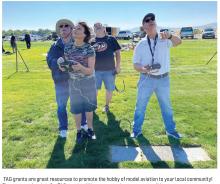
YOUTH SAFETY AT EVENTS AND CLUBS
By Kyle Jaracz, AMA Education Director | kylej@modelaircraft.org
ANY TIME IS a wonderful time to share model aviation with others, and AMA is proud to support our members who safely foster a love of flight through model aviation in all of its forms.
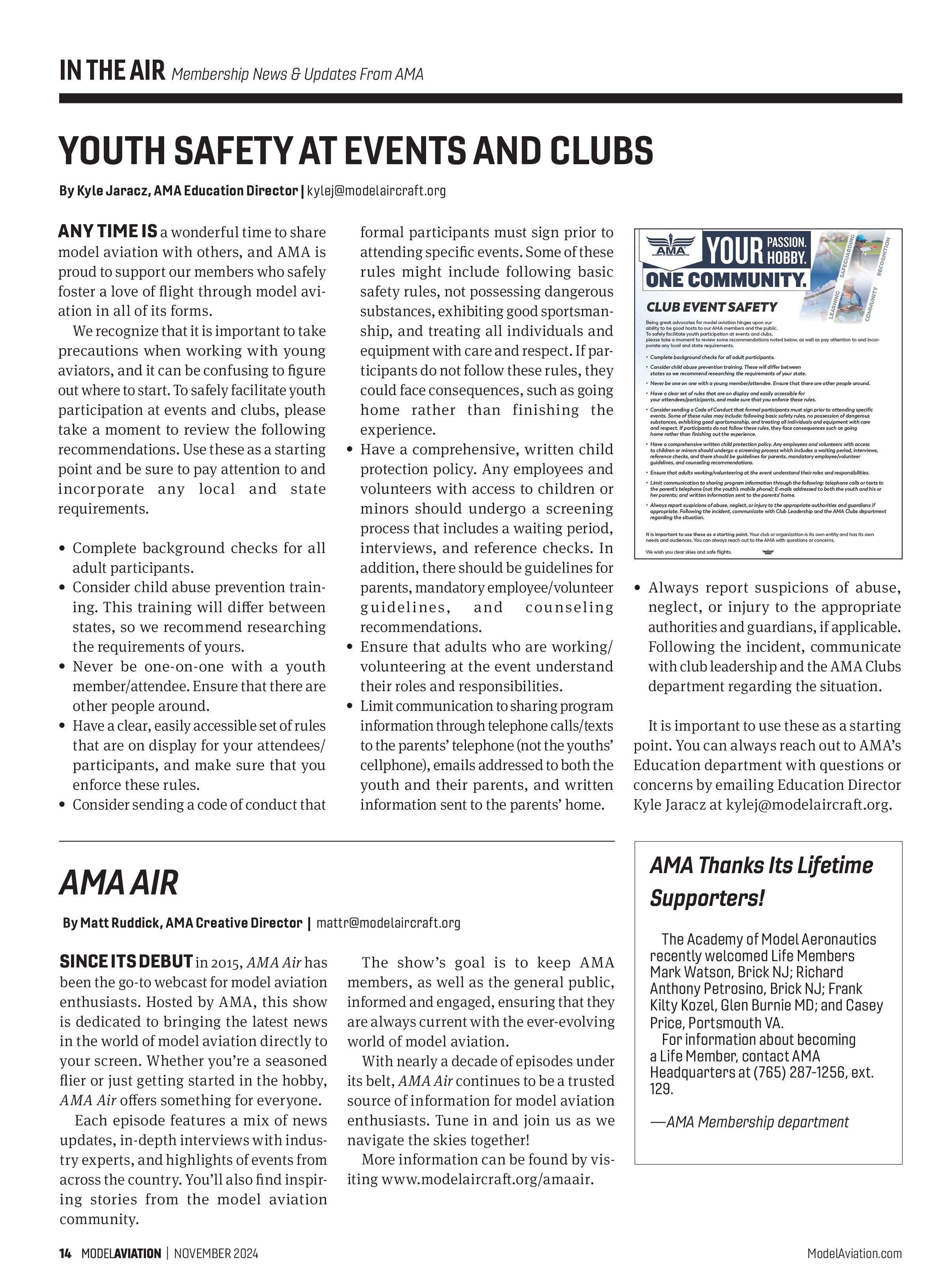
We recognize that it is important to take precautions when working with young aviators, and it can be confusing to figure out where to start. To safely facilitate youth participation at events and clubs, please take a moment to review the following recommendations. Use these as a starting point and be sure to pay attention to and incorporate any local and state requirements.
- Complete background checks for all adult participants.
- Consider child abuse prevention training. This training will differ between states, so we recommend researching the requirements of yours.
- Never be one-on-one with a youth member/attendee. Ensure that there are other people around.
- Have a clear, easily accessible set of rules that are on display for your attendees/participants, and make sure that you enforce these rules.
- Consider sending a code of conduct that formal participants must sign prior to attending specific events. Some of these rules might include following basic safety rules, not possessing dangerous substances, exhibiting good sportsmanship, and treating all individuals and equipment with care and respect. If participants do not follow these rules, they could face consequences, such as going home rather than finishing the experience.
- Have a comprehensive, written child protection policy. Any employees and volunteers with access to children or minors should undergo a screening process that includes a waiting period, interviews, and reference checks. In addition, there should be guidelines for parents, mandatory employee/volunteer guidelines, and counseling recommendations.
- Ensure that adults who are working/volunteering at the event understand their roles and responsibilities.
- Limit communication to sharing program information through telephone calls/texts to the parents’ telephone (not the youths’ cellphone), emails addressed to both the youth and their parents, and written information sent to the parents’ home.

- Always report suspicions of abuse, neglect, or injury to the appropriate authorities and guardians, if applicable. Following the incident, communicate with club leadership and the AMA Clubs department regarding the situation.
It is important to use these as a starting point. You can always reach out to AMA’s Education department with questions or concerns by emailing Education Director Kyle Jaracz at kylej@modelaircraft.org.
AMA AIR
By Matt Ruddick, AMA Creative Director | mattr@modelaircraft.org
SINCE ITS DEBUT in 2015, AMA Air has been the go-to webcast for model aviation enthusiasts. Hosted by AMA, this show is dedicated to bringing the latest news in the world of model aviation directly to your screen. Whether you’re a seasoned flier or just getting started in the hobby, AMA Air offers something for everyone.
Each episode features a mix of news updates, in-depth interviews with industry experts, and highlights of events from across the country. You’ll also find inspiring stories from the model aviation community.
The show’s goal is to keep AMA members, as well as the general public, informed and engaged, ensuring that they are always current with the ever-evolving world of model aviation.
With nearly a decade of episodes under its belt, AMA Air continues to be a trusted source of information for model aviation enthusiasts. Tune in and join us as we navigate the skies together!
More information can be found by visiting www.modelaircraft.org/amaair.
CLUB GRANT UPDATES
By Rachelle Haughn, AMA Foundation Deputy Director | rachelleh@modelaircraft.org
A GRANT PROGRAM that benefits AMA chartered clubs is now accepting applications. The Flying Site Improvement Grant program opened on October 1, 2024. Applications will close at 11:59 p.m. Eastern time on February 1, 2025.
Flying Site Improvement Grants help clubs improve their flying sites. Through this program, AMA contributes 25% of the total project costs (with a minimum contribution of $100 and a maximum contribution of $3,000) to clubs that demonstrate their commitment to AMA’s mission.
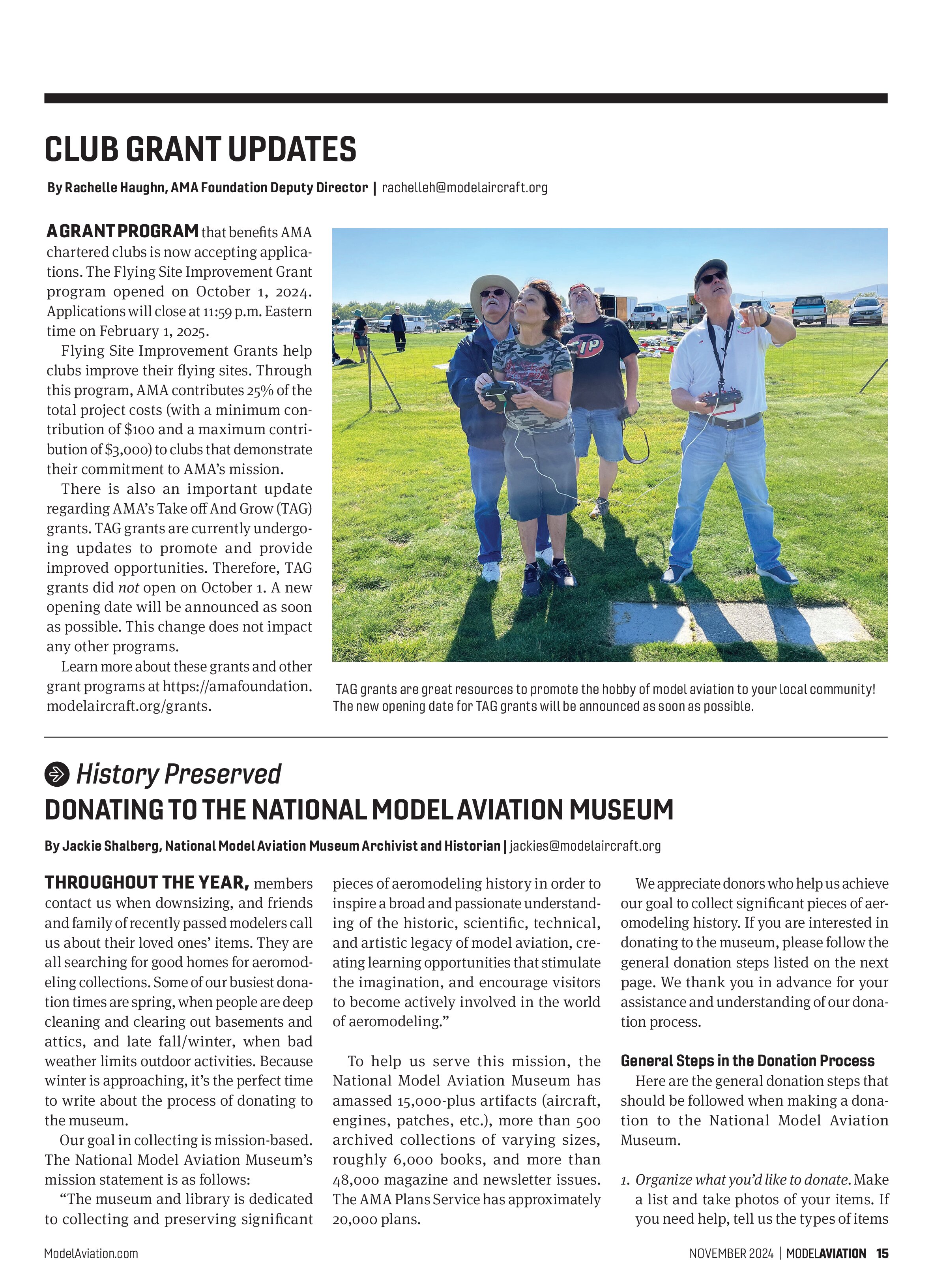
There is also an important update regarding AMA’s Take off And Grow (TAG) grants. TAG grants are currently undergoing updates to promote and provide improved opportunities. Therefore, TAG grants did not open on October 1. A new opening date will be announced as soon as possible. This change does not impact any other programs.
Learn more about these grants and other grant programs at https://amafoundation.modelaircraft.org/grants.

History Preserved
DONATING TO THE NATIONAL MODEL AVIATION MUSEUM
By Jackie Shalberg, National Model Aviation Museum Archivist and Historian | jackies@modelaircraft.org
THROUGHOUT THE YEAR, members contact us when downsizing, and friends and family of recently passed modelers call us about their loved ones’ items. They are all searching for good homes for aeromodeling collections. Some of our busiest donation times are spring, when people are deep cleaning and clearing out basements and attics, and late fall/winter, when bad weather limits outdoor activities. Because winter is approaching, it’s the perfect time to write about the process of donating to the museum.
Our goal in collecting is mission-based. The National Model Aviation Museum’s mission statement is as follows:
“The museum and library is dedicated to collecting and preserving significant pieces of aeromodeling history in order to inspire a broad and passionate understanding of the historic, scientific, technical, and artistic legacy of model aviation, creating learning opportunities that stimulate the imagination, and encourage visitors to become actively involved in the world of aeromodeling.”
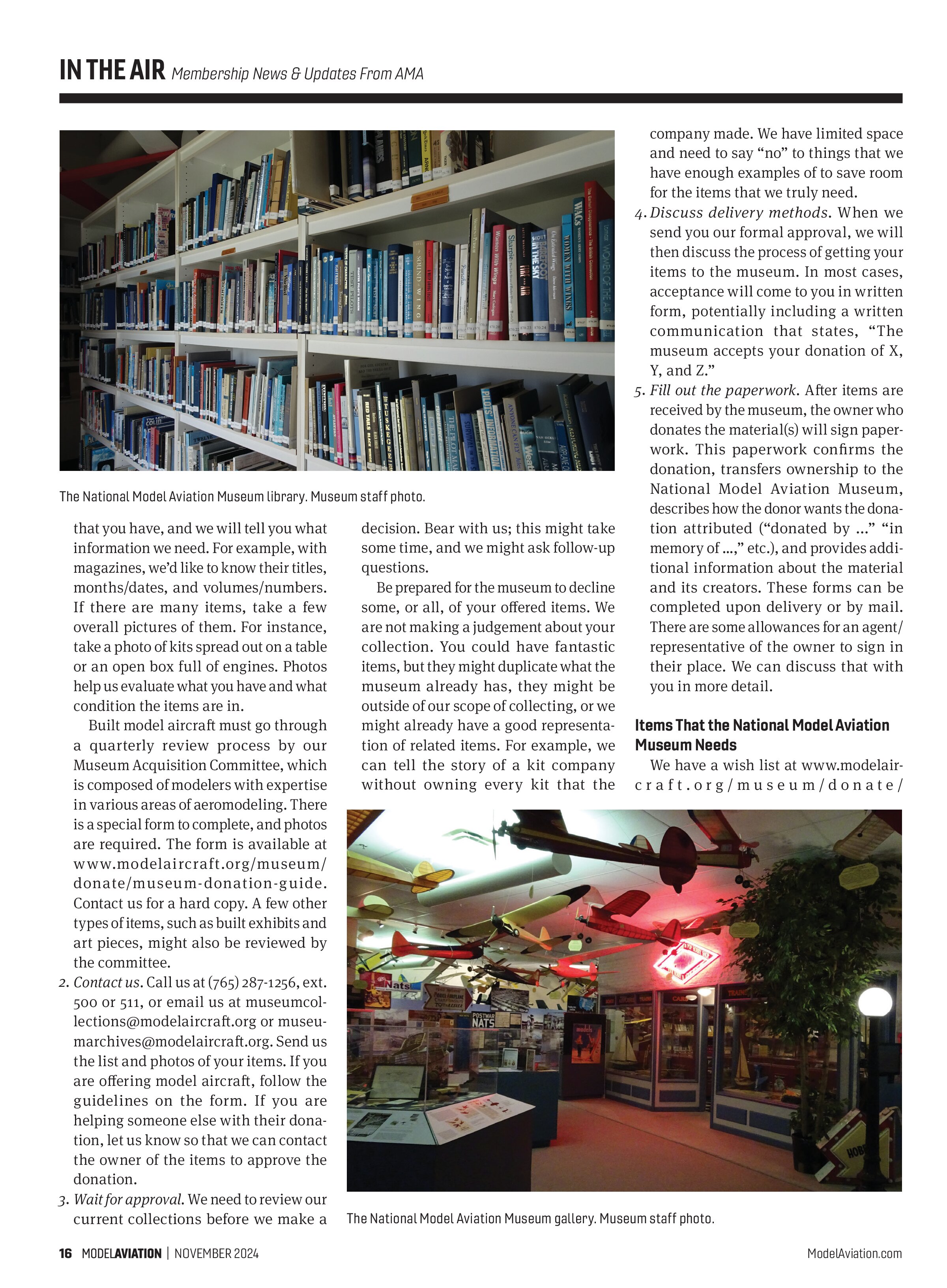
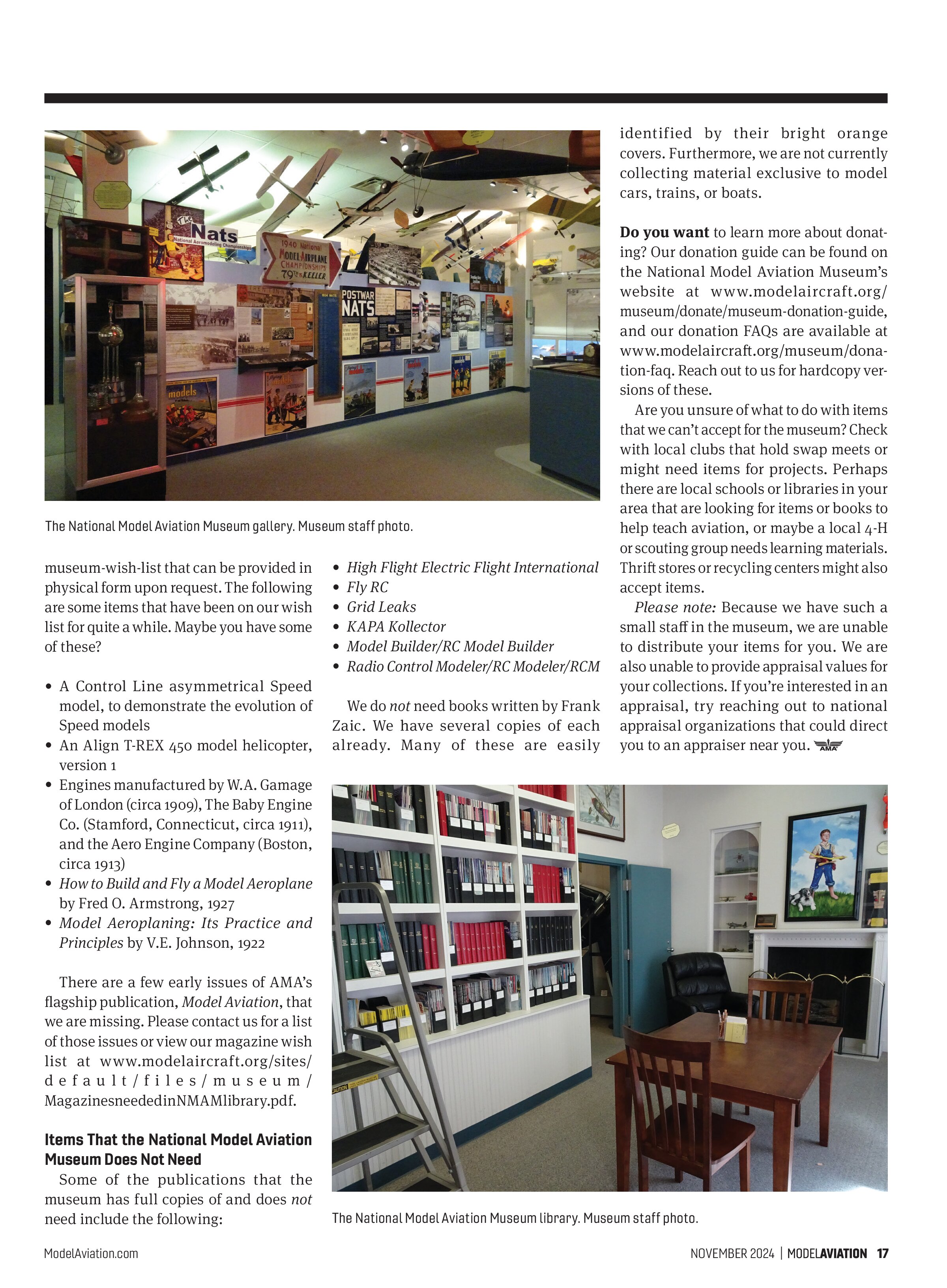
To help us serve this mission, the National Model Aviation Museum has amassed 15,000-plus artifacts (aircraft, engines, patches, etc.), more than 500 archived collections of varying sizes, roughly 6,000 books, and more than 48,000 magazine and newsletter issues. The AMA Plans Service has approximately 20,000 plans.
We appreciate donors who help us achieve our goal to collect significant pieces of aeromodeling history. If you are interested in donating to the museum, please follow the general donation steps listed on the next page. We thank you in advance for your assistance and understanding of our donation process.
General Steps in the Donation Process
Here are the general donation steps that should be followed when making a donation to the National Model Aviation Museum.
- Organize what you’d like to donate. Make a list and take photos of your items. If you need help, tell us the types of items
that you have, and we will tell you what information we need. For example, with magazines, we’d like to know their titles, months/dates, and volumes/numbers. If there are many items, take a few overall pictures of them. For instance, take a photo of kits spread out on a table or an open box full of engines. Photos help us evaluate what you have and what condition the items are in.
Built model aircraft must go through a quarterly review process by our Museum Acquisition Committee, which is composed of modelers with expertise in various areas of aeromodeling. There is a special form to complete, and photos are required. The form is available at www.modelaircraft.org/museum/donate/museum-donation-guide. Contact us for a hard copy. A few other types of items, such as built exhibits and art pieces, might also be reviewed by the committee.
2. Contact us. Call us at (765) 287-1256, ext. 500 or 511, or email us at museumcollections@modelaircraft.org or museum-archives@modelaircraft.org. Send us the list and photos of your items. If you are offering model aircraft, follow the guidelines on the form. If you are helping someone else with their donation, let us know so that we can contact the owner of the items to approve the donation.
3. Wait for approval. We need to review our current collections before we make a decision. Bear with us; this might take some time, and we might ask follow-up questions.
Be prepared for the museum to decline some, or all, of your offered items. We are not making a judgement about your collection. You could have fantastic items, but they might duplicate what the museum already has, they might be outside of our scope of collecting, or we might already have a good representation of related items. For example, we can tell the story of a kit company without owning every kit that the company made. We have limited space and need to say “no” to things that we have enough examples of to save room for the items that we truly need.
4. Discuss delivery methods. When we send you our formal approval, we will then discuss the process of getting your items to the museum. In most cases, acceptance will come to you in written form, potentially including a written communication that states, “The museum accepts your donation of X, Y, and Z.”
5. Fill out the paperwork. After items are received by the museum, the owner who donates the material(s) will sign paperwork. This paperwork confirms the donation, transfers ownership to the National Model Aviation Museum, describes how the donor wants the donation attributed (“donated by ...,” “in memory of ...,” etc.), and provides additional information about the material and its creators. These forms can be completed upon delivery or by mail. There are some allowances for an agent/representative of the owner to sign in their place. We can discuss that with you in more detail.

Items That the National Model Aviation Museum Needs
We have a wish list at www.modelaircraft.org/museum/donate/museum-wish-list that can be provided in physical form upon request. The following are some items that have been on our wish list for quite a while. Maybe you have some of these?
- A Control Line asymmetrical Speed model, to demonstrate the evolution of Speed models
- An Align T-REX 450 model helicopter, version 1
- Engines manufactured by W.A. Gamage of London (circa 1909), The Baby Engine Co. (Stamford, Connecticut, circa 1911), and the Aero Engine Company (Boston, circa 1913)
- How to Build and Fly a Model Aeroplane by Fred O. Armstrong, 1927
- Model Aeroplaning: Its Practice and Principles by V.E. Johnson, 1922
There are a few early issues of AMA’s flagship publication, Model Aviation, that we are missing. Please contact us for a list of those issues or view our magazine wish list at www.modelaircraft.org/sites/default/files/museum/MagazinesneededinNMAMli....
Items That the National Model Aviation Museum Does Not Need
Some of the publications that the museum has full copies of and does not need include the following:
- High Flight Electric Flight International
- Fly RC
- Grid Leaks
- KAPA Kollector
- Model Builder/RC Model Builder
- Radio Control Modeler/RC Modeler/RCM
We do not need books written by Frank Zaic. We have several copies of each already. Many of these are easily identified by their bright orange covers. Furthermore, we are not currently collecting material exclusive to model cars, trains, or boats.

Do you want to learn more about donating? Our donation guide can be found on the National Model Aviation Museum’s website at www.modelaircraft.org/museum/donate/museum-donation-guide, and our donation FAQs are available at www.modelaircraft.org/museum/donation-faq. Reach out to us for hardcopy versions of these.
Are you unsure of what to do with items that we can’t accept for the museum? Check with local clubs that hold swap meets or might need items for projects. Perhaps there are local schools or libraries in your area that are looking for items or books to help teach aviation, or maybe a local 4-H or scouting group needs learning materials. Thrift stores or recycling centers might also accept items.
Please note: Because we have such a small staff in the museum, we are unable to distribute your items for you. We are also unable to provide appraisal values for your collections. If you’re interested in an appraisal, try reaching out to national appraisal organizations that could direct you to an appraiser near you.