ADVANCED FLIGHT TECHNOLOGIES
SPLISH-SPLASH
By Patrick Sherman
lucidity@roswellflighttestcrew.com
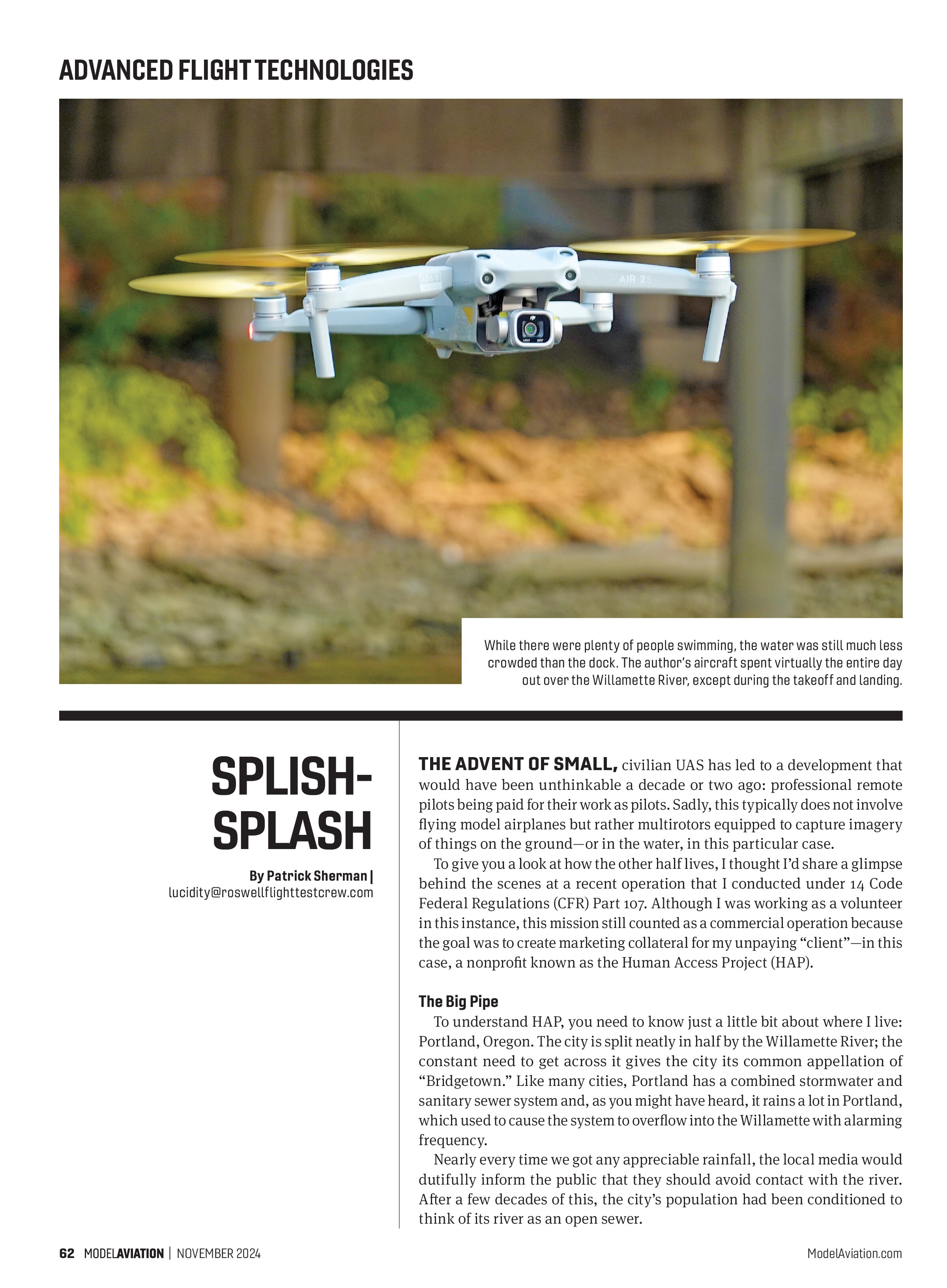
THE ADVENT OF SMALL, civilian UAS has led to a development that would have been unthinkable a decade or two ago: professional remote pilots being paid for their work as pilots. Sadly, this typically does not involve flying model airplanes but rather multirotors equipped to capture imagery of things on the ground—or in the water, in this particular case.
To give you a look at how the other half lives, I thought I’d share a glimpse behind the scenes at a recent operation that I conducted under 14 Code Federal Regulations (CFR) Part 107. Although I was working as a volunteer in this instance, this mission still counted as a commercial operation because the goal was to create marketing collateral for my unpaying “client”—in this case, a nonprofit known as the Human Access Project (HAP).
The Big Pipe
To understand HAP, you need to know just a little bit about where I live: Portland, Oregon. The city is split neatly in half by the Willamette River; the constant need to get across it gives the city its common appellation of “Bridgetown.” Like many cities, Portland has a combined stormwater and sanitary sewer system and, as you might have heard, it rains a lot in Portland, which used to cause the system to overflow into the Willamette with alarming frequency.
Nearly every time we got any appreciable rainfall, the local media would dutifully inform the public that they should avoid contact with the river. After a few decades of this, the city’s population had been conditioned to think of its river as an open sewer.


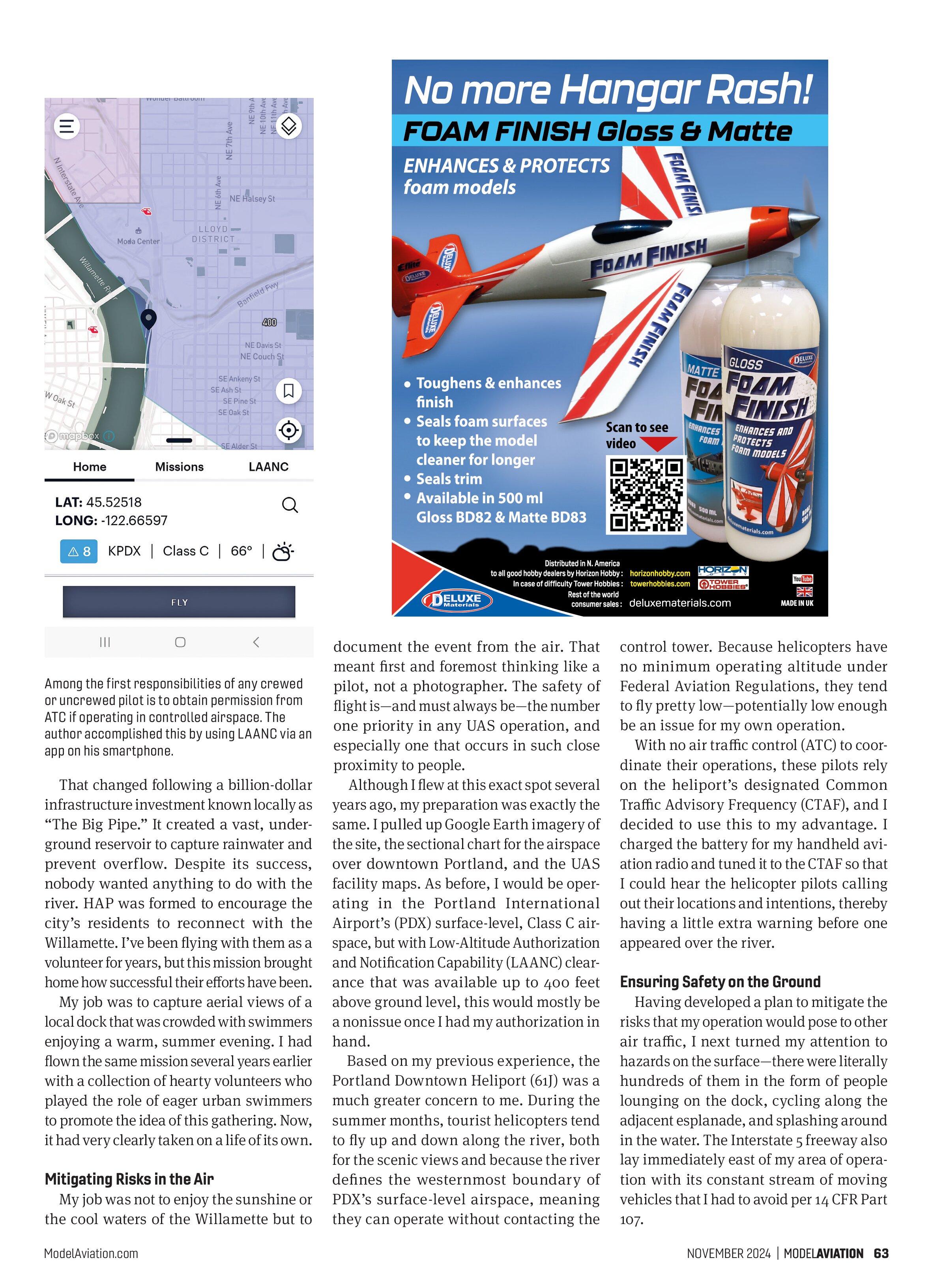
Among the first responsibilities of any crewed or uncrewed pilot is to obtain permission from ATC if operating in controlled airspace. The author accomplished this by using LAANC via an app on his smartphone.
That changed following a billion-dollar infrastructure investment known locally as “The Big Pipe.” It created a vast, underground reservoir to capture rainwater and prevent overflow. Despite its success, nobody wanted anything to do with the river. HAP was formed to encourage the city’s residents to reconnect with the Willamette. I’ve been flying with them as a volunteer for years, but this mission brought home how successful their efforts have been.
My job was to capture aerial views of a local dock that was crowded with swimmers enjoying a warm, summer evening. I had flown the same mission several years earlier with a collection of hearty volunteers who played the role of eager urban swimmers to promote the idea of this gathering. Now, it had very clearly taken on a life of its own.
Mitigating Risks in the Air
My job was not to enjoy the sunshine or the cool waters of the Willamette but to document the event from the air. That meant first and foremost thinking like a pilot, not a photographer. The safety of flight is—and must always be—the number one priority in any UAS operation, and especially one that occurs in such close proximity to people.
Although I flew at this exact spot several years ago, my preparation was exactly the same. I pulled up Google Earth imagery of the site, the sectional chart for the airspace over downtown Portland, and the UAS facility maps. As before, I would be operating in the Portland International Airport’s (PDX) surface-level, Class C airspace, but with Low-Altitude Authorization and Notification Capability (LAANC) clearance that was available up to 400 feet above ground level, this would mostly be a nonissue once I had my authorization in hand.
Based on my previous experience, the Portland Downtown Heliport (61J) was a much greater concern to me. During the summer months, tourist helicopters tend to fly up and down along the river, both for the scenic views and because the river defines the westernmost boundary of PDX’s surface-level airspace, meaning they can operate without contacting the control tower. Because helicopters have no minimum operating altitude under Federal Aviation Regulations, they tend to fly pretty low—potentially low enough to be an issue for my own operation.
With no air traffic control (ATC) to coordinate their operations, these pilots rely on the heliport’s designated Common Traffic Advisory Frequency (CTAF), and I decided to use this to my advantage. I charged the battery for my handheld aviation radio and tuned it to the CTAF so that I could hear the helicopter pilots calling out their locations and intentions, thereby having a little extra warning before one appeared over the river.
Ensuring Safety on the Ground
Having developed a plan to mitigate the risks that my operation would pose to other air traffic, I next turned my attention to hazards on the surface—there were literally hundreds of them in the form of people lounging on the dock, cycling along the adjacent esplanade, and splashing around in the water. The Interstate 5 freeway also lay immediately east of my area of operation with its constant stream of moving vehicles that I had to avoid per 14 CFR Part 107.

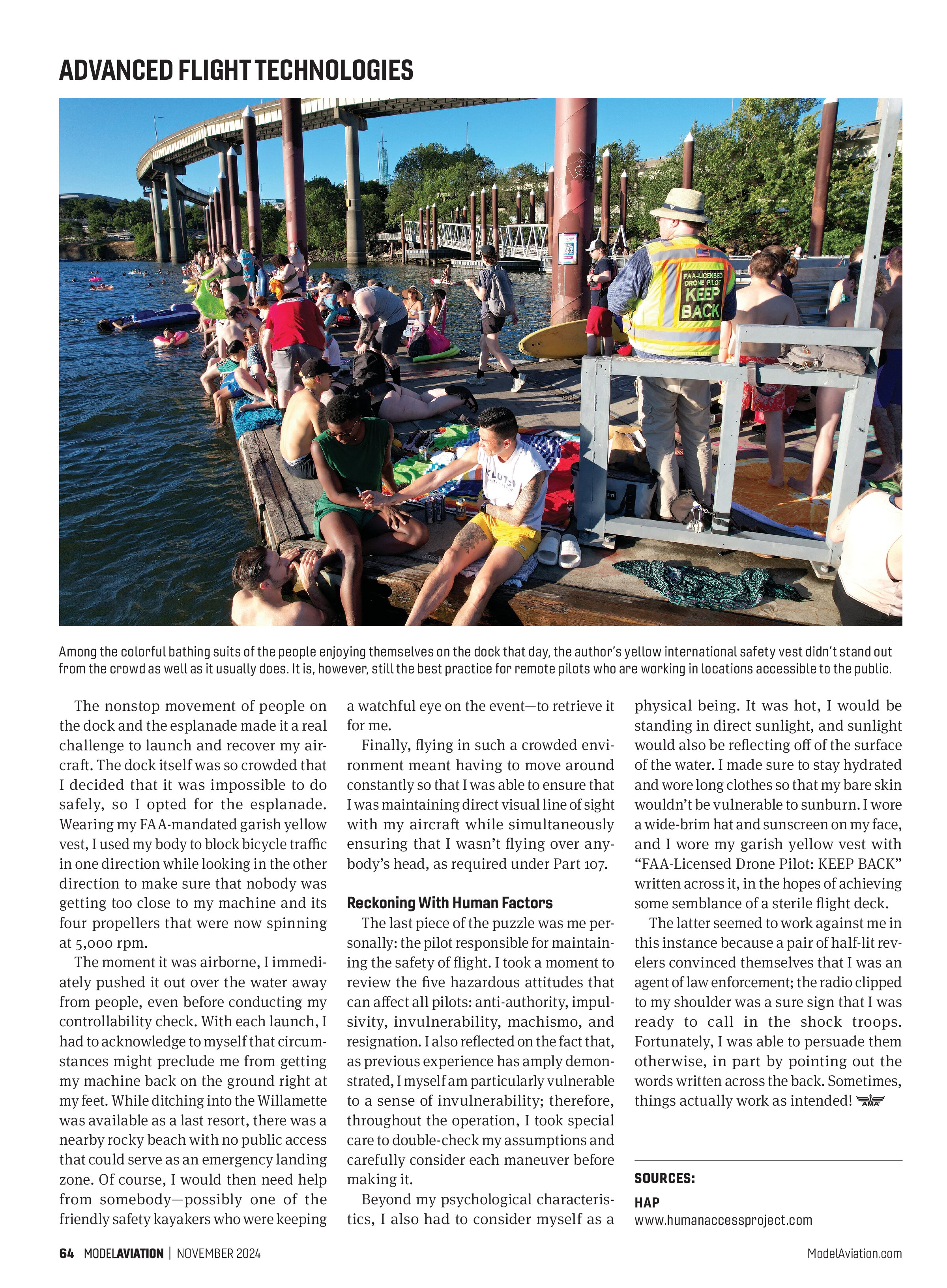
The nonstop movement of people on the dock and the esplanade made it a real challenge to launch and recover my aircraft. The dock itself was so crowded that I decided that it was impossible to do safely, so I opted for the esplanade. Wearing my FAA-mandated garish yellow vest, I used my body to block bicycle traffic in one direction while looking in the other direction to make sure that nobody was getting too close to my machine and its four propellers that were now spinning at 5,000 rpm.
The moment it was airborne, I immediately pushed it out over the water away from people, even before conducting my controllability check. With each launch, I had to acknowledge to myself that circumstances might preclude me from getting my machine back on the ground right at my feet. While ditching into the Willamette was available as a last resort, there was a nearby rocky beach with no public access that could serve as an emergency landing zone. Of course, I would then need help from somebody—possibly one of the friendly safety kayakers who were keeping a watchful eye on the event—to retrieve it for me.
Finally, flying in such a crowded environment meant having to move around constantly so that I was able to ensure that I was maintaining direct visual line of sight with my aircraft while simultaneously ensuring that I wasn’t flying over anybody’s head, as required under Part 107.
Reckoning With Human Factors
The last piece of the puzzle was me personally: the pilot responsible for maintaining the safety of flight. I took a moment to review the five hazardous attitudes that can affect all pilots: anti-authority, impulsivity, invulnerability, machismo, and resignation. I also reflected on the fact that, as previous experience has amply demonstrated, I myself am particularly vulnerable to a sense of invulnerability; therefore, throughout the operation, I took special care to double-check my assumptions and carefully consider each maneuver before making it.
Beyond my psychological characteristics, I also had to consider myself as a physical being. It was hot, I would be standing in direct sunlight, and sunlight would also be reflecting off of the surface of the water. I made sure to stay hydrated and wore long clothes so that my bare skin wouldn’t be vulnerable to sunburn. I wore a wide-brim hat and sunscreen on my face, and I wore my garish yellow vest with “FAA-Licensed Drone Pilot: KEEP BACK” written across it, in the hopes of achieving some semblance of a sterile flight deck.
The latter seemed to work against me in this instance because a pair of half-lit revelers convinced themselves that I was an agent of law enforcement; the radio clipped to my shoulder was a sure sign that I was ready to call in the shock troops. Fortunately, I was able to persuade them otherwise, in part by pointing out the words written across the back. Sometimes, things actually work as intended!