IT'S A FAMILY TRADITION
SMALL-FIELD FLYING
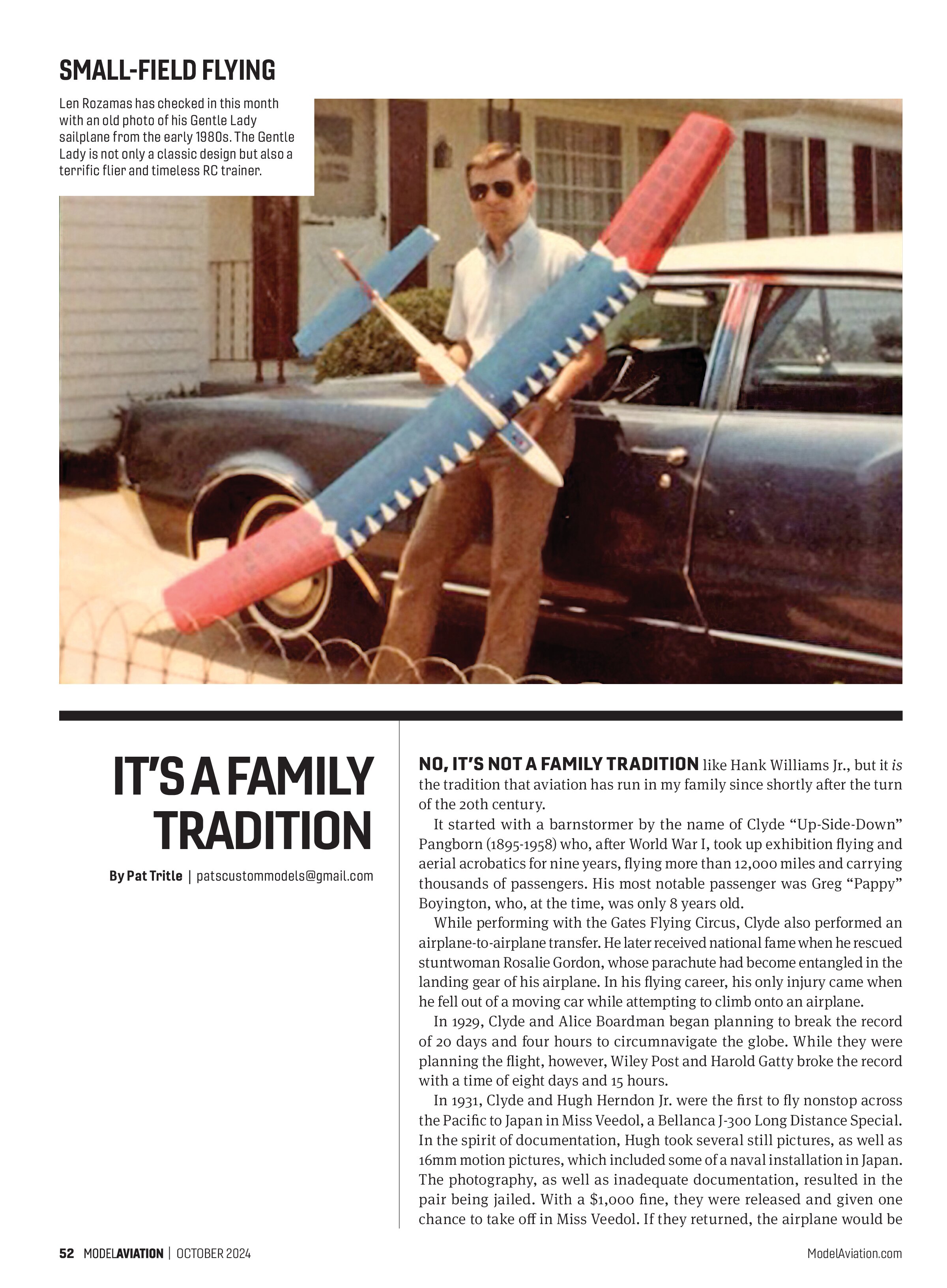
Len Rozamas has checked in this month with an old photo of his Gentle Lady sailplane from the early 1980s. The Gentle Lady is not only a classic design but also a terrific flier and timeless RC trainer.
By Pat Tritle | patscustommodels@gmail.com

NO, IT’S NOT A FAMILY TRADITION like Hank Williams Jr., but it is the tradition that aviation has run in my family since shortly after the turn of the 20th century.
It started with a barnstormer by the name of Clyde “Up-Side-Down” Pangborn (1895-1958) who, after World War I, took up exhibition flying and aerial acrobatics for nine years, flying more than 12,000 miles and carrying thousands of passengers. His most notable passenger was Greg “Pappy” Boyington, who, at the time, was only 8 years old.
While performing with the Gates Flying Circus, Clyde also performed an airplane-to-airplane transfer. He later received national fame when he rescued stuntwoman Rosalie Gordon, whose parachute had become entangled in the landing gear of his airplane. In his flying career, his only injury came when he fell out of a moving car while attempting to climb onto an airplane.
In 1929, Clyde and Alice Boardman began planning to break the record of 20 days and four hours to circumnavigate the globe. While they were planning the flight, however, Wiley Post and Harold Gatty broke the record with a time of eight days and 15 hours.
In 1931, Clyde and Hugh Herndon Jr. were the first to fly nonstop across the Pacific to Japan in Miss Veedol, a Bellanca J-300 Long Distance Special. In the spirit of documentation, Hugh took several still pictures, as well as 16mm motion pictures, which included some of a naval installation in Japan. The photography, as well as inadequate documentation, resulted in the pair being jailed. With a $1,000 fine, they were released and given one chance to take off in Miss Veedol. If they returned, the airplane would be confiscated and the two of them would return to prison.
The return trip began on October 4, 1931, from Sabishiro Beach in Misawa Aomori, Japan. The airplane had been rigged to jettison the landing gear to increase the range enough to make it back to the states. The landing gear ejected as planned, but two root struts remained, so at 14,000 feet (and barefoot), Clyde crawled out of the airplane onto the wing struts to manually knock the landing gear struts off of the airplane.
They planned to belly land in Vancouver, British Columbia, Canada, or Seattle, but both were fogged in, so they ended up landing in Wenatchee, Washington, after 41 hours and 13 minutes in flight.
Today, the Pangborn-Herndon Memorial that is dedicated to this flight is located near their landing site, and the damaged propeller from Miss Veedol is on display at the Wenatchee Valley Museum and Cultural Center. Miss Veedol was trucked to Seattle, where it was repaired and the landing gear replaced. Clyde and Hugh then continued on to New York to complete their world tour.
What does this have to do with “family tradition,” you ask? As it turns out, Clyde was my dad’s second cousin on his mom’s side. When my dad left the U.S. Army in 1947, he earned his pilot’s and airframe and engine licenses on the GI Bill, followed by the ownership of two J-3 Cubs and later, a Luscombe 8E.
Dad sold the last airplane in 1961 but spent his 34-year career in the aviation industry, starting as an airplane mechanic at a small, fixed-base operation in Iowa, then with United Airlines, and later in management with United and Allegheny Airlines.
That’s where my interest in aviation started, although my involvement has always been at quarter-scale or less. That’s also how the family tradition began—and continues on—with the 93rd anniversary of the historic first transpacific flight.
Modeling Old and New
While I’m on the subject of long traditions in modeling, Len Rozamas sent a photo of his Carl Goldberg Gentle Lady from 40 years ago.
Len is a dyed-in-the-wool “old-school modeler,” having come up through the ranks of Free Flight, U-Control (Control Line), and RC. He has flown models of many different types throughout the years. Even in today’s high-tech world of


computer designs, the Gentle Lady is still a great flyer; one can only wonder how many RC pilots have learned to fly on this model since its release in approximately 1980.
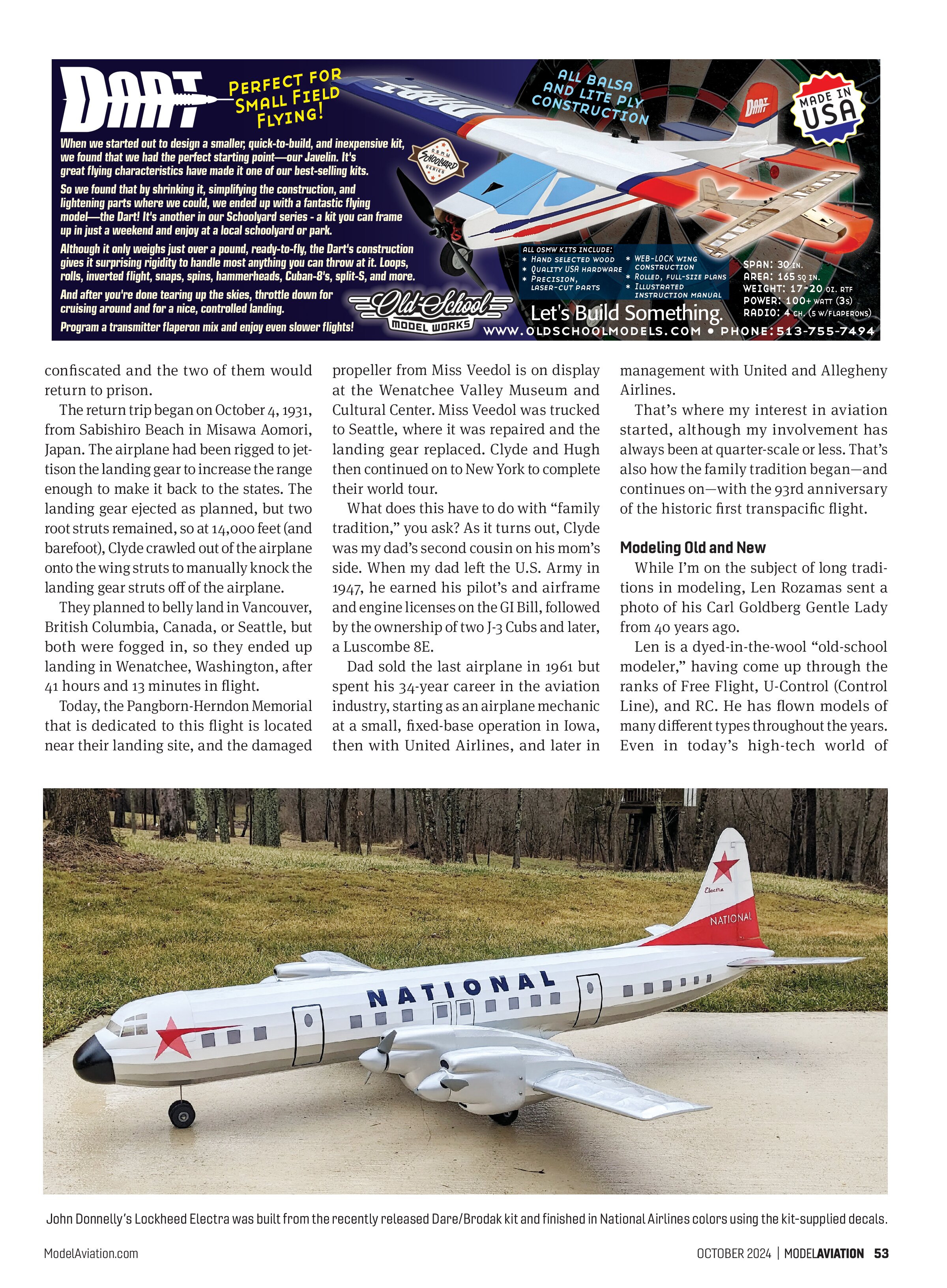
Next up, John Donnelly has joined us with his newly completed Lockheed L-188 Electra. John built his Electra from the recently released Dare/Brodak kit. The 60-inch wingspan model is powered by four Suppo 2212 930 Kv outrunner motors with Hobbywing FunFly 20-amp ESCs and APC 8 x 6E counterrotating propellers. Eight-gram servos operate the flight controls by way of a Radiomaster ER5A V2 receiver.
John describes the 55-ounce Electra as a terrific flyer that climbs nicely at half power. The flight time using the 2,200 mAh 3S LiPo battery is a solid 8 minutes.
A Little Tidbit Worth Mentioning
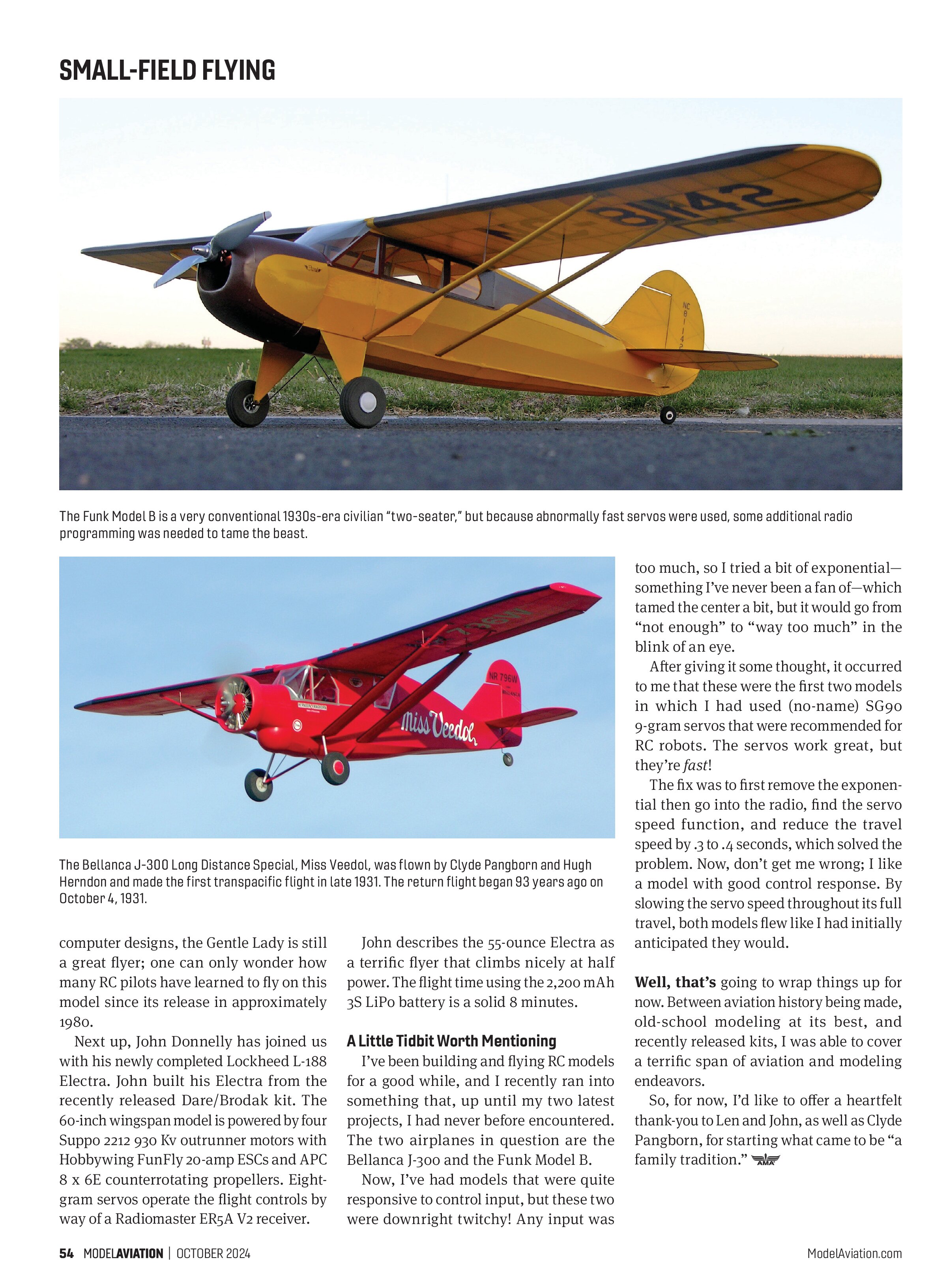
I’ve been building and flying RC models for a good while, and I recently ran into something that, up until my two latest projects, I had never before encountered. The two airplanes in question are the Bellanca J-300 and the Funk Model B.
Now, I’ve had models that were quite responsive to control input, but these two were downright twitchy! Any input was too much, so I tried a bit of exponential—something I’ve never been a fan of—which tamed the center a bit, but it would go from “not enough” to “way too much” in the blink of an eye.
After giving it some thought, it occurred to me that these were the first two models in which I had used (no-name) SG90 9-gram servos that were recommended for RC robots. The servos work great, but they’re fast!
The fix was to first remove the exponential then go into the radio, find the servo speed function, and reduce the travel speed by .3 to .4 seconds, which solved the problem. Now, don’t get me wrong; I like a model with good control response. By slowing the servo speed throughout its full travel, both models flew like I had initially anticipated they would.
Well, that’s going to wrap things up for now. Between aviation history being made, old-school modeling at its best, and recently released kits, I was able to cover a terrific span of aviation and modeling endeavors.
So, for now, I’d like to offer a heartfelt thank-you to Len and John, as well as Clyde Pangborn, for starting what came to be “a family tradition.”