RC SLOPE SOARING

FLYING WITH
THE BIRDS
By Greg Schutte | gshooty@yahoo.com
I WANT TO THANK Taylor Bracke for filling in for me this month. Taylor’s dad, Mike, informed me that she is considering writing for her college degree. I briefly talked to her about Slope Soaring, and she was interested in writing about her introduction to the hobby. This sounded like an opportunity to introduce Sloping to another generation!
My dad and I followed Greg Schutte in our truck along an extremely rocky and dusty road to get to the takeoff location on top of Pickles Butte, the highest point in Idaho’s Canyon County. According to the Idaho Press, the butte was named after a dog whose name was Pickle and belonged to a local rancher’s son.
Pickles Butte is located just south of Lake Lowell in Nampa, Idaho. I was excited to see the general location of my college, Northwest Nazarene University. The prominent Owyhee Mountain range stood out in the distance to the south, and Boise’s Bogus Basin Ski Resort is to the northwest. It was fun listening to Greg point out many of the other locations that he had taken his airplanes to slope soar. The view was amazing from the top of the butte.
Before this day, I didn’t know what Slope Soaring was. It was all new to me! I learned about the wind and how it works in a flying zone. There was very little wind at the top nearby our parked vehicles, but as we neared the edge of the slope, it was blowing up to 20 mph in an upward direction.
Greg explained that the wind from the valley usually blows much slower, but as it climbs up the side of the hill, it gains speed. It was definitely gaining speed! Once the wind reaches the top, it continues upward before looping back down, creating a no-fly, calm zone that the pilots like to call “the washing machine.”
Greg told me that Slope Soaring is exactly like what the birds were doing as we watched them soar above the ridge. We saw some crows, an eagle or two, and even a few smaller birds in the area that were using the wind to glide. He explained Slope Soaring to me in that way—that RC sailplanes will use the wind in the same manner.
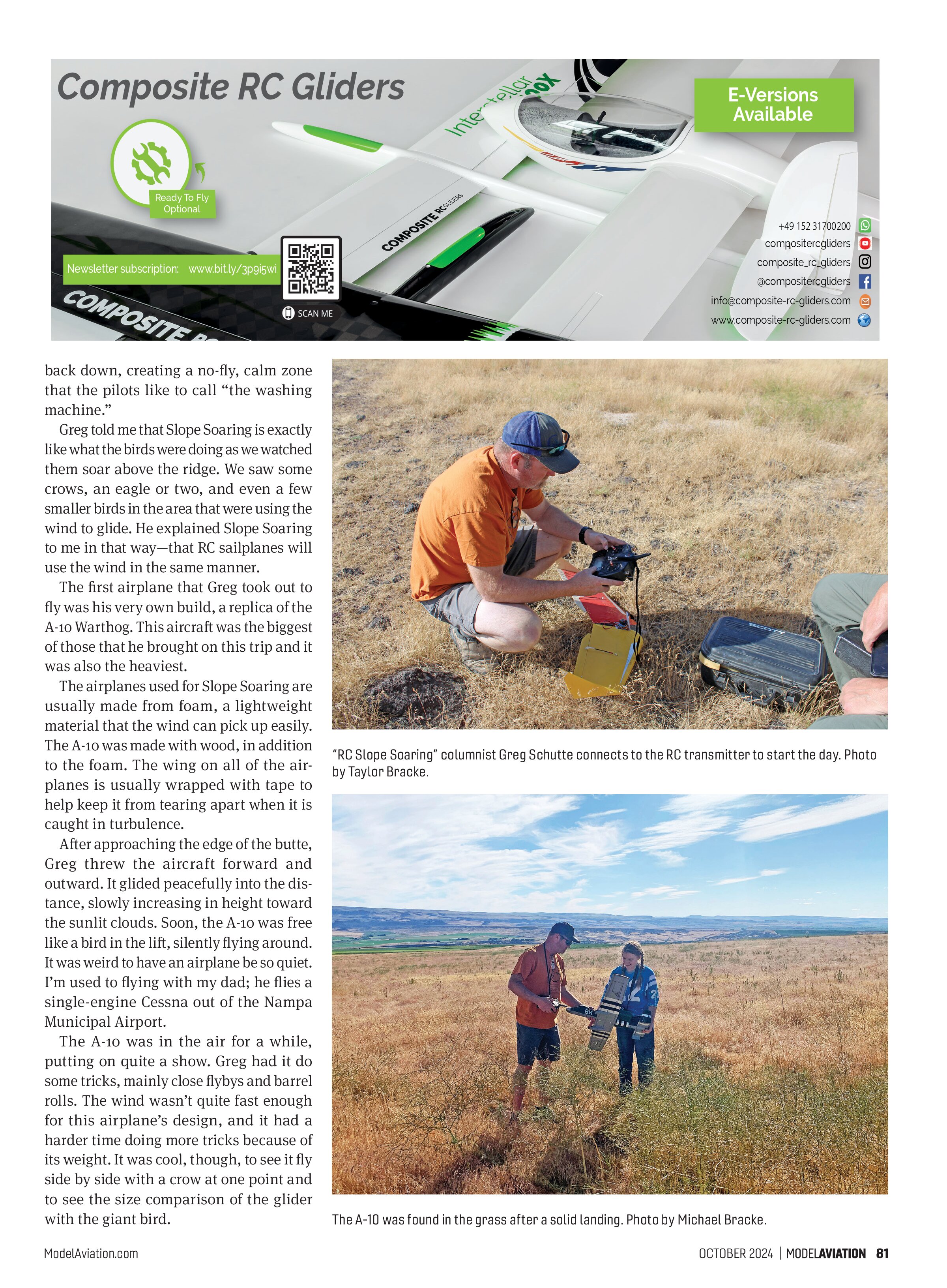
The first airplane that Greg took out to fly was his very own build, a replica of the A-10 Warthog. This aircraft was the biggest of those that he brought on this trip and it was also the heaviest.
The airplanes used for Slope Soaring are usually made from foam, a lightweight material that the wind can pick up easily. The A-10 was made with wood, in addition to the foam. The wing on all of the airplanes is usually wrapped with tape to help keep it from tearing apart when it is caught in turbulence.
After approaching the edge of the butte, Greg threw the aircraft forward and outward. It glided peacefully into the distance, slowly increasing in height toward the sunlit clouds. Soon, the A-10 was free like a bird in the lift, silently flying around. It was weird to have an airplane be so quiet. I’m used to flying with my dad; he flies a single-engine Cessna out of the Nampa Municipal Airport.

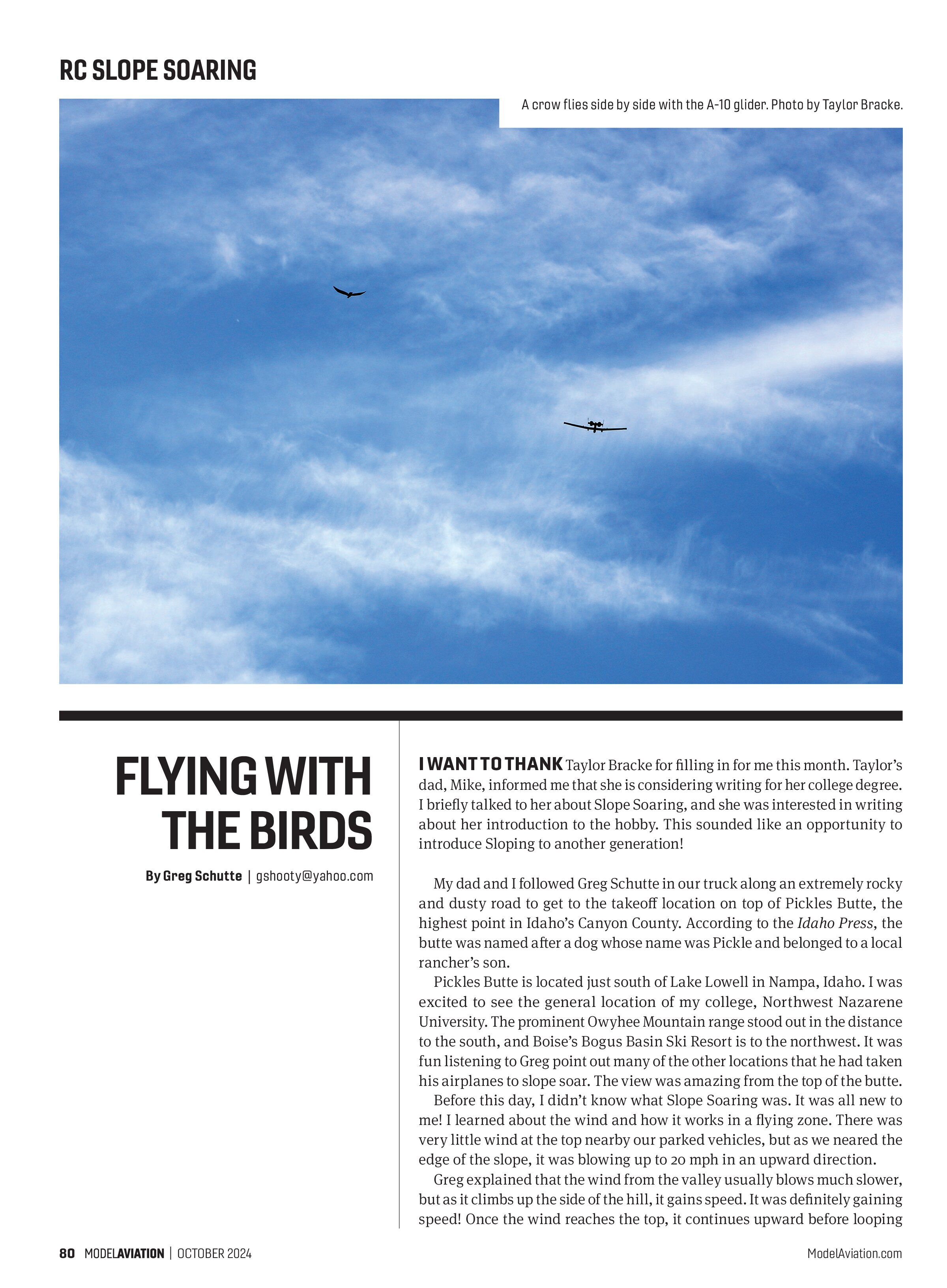
The A-10 was in the air for a while, putting on quite a show. Greg had it do some tricks, mainly close flybys and barrel rolls. The wind wasn’t quite fast enough for this airplane’s design, and it had a harder time doing more tricks because of its weight. It was cool, though, to see it fly side by side with a crow at one point and to see the size comparison of the glider with the giant bird.


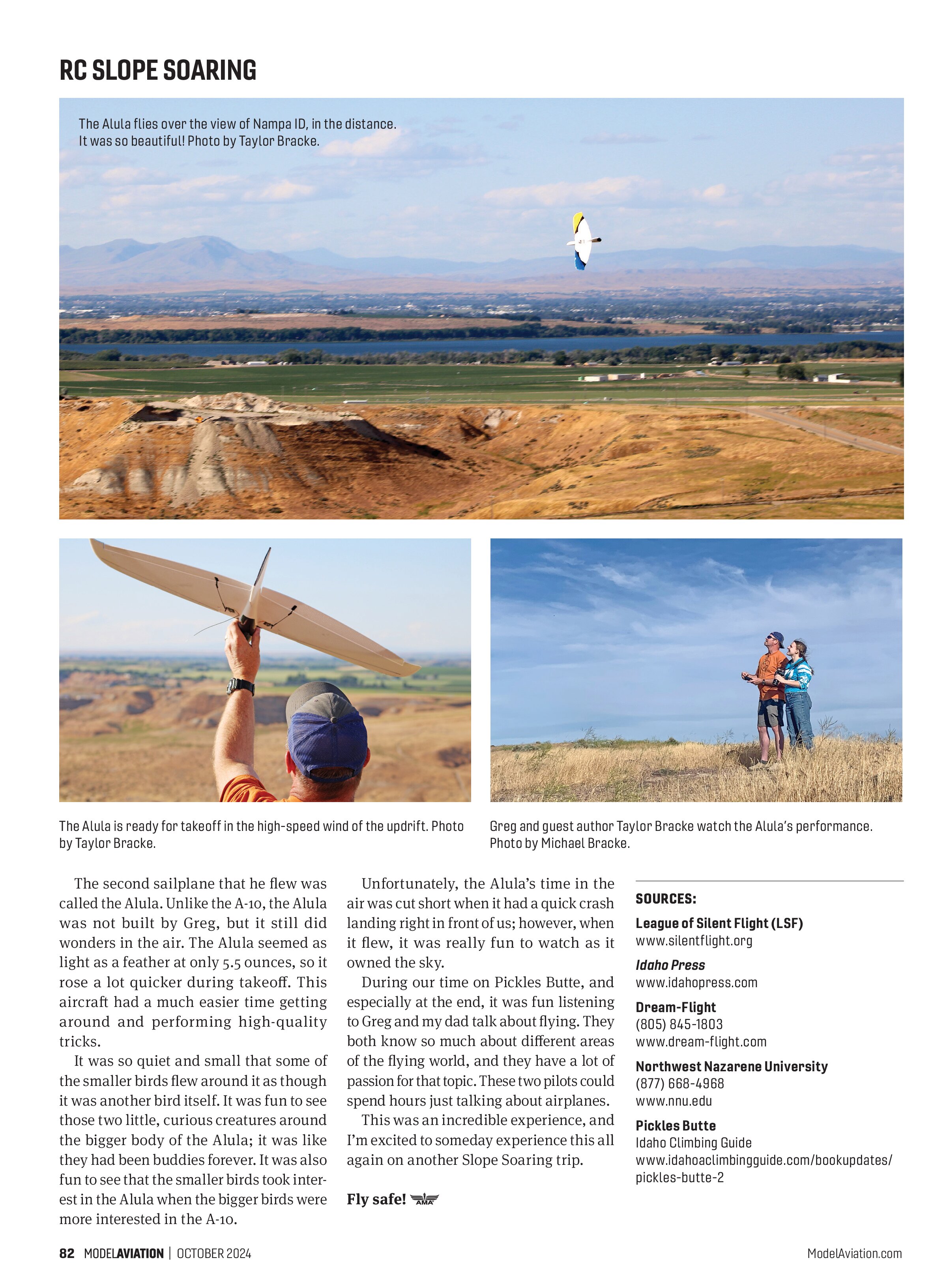
The second sailplane that he flew was called the Alula. Unlike the A-10, the Alula was not built by Greg, but it still did wonders in the air. The Alula seemed as light as a feather at only 5.5 ounces, so it rose a lot quicker during takeoff. This aircraft had a much easier time getting around and performing high-quality tricks.
It was so quiet and small that some of the smaller birds flew around it as though it was another bird itself. It was fun to see those two little, curious creatures around the bigger body of the Alula; it was like they had been buddies forever. It was also fun to see that the smaller birds took interest in the Alula when the bigger birds were more interested in the A-10.
Unfortunately, the Alula’s time in the air was cut short when it had a quick crash landing right in front of us; however, when it flew, it was really fun to watch as it owned the sky.
During our time on Pickles Butte, and especially at the end, it was fun listening to Greg and my dad talk about flying. They both know so much about different areas of the flying world, and they have a lot of passion for that topic. These two pilots could spend hours just talking about airplanes.
This was an incredible experience, and I’m excited to someday experience this all again on another Slope Soaring trip.
Fly safe!
SOURCES:
League of Silent Flight (LSF)
www.silentflight.org
Idaho Press
www.idahopress.com
Dream-Flight
(805) 845-1803
www.dream-flight.com
Northwest Nazarene University
(877) 668-4968
www.nnu.edu
Pickles Butte
Idaho Climbing Guide
www.idahoclimbingguide.com/lookupdates/
pickles-butte-2