RC SCALE AEROBATICS

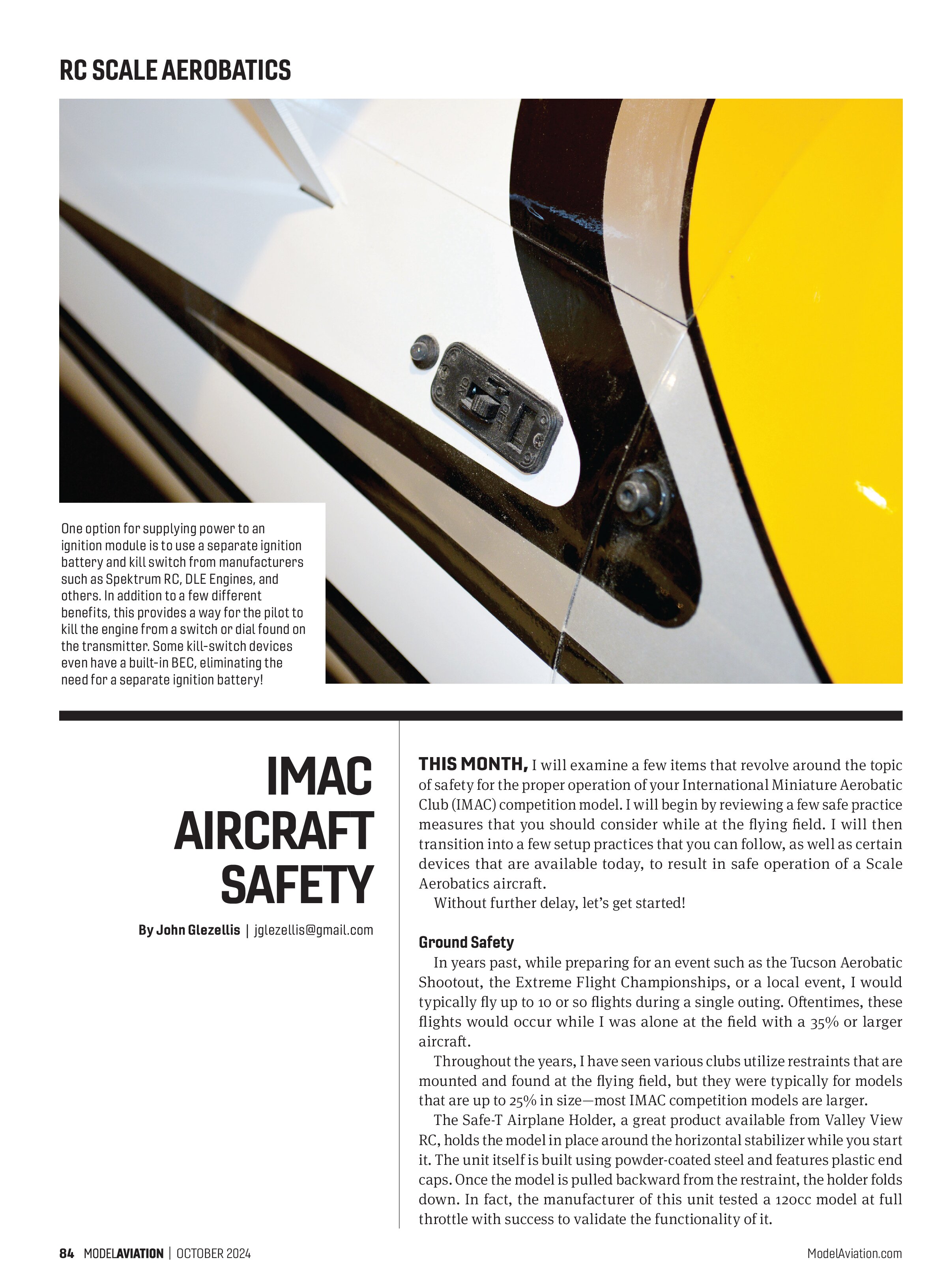
One option for supplying power to an ignition module is to use a separate ignition battery and kill switch from manufacturers such as Spektrum RC, DLE Engines, and others. In addition to a few different benefits, this provides a way for the pilot to kill the engine from a switch or dial found on the transmitter. Some kill-switch devices even have a built-in BEC, eliminating the need for a separate ignition battery!
IMAC AIRCRAFT SAFETY
By John Glezellis | jglezellis@gmail.com
THIS MONTH, I will examine a few items that revolve around the topic of safety for the proper operation of your International Miniature Aerobatic Club (IMAC) competition model. I will begin by reviewing a few safe practice measures that you should consider while at the flying field. I will then transition into a few setup practices that you can follow, as well as certain devices that are available today, to result in safe operation of a Scale Aerobatics aircraft.
Without further delay, let’s get started!
Ground Safety
In years past, while preparing for an event such as the Tucson Aerobatic Shootout, the Extreme Flight Championships, or a local event, I would typically fly up to 10 or so flights during a single outing. Oftentimes, these flights would occur while I was alone at the field with a 35% or larger aircraft.
Throughout the years, I have seen various clubs utilize restraints that are mounted and found at the flying field, but they were typically for models that are up to 25% in size—most IMAC competition models are larger.
The Safe-T Airplane Holder, a great product available from Valley View RC, holds the model in place around the horizontal stabilizer while you start it. The unit itself is built using powder-coated steel and features plastic end caps. Once the model is pulled backward from the restraint, the holder folds down. In fact, the manufacturer of this unit tested a 120cc model at full throttle with success to validate the functionality of it.
For any full-throttle tests, I would personally use the unit, but I would also hold the aircraft at the root of the wing to decrease the loading encountered on the horizontal stabilizer. For the purpose of practice, though, this is a great way to guarantee that safe measures are taken when others are not present to assist.
Now, you might need to adjust the engine for peak performance. Please don’t hesitate to adjust the high-speed and low-speed needles. Different propellers, exhaust systems, elevation/altitudes, and weather might impact the performance of the engine.
Whenever you make a change to the setup of an aircraft, such as a throttle servo, electronic settings, and so forth, it is always important to perform a comprehensive preflight check throughout the entire model. Verify that the throttle fail-safe settings are stored properly after a component change so that the aircraft engine is killed should the radio link fail and the aircraft enters a failsafe mode.
During all engine tests, make sure that the aircraft is properly restrained, either by an individual or some other means, such as the Safe-T Airplane Holder that I mentioned earlier. Even a high idle setting can result in undesired movement of the model and result in injury. Safety first!
Safe Build Practices
Some kill-switch units are designed only to work with magneto-only engines, such as those from Zenoah, for example, and not those that feature an electronic ignition module, like the Desert Aircraft line of engines. An optical kill switch, from Spektrum, for example, is beneficial for numerous reasons.
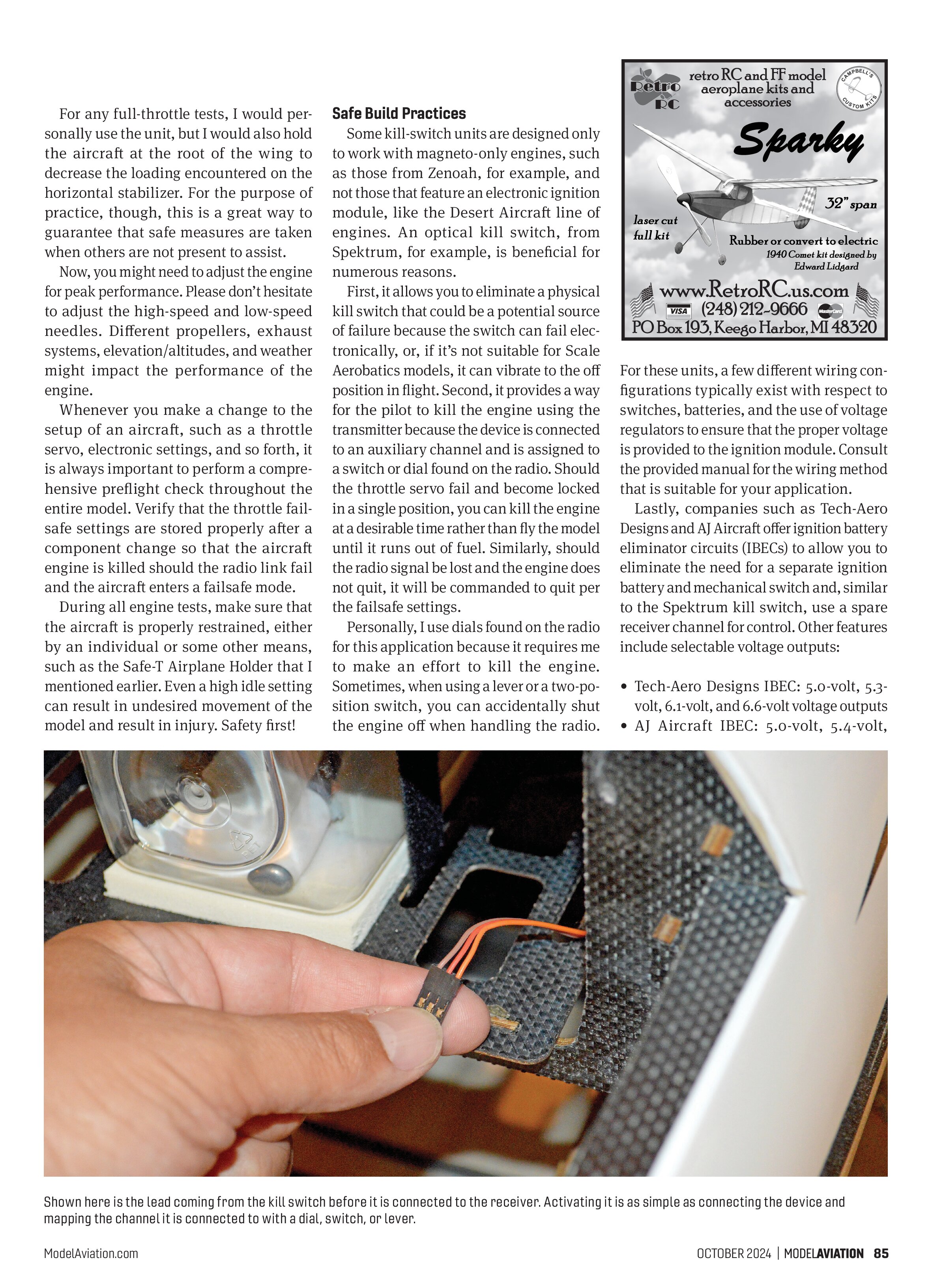
First, it allows you to eliminate a physical kill switch that could be a potential source of failure because the switch can fail electronically, or, if it’s not suitable for Scale Aerobatics models, it can vibrate to the off position in flight. Second, it provides a way for the pilot to kill the engine using the transmitter because the device is connected to an auxiliary channel and is assigned to a switch or dial found on the radio. Should the throttle servo fail and become locked in a single position, you can kill the engine at a desirable time rather than fly the model until it runs out of fuel. Similarly, should the radio signal be lost and the engine does not quit, it will be commanded to quit per the failsafe settings.
Personally, I use dials found on the radio for this application because it requires me to make an effort to kill the engine. Sometimes, when using a lever or a two-position switch, you can accidentally shut the engine off when handling the radio.
For these units, a few different wiring configurations typically exist with respect to switches, batteries, and the use of voltage regulators to ensure that the proper voltage is provided to the ignition module. Consult the provided manual for the wiring method that is suitable for your application.
Lastly, companies such as Tech-Aero Designs and AJ Aircraft offer ignition battery eliminator circuits (IBECs) to allow you to eliminate the need for a separate ignition battery and mechanical switch and, similar to the Spektrum kill switch, use a spare receiver channel for control. Other features include selectable voltage outputs:
- Tech-Aero Designs IBEC: 5.0-volt, 5.3-volt, 6.1-volt, and 6.6-volt voltage outputs
- AJ Aircraft IBEC: 5.0-volt, 5.4-volt,


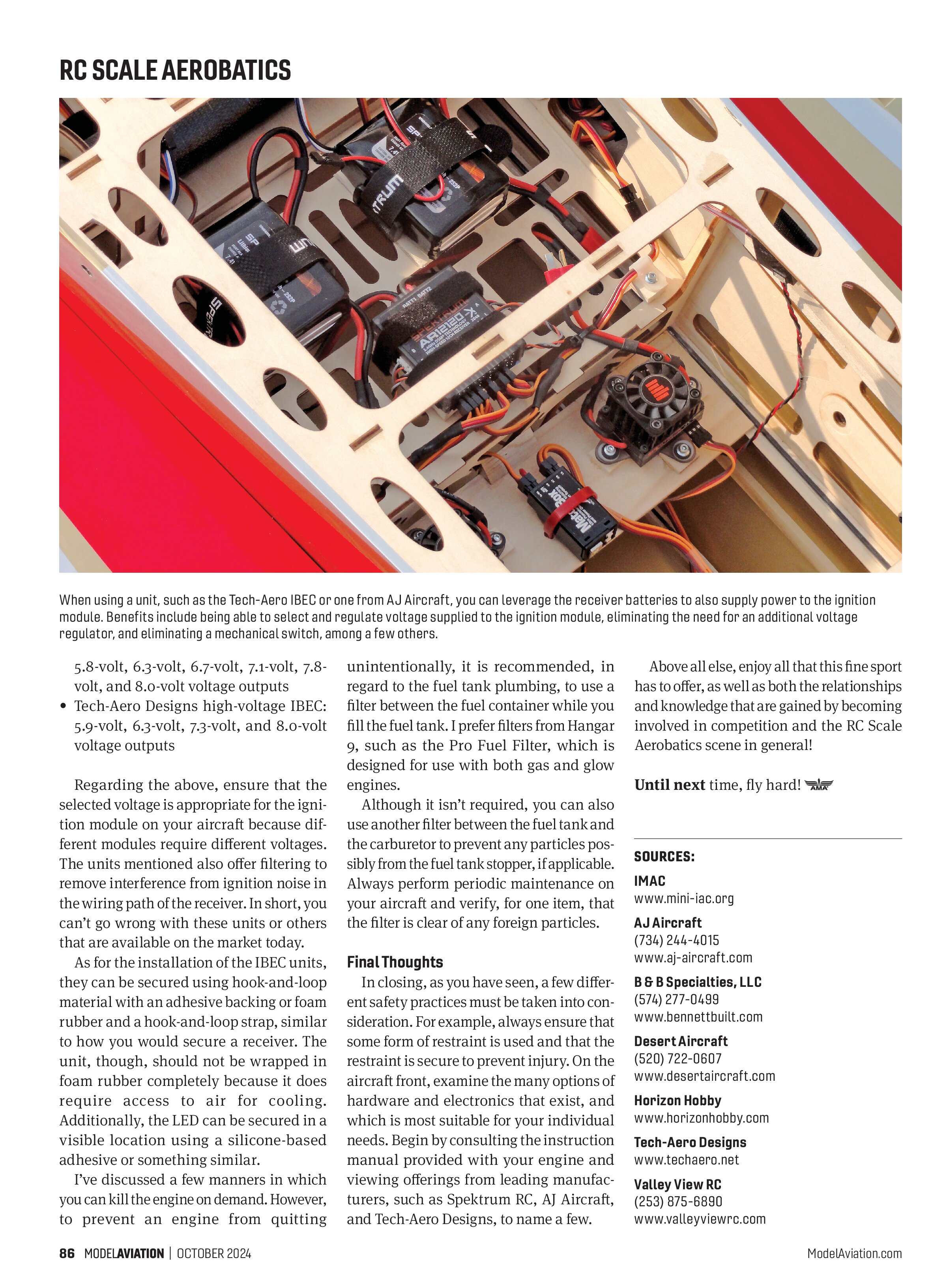
When using a unit, such as the Tech-Aero IBEC or one from AJ Aircraft, you can leverage the receiver batteries to also supply power to the ignition module. Benefits include being able to select and regulate voltage supplied to the ignition module, eliminating the need for an additional voltage regulator, and eliminating a mechanical switch, among a few others.
- 5.8-volt, 6.3-volt, 6.7-volt, 7.1-volt, 7.8-volt, and 8.0-volt voltage outputs
- Tech-Aero Designs high-voltage IBEC: 5.9-volt, 6.3-volt, 7.3-volt, and 8.0-volt voltage outputs
Regarding the above, ensure that the selected voltage is appropriate for the ignition module on your aircraft because different modules require different voltages. The units mentioned also offer filtering to remove interference from ignition noise in the wiring path of the receiver. In short, you can’t go wrong with these units or others that are available on the market today.
As for the installation of the IBEC units, they can be secured using hook-and-loop material with an adhesive backing or foam rubber and a hook-and-loop strap, similar to how you would secure a receiver. The unit, though, should not be wrapped in foam rubber completely because it does require access to air for cooling. Additionally, the LED can be secured in a visible location using a silicone-based adhesive or something similar.
I’ve discussed a few manners in which you can kill the engine on demand. However, to prevent an engine from quitting unintentionally, it is recommended, in regard to the fuel tank plumbing, to use a filter between the fuel container while you fill the fuel tank. I prefer filters from Hangar 9, such as the Pro Fuel Filter, which is designed for use with both gas and glow engines.
Although it isn’t required, you can also use another filter between the fuel tank and the carburetor to prevent any particles possibly from the fuel tank stopper, if applicable. Always perform periodic maintenance on your aircraft and verify, for one item, that the filter is clear of any foreign particles.
Final Thoughts
In closing, as you have seen, a few different safety practices must be taken into consideration. For example, always ensure that some form of restraint is used and that the restraint is secure to prevent injury. On the aircraft front, examine the many options of hardware and electronics that exist, and which is most suitable for your individual needs. Begin by consulting the instruction manual provided with your engine and viewing offerings from leading manufacturers, such as Spektrum RC, AJ Aircraft, and Tech-Aero Designs, to name a few.
Above all else, enjoy all that this fine sport has to offer, as well as both the relationships and knowledge that are gained by becoming involved in competition and the RC Scale Aerobatics scene in general!
Until next time, fly hard!
SOURCES:
IMAC
www.mini-iac.org
AJ Aircraft
(734) 244-4015
www.aj-aircraft.com
B & B Specialties, LLC
(574) 277-0499
www.bennettbuilt.com
Desert Aircraft
(520) 722-0607
www.desertaircraft.com
Horizon Hobby
www.horizonhobby.com
Tech-Aero Designs
www.techaero.net
Valley View RC
(253) 875-6890
www.valleyviewrc.com