FLYBAR VS. FLYBARLESS HELICOPTERS
By James Wang | heloeditor@gmail.com
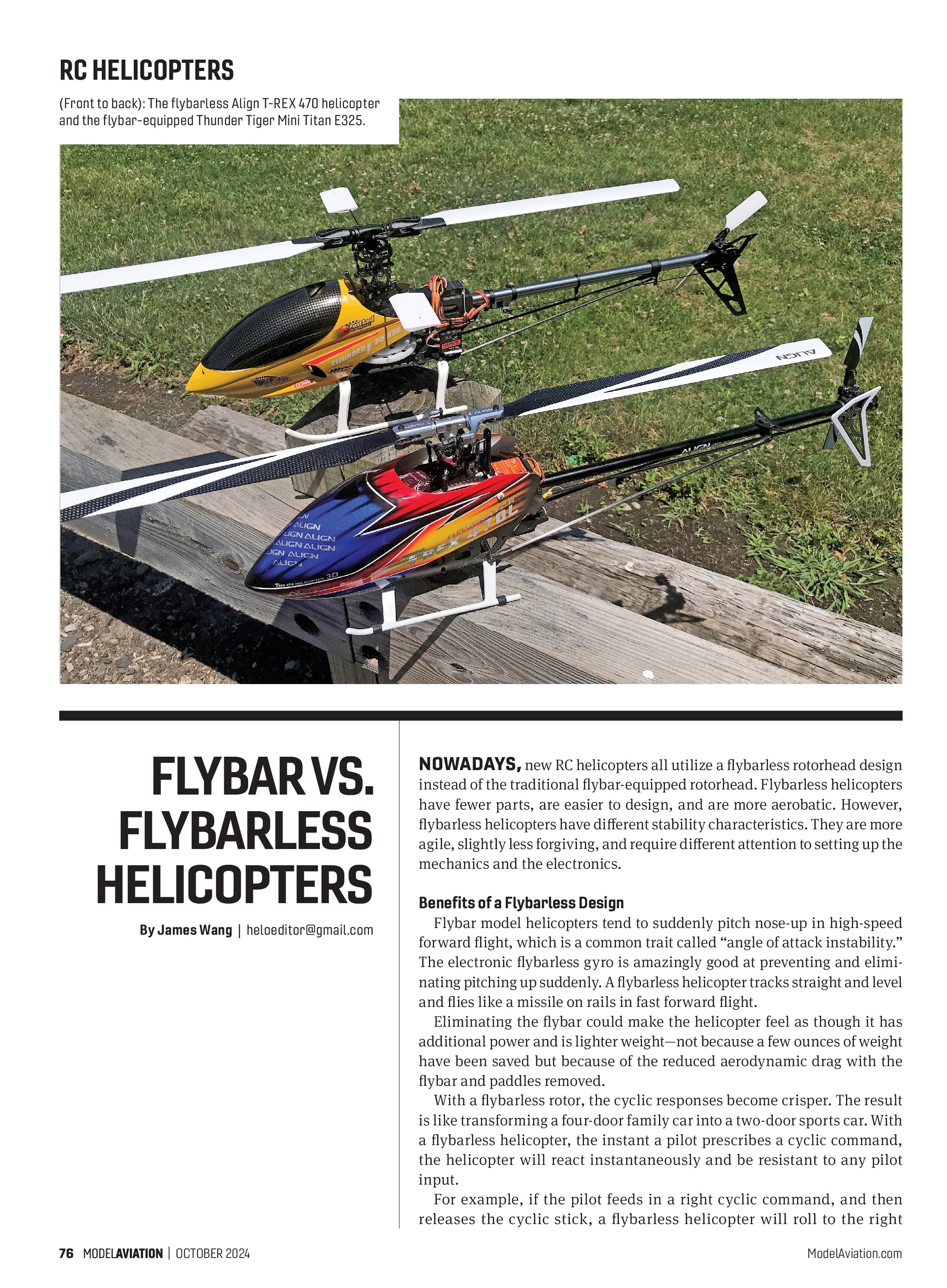
(Front to back): The flybarless Align T-REX 470 helicopter and the flybar-equipped Thunder Tiger Mini Titan E325.

NOWADAYS, new RC helicopters all utilize a flybarless rotorhead design instead of the traditional flybar-equipped rotorhead. Flybarless helicopters have fewer parts, are easier to design, and are more aerobatic. However, flybarless helicopters have different stability characteristics. They are more agile, slightly less forgiving, and require different attention to setting up the mechanics and the electronics.
Benefits of a Flybarless Design
Flybar model helicopters tend to suddenly pitch nose-up in high-speed forward flight, which is a common trait called “angle of attack instability.” The electronic flybarless gyro is amazingly good at preventing and eliminating pitching up suddenly. A flybarless helicopter tracks straight and level and flies like a missile on rails in fast forward flight.
Eliminating the flybar could make the helicopter feel as though it has additional power and is lighter weight—not because a few ounces of weight have been saved but because of the reduced aerodynamic drag with the flybar and paddles removed.
With a flybarless rotor, the cyclic responses become crisper. The result is like transforming a four-door family car into a two-door sports car. With a flybarless helicopter, the instant a pilot prescribes a cyclic command, the helicopter will react instantaneously and be resistant to any pilot input.
For example, if the pilot feeds in a right cyclic command, and then releases the cyclic stick, a flybarless helicopter will roll to the right immediately and stay in that banked angle until the model crashes or the pilot corrects it with some left cyclic command. With a flybar helicopter, the mechanical flybar will try to resist the pilot’s command and restore the model to level flight because the flybar provides some rate integration effect to restore the attitude.
All flybarless gyros are three-axis electronic stability augmentation systems (SAS), and they measure a helicopter’s pitch, roll, and yaw rates, automatically adding damping to all three axes. The pilot’s cyclic stick controls the tilting of the main rotor disk, and when the rotor disk tilts, that produces a pitching or rolling moment or angular acceleration for the helicopter.
A flybarless helicopter without an electronic SAS has an “angular acceleration command” system. The electronic SAS purposely converts the helicopter dynamics into a “rate command” system, meaning that when you move the transmitter cyclic stick to give roll cyclic command, the helicopter roll rate will be proportional to the transmitter stick deflection.
For example, a full right cyclic stick could correspond to a 300° roll rate per second. If you hold the transmitter stick at full right, your helicopter will perform a right axial roll at 300° per second. If you hold the transmitter stick halfway to the right, your helicopter will roll at 150° per second.
Where flybarless helicopters really shine is with 3D aerobatics. They can flip and roll faster by turning up the travel endpoint setting in the transmitter for the pitch and roll channels. The only limitation to how fast a helicopter can pitch or roll is how much aerodynamic force the main rotor can generate. Usually, if the main rotor is already spinning at 2,000-plus rpm, the limiting factor to how fast you want a helicopter to roll is not restricted by the main rotor aerodynamic capability nor the machine but instead by whether the pilot can handle the lightning-fast response.
Another advantage of an electronic SAS is that the moment a pilot lets go of the transmitter stick, the helicopter’s rolling or pitching motion snaps to a halt instantly. Remember, zero cyclic stick means zero roll rate.
A unique characteristic of SAS-equipped flybarless RC helicopters is that the cyclic control response’s feel is nearly constant regardless of the rotor rpm. They can flip, tumble, and roll at nearly the same rate, despite whether the rotor rpm is at 1,600 or 2,000. The SAS will put in whatever amount of swashplate tilt is necessary to give the pilot commanded roll rate or pitch rate, which is in proportion to the pilot’s cyclic stick input, regardless of the rotor rpm. For flybar-equipped helicopters, the pitch and roll rates decrease when the rpm drops because the aerodynamic force reduces.
Flybarless helicopters work best with a rigid flapping rotor so that every disturbance to the rotor disk can be felt by the three-axis gyro sensors that are sitting inside of the fuselage. This produces a tight, closed-loop feedback system. If you want to fly with a very slow rotor rpm of 1,200 or less, it is even more critical to have stiff flapping; otherwise, the model won’t have enough “rotor control moment” transferred between the rotor disk and the fuselage to have authoritative enough cyclic controls, nor enough gyroscopic stability.
Flybarless helicopters also rely on the main rotor disk to behave like a spinning gyroscope to boost the helicopter stability. This is why, in the 1980s, before flybarless gyros were invented, flybarless models, such as the GMP Legend and the Horizon 60, relied on using very heavy main blades (190 grams each) for stability.
When flying at a very low rotor speed, be careful when performing 3D maneuvers. A slow rpm reduces the centrifugal
stiffening effect of the rotor blades, and it becomes easier to have a boom strike. The gyro will especially try to put in as much cyclic command and rotor tilting as required to accomplish the cyclic rate that you have commanded.
Tips for Setting Up and Flying Flybarless Helicopters
A common problem that is encountered on flybarless helicopters is when the entire helicopter wobbles or oscillates during a hover or the helicopter porpoises in forward flight.
If this happens, check to see whether the main rotor shaft and spindle are perfectly straight. Is the flybarless gyro box mounted perfectly level and perpendicular to the main rotor shaft and parallel to the tailboom? Otherwise, there could be cross-coupling among roll, pitch, and yaw feedback, and the helicopter could nod and oscillate in a hover. The rolls could also corkscrew.
A common tendency is to keep dialing up the gyro gain to make a flybarless helicopter more stable. If the gain is too high, that will cause the helicopter to oscillate. Remember, in the old days, when setting up a single-axis tail gyro, the trick was to increase the gyro gain until the tail started to wag then back off on the gain and leave it alone. Do the same trick for the SAS. Keep turning up the gyro gain until the helicopter starts to oscillate then back off.
By turning up the gyro gain with a single-axis tail gyro, yaw motion becomes more damped. To reclaim the yaw control authority, we compensate by increasing the travel endpoint for the rudder channel. However, with some flybarless gyros, increasing the cyclic gain helps make pitching and rolling cyclic controls more responsive (such as the BeastX MicroBeast).
A warning: If the SAS gain is too high or too low, a flybarless helicopter could become sluggish, barely controllable, or behave digitally, which is dangerous.
Because a helicopter has less inertia in the roll axis compared with the pitch axis, it could be more versatile if there are separate SAS gain adjustments. Having two separate gains, however, makes setting up much more complicated for most people. Most flybarless gyros try to make it simpler
for pilots by only having a single cyclic gain control for both rolling and pitching axes. Some older SAS allow independent adjustments of the roll axis and pitch axis gains.
For most flybarless gyros, the cyclic control responsiveness is controlled by the travel endpoint in the transmitter. We usually use the same value for roll cyclic and fore/aft cyclic (example: 100% and 100%). Often, that might not give a perfectly balanced pitching and rolling rate (the Chaos maneuver is not spherical).
I experiment with different travel endpoint values in the transmitter until I get a perfectly symmetrical cyclic control feel. That could be 105% for left/right cyclic and 100% for fore/aft cyclic.
To improve cyclic control precision, I recommend adding 20% to 40% exponential to both left/right and fore/aft cyclic control. I also suggest using the dual-rate feature in the transmitter. I set the high-rate cyclic at 100% and the low-rate cyclic at 85% to 90%. Low-rate cyclic provides a more relaxed and docile hover, while high-rate cyclic is for 3D aerobatics, and the high-rate tail rotor is for fast pirouettes and 540 stall turns. I tweak the dual-rate control throw of the cyclic and tail rotor so that full stick deflections provide a perfectly timed and spherical Chaos.
I recommend connecting the battery right before you are ready to fly. After connecting the battery for the receiver and the gyro, let the model sit on the ground for 5 seconds and allow the gyro to initialize and settle down. If you must carry the model from the pits to the runway, try carrying it in a level attitude.
Before lifting a flybarless helicopter up from the ground, look at the swashplate and the spinning rotor disk. Are they level? Then you can spool up slowly. Try taking off from a level surface. When the skids become light, the helicopter might want to tilt immediately—do not panic; just gradually increase the collective pitch and control the tail rotor. The rotor disk should level off by itself. If not, give it a very gentle cyclic correction.
Once the helicopter skids clear the ground, the SAS will keep the helicopter level. For beginners, this is the scariest moment because they usually panic and cram in cyclic control, causing the helicopter to overreact and get into a pilot-induced oscillation and crash. Do not let the helicopter bounce on its skids because the gyro will become confused and cause a crash. Adding rubber skid stoppers on the landing skids could improve taking off and landing.
See you next time.
SOURCES:
International Radio-Controlled Helicopter Association (IRCHA)
www.ircha.org