3D-PRINTED
DH 108
SWALLOW
By Don Slusarczyk | don@slusarczyk.com
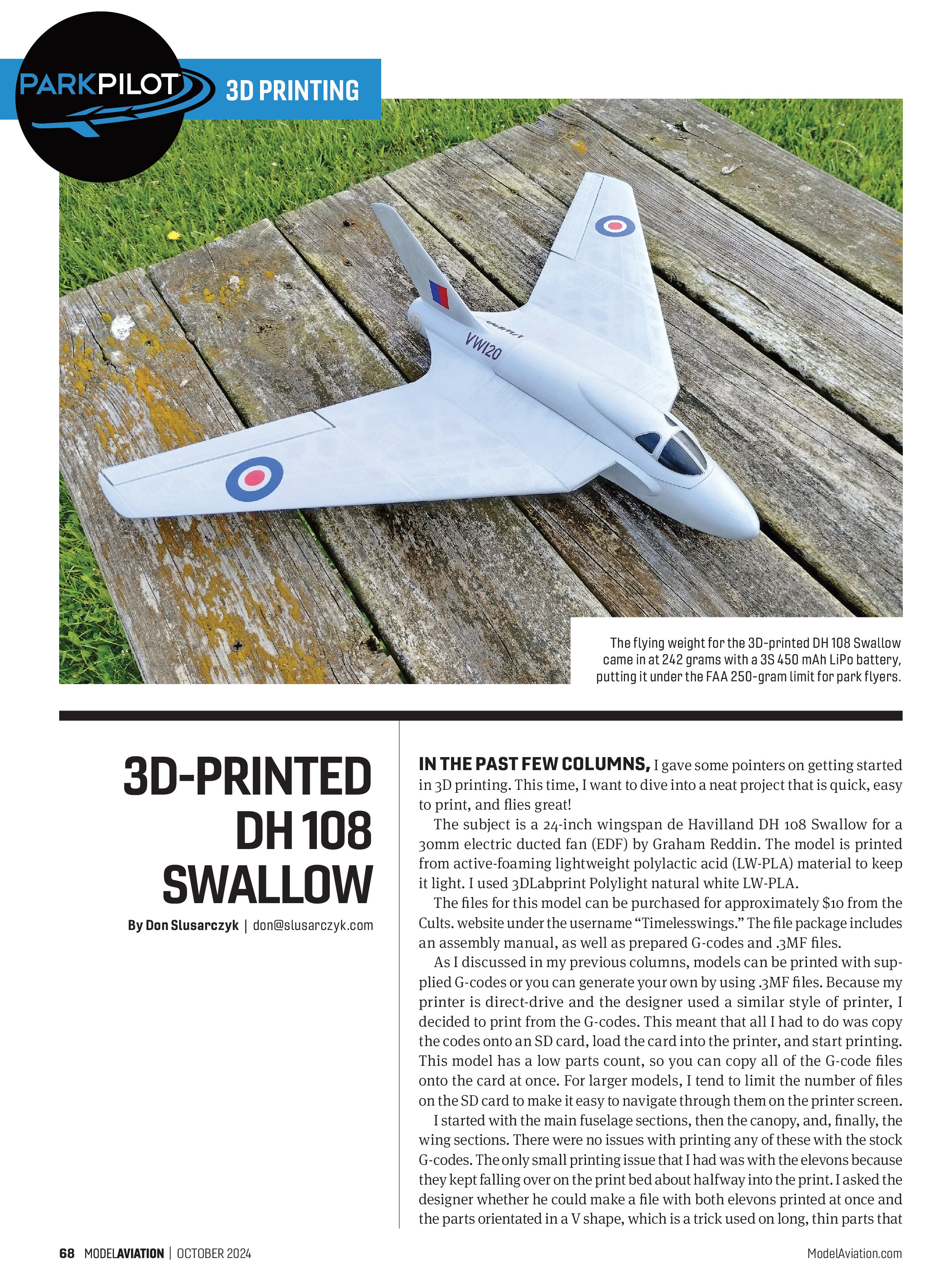
IN THE PAST FEW COLUMNS, I gave some pointers on getting started in 3D printing. This time, I want to dive into a neat project that is quick, easy to print, and flies great!
The subject is a 24-inch wingspan de Havilland DH 108 Swallow for a 30mm electric ducted fan (EDF) by Graham Reddin. The model is printed from active-foaming lightweight polylactic acid (LW-PLA) material to keep it light. I used 3DLabPrint Polylight natural white LW-PLA.
The files for this model can be purchased for approximately $10 from the Cults. website under the username “Timelesswings.” The file package includes an assembly manual, as well as prepared G-codes and .3MF files.
As I discussed in my previous columns, models can be printed with supplied G-codes or you can generate your own by using .3MF files. Because my printer is direct-drive and the designer used a similar style of printer, I decided to print from the G-codes. This meant that all I had to do was copy the codes onto an SD card, load the card into the printer, and start printing. This model has a low parts count, so you can copy all of the G-code files onto the card at once. For larger models, I tend to limit the number of files on the SD card to make it easy to navigate through them on the printer screen.
I started with the main fuselage sections, then the canopy, and, finally, the wing sections. There were no issues with printing any of these with the stock G-codes. The only small printing issue that I had was with the elevons because they kept falling over on the print bed about halfway into the print. I asked the designer whether he could make a file with both elevons printed at once and the parts orientated in a V shape, which is a trick used on long, thin parts that
are made from active-foaming LW-PLA to add stability during a print. With the modification, the elevons printed just fine. The total print time was approximately 22 hours.
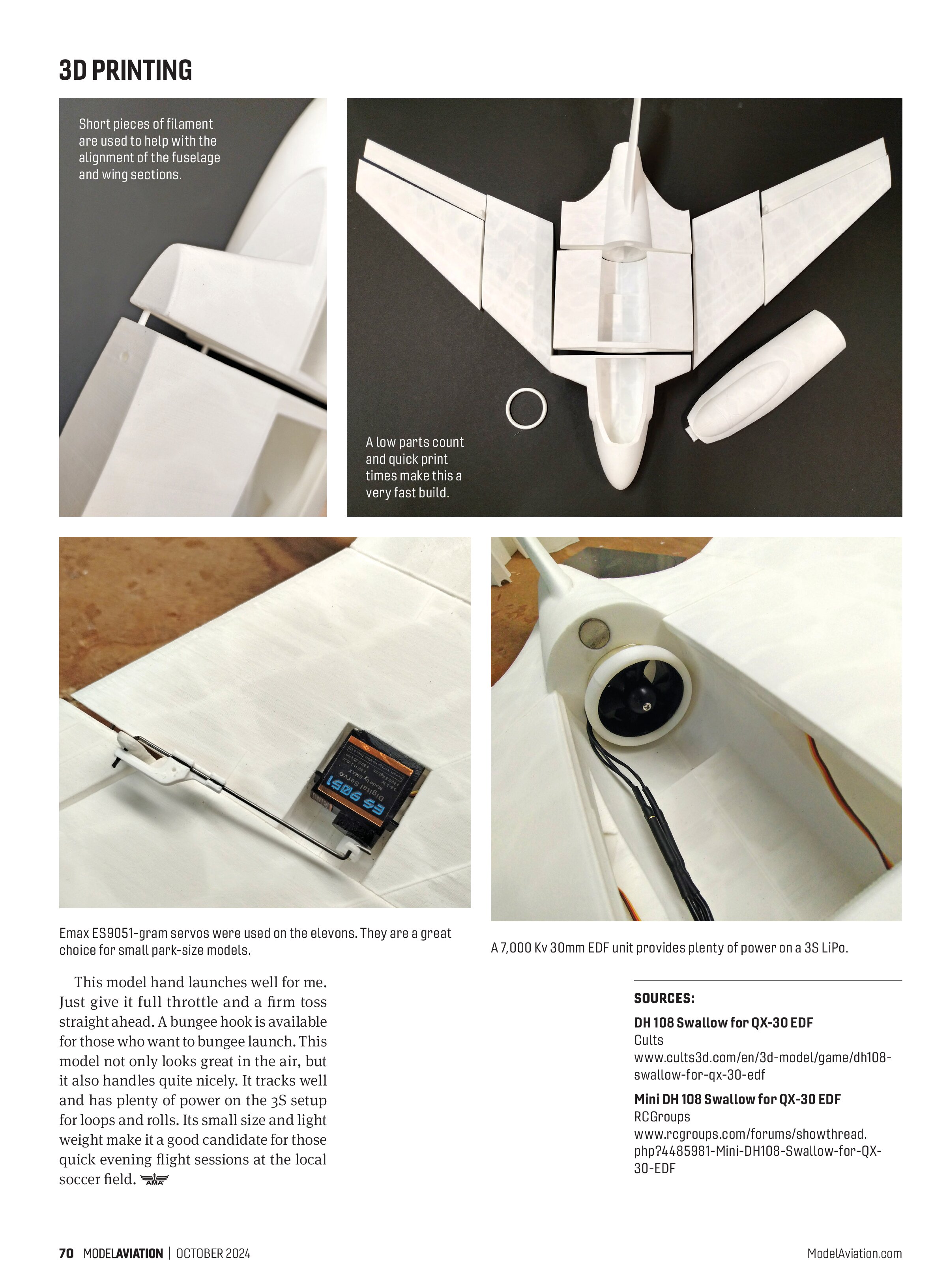
The assembly of the model is straightforward. The fuselage pieces have some small holes to help with alignment. You can use short pieces (about 20mm) of printer filament for this. I use Loctite-brand CA for my 3D-printed models, but any medium CA will work. The wing is assembled in a similar way, with short pieces of filament for alignment pins. CA hinges were used on the elevons.
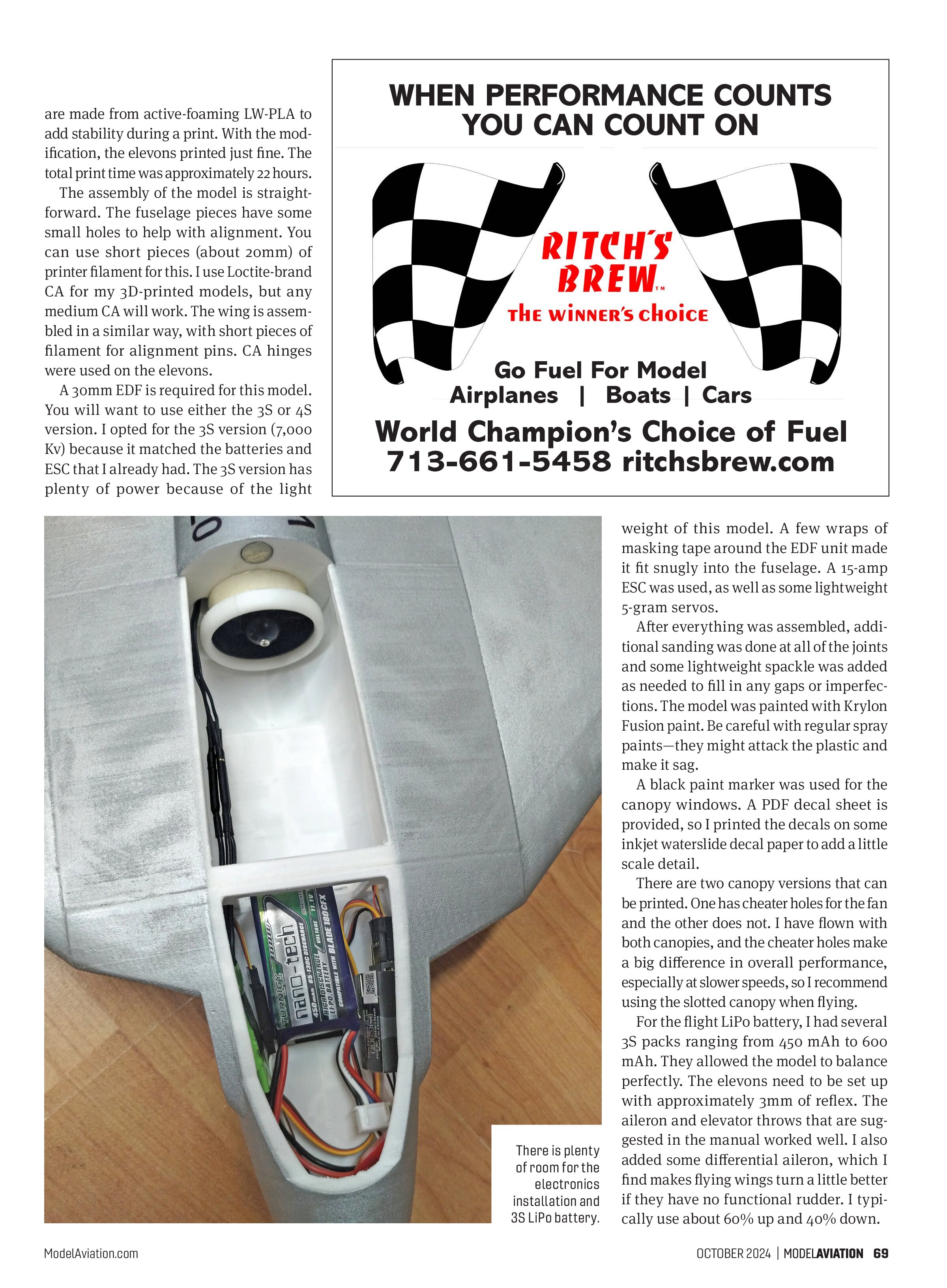
A 30mm EDF is required for this model. You will want to use either the 3S or 4S version. I opted for the 3S version (7,000 Kv) because it matched the batteries and ESC that I already had. The 3S version has plenty of power because of the light

weight of this model. A few wraps of masking tape around the EDF unit made it fit snugly into the fuselage. A 15-amp ESC was used, as well as some lightweight 5-gram servos.
After everything was assembled, additional sanding was done at all of the joints and some lightweight spackle was added as needed to fill in any gaps or imperfections. The model was painted with Krylon Fusion paint. Be careful with regular spray paints—they might attack the plastic and make it sag.
A black paint marker was used for the canopy windows. A PDF decal sheet is provided, so I printed the decals on some inkjet waterslide decal paper to add a little scale detail.
There are two canopy versions that can be printed. One has cheater holes for the fan and the other does not. I have flown with both canopies, and the cheater holes make a big difference in overall performance, especially at slower speeds, so I recommend using the slotted canopy when flying.
For the flight LiPo battery, I had several 3S packs ranging from 450 mAh to 600 mAh. They allowed the model to balance perfectly. The elevons need to be set up with approximately 3mm of reflex. The aileron and elevator throws that are suggested in the manual worked well. I also added some differential aileron, which I find makes flying wings turn a little better if they have no functional rudder. I typically use about 60% up and 40% down.


This model hand launches well for me. Just give it full throttle and a firm toss straight ahead. A bungee hook is available for those who want to bungee launch. This model not only looks great in the air, but it also handles quite nicely. It tracks well and has plenty of power on the 3S setup for loops and rolls. Its small size and light weight make it a good candidate for those quick evening flight sessions at the local soccer field.
SOURCES:
DH 108 Swallow for QX-30 EDF
Cults
www.cults3d.com/en/3d-model/game/dh108-swallow-for-qx-30-edf
Mini DH 108 Swallow for QX-30 EDF
RCGroups
www.rcgroups.com/forums/showthread.php?4485981-Mini-DH108-Swallow-for-QX-30-EDF