I AM THE AMA

DON BELFORT
Former Park Pilot columnist and builder
By Jay Smith | jays@modelaircraft.org
JAY SMITH: How did you become involved with model aviation?
DON BELFORT: My start in model aviation began, as did many others, with hand-launch and rubber-powered gliders. My father saw how much I enjoyed flight and purchased a printed wood kit of a de Havilland Chipmunk, which we built together. It seemed to take months to complete but showed such progress along the way.
One day, I was sanding the Chipmunk’s wing outside and a delivery person said to me, “My kids do not like that stuff. I have something for you.” A few days later, he returned with a couple of Fox .35 engines and two sets of metal lines along with bits and pieces. That might have been my real start into model aviation.
JS: How has model aviation impacted your life and/or career?
DB: Model aviation has taught me patience, planning, long-term goals, and safety. Much of what aeromodeling involves—attention to detail—directly assisted me in my career in the quality department of high-speed beverage production.
The safety procedures in place at all RC fields are no different from jobs requiring hardhats or dads requiring seatbelts. Being resourceful at the RC field in order to get a model flying can carry over to home and work projects.
JS: What disciplines of modeling do you currently participate in?
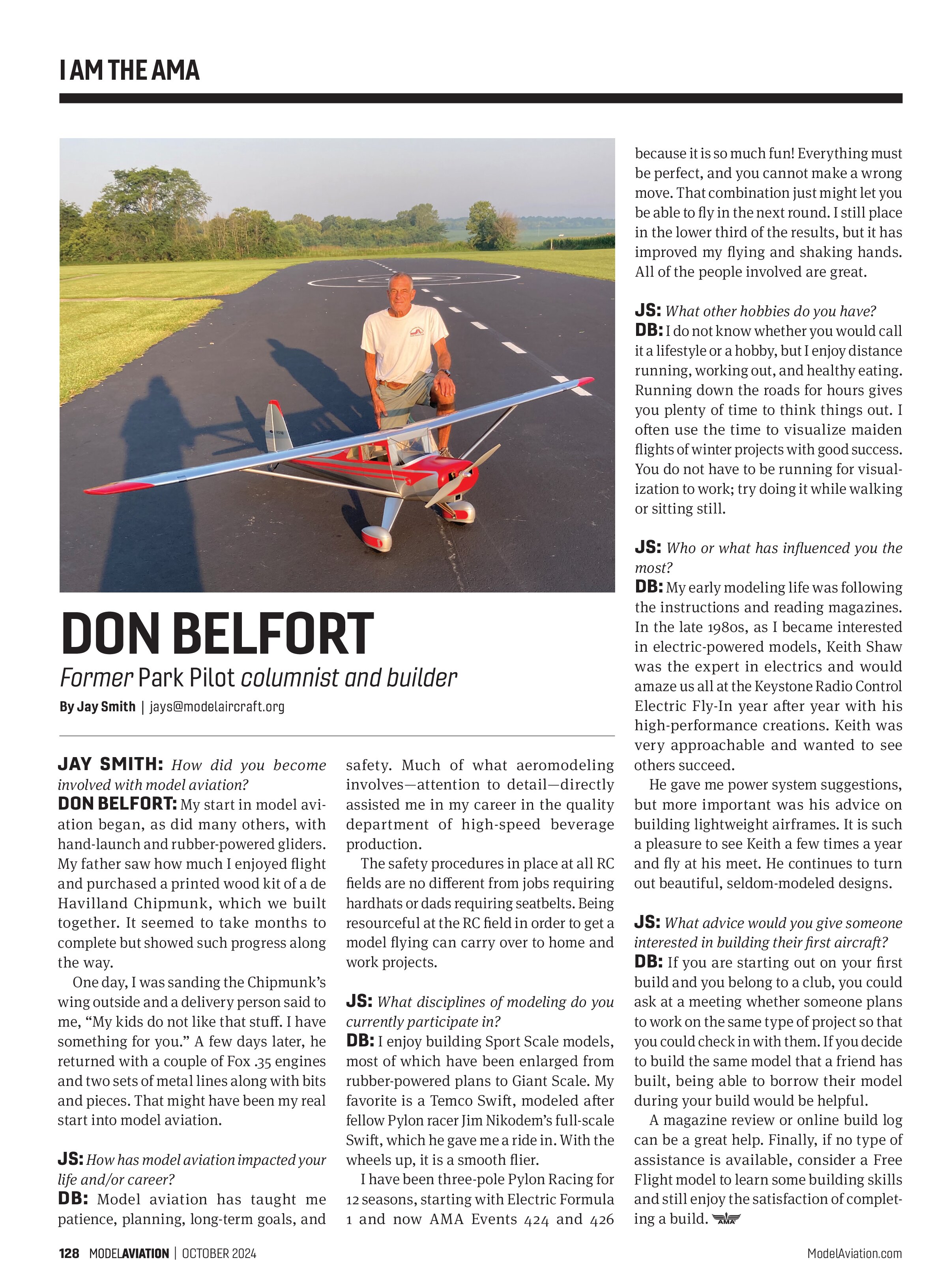
DB: I enjoy building Sport Scale models, most of which have been enlarged from rubber-powered plans to Giant Scale. My favorite is a Temco Swift, modeled after fellow Pylon racer Jim Nikodem’s full-scale Swift, which he gave me a ride in. With the wheels up, it is a smooth flier.
I have been three-pole Pylon Racing for 12 seasons, starting with Electric Formula 1 and now AMA Events 424 and 426 because it is so much fun! Everything must be perfect, and you cannot make a wrong move. That combination just might let you be able to fly in the next round. I still place in the lower third of the results, but it has improved my flying and shaking hands. All of the people involved are great.
JS: What other hobbies do you have?
DB: I do not know whether you would call it a lifestyle or a hobby, but I enjoy distance running, working out, and healthy eating. Running down the roads for hours gives you plenty of time to think things out. I often use the time to visualize maiden flights of winter projects with good success. You do not have to be running for visualization to work; try doing it while walking or sitting still.
JS: Who or what has influenced you the most?
DB: My early modeling life was following the instructions and reading magazines. In the late 1980s, as I became interested in electric-powered models, Keith Shaw was the expert in electrics and would amaze us all at the Keystone Radio Control Electric Fly-In year after year with his high-performance creations. Keith was very approachable and wanted to see others succeed.
He gave me power system suggestions, but more important was his advice on building lightweight airframes. It is such a pleasure to see Keith a few times a year and fly at his meet. He continues to turn out beautiful, seldom-modeled designs.
JS: What advice would you give someone interested in building their first aircraft?
DB: If you are starting out on your first build and you belong to a club, you could ask at a meeting whether someone plans to work on the same type of project so that you could check in with them. If you decide to build the same model that a friend has built, being able to borrow their model during your build would be helpful.
A magazine review or online build log can be a great help. Finally, if no type of assistance is available, consider a Free Flight model to learn some building skills and still enjoy the satisfaction of completing a build.