FREE FLIGHT DURATION

FFTOOLS,
THEN AND
NOW
By Louis Joyner | joynerduration@gmail.com
I’VE BEEN LUGGING AROUND Edwin F. Hamilton’s 569-page Complete Model Aircraft Manual from the 1930s for years. The book includes plenty of construction tips, as well as page-size plans for a wide variety of Indoor and Outdoor Rubber models and Scale World War I fighters. Other plans include a rubber-powered autogyro, a twin pusher, and a blimp.
Chapter 1, titled “Airplane Alphabet,” explains the parts of a Free Flight (FF) model. Chapter 2 suggests the 10 tools that are needed to build a model, which includes two pairs of pliers, a coping saw, razor blades, a pin vise, scissors, and a folding ruler.
A propeller carving knife is also suggested. To the modern reader, perhaps the most unexpected tool is a small alcohol lamp for bending bamboo, which was then a popular choice for wingtips.
In my youth, I built a few models from the book, including a twin pusher and an umbrella-tail tractor. Now, I’m building an S.E.5 and a Darmstadt D-22.
Some modeling tools seem to have been around forever. The X-Acto knife was invented in the 1930s and has been in use by modelers ever since. The Zona razor saw from the 1950s is still available, along with its companion miter box for sawing accurate 90° and 45° angles.
There is, however, more to building than cutting and sawing. Accurate construction requires tools for measuring and for careful alignment during assembly.
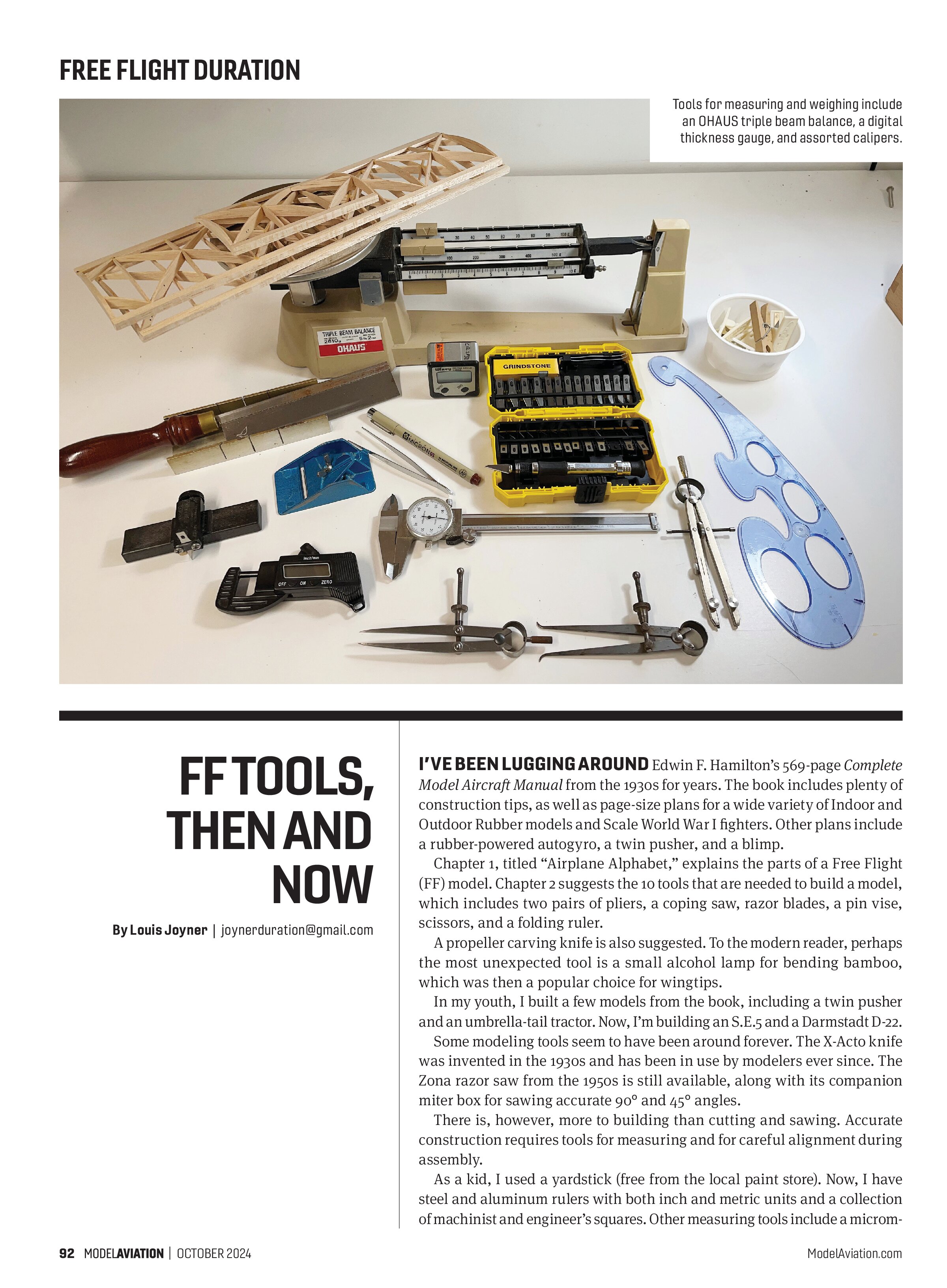
As a kid, I used a yardstick (free from the local paint store). Now, I have steel and aluminum rulers with both inch and metric units and a collection of machinist and engineer’s squares. Other measuring tools include a micrometer, digital calipers, and a protractor.
Tools don’t have to be expensive. For example, I found a plastic Pittsburgh 6-inch utility caliper at Harbor Freight for $1.79. My stainless-steel caliper cost $60. I use the plastic one for most work and pull the expensive one out when precise measurements are called for.

Watching weight is an important part of building a FF model. When selecting balsa at the local hobby shop, I use a small digital scale to weigh each piece of wood. During construction, I use an OHAUS triple beam balance to check weights. It takes up a good bit of space on the workbench, but it doesn’t use batteries or get lost on a cluttered bench. It is also the best tool I’ve found for weighing rubber motors. A new triple beam balance can cost approximately $200 or more. Used ones can be found on eBay for much less. Digital kitchen scales offer an affordable option.
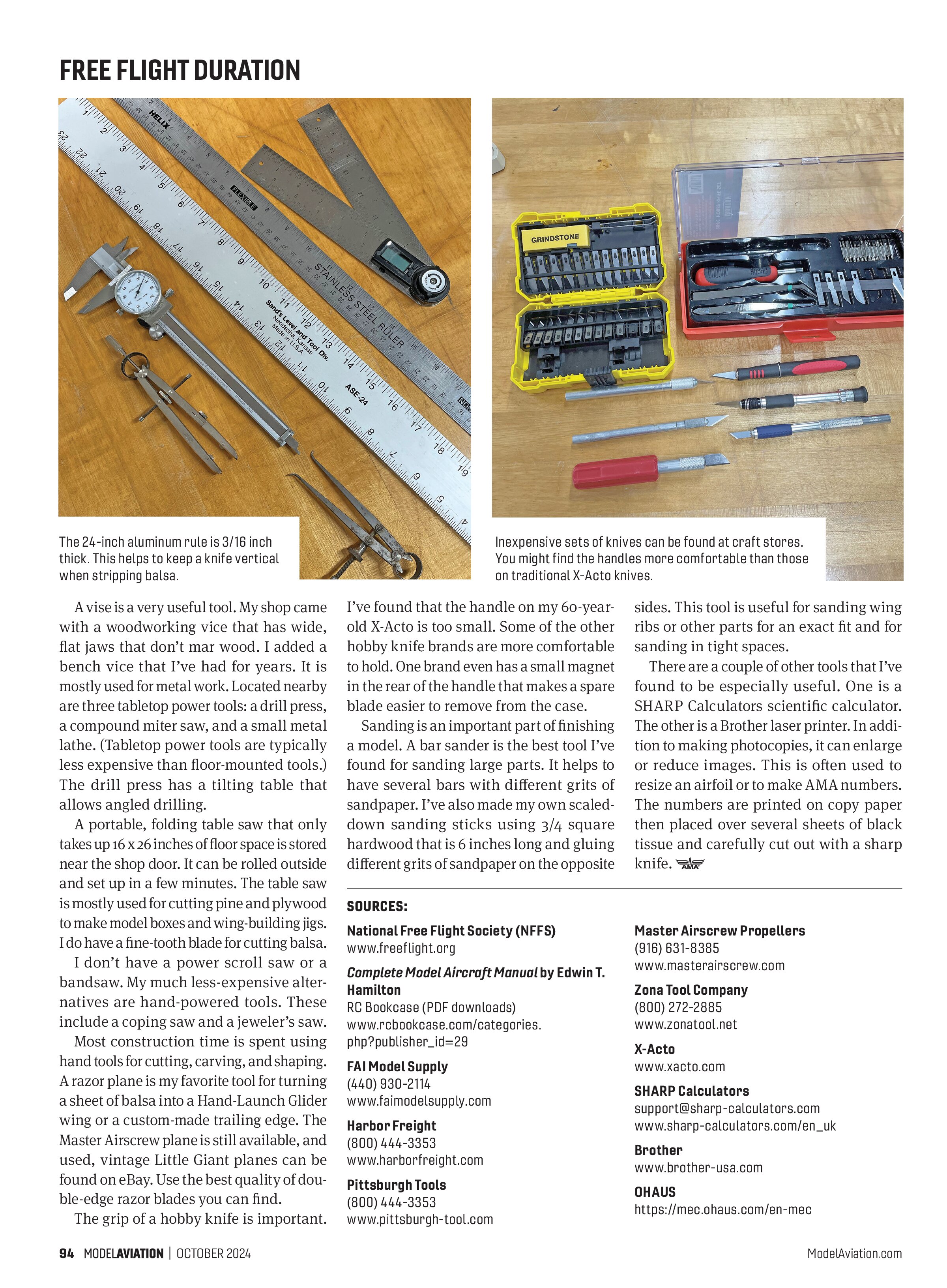
Tools are also needed to hold parts in place during assembly. Wooden clothespins are inexpensive and widely available. A pack of 50 is less than $2 at Target or Walmart. Pittsburgh offers a colorful set of six spring clamps for less than $2 at Harbor Freight.


A vise is a very useful tool. My shop came with a woodworking vice that has wide, flat jaws that don’t mar wood. I added a bench vice that I’ve had for years. It is mostly used for metal work. Located nearby are three tabletop power tools: a drill press, a compound miter saw, and a small metal lathe. (Tabletop power tools are typically less expensive than floor-mounted tools.) The drill press has a tilting table that allows angled drilling.
A portable, folding table saw that only takes up 16 x 26 inches of floor space is stored near the shop door. It can be rolled outside and set up in a few minutes. The table saw is mostly used for cutting pine and plywood to make model boxes and wing-building jigs. I do have a fine-tooth blade for cutting balsa.
I don’t have a power scroll saw or a bandsaw. My much less-expensive alternatives are hand-powered tools. These include a coping saw and a jeweler’s saw.
Most construction time is spent using hand tools for cutting, carving, and shaping. A razor plane is my favorite tool for turning a sheet of balsa into a Hand-Launch Glider wing or a custom-made trailing edge. The Master Airscrew plane is still available, and used, vintage Little Giant planes can be found on eBay. Use the best quality of double-edge razor blades you can find.
The grip of a hobby knife is important. I’ve found that the handle on my 60-year-old X-Acto is too small. Some of the other hobby knife brands are more comfortable to hold. One brand even has a small magnet in the rear of the handle that makes a spare blade easier to remove from the case.
Sanding is an important part of finishing a model. A bar sander is the best tool I’ve found for sanding large parts. It helps to have several bars with different grits of sandpaper. I’ve also made my own scaled-down sanding sticks using 3/4 square hardwood that is 6 inches long and gluing different grits of sandpaper on the opposite sides. This tool is useful for sanding wing ribs or other parts for an exact fit and for sanding in tight spaces.
There are a couple of other tools that I’ve found to be especially useful. One is a SHARP Calculators scientific calculator. The other is a Brother laser printer. In addition to making photocopies, it can enlarge or reduce images. This is often used to resize an airfoil or to make AMA numbers. The numbers are printed on copy paper then placed over several sheets of black tissue and carefully cut out with a sharp knife.
SOURCES:
National Free Flight Society (NFFS)
www.freeflight.org
Complete Model Aircraft Manual by Edwin T. Hamilton
RC Bookcase (PDF downloads)
www.rcbookcase.com/categories.php?publisher_id=29
FAI Model Supply
(440) 930-2114
www.faimodelsupply.com
Harbor Freight
(800) 444-3353
www.harborfreight.com
Pittsburgh Tools
(800) 444-3353
www.pittsburgh-tool.com
Master Airscrew Propellers
(916) 631-8385
www.masterairscrew.com
Zona Tool Company
(800) 272-2885
www.zonatool.net
X-Acto
www.xacto.com
SHARP Calculators
support@sharp-calculators.com
www.sharp-calculators.com/en_uk
Brother
www.brother-usa.com