FOCAL POINT
Interested in sharing your handiwork? Visit www.ModelAviation.com for submission guidelines.
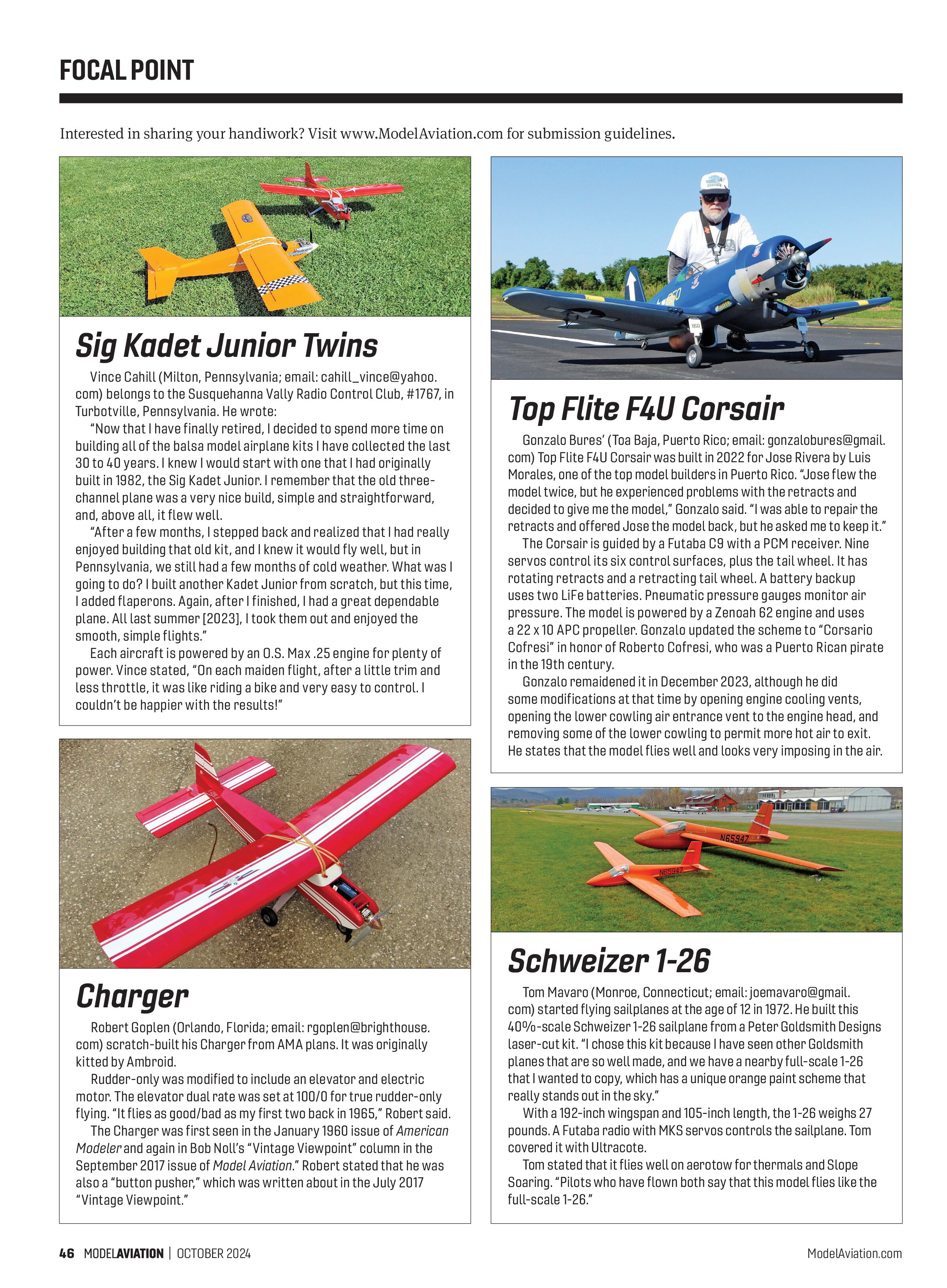
Sig Kadet Junior Twins
Vince Cahill (Milton, Pennsylvania; email: cahill_vince@yahoo.com) belongs to the Susquehanna Valley Radio Control Club, #1767, in Turbotville, Pennsylvania. He wrote:
“Now that I have finally retired, I decided to spend more time on building all of the balsa model airplane kits I have collected the last 30 to 40 years. I knew I would start with one that I had originally built in 1982, the Sig Kadet Junior. I remember that the old three-channel plane was a very nice build, simple and straightforward, and, above all, it flew well.”
“After a few months, I stepped back and realized that I had really enjoyed building that old kit, and I knew it would fly well, but in Pennsylvania, we still had a few months of cold weather. What was I going to do? I built another Kadet Junior from scratch, but this time, I added flaperons. Again, after I finished, I had a great dependable plane. All last summer [2023], I took them out and enjoyed the smooth, simple flights.”
Each aircraft is powered by an O.S. Max .25 engine for plenty of power. Vince stated, “On each maiden flight, after a little trim and less throttle, it was like riding a bike and very easy to control. I couldn’t be happier with the results!”

Charger
Robert Goplen (Orlando, Florida; email: rgoplen@brightthouse.com) scratch-built his Charger from AMA plans. It was originally kitted by Ambroid.
Rudder-only was modified to include an elevator and electric motor. The elevator dual rate was set at 100/0 for true rudder-only flying. “It flies as good/bad as my first two back in 1965,” Robert said.
The Charger was first seen in the January 1960 issue of American Modeler and again in Bob Noll’s “Vintage Viewpoint” column in the September 2017 issue of Model Aviation. Robert stated that he was also a “button pusher,” which was written about in the July 2017 “Vintage Viewpoint.”

Top Flite F4U Corsair
Gonzalo Bures (Toa Baja, Puerto Rico; email: gonzalohbures@gmail.com) Top Flite F4U Corsair was built in 2022 for Jose Rivera by Luis Morales, one of the top model builders in Puerto Rico. “Jose flew the model twice, but he experienced problems with the retracts and decided to give me the model,” Gonzalo said. “I was able to repair the retracts and offered Jose the model back, but he asked me to keep it.”
The Corsair is guided by a Futaba C9 with a PCM receiver. Nine servos control its six control surfaces, plus the tail wheel. It has rotating retracts and a retracting tail wheel. A battery backup uses two LiFe batteries. Pneumatic pressure gauges monitor air pressure. The model is powered by a Zenoah 62 engine and uses a 22 x 10 APC propeller. Gonzalo updated the scheme to “Corsario Cofresí” in honor of Roberto Cofresí, who was a Puerto Rican pirate in the 19th century.
Gonzalo remanented it in December 2023, although he did some modifications at that time by opening engine cooling vents, opening the lower cowling air entrance vent to the engine head, and removing some of the lower cowling to permit more hot air to exit. He states that the model flies well and looks very imposing in the air.

Schweizer 1-26
Tom Mavaro (Monroe, Connecticut; email: joemavaro@gmail.com) started flying sailplanes at the age of 12 in 1972. He built this 40%-scale Schweizer 1-26 sailplane from a Peter Goldsmith Designs laser-cut kit. “I chose this kit because I have seen other Goldsmith planes that are so well made, and we have a nearby full-scale 1-26 that I wanted to copy, which has a unique orange paint scheme that really stands out in the sky.”
With a 192-inch wingspan and 105-inch length, the 1-26 weighs 27 pounds. A Futaba radio with MKS servos controls the sailplane. Tom covered it with Ultracote.
Tom stated that it flies well on aerotow for thermals and Slope Soaring. “Pilots who have flown both say that this model flies like the full-scale 1-26.”

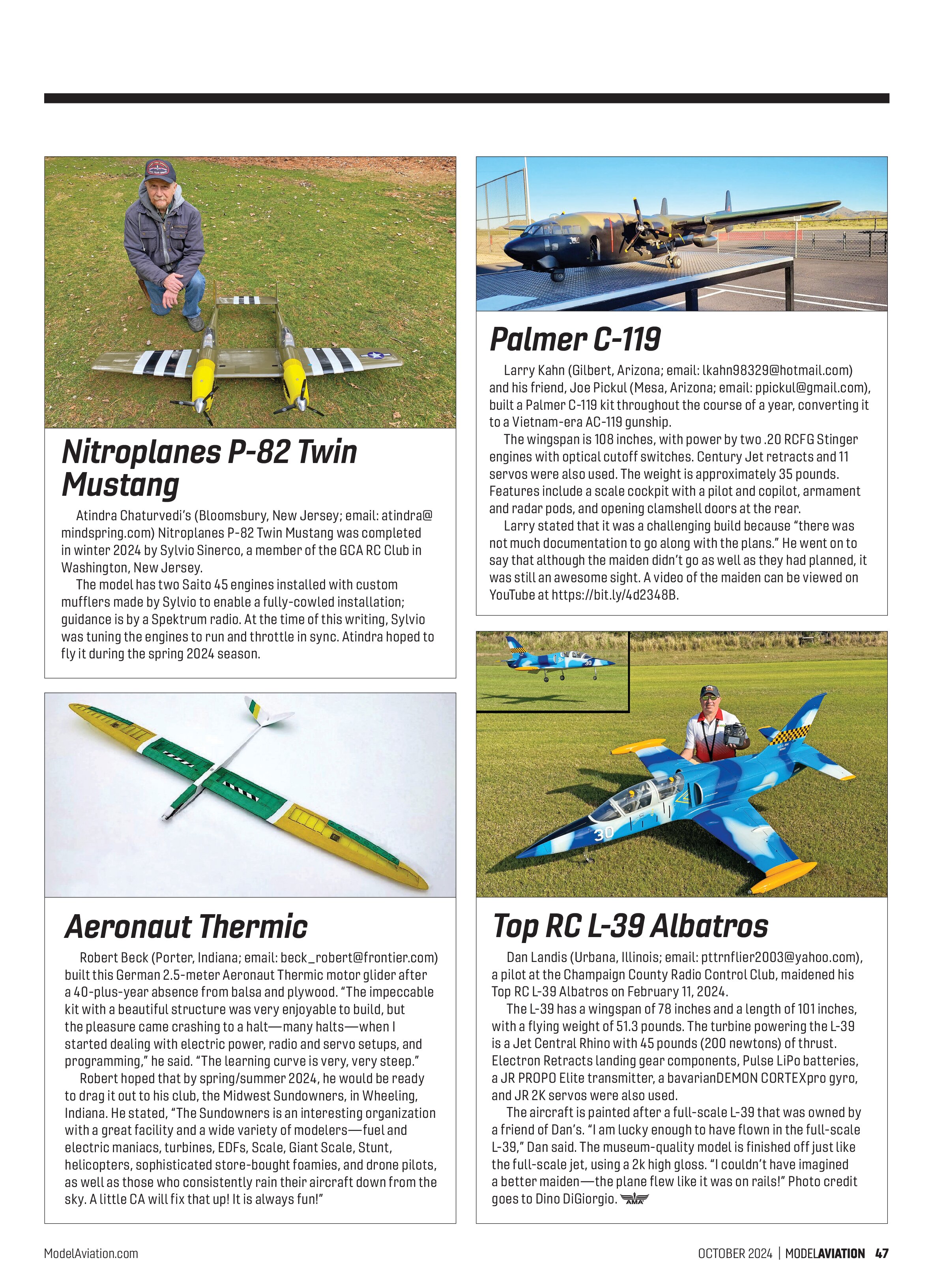
Nitroplanes P-82 Twin Mustang
Atindra Chaturvedi’s (Bloomsbury, New Jersey; email: atindra@mindspring.com) Nitroplanes P-82 Twin Mustang was completed in winter 2024 by Sylvio Sinerco, a member of the GCA RC Club in Washington, New Jersey.
The model has two Saito 45 engines installed with custom mufflers made by Sylvio to enable a fully-cowled installation, guidance is by a Spektrum radio. At the time of this writing, Sylvio was tuning the engines to run and throttle in sync. Atindra hoped to fly it during the spring 2024 season.

Aeron aut Thermic
Robert Beck (Porter, Indiana; email: beck_robert@frontier.com) built this German 2.5-meter Aeronaut Thermic motor glider after a 40-plus-year absence from balsa and plywood. “The impeccable kit with a beautiful structure was very enjoyable to build, but the pleasure came crashing to a halt— many halts—when I started dealing with electric power, radio and servo setups, and programming,” he said. “The learning curve is very, very steep.”
Robert hoped that by spring/summer 2024, he would be ready to drag it out to his club, the Midwest Sundowners, in Wheeling, Indiana. He stated, “The Sundowners is an interesting organization with a great facility and a wide variety of modelers—fuel and electric maniacs, turbines, EDFs, Scale, Giant Scale, Stunt, helicopters, sophisticated store-bought foamies, and drone pilots, as well as those who consistently rain their aircraft down from the sky. A little CA will fix that up! It is always fun!”

Palmer C-119
Larry Kahn (Gilbert, Arizona; email: lkahn98329@hotmail.com) and his friend, Joe Pickul (Mesa, Arizona; email: ppickul@gmail.com), built a Palmer C-119 kit throughout the course of a year, converting it to a Vietnam-era AC-119 gunship.
The wingspan is 108 inches, with power by two .20 RCFG Stinger engines with optical cutoff switches. Century Jet retracts and 11 servos were also used. The weight is approximately 35 pounds. Features include a scale cockpit with a pilot and copilot, armament and radar pods, and opening clamshell doors at the rear.
Larry stated that it was a challenging build because “there was not much documentation to go along with the plans.” He went on to say that although the maiden didn’t go as well as they had planned, it was still an awesome sight. A video of the maiden can be viewed on YouTube at https://bit.ly/4d2348B.

Top RC L-39 Albatros
Dan Landis (Urbana, Illinois; email: pttrnflier2003@yahoo.com), a pilot at the Champaign County Radio Control Club, maidened his Top RC L-39 Albatros on February 11, 2024.
The L-39 has a wingspan of 78 inches and a length of 101 inches, with a flying weight of 51.3 pounds. The turbine powering the L-39 is a Jet Central Rhino with 45 pounds (200 newtons) of thrust. Electron Retracts landing gear components, Pulse LiPo batteries, a JR PROPO Elite transmitter, a bavarianDEMON CORТEXpro gyro, and JR 2K servos were also used.
The aircraft is painted after a full-scale L-39 that was owned by a friend of Dan’s. “I am lucky enough to have flown in the full-scale L-39,” Dan said. The museum-quality model is finished off just like the full-scale jet, using a 2K high gloss. “I couldn’t have imagined a better maiden—the plane flew like it was on rails!”