LESS IS MORE: ELIMINATE OVERCONTROLLING
By Dave Scott | lusrcrfs@gmail.com
DESCRIPTIONS OF WHAT the airplane or pilot are supposed to do—or not do—are everywhere. My name is Dave Scott. I look forward to sharing with you my experiences of professionally instructing thousands of pilots of all skill levels to explain how to actually improve pilot performance.
Those who think that stick time and age are the primary factors that dictate pilot success, versus the quality of the practice, might not relate to everything in my column. However, if you’re seeking to fly with more purpose instead of just boring holes in the sky, I assure you that there is a cause and effect for every outcome that a pilot experiences. In fact, in my experience, it’s just a few easily correctable errors that are responsible for hampering most pilots’ progress. A simple change in thinking and approach is often all it takes to immediately improve performance.
Cause and Effect
Proficient pilots, or “the ones who make it look easy,” can be seen routinely landing near the front of the runway on the centerline. They can take control of any type of airplane and fly it well right from the start. They can link together several maneuvers in sequence and continue to perform at a high level, even in the wind.
Proficient pilots are said to be “ahead of the airplane,” or that they “know how to fly.” By definition, knowing and being ahead of the airplane points to various thought processes—rather than relying on reacting to the airplane, proficient pilots input consistent commands with the aircraft predictably following along. Having consolidated the correct techniques, proficient pilots bypass the need for extraneous adjustments, making it look easy and giving little opportunity to the wind to exploit deviations or mistakes!

In this column, I will address the subject of overcontrolling. Most fliers assume that overcontrolling is making large, aggressive inputs, but that is often not the case. The most common forms of overcontrolling (which can ultimately lead to larger inputs) are making too many inputs and holding them in too long, particularly the ailerons!
If you don’t like what the airplane is doing, stop!
The root of holding inputs in too long is when a reactive pilot gets behind the airplane. In short, reactive pilots literally have to make the mistake before realizing that they’ve held an input in too long.
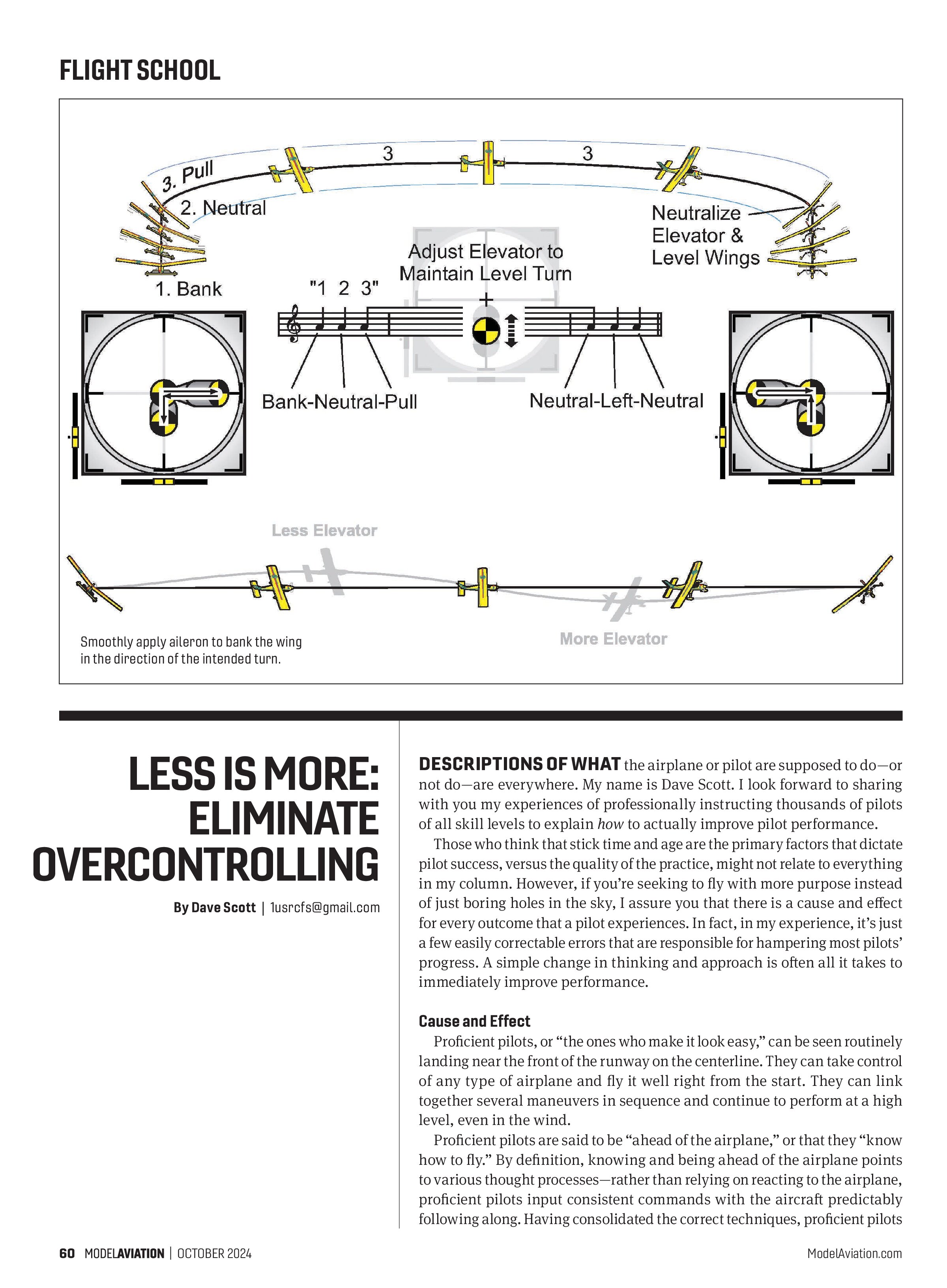
A prime example is encountered when entering a turn. (Note: The following applies to conventional control without using the self-righting SAFE mode.) New pilots are often told to avoid overcontrolling and to keep their turns level; however, the fact that the aileron input has to be neutralized early in the turn to avoid overbanking and entering a downward spiral is often not mentioned.
Nearly all new pilots will hold in the aileron at the start of a turn, watching the airplane for cues of what to do next. Upon seeing the airplane starting to descend, they react by pulling up-elevator, yet, with the aileron still held in, the result is a panic recovery or crash. Although it is common to blame wind, radio problems, stalls, and the like, the reason they struggle to recover is because pulling up-elevator while still holding in aileron will only make the spiral tighter.
Consciously or unconsciously, most pilots come to the wrong conclusion that diving turns are to be dealt with by applying opposite aileron to shallow the bank angle. As a result, the vast majority of pilots in our sport pick up the bad habit early on of making constant aileron adjustments throughout the turn.
The problem with doing so is that the amount of elevator required to keep a turn level varies with bank angle. For example, a steeper bank requires more elevator to keep the turn level, while a shallower bank requires less elevator. Pilots who continually vary the bank angle also have to juggle constant elevator adjustments. Needless to say, this technique uses up a lot of brain bytes in the process. This is largely why many pilots prefer to fly “one mistake high” to give themselves more time to work through things.
The problem with flying higher is that you have to eventually lower the airplane to land, at which time the pucker factor shoots through the roof! The combination of a higher workload, irregular turns, and steeply approaching the runway leads to many of the landing difficulties that RC pilots experience.
The solution is to pay attention to neutralizing the aileron input early in the turn to avoid overbanking in the first place! Proficient pilots, rather than reacting to the wing, smoothly apply aileron to bank the wing, return the aileron input to neutral, and then focus on keeping the turn level throughout by using elevator. The average aileron bank input takes the same amount of time as saying or thinking “in-and-out.” Returning to neutral also provides a distinct point to consistently gauge the size of your aileron and elevator inputs, making correct amounts

easier to repeat and incorrect amounts easier to fix.
Most importantly, with a fixed bank angle (versus one that is constantly changing), pilots can focus entirely on the elevator to keep the turn level and, as such, do a much better job at it.
Mastering level turns instills confidence to set up landings lower to the ground. This is crucial to pilots being able to judge when to start reducing power and controlling their landing touchdown, knowing that the airplane won’t have far to go before touching down from a lower approach.
When proficient pilots wish to perform a tighter or wider turn, rather than holding in the aileron longer or shorter, they simply apply a larger or smaller aileron input that follows the same smooth aileron “in-and-out” cadence used to initiate all of the turns. If a turn does need a touch of aileron to steepen or shallow the bank, be careful to input a brief (not held in) bump of aileron to do so without overcontrolling.
If you’d like to see these inputs in action, I have numerous videos on my YouTube channel, @1RCFlightSchool. The link is listed in “Sources.”
Less Is More
The next most common example of over-controlling is making too many inputs. With the exception of 3D stunt flying, there is never an instance in which a pilot needs to make constant corrections. If you find yourself doing so, it is likely that you’re correcting a lot of your own corrections.
It’s not unlike when most of us learned to drive. We initially thought that we had to keep making inputs to keep the car going where we wanted. We were also prone to holding in corrections too long, therefore taking a deviation one way and creating a new deviation. Doing so triggered a cycle of constant left and right inputs just to drive in a straight line. In aviation, we see the worst example of this during landing and while flying in wind, when pilots think that they need to work harder to ensure a positive outcome. In fact, it is just the opposite!
Flying low to the ground and/or in wind is not necessarily harder; rather, it is less forgiving to overcontrolling. The fact is, the majority of problems that people have while flying in wind are that the wind exaggerates the bad habits of holding in aileron and making too many inputs that pilots can otherwise get away with in more forgiving, calmer conditions.
When I’m instructing pilots to land, especially in the wind, I will occasionally ask them to remove their fingers from the control stick, at which time the wind and zigzagging magically seem to subside. In other words, what they thought was battling with the wind was, in fact, overcontrolling.
Next time there’s some wind and you find yourself battling to fly straight and level, take your hands off the controls (at a safe height, of course) and you’ll almost certainly discover that the wind is not nearly as bad as what you were making it seem. Pilots need to approach the critical phases of landing and flying in wind in the same way that we do when we drive on icy roads in the Midwest. Because of the unforgiving nature of driving on slippery roads, we learn very early that it is vital to keep corrections small and to be patient. If we overcontrol (make too large of a correction) and lose traction with the road, we’ll end up crashing. When a deviation does need correcting, we gently nudge the wheel, followed possibly by another nudge if the first proves to not be enough, but ultimately being mindful to keep our adjustments brief, small, and minimal.
This process is known in full-scale aviation as “shaving,” which is used in situations when high-performance aircraft with lots of control authority are flown and overcontrolling is not an option! Doing so results in holding straighter lines (easier landings) and less opportunity for the wind to exaggerate deviations, and our corrections become barely visible to onlookers.
I hope you give these techniques a try and experience what all good pilots already know: “A superior pilot uses their superior know-how to avoid situations that might require the use of their superior skill.”
A note about SAFE mode: In my experience, pilots who learn to fly in SAFE mode, and thereby hold in left or right to turn, are not learning bad habits. Whether learning with conventional control or making the transition out of SAFE mode, having the correct understanding of the proper technique is the key in either case.
Happy flying!

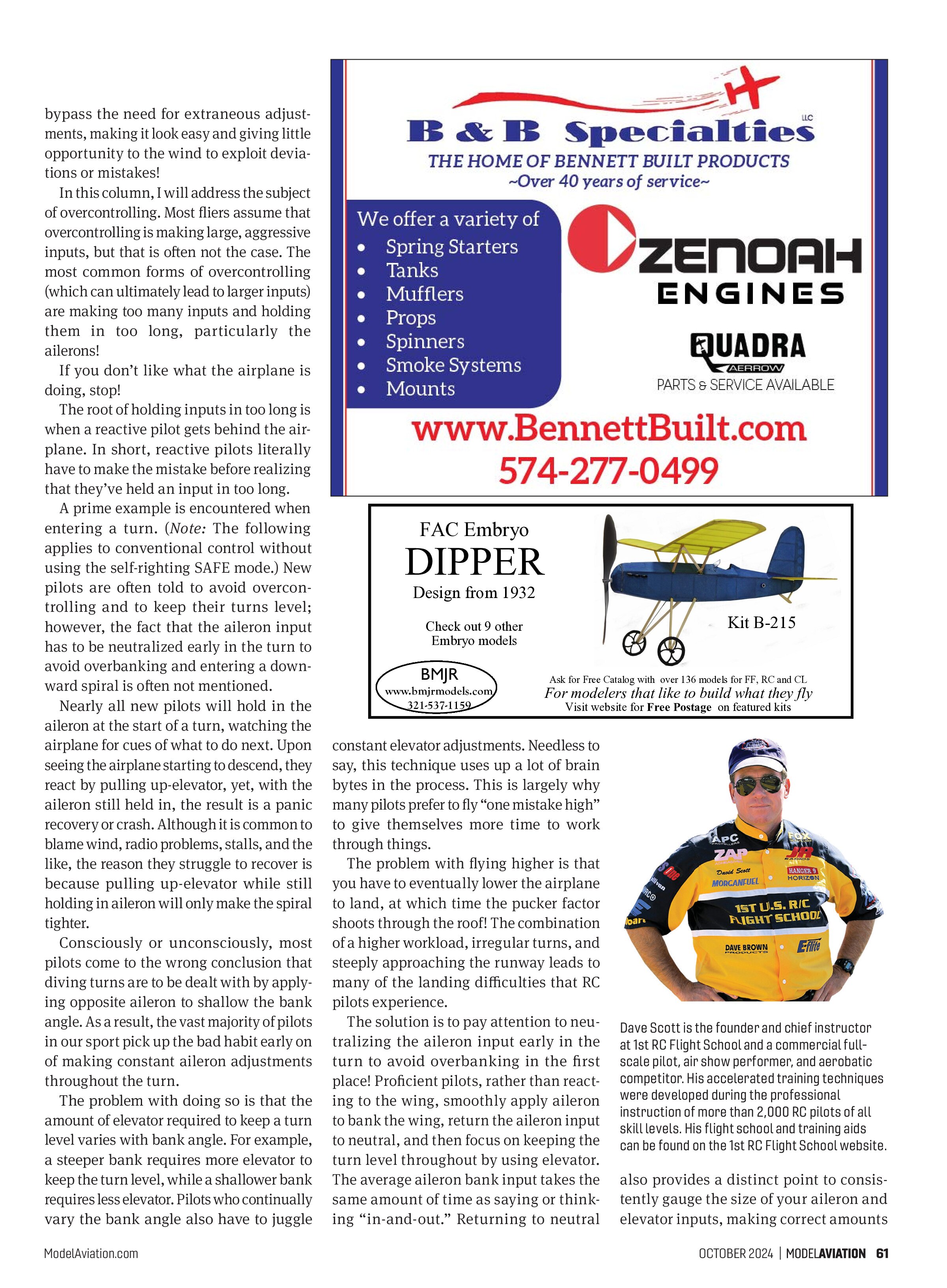
Quickly neutralize the aileron input to stop the wing from banking more.

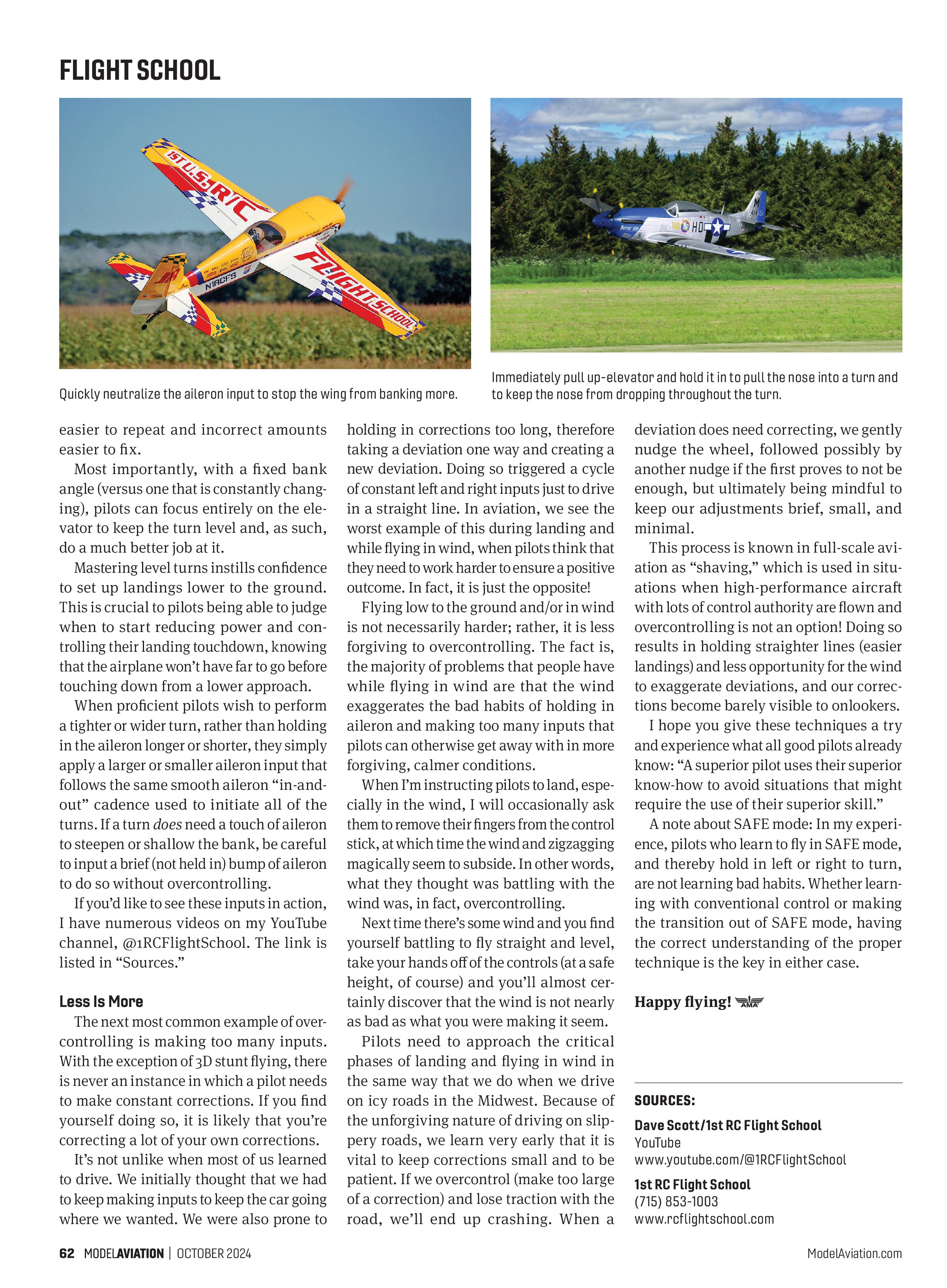
Immediately pull up-elevator and hold it in to pull the nose into a turn and to keep the nose from dropping throughout the turn.
SOURCES:
Dave Scott/1st RC Flight School
YouTube
www.youtube.com/@1RCFlightSchool
1st RC Flight School
(715) 853-1003
www.rcflightschool.com