ELECTRIC PROJECTS SMALL AND LARGE
By Terry Dunn | terrydunn74@gmail.com
I JUST RETURNED HOME from the 2024 AMA National Fun Fly that was held June 28-30 at the International Aeromodeling Center (IAC) in Muncie, Indiana, which is also the headquarters for AMA. This was my first time attending the AMA National Fun Fly, as well as my first time flying at the IAC. It was an experience like no other.
There were so many different things to do at the fun-fly that I had trouble fitting it all into three days. Of course, there was a great variety of flying machines that ranged from tiny ultramicro airplanes to glow-powered Free Flight models to large turbine-powered jets, and even full-scale powered paramotors. Everyone shared the sky in harmony.
If attendees ever tired of things that fly (impossible!), there was also fun to be had with surface vehicles. Numerous RC boats navigated the pond in front of the AMA Headquarters building. I heard stories about a huge model of the RMS Titanic that could be sunk and resurrected on command! However, I missed seeing it when I visited the pond.
There was also an RC car track, where newcomers could take a turn at the wheel. Laughter echoed across the tarmac as more than a few dramatic crashes took place. Those cars took a licking and kept on ticking.
One of my highlights of the weekend was taking a ride in the Goodfolk & O’Tyme 1930 New Standard biplane. This was my first experience riding in an open cockpit airplane. The front cockpit holds up to four people, so I was able to share the ride with two of my buddies. The sound of the wind whistling through the flying wires was almost melodic, which contrasted sharply with the vibration and heat emitted from the large radial engine

just a few feet away. The overall experience was a true thrill. I definitely recommend it.
A few passing showers on Saturday provided the perfect excuse to explore the National Model Aviation Museum. It is top-notch, with amazing artifacts that cover the full breadth of our hobby. If you are ever near Muncie, be sure to carve out some time for the museum. It’s free for AMA members. You won’t regret it.
If you missed the AMA National Fun Fly this year, start planning for next year. Even if you do not attend it, make an effort to attend an RC event outside of your normal routine. I always get a burst of inspiration when I meet new modelers and admire their creations.
Sparky's DeGoose
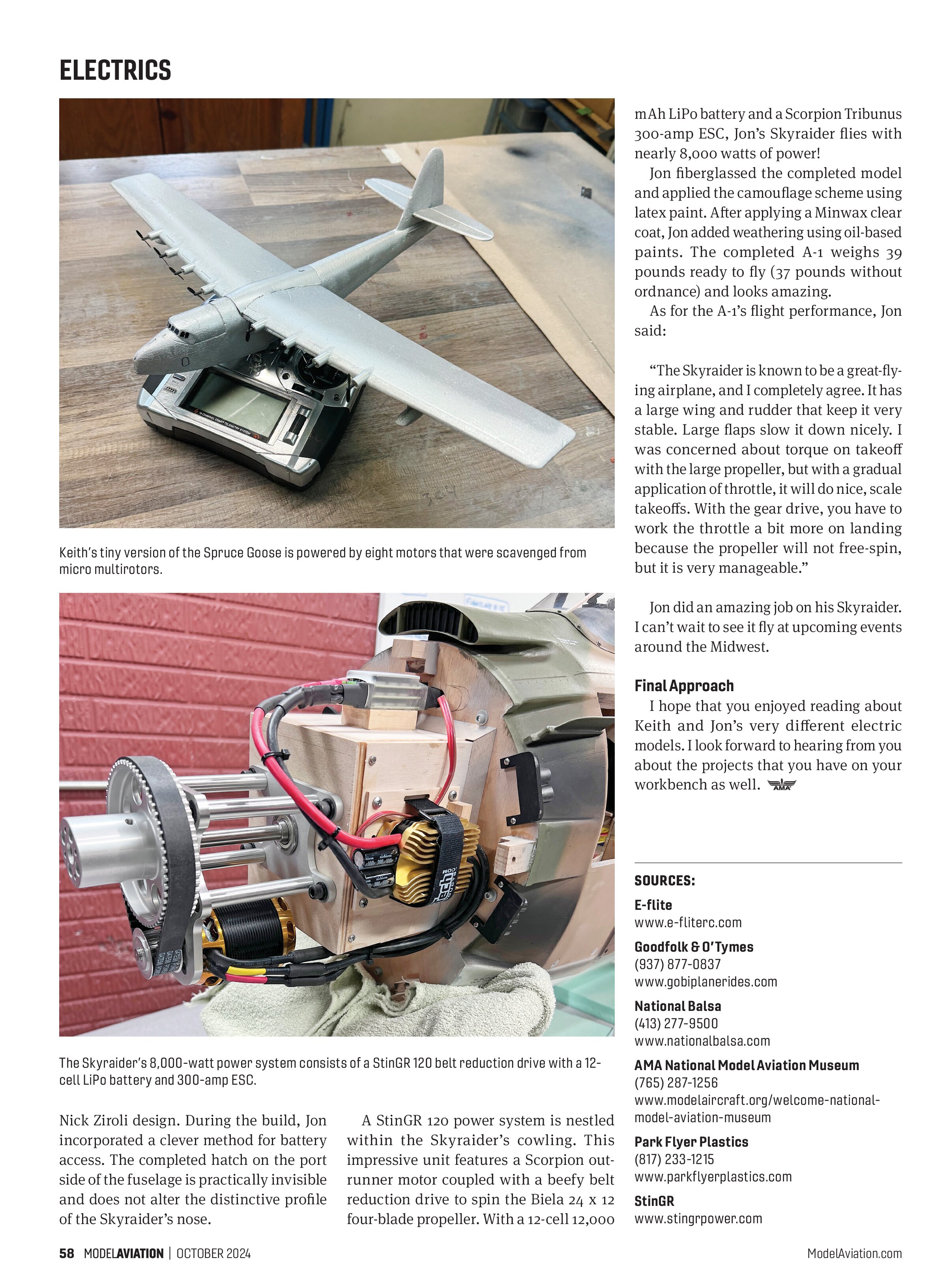
Keith Sparks is a modeler who needs no introduction. Not only is Keith the proprietor of Park Flyer Plastics, but he is also a prolific builder of interesting models. His latest creation is an ultramicro-size rendition of the Spruce Goose that he made with Depron foam. Just as the full-scale airplane earned its nickname because of its wooden structure, Keith’s downsized version has been dubbed the Depron Goose, or DeGoose for short.
Keith literally wrote the book on scratch-building foam models, which is titled Building with Foam. You can find the book on the Park Flyer Plastics website. Keith used several of the techniques outlined in the book to create his 23-inch wingspan Spruce Goose.
Of particular interest is the power system. Keith used eight tiny, brushed motors that he scavenged from broken micro multirotor drones. He wired the motors so that there are four parallel sets of two motors wired in series. The motors are controlled with a single GWS 2-amp ESC, and the model is powered with a two-cell 150 mAh battery. Two E-flite 3.6-gram servos actuate the rudder and elevator via a Corona micro receiver. The total flying weight of the tiny seaplane is just 2 ounces!
The initial test flights began with hand launches over grass. Afterward, Keith enlarged the rudder for better yaw authority. He said that he can now fly the model in wind up to 7 mph. He is also considering the addition of ailerons. And, of course, Keith is preparing the DeGoose for flights off of water. That will be something to see!
Giant Skyraider
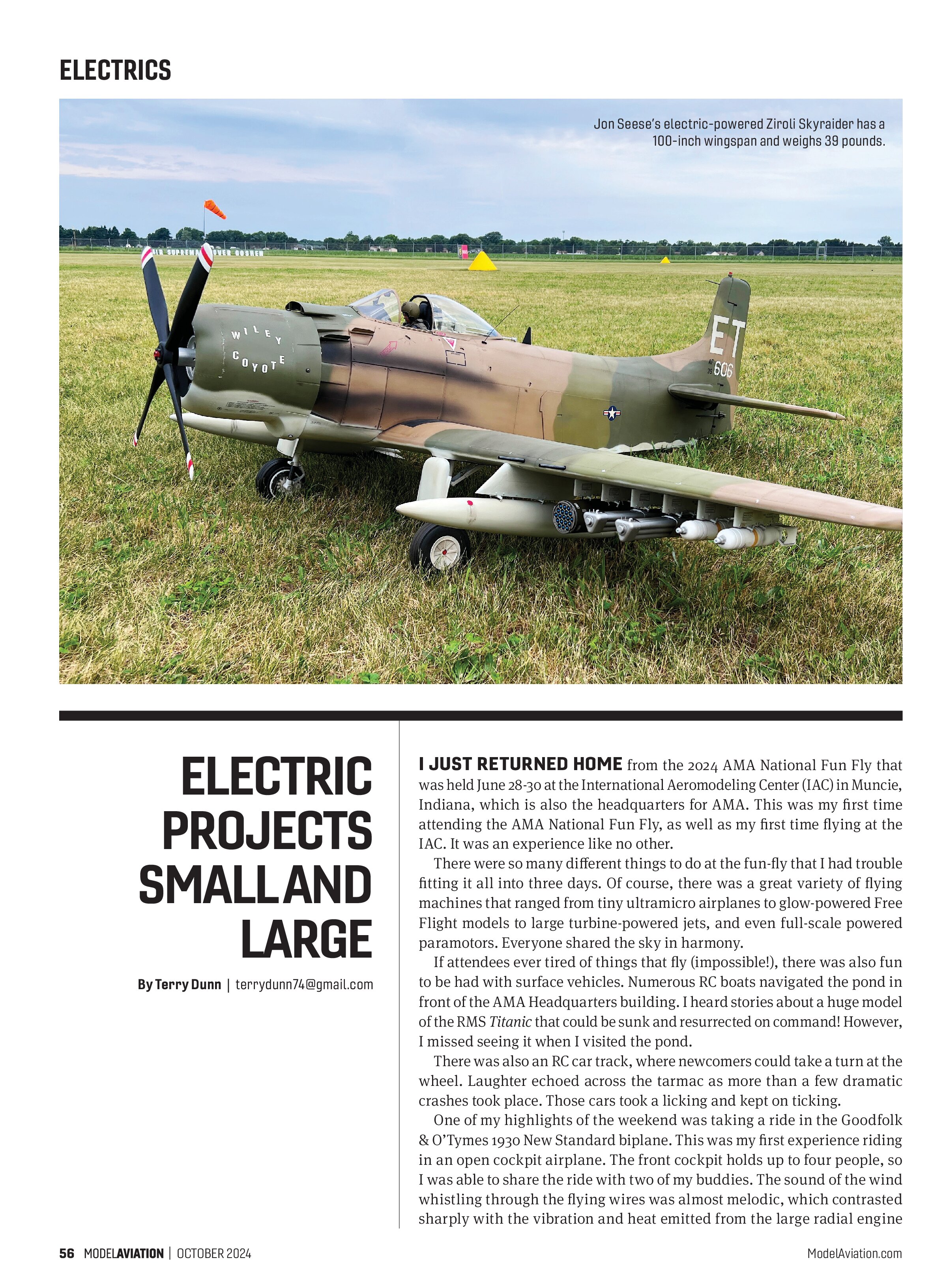
At the other end of the size spectrum is Jon Seese’s Douglas A-1 Skyraider with a 100-inch wingspan. Jon wanted a warbird model that could haul lots of ordnance on the wing. A Skyraider is tough to beat in that category. He also wanted his electric-powered “Spad” to spin a scale-diameter four-blade propeller while achieving flight times of 8 minutes or better.
The foundation of Jon’s A-1 is a short kit from National Balsa that is based on the
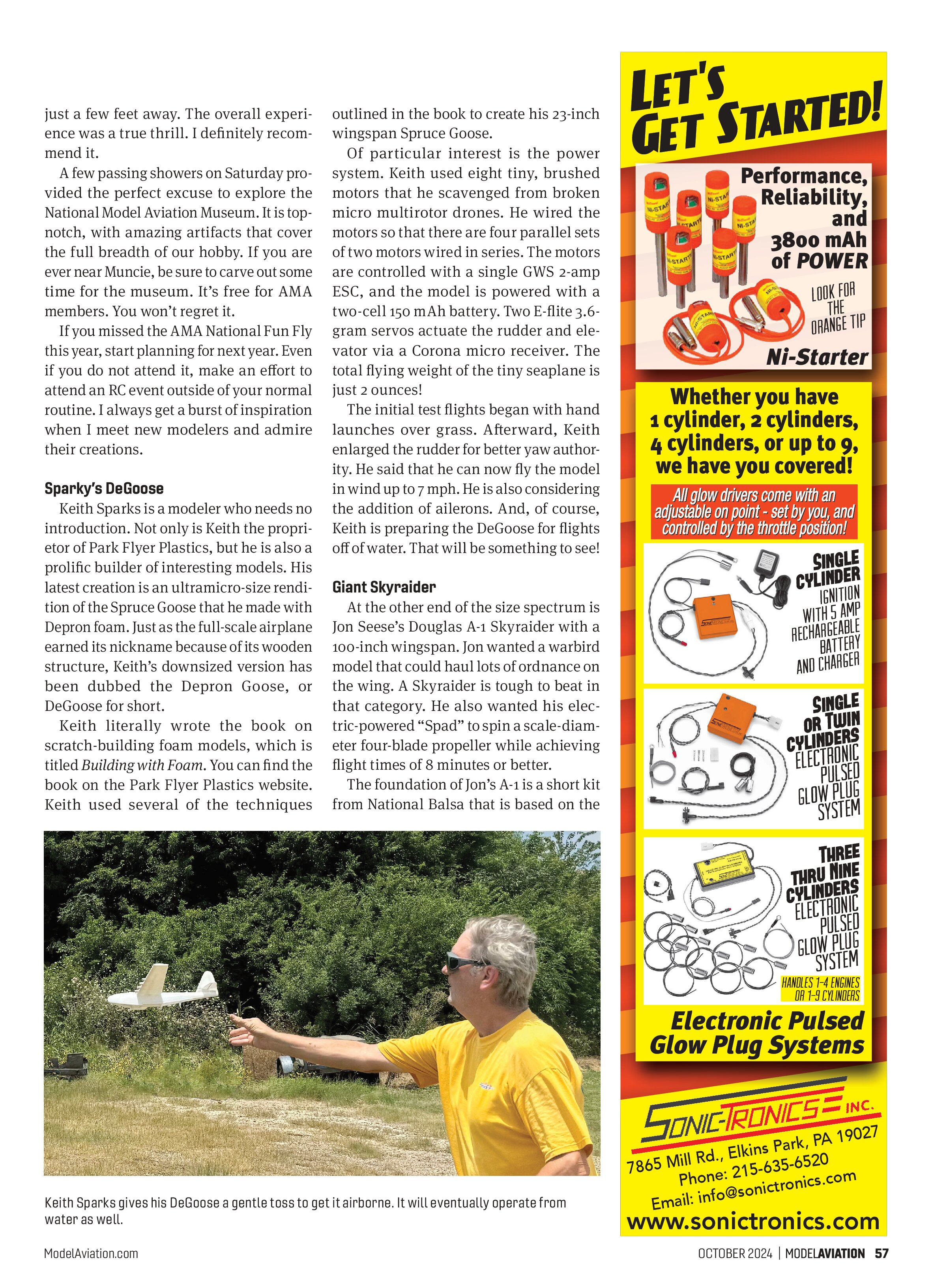
Keith Sparks gives his DeGoose a gentle toss to get it airborne. It will eventually operate from water as well.

Nick Ziroli design. During the build, Jon incorporated a clever method for battery access. The completed hatch on the port side of the fuselage is practically invisible and does not alter the distinctive profile of the Skyraider’s nose.
A StingGR 120 power system is nestled within the Skyraider’s cowling. This impressive unit features a Scorpion outrunner motor coupled with a beefy belt reduction drive to spin the Biela 24 x 12 four-blade propeller. With a 12-cell 12,000 mAh LiPo battery and a Scorpion Tribunus 300-amp ESC, Jon’s Skyraider flies with nearly 8,000 watts of power!
Jon fiberglassed the completed model and applied the camouflage scheme using latex paint. After applying a Minwax clear coat, Jon added weathering using oil-based paints. The completed A-1 weighs 39 pounds ready to fly (37 pounds without ordnance) and looks amazing.
As for the A-1’s flight performance, Jon said:
“The Skyraider is known to be a great-flying airplane, and I completely agree. It has a large wing and rudder that keep it very stable. Large flaps slow it down nicely. I was concerned about torque on takeoff with the large propeller, but with a gradual application of throttle, it will do nice, scale takeoffs. With the gear drive, you have to work the throttle a bit more on landing because the propeller will not free-spin, but it is very manageable.”
Jon did an amazing job on his Skyraider. I can’t wait to see it fly at upcoming events around the Midwest.
Final Approach
I hope that you enjoyed reading about Keith and Jon’s very different electric models. I look forward to hearing from you about the projects that you have on your workbench as well.