Old School
Model Works
By Jay Smith |
jays@modelaircraft.org
I might have been able to write this article without even interviewing the owner of Old School Model Works. That is because I worked with Mark Lanterman for nearly 10 when he was the advertising representative for this publication. I remember many years ago being in California for the AMA Expo and taking a road trip to visit Hitec USA. Making conversation while Mark drove us to our destination, I asked, “What would you do for a living if you were not working as our advertising representative?”
He laughed and threw out a few suggestions, but I don’t recall starting his own kit company as being one of them. It was a bold move that began to take shape in 2016 and officially launched in 2017.

Mark has been building and flying airplanes since he was roughly five years old. He grew up as a modeler and was involved in model aviation through his father, who worked with World Engines. He later worked for Dave Brown Products before becoming the advertising representative for Model Aviation. Mark’s upbringing and career path led to him knowing a large number of people and companies within the hobby, something that greatly helped him when he launched his own business.
Before starting Old School Model Works, he had never designed an aircraft but had built many. His first kit, the Robinhood 25, was his spin on the Robinhood kit from World Engines. He got the rights to produce it. His second kit, the Sky Ranger, was based off of a Pilot Das Box Fly.
The reimagined designs would take three to four months to complete, but the biggest challenge was finding boxes to safely house the kits. After an extensive search, Mark found exactly what he needed from a company not far from his home.
He also decided from the beginning that everything he put in the kits would be sourced from US-based companies. To learn more about running a model airplane kit company, he would leverage his friendship with Mark Freeland of Retro RC, who not only cut his first kit, but also shared his knowledge and experiences.
Mark’s background in graphic design would serve him well with his new company, but he wasn’t quite as fond of writing. Providing a comprehensive manual was important to him but definitely not as fun as test-flying his new creations.
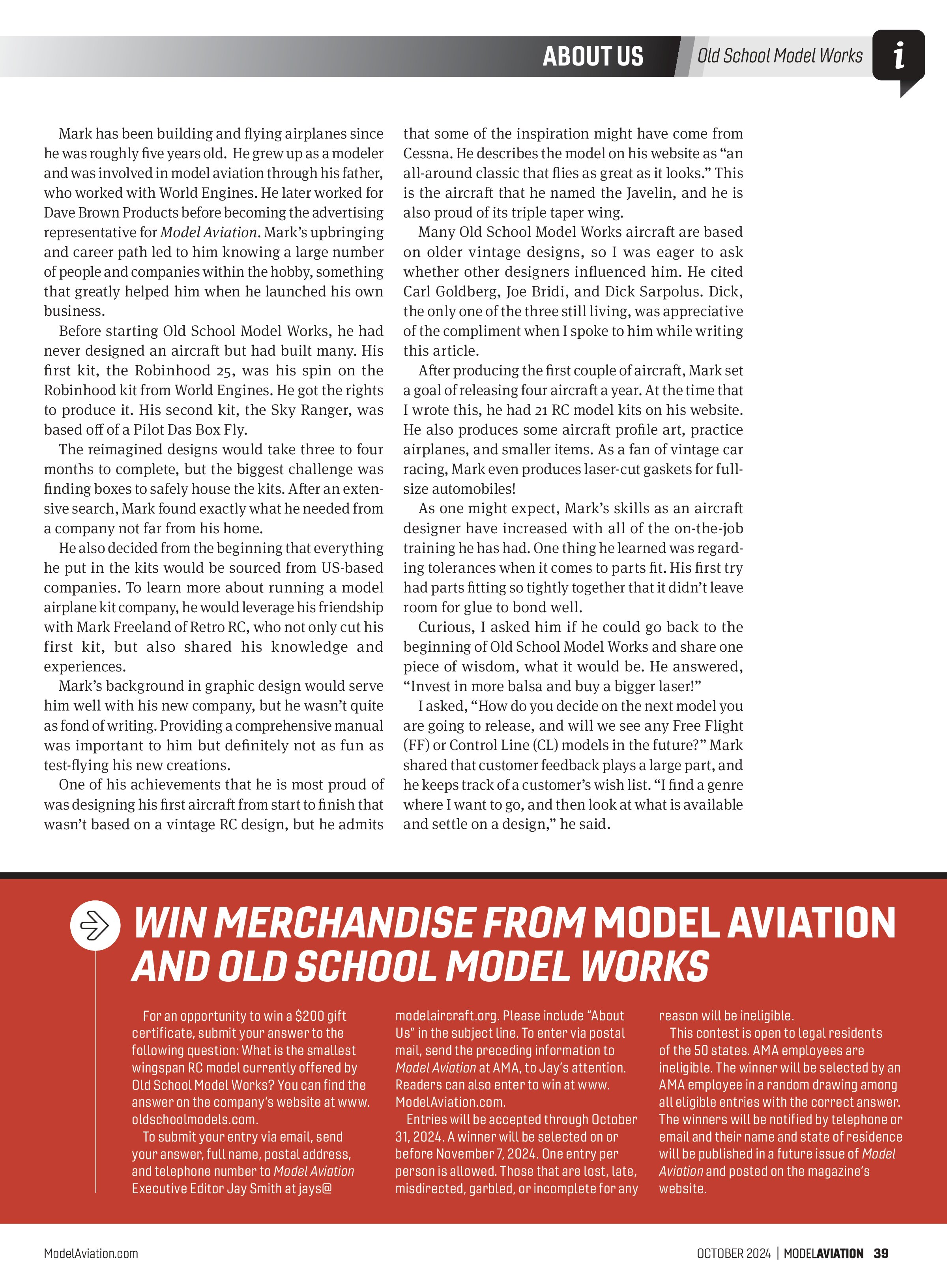
One of his achievements that he is most proud of was designing his first aircraft from start to finish that wasn’t based on a vintage RC design, but he admits that some of the inspiration might have come from Cessna. He describes the model on his website as “an all-around classic that flies as great as it looks.” This is the aircraft that he named the Javelin, and he is also proud of its triple taper wing.
Many Old School Model Works aircraft are based on older vintage designs, so I was eager to ask whether other designers influenced him. He cited Carl Goldberg, Joe Bridi, and Dick Sarpolus. Dick, the only one of the three still living, was appreciative of the compliment when I spoke to him while writing this article.
After producing the first couple of aircraft, Mark set a goal of releasing four aircraft a year. At the time that I wrote this, he had 21 RC model kits on his website. He also produces some aircraft profile art, practice airplanes, and smaller items. As a fan of vintage car racing, Mark even produces laser-cut gaskets for full-size automobiles!
As one might expect, Mark’s skills as an aircraft designer have increased with all of the on-the-job training he has had. One thing he learned was regarding tolerances when it comes to parts fit. His first try had parts fitting so tightly together that it didn’t leave room for glue to bond well.
Curious, I asked him if he could go back to the beginning of Old School Model Works and share one piece of wisdom, what it would be. He answered, “Invest in more balsa and buy a bigger laser!”
I asked, “How do you decide on the next model you are going to release, and will we see any Free Flight (FF) or Control Line (CL) models in the future?” Mark shared that customer feedback plays a large part, and he keeps track of a customer’s wish list. “I find a genre where I want to go, and then look at what is available and settle on a design,” he said.