SAFETY COMES FIRST

MR. HOT PANTS
By Dave Gee | safetycolumn@cs.com
WE START OFF with a story from William Bickel, who is probably still laughing about it.
“The resistance soldering unit in the January 2024 Model Aviation ‘Product Spotlight’ brought back memories of an incident that occurred in the late 1960s.
“I worked at a factory that made autopilot components for jetliners and military aircraft. Some tasks required resistance soldering units because you could simply wrap the wire around a post and touch it with the tool and some solder.
“One day, a tech who was using one of these devices quickly pushed his chair away from the workbench, and then stood up and started rapidly swatting his pants while muttering various expletives.
“Unlike the device reviewed in the Model Aviation article, our tools did not have a foot switch to activate the hand unit. With the power supply on, the tool was always ready to use. Since the soldering tip instantly cooled down after usage, an operator would just drop the hand unit onto his or her lap rather than return it to the holder on the workbench while further connections were being prepared.
“In this case, the tips of the hand unit had contacted the metal zipper on the tech’s pants, which resulted in a lot of heat in a very personal area. This is not a good way to acquire a nickname.”
How High Is High?
Our sport is under more scrutiny these days than ever before. One issue is altitude limits. RC fields located near full-scale airports require special care to keep the models separate from full-scale aircraft. One careless pilot (on the ground or airborne) could cause plenty of trouble. Sometimes there are activists who want one or both airfields closed down. These protesters would love to see altitude rules being broken!
How can we tell how high we are flying? Some pilots (not me!) are extra good at just guessing by eye. This is not a preferred technique. A better way is to add electronic telemetry to transmit altitude back to the ground. This adds weight to the model and costs money. The classic method is to use triangulation by having two observers sight the airplane with protractors as it passes a spot on the ground. Then it’s simple to calculate the actual height of the aircraft.
I suggest making this a club safety activity, using either a demonstrator airplane equipped with altitude telemetry or by setting up a triangulation and letting pilots fly around at what they think is the maximum altitude. You might be surprised at how far off your estimates have been!
Preflight Routine Pays Off
Robert Fitch is a wise and cautious pilot who has developed a preflight routine to use when operating his RC aircraft. Why is that a big deal? Robert explains:
“While preparing to fly my .40-size sport airplane (converted to electric), I learned the importance of having a motor cutoff switch function enabled on my transmitter.
“The grass at our field was too long to taxi to the runway from the pits, so I carried the aircraft and transmitter out to the [geo-textile] runway. I placed the airplane on the runway and when I attempted to stand up, I caught my foot on the edge of [the] runway and fell forward, dropping the transmitter.
“After I regained my footing, I checked the transmitter. It was undamaged, but the throttle stick had been bumped to the full up position! Luckily, I had the motor cut switch engaged, so the airplane remained motionless.
“Things could have been very different without the safety switch, as the airplane was pointed directly at me when I tripped.”
Robert had the basics nailed! Using a motor cutoff switch on your transmitter is a recommended best practices thing, but we’ve all seen pilots who don’t do it. He followed his standard flight operations routine and had that switch engaged, with no idea that it would be needed so badly. That good habit paid off in a big way. Let’s follow his example!
Dirigible Danger!
Just kidding; there is virtually no risk involved in operating RC lighter-than-air models. You could be hit by one at top speed and not even notice it. They range from parlor blimps up to car-size dirigibles that need a stadium or hangar in which to fly.
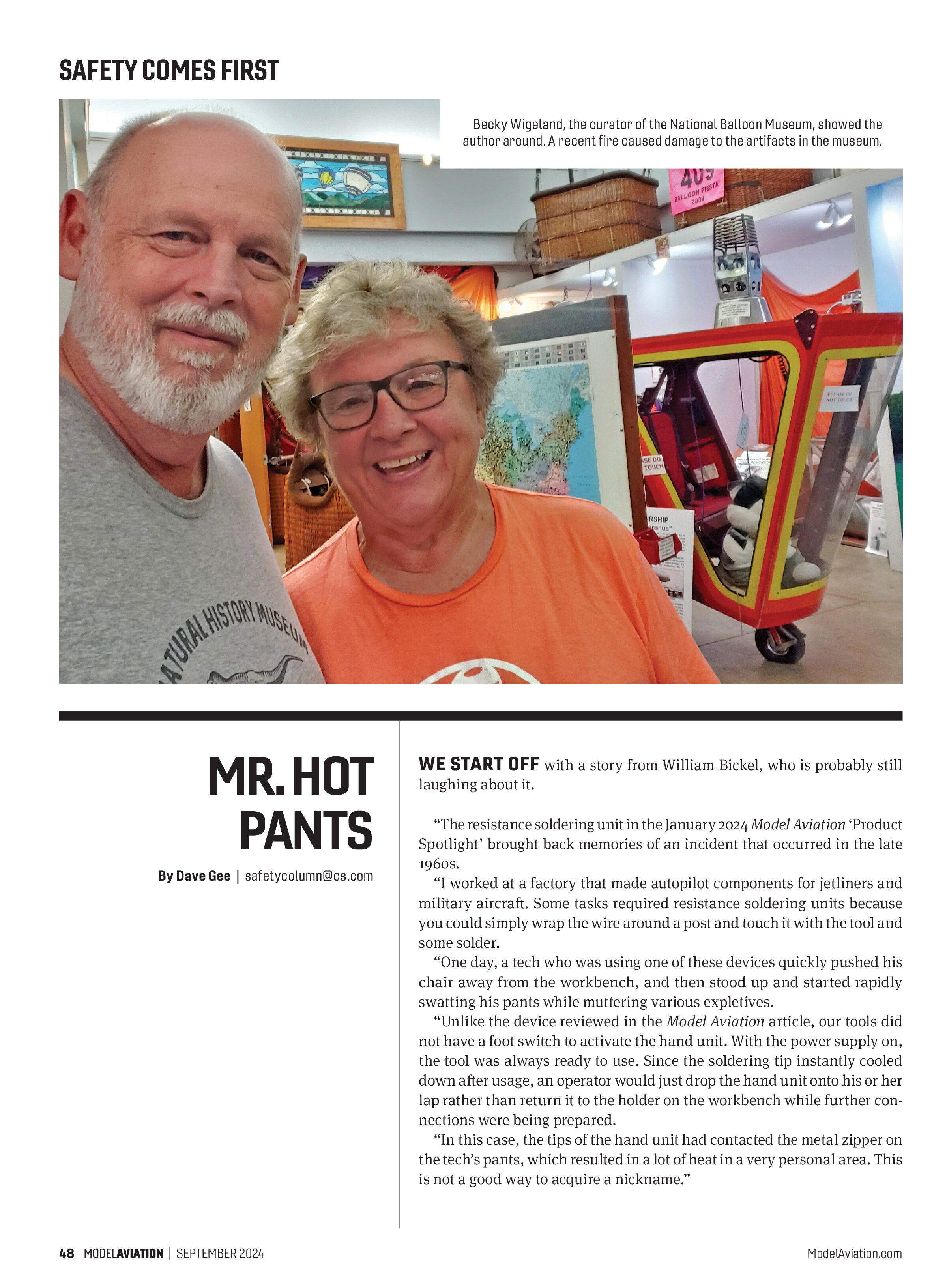
This is all just an excuse to mention my visit to the National Balloon Museum in Indianola, Iowa. Don’t worry—I’ll cover all the puns.
Curator Becky Wigeland launched into the weighty aspects of ballooning as she
showed me around. The museum displays only gondolas of famous balloons, but that counts as having the whole thing there. I was amazed at the courage and creativity of balloonists!
The U.S. Ballooning Hall of Fame might have an inflated reputation, but my visit was an uplifting experience. Becky has rising hopes of even more visitors. I had a basket of fun before she finally cut me loose and gave me a colorful member’s lapel pin. They allow pins in the balloon museum?
Sad Balloon Update
At press time in June, news arrived about a fire at the National Balloon Museum, which damaged some of the artifacts. It is fundraising for recovery, and I hope that many donors join me in supporting the restoration effort.
Jet-on-a-Stick
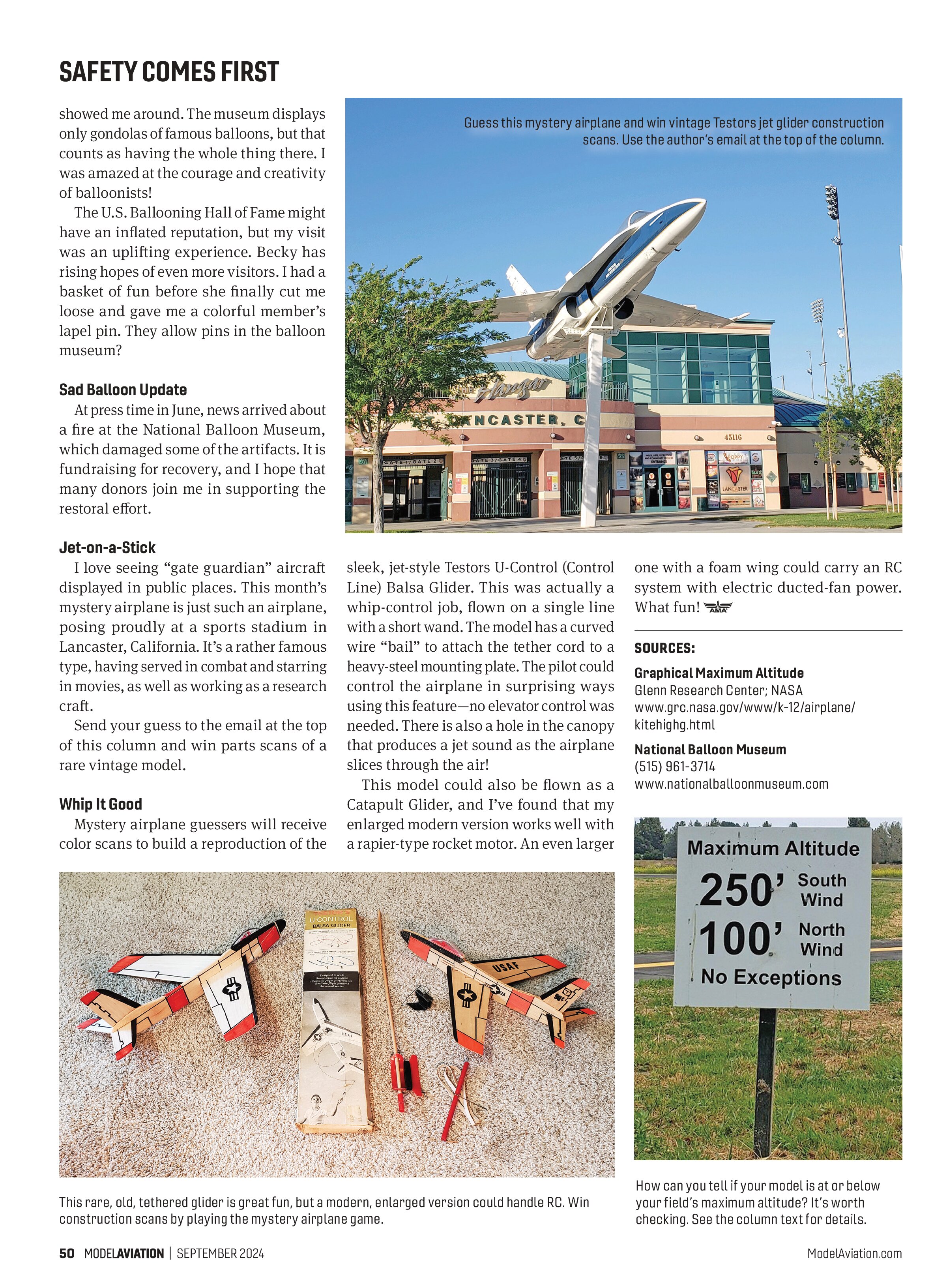
I love seeing “gate guardian” aircraft displayed in public places. This month’s mystery airplane is just such an airplane, posing proudly at a sports stadium in Lancaster, California. It’s a rather famous type, having served in combat and starring in movies, as well as working as a research craft.
Send your guess to the email at the top of this column and win parts scans of a rare vintage model.
Whip It Good
Mystery airplane guessers will receive color scans to build a reproduction of the

sleek, jet-style Testors U-Control (Control Line) Balsa Glider. This was actually a whip-control job, flown on a single line with a short wand. The model has a curved wire “bail” to attach the tether cord to a heavy-steel mounting plate. The pilot could control the airplane in surprising ways using this feature—no elevator control was needed. There is also a hole in the canopy that produces a jet sound as the airplane slices through the air!
This model could also be flown as a Catapult Glider, and I’ve found that my enlarged modern version works well with a rapier-type rocket motor. An even larger one with a foam wing could carry an RC system with electric ducted-fan power. What fun!

How can you tell if your model is at or below your field’s maximum altitude? It’s worth checking. See the column text for details.
This rare, old, tethered glider is great fun, but a modern, enlarged version could handle RC. Win construction scans by playing the mystery airplane game.

SOURCES:
Graphical Maximum Altitude
Glenn Research Center; NASA
www.grc.nasa.gov/www/k-12/airplane/kitehigh.html
National Balloon Museum
(515) 961-3714
www.nationalballoonmuseum.com