MILESTONES IN A NEW PYLON RACING PILOT’S PROGRESSION

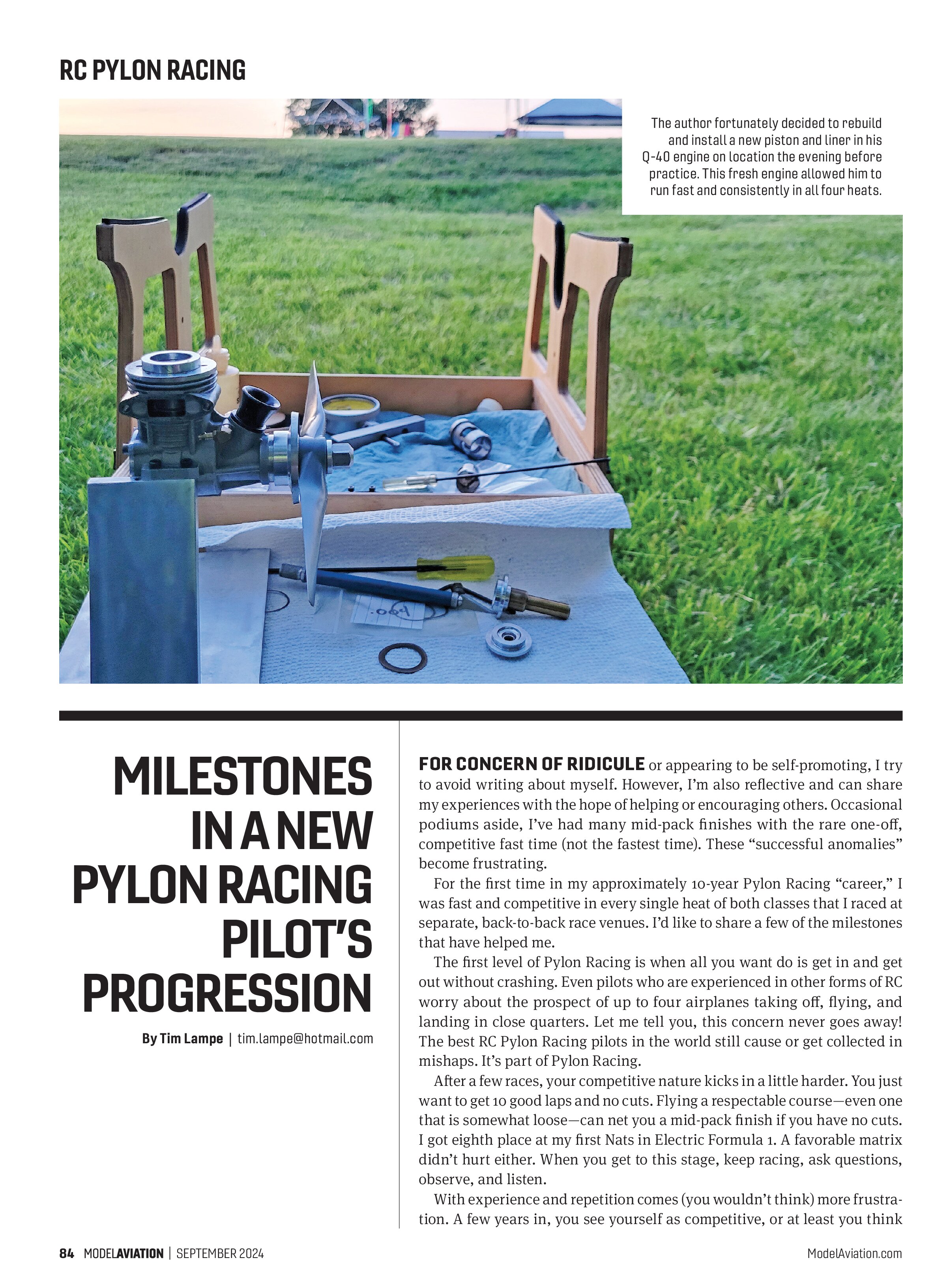
The author fortunately decided to rebuild and install a new piston and liner in his Q-40 engine on location the evening before practice. This fresh engine allowed him to run fast and consistently in all four heats.
By Tim Lampe | tim.lampe@hotmail.com
FOR CONCERN OF RIDICULE or appearing to be self-promoting, I try to avoid writing about myself. However, I’m also reflective and can share my experiences with the hope of helping or encouraging others. Occasional podiums aside, I’ve had many mid-pack finishes with the rare one-off, competitive fast time (not the fastest time). These “successful anomalies” become frustrating.
For the first time in my approximately 10-year Pylon Racing “career,” I was fast and competitive in every single heat of both classes that I raced at separate, back-to-back race venues. I’d like to share a few of the milestones that have helped me.
The first level of Pylon Racing is when all you want to do is get in and get out without crashing. Even pilots who are experienced in other forms of RC worry about the prospect of up to four airplanes taking off, flying, and landing in close quarters. Let me tell you, this concern never goes away! The best RC Pylon Racing pilots in the world still cause or get collected in mishaps. It’s part of Pylon Racing.
After a few races, your competitive nature kicks in a little harder. You just want to get 10 good laps and no cuts. Flying a respectable course—even one that is somewhat loose—can net you a mid-pack finish if you have no cuts. I got eighth place at my first Nats in Electric Formula 1. A favorable matrix didn’t hurt either. When you get to this stage, keep racing, ask questions, observe, and listen.
With experience and repetition comes (you wouldn’t think) more frustration. A few years in, you see yourself as competitive, or at least you think you should be by now. What’s helped me through this stage is preparation. With domestic responsibilities, I understand that not everybody can do it, but taking time in the shop to maintain your airplanes, engines, and equipment, and making sure that you have the necessary tools, supplies, spare parts, and/or airplanes, will help you maximize every opportunity by not missing a race heat or having to pack up early.
One of the most vivid milestones in my progression was the time I teamed up with Dan Kane. In an effort to see the best way around the course, I had already been studying the elite pilots. This particular weekend, however, I was calling for Dan. For whatever reason, I finally “got it” and could really see where the airplane was supposed to be and how it was supposed to “look,” specifically around Pylons Two to Three. With the fastest guys, their “Two-Three” looks about the same as coming around Pylon One—darn fast! It’s phenomenal. Although it was four or five years ago when I teamed up with Dan, it’s taken this many years to zero-in on a decent Two-Three, so just because you learn something doesn’t mean you can apply it right away.
Milestones or not, I’ll pause here to say that one thing that definitely helps is, simply, repetition. I believe that you have to be able to fly and position the airplane regardless of the pylons.
This really sunk in for me the last time I raced in Tavares, Florida. The course there is not positioned parallel with the runway or the main footprint of the flying site—it’s somewhat disorienting. The very first time I flew there, I had difficulty “finding” Pylon One and didn’t have a great race. The next time (a few years later), I forgot about any orientation issues and even got fourth place in Quarter 40 (Q-40). The reps and experience that I gained in the time between the two races helped me understand the course and visualize it better. This just comes with time and laps.
Another milestone came just last year. I was becoming frustrated at the May 2023 CAPS Indy Shootout when, for no reason that I could see, I was not competitive and had slow times despite seemingly good engine runs. It seemed my learning curve had plateaued.
Dan noticed my frustration and offered to coach me at the next race. Sure enough, two weeks later during the Moonshot Pylon Race in Cincinnati, Dan observed my flights. He could see that my lines from

To pilots who are new to Pylon Racing, such as Glen Lang, you’re doing fine. Don’t be afraid to ask for assistance or advice and stick with it.
Pylons Three to One and from Pylon One back to Two were “off.” With a little coaching, Dan had me back on track. These realizations seem to come and go, illustrating that it is a continual learning experience that you have to work on perpetually.
An even more recent milestone isn’t really a milestone—it’s more of a realization. I used to think that success in Pylon Racing was approximately 50% the pilot and 50% the engine. Now, I think it’s more like 25% the pilot and 75% the engine. Whatever the actual percentage, your engine must be in good condition to be able to get up to rpm.
I might be going out on a limb here, but I am starting to believe that more people than I originally thought send their engines back to the manufacturer for repair, inspection, or refurbishment, although I think this applies mostly to Q-40. My nature is frugal and conservative, so I tend to hold on too long to engines that have “gone bad,” or I attempt to “revitalize” them myself. This epiphany came to me at the last race just two weeks ago.

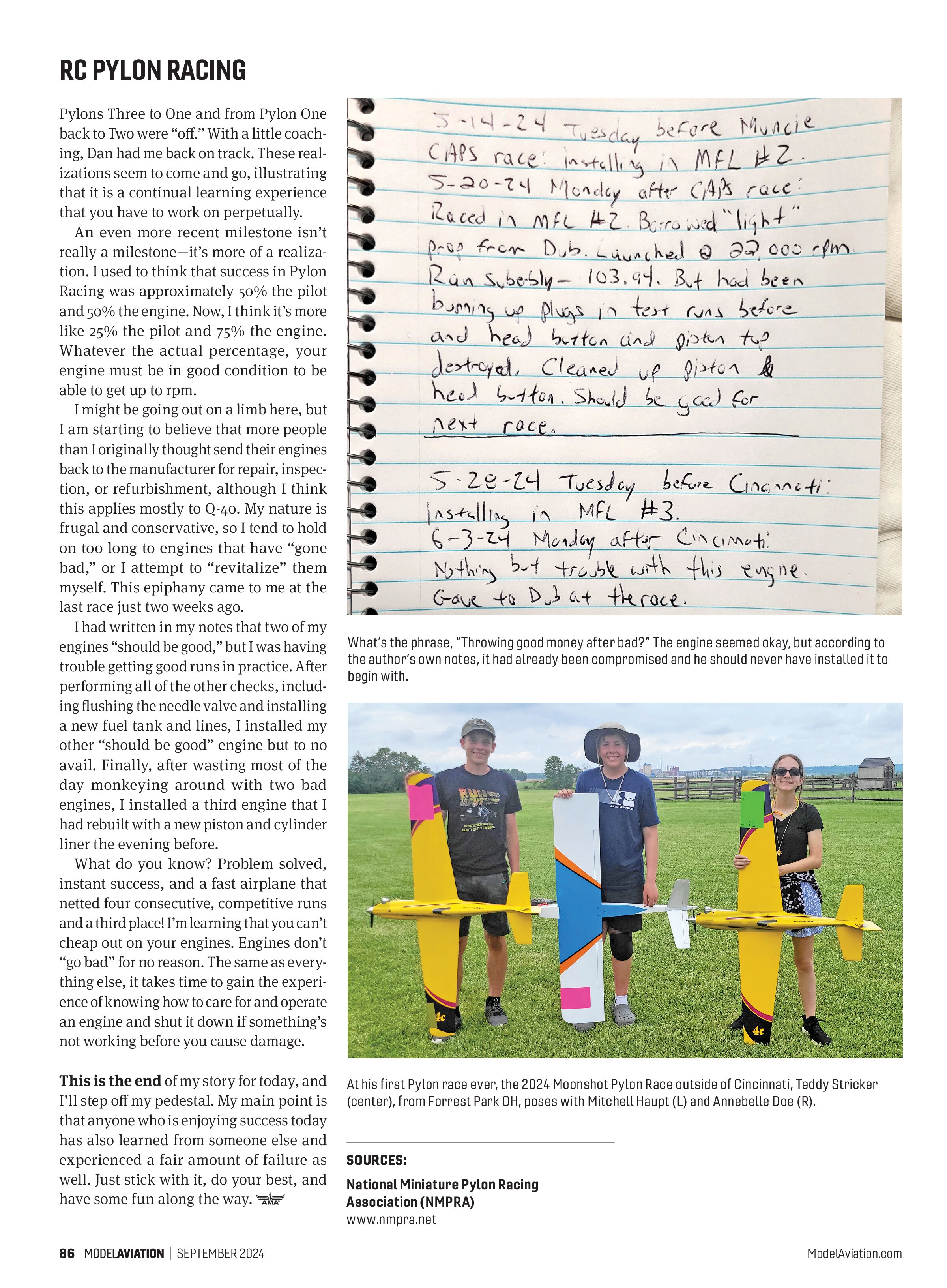
I had written in my notes that two of my engines “should be good,” but I was having trouble getting good runs in practice. After performing all of the other checks, including flushing the needle valve and installing a new fuel tank and lines, I installed my other “should be good” engine but to no avail. Finally, after wasting most of the day monkeying around with two bad engines, I installed a third engine that I had rebuilt with a new piston and cylinder liner the evening before.
What do you know? Problem solved, instant success, and a fast airplane that netted four consecutive, competitive runs and a third place! I’m learning that you can’t cheap out on your engines. Engines don’t “go bad” for no reason. The same as everything else, it takes time to gain the experience of knowing how to care for and operate an engine and shut it down if something’s not working before you cause damage.
This is the end of my story for today, and I’ll step off my pedestal. My main point is that anyone who is enjoying success today has also learned from someone else and experienced a fair amount of failure as well. Just stick with it, do your best, and have some fun along the way.

SOURCES:
National Miniature Pylon Racing Association (NMPRA)
www.nmpra.net