RC JETS

SELECTING AN INTRODUCTORY JET
By Jim Hiller | jetmodeler@earthlink.net
STEPPING INTO jet modeling appears to many to be a daunting task. It really isn’t, but similar to anything in life, it is best done with some forethought. Today we have many “introduction” ARF jet models that are available to select from, with several different construction materials for a wide variety of skill sets. The selection of the proper model to meet your skills and the field from which you intend to fly are extremely important to future success.
The most difficult part of transitioning to flying turbine-powered aircraft is the landing. These airplanes are heavier than most models, and poor landings can lead to landing gear damage. Landing approaches tend to be flatter because the aerodynamically clean airplanes have no propeller to drag them down to slower speeds based on the throttle setting. Pilots must control their approach speed with the proper use of elevator to maintain a consistent speed and angle of attack. The difference that this makes is only truly understood once it’s experienced. Experience with electric ducted-fan (EDF) jets will help to improve landings.
I strongly suggest sport jets as a starting point; however, a scale jet with a reasonable aspect-ratio wing also works fine. Low aspect-ratio scale jets, such as F-15s, F-16s, and F-18s, add in a learning curve, complicating the transition process. Their wings increase drag quickly as you pull on the elevator and increase the angle of attack. It is an unusual response for pilots who are accustomed to traditional aspect-ratio wings, and you will be surprised with the skills that need to be developed to truly enjoy them.
Foam, balsa, and composite jets are all available. Each type has its advantages and disadvantages. The decision should be made on the material that you are comfortable with for your repair and upkeep skills. Remember that you will likely need to make some minor repairs along the way.
Foam is pretty straightforward to repair, but it ages quickly from rash. Balsa repairs are also straightforward because most are covered with iron-on film, making cosmetic repairs quick and easy. Composite jets are more rigid, solid flyers, but repairs are more involved. The methods for structural repairs are dependent on the molding technique, and cosmetic repairs normally require painting skills.
Many modelers are flying foam jets that are specifically made for turbines, or they are converting EDF models with great success. Do not try to reinvent the wheel with your first jet—go with the successful experiences of others. Paul Applebaum has conversion kits for the 90mm E-flite Viper and the Freewing 80mm T-33; both are very successful and well-proven setups. Another foam sport jet option is the HSD Super Viper. Many pilots have successfully transitioned to turbine modeling with this package.
The foam makes the Super Viper a good introductory jet. It is a high-drag material, making the approach to landing steeper, with the approach angles similar to propeller airplanes. This steeper glide angle is great when you are learning; however, when the turbine quits, it isn’t going to glide as far, so a good deadstick technique is very important. You should immediately turn for the field—do not extend the landing gear until you are sure that you have the runway made. Landing gear that is extended creates a lot of drag and greatly reduces your gliding distance. If you crash in a plowed field with your gear extended, serious damage will occur.
On to balsa jets. I grew up flying balsa airplanes, so I am very familiar with working with balsa. With heat-shrink covering, repairs are simple. Many sport jets have been developed around balsa construction, and many of them are just right for transitioning to turbine flying. Unlike foam airframes, balsa construction holds up to hangar rash much better and repairs can be made to bring them back to a like-new appearance if you take your time.
Some balsa jets that are available today include the Hangar 9 Aermacchi MB-339, a nicely sized model that is marketed with various packages, including one that is complete with a KingTech K-85 turbine and Spektrum servos. This model was developed by an experienced group of turbine modelers as an excellent step up to jet modeling—that doesn’t mean you won’t see some very experienced jet pilots owning one for everyday sport flying though. The Hangar 9 MB-339 has become popular, and the latest version now has a scale color scheme to provide the warbird appearance that it deserves.
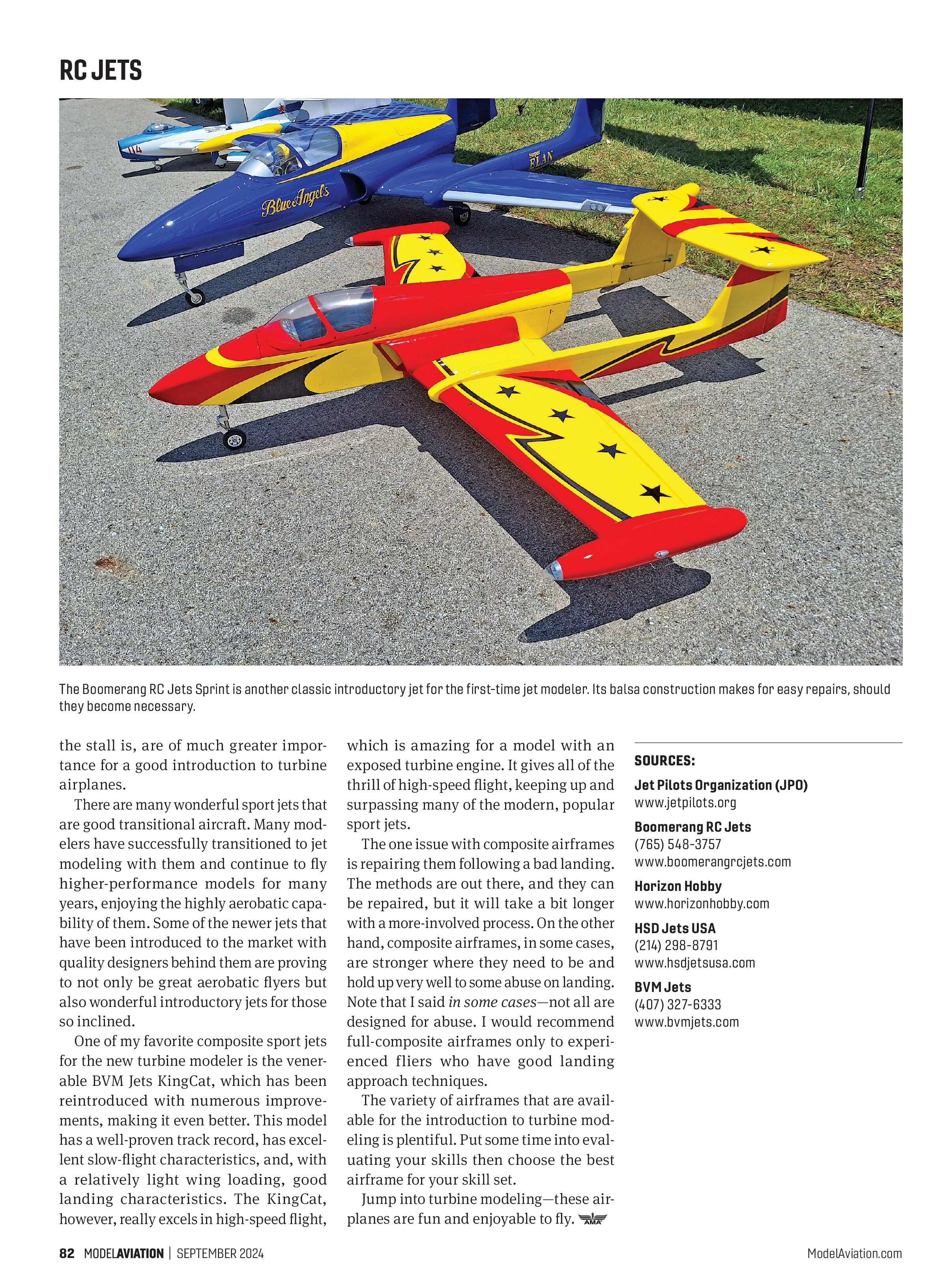
The infamous Boomerang RC Jets line of twin-boom introduction jets has successfully stepped many modelers into turbine-powered flight with its quality aircraft. The Sprint, now in version two, is one of the most popular models.
My favorite Boomerang airplane for the experienced modeler to transition to jets is the Elan V2. The landing flaps act as very effective dive brakes. The top of the flaps extend forward of the hinge line and extend above the wing when the flaps are deployed, greatly increasing drag and steepening the landing approach. This feature helps the transitioning pilot who is used to turning a final for landing that still drops the nose of the aircraft and dives before the landing and final flare. High-drag flap arrangements are of great value to pilots who have this habit.
The last class of introduction jet models is composite airframes. There are so many from which to choose. Almost every pilot claims that their airframe is the best trainer/introductory airplane, so my thought is for the buyer to beware. A highly experienced turbine pilot will think that their jet is easy to fly, but do they know your experience and flying skills?
Composite turbine airframes tend to have a heavier wing loading in most cases, hence a faster landing speed, so good, slow flight characteristics are very important for the transitioning pilot. Flight demonstrations that show off the airplane’s awesome rifle rolling, very low, slow rolls, and the like, do not demonstrate the most important part of the flight regime. Slow flight, with flaps extended, and how gentle or, in many cases, abrupt

The stall is, are of much greater importance for a good introduction to turbine airplanes.
There are many wonderful sport jets that are good transitional aircraft. Many modelers have successfully transitioned to jet modeling with them and continue to fly higher-performance models for many years, enjoying the highly aerobatic capability of them. Some of the newer jets that have been introduced to the market with quality designers behind them are proving to not only be great aerobatic flyers but also wonderful introductory jets for those so inclined.
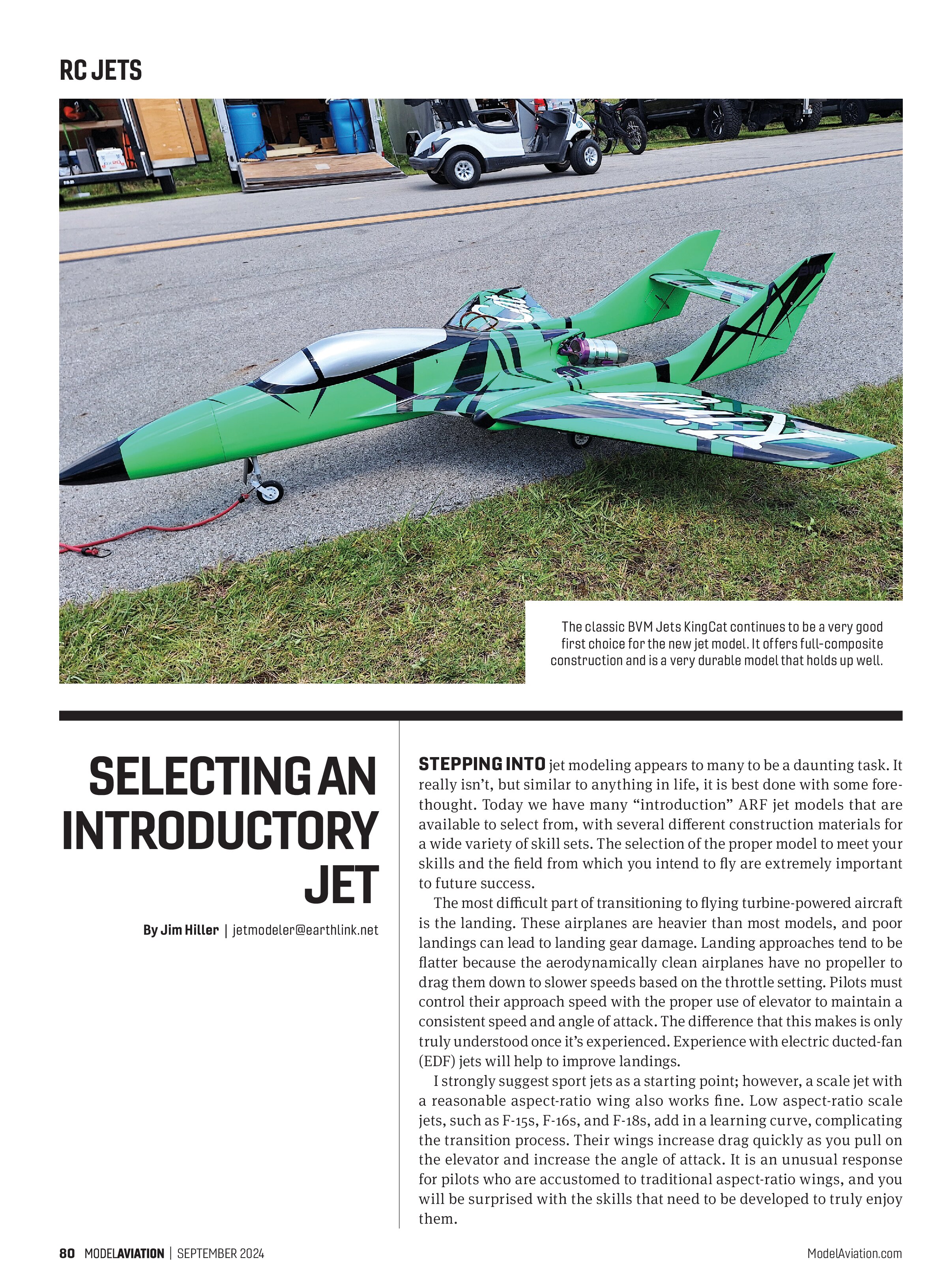
One of my favorite composite sport jets for the new turbine modeler is the venerable BVM Jets KingCat, which has been reintroduced with numerous improvements, making it even better. This model has a well-proven track record, has excellent slow-flight characteristics, and, with a relatively light wing loading, good landing characteristics. The KingCat, however, really excels in high-speed flight, which is amazing for a model with an exposed turbine engine. It gives all of the thrill of high-speed flight, keeping up and surpassing many of the modern, popular sport jets.
The one issue with composite airframes is repairing them following a bad landing. The methods are out there, and they can be repaired, but it will take a bit longer with a more-involved process. On the other hand, composite airframes, in some cases, are stronger where they need to be and hold up very well to some abuse on landing. Note that I said in some cases—not all are designed for abuse. I would recommend full-composite airframes only to experienced fliers who have good landing approach techniques.
The variety of airframes that are available for the introduction to turbine modeling is plentiful. Put some time into evaluating your skills then choose the best airframe for your skill set.
Jump into turbine modeling—these airplanes are fun and enjoyable to fly.
SOURCES:
Jet Pilots Organization (JPO)
www.jetpilots.org
Boomerang RC Jets
(765) 548-3757
www.boomerangrcjets.com
Horizon Hobby
www.horizonhobby.com
HSD Jets USA
(214) 298-8791
www.hsdjetsusa.com
BVM Jets
(407) 327-6333
www.bvmjets.com