RC AEROBATICS

EASY POINTS
IN PATTERN
By Justin Wells | justinwells@mac.com
IF YOU READ my articles over the past few issues, I gave a lot of high-level pointers on how to perform maneuvers in the air. I want to discuss a few easy 10s for you as a budding RC Aerobatics (Pattern) pilot: takeoffs and landings!
In the AMA classes, from Sportsman all the way to Masters, takeoffs and landings are judged on the same scale as any maneuver. You can get a zero, as well as anything in between one and 10. I always viewed these as two easy maneuvers for which to get 10s.
Before I dive into some techniques on how to improve these and get maximum scoring, let’s look at the downgrades defined by the National Society of Radio Controlled Aerobatics (NSRCA) for each:
Downgrades for Takeoff
- Model jumps from the ground
- Liftoff is not within one meter of each side of center
- Model retouches the ground after becoming airborne
- Steep climb angle
- Gallops in elevation during climb
- Wing is not level
- Throttle is not smoothly advanced
- Track is not maintained through completion of maneuver (6-1/2 feet from the ground)
- Failure to call the start of the maneuver
- Model passes behind the judge’s line; scored zero points
- Failure to call beginning of maneuver

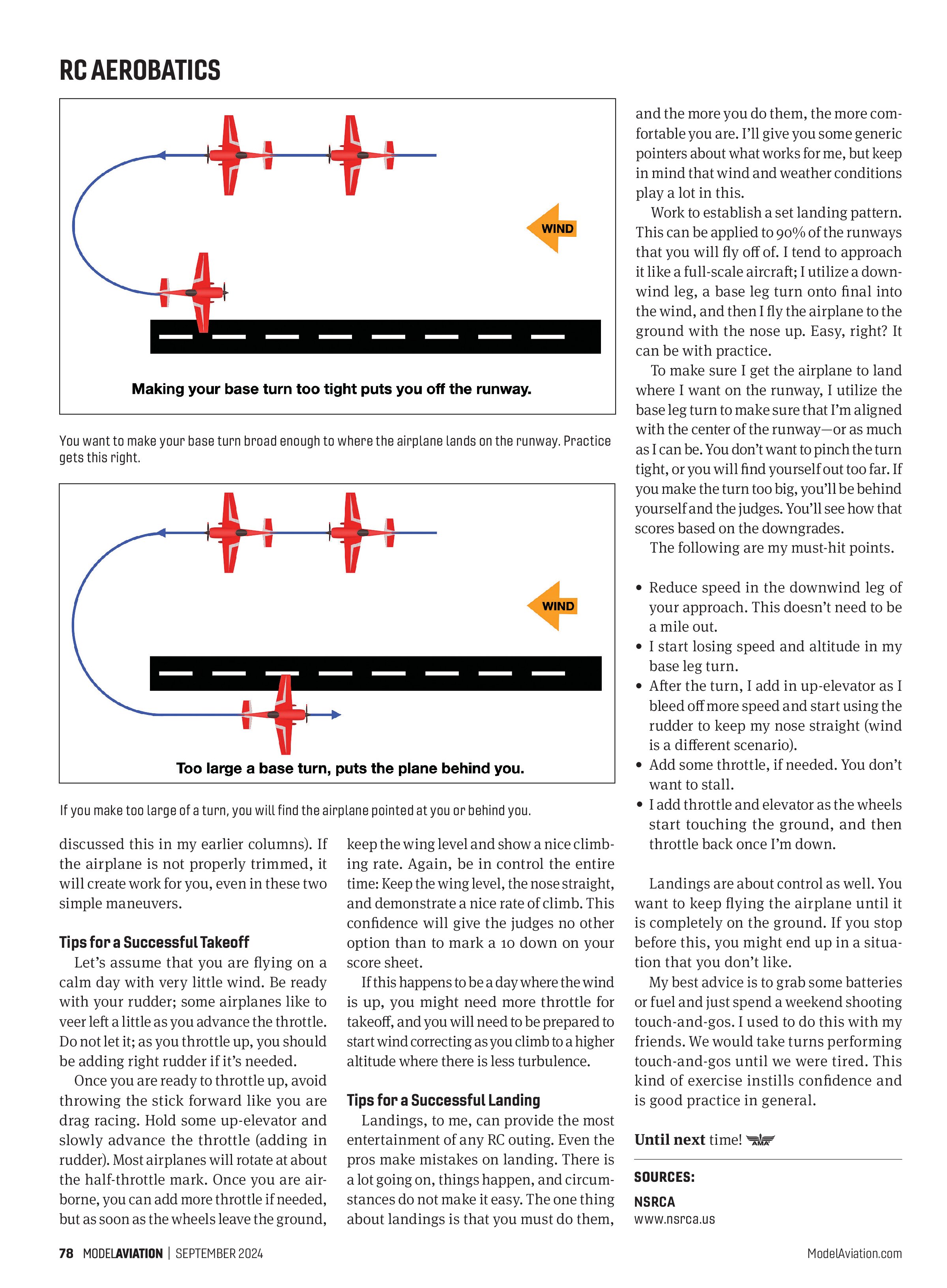
The general approach method that the author uses for landing. Find something like this that works for you.
Downgrades for Landing
- Model passes behind the judge’s line; scored zero points
- Model impacts the runway because of lack of flare
- Model bounces
- Changes in track
- Model ends on its back; scored zero points
- Model lands outside of landing zone
- Any undercarriage retracts before the landing is complete; scored zero points
- Aircraft porpoises and/or wanders during approach or flare
- Aircraft lands outside of the landing area or runway; scored zero points
- Aircraft touches down while not straight to runway and ground track
- Failure to call beginning of maneuver
After reading through the downgrades, it seems like a tall order—but it really isn’t. This is about controlling your aircraft 100% of the time. You never let it do anything that you don’t want it to do.
Let me give you some pointers on each and, hopefully, the illustrations will assist you in having more control of your takeoffs and landings. You need to assume that your aircraft is in good flying trim (I

You want to make your base turn broad enough to where the airplane lands on the runway. Practice gets this right.

If you make too large of a turn, you will find the airplane pointed at you or behind you.
discussed this in my earlier columns). If the airplane is not properly trimmed, it will create work for you, even in these two simple maneuvers.
Tips for a Successful Takeoff
Let’s assume that you are flying on a calm day with very little wind. Be ready with your rudder; some airplanes like to veer left a little as you advance the throttle. Do not let it; as you throttle up, you should be adding right rudder if it’s needed.
Once you are ready to throttle up, avoid throwing the stick forward like you are drag racing. Hold some up-elevator and slowly advance the throttle (adding in rudder). Most airplanes will rotate at about the half-throttle mark. Once you are airborne, you can add more throttle if needed, but as soon as the wheels leave the ground,
keep the wing level and show a nice climbing rate. Again, be in control the entire time: Keep the wing level, the nose straight, and demonstrate a nice rate of climb. This confidence will give the judges no other option than to mark a 10 down on your score sheet.
If this happens to be a day where the wind is up, you might need more throttle for takeoff, and you will need to be prepared to start wind correcting as you climb to a higher altitude where there is less turbulence.
Tips for a Successful Landing
Landings, to me, can provide the most entertainment of any RC outing. Even the pros make mistakes on landing. There is a lot going on, things happen, and circumstances do not make it easy. The one thing about landings is that you must do them,
and the more you do them, the more comfortable you are. I’ll give you some generic pointers about what works for me, but keep in mind that wind and weather conditions play a lot in this.
Work to establish a set landing pattern. This can be applied to 90% of the runways that you will fly off of. I tend to approach it like a full-scale aircraft; I utilize a downwind leg, a base leg turn onto final into the wind, and then I fly the airplane to the ground with the nose up. Easy, right? It can be with practice.
To make sure I get the airplane to land where I want on the runway, I utilize the base leg turn to make sure that I’m aligned with the center of the runway—or as much as I can be. You don’t want to pinch the turn tight, or you will find yourself out too far. If you make the turn too big, you’ll be behind yourself and the judges. You’ll see how that scores based on the downgrades.
The following are my must-hit points.
- Reduce speed in the downwind leg of your approach. This doesn’t need to be a mile out.
- I start losing speed and altitude in my base leg turn.
- After the turn, I add in up-elevator as I bleed off more speed and start using the rudder to keep my nose straight (wind is a different scenario).
- Add some throttle, if needed. You don’t want to stall.
- I add throttle and elevator as the wheels start touching the ground, and then throttle back once I’m down.
Landings are about control as well. You want to keep flying the airplane until it is completely on the ground. If you stop before this, you might end up in a situation that you don’t like.
My best advice is to grab some batteries or fuel and just spend a weekend shooting touch-and-gos. I used to do this with my friends. We would take turns performing touch-and-gos until we were tired. This kind of exercise instills confidence and is good practice in general.
Until next time!
SOURCES:
NSRCA
www.nsrca.us