LET YOUR
MEMORIES
TAKE FLIGHT
By Tim Bailiff | casurfischaol.com

FOR REALLY GREAT FUN, use simple balsa, slide-together airplanes to make RC conversions. Working with these airplanes brings back wonderfully fond memories from when I was a young boy.
It’s nice to have you back again. If you are ready for more flying adventures, I’d be pleased to have your company.
4-Mation
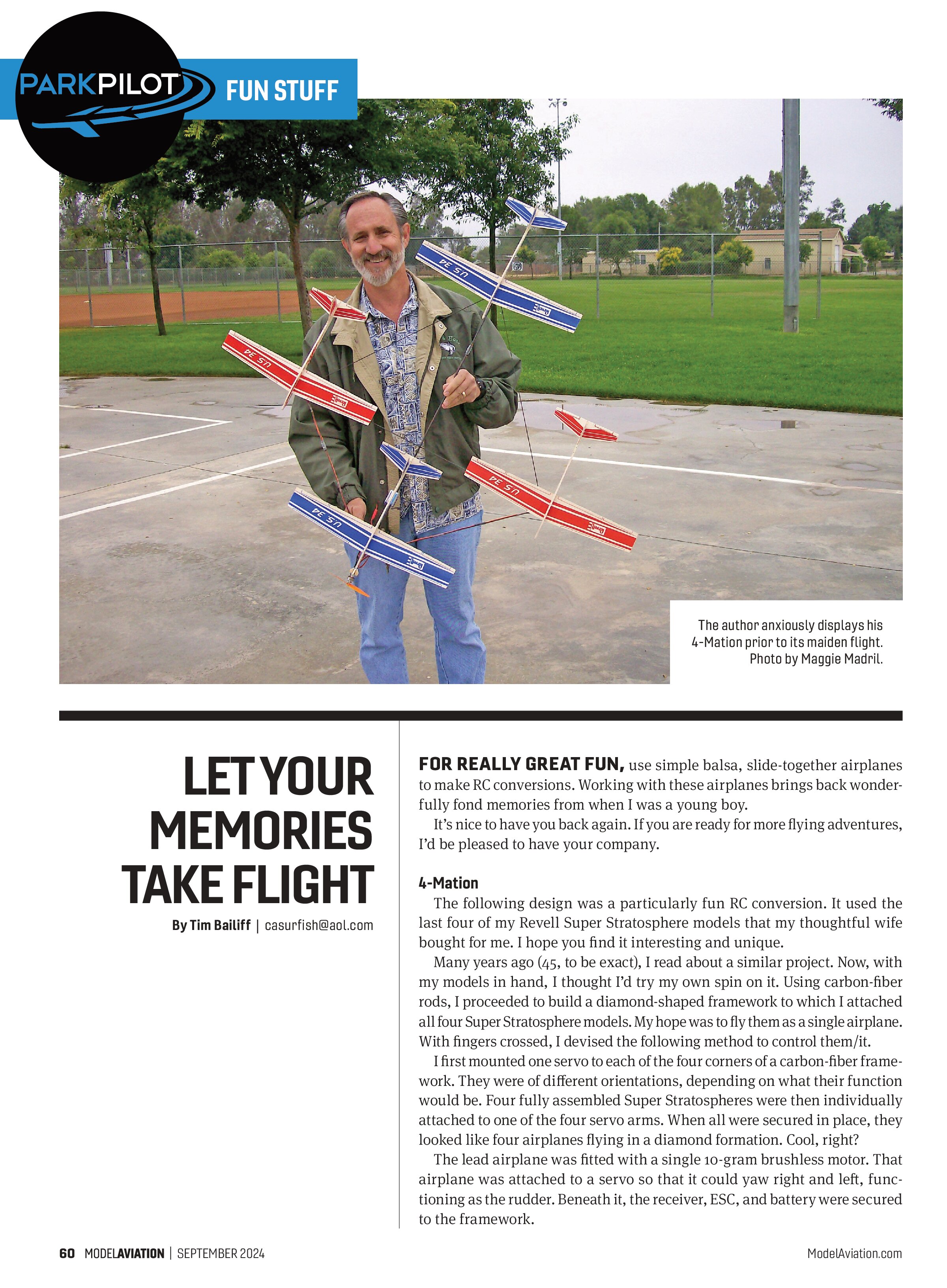
The following design was a particularly fun RC conversion. It used the last four of my Revell Super Stratosphere models that my thoughtful wife bought for me. I hope you find it interesting and unique.
Many years ago (45, to be exact), I read about a similar project. Now, with my models in hand, I thought I’d try my own spin on it. Using carbon-fiber rods, I proceeded to build a diamond-shaped framework to which I attached all four Super Stratosphere models. My hope was to fly them as a single airplane. With fingers crossed, I devised the following method to control them/it.
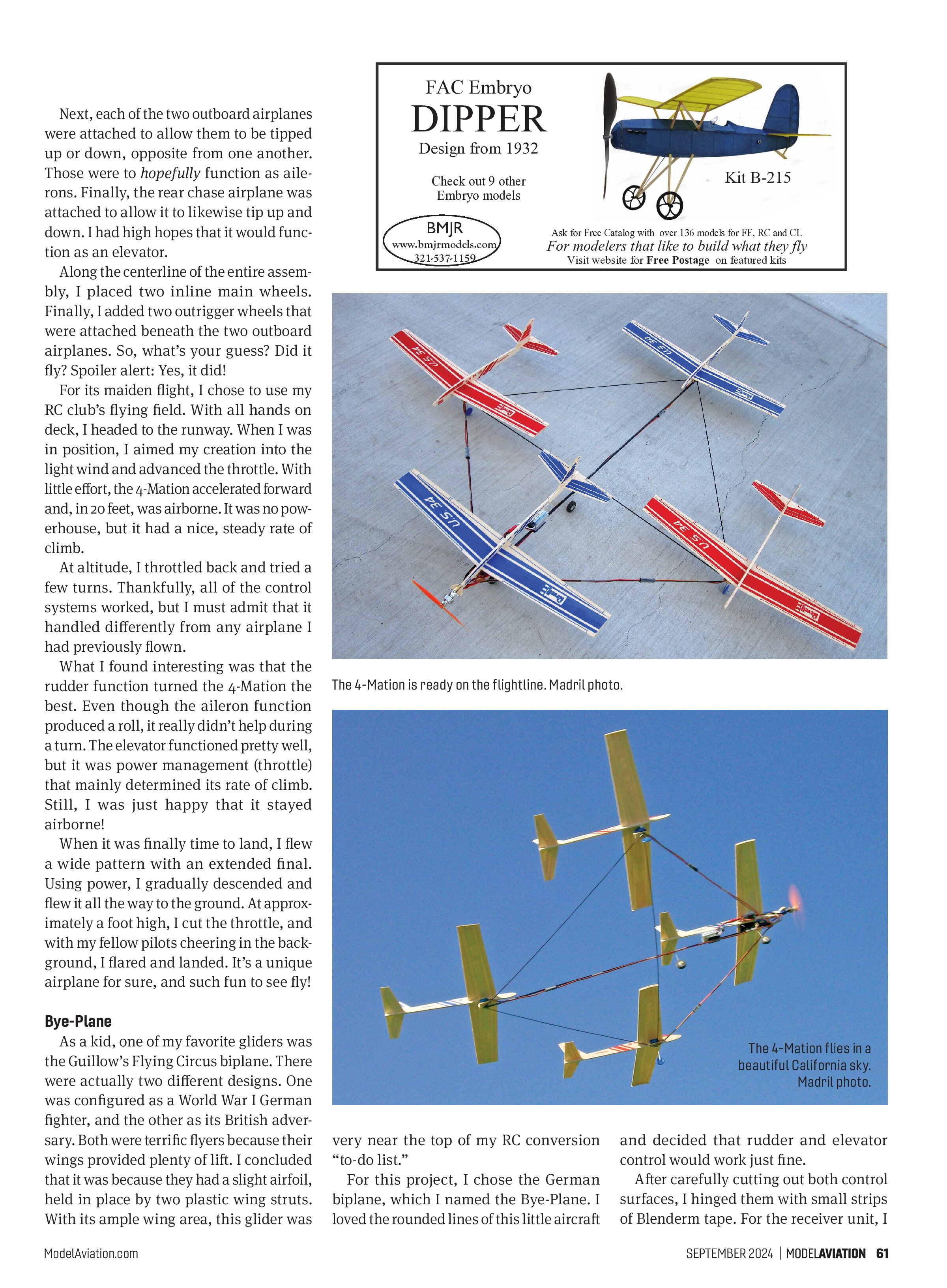
I first mounted one servo to each of the four corners of a carbon-fiber framework. They were of different orientations, depending on what their function would be. Four fully assembled Super Stratospheres were then individually attached to one of the four servo arms. When all were secured in place, they looked like four airplanes flying in a diamond formation. Cool, right?
The lead airplane was fitted with a single 10-gram brushless motor. That airplane was attached to a servo so that it could yaw right and left, functioning as the rudder. Beneath it, the receiver, ESC, and battery were secured to the framework.
Next, each of the two outboard airplanes were attached to allow them to be tipped up or down, opposite from one another. Those were to hopefully function as ailerons. Finally, the rear chase airplane was attached to allow it to likewise tip up and down. I had high hopes that it would function as an elevator.
Along the centerline of the entire assembly, I placed two inline main wheels. Finally, I added two outrigger wheels that were attached beneath the two outboard airplanes. So, what’s your guess? Did it fly? Spoiler alert: Yes, it did!
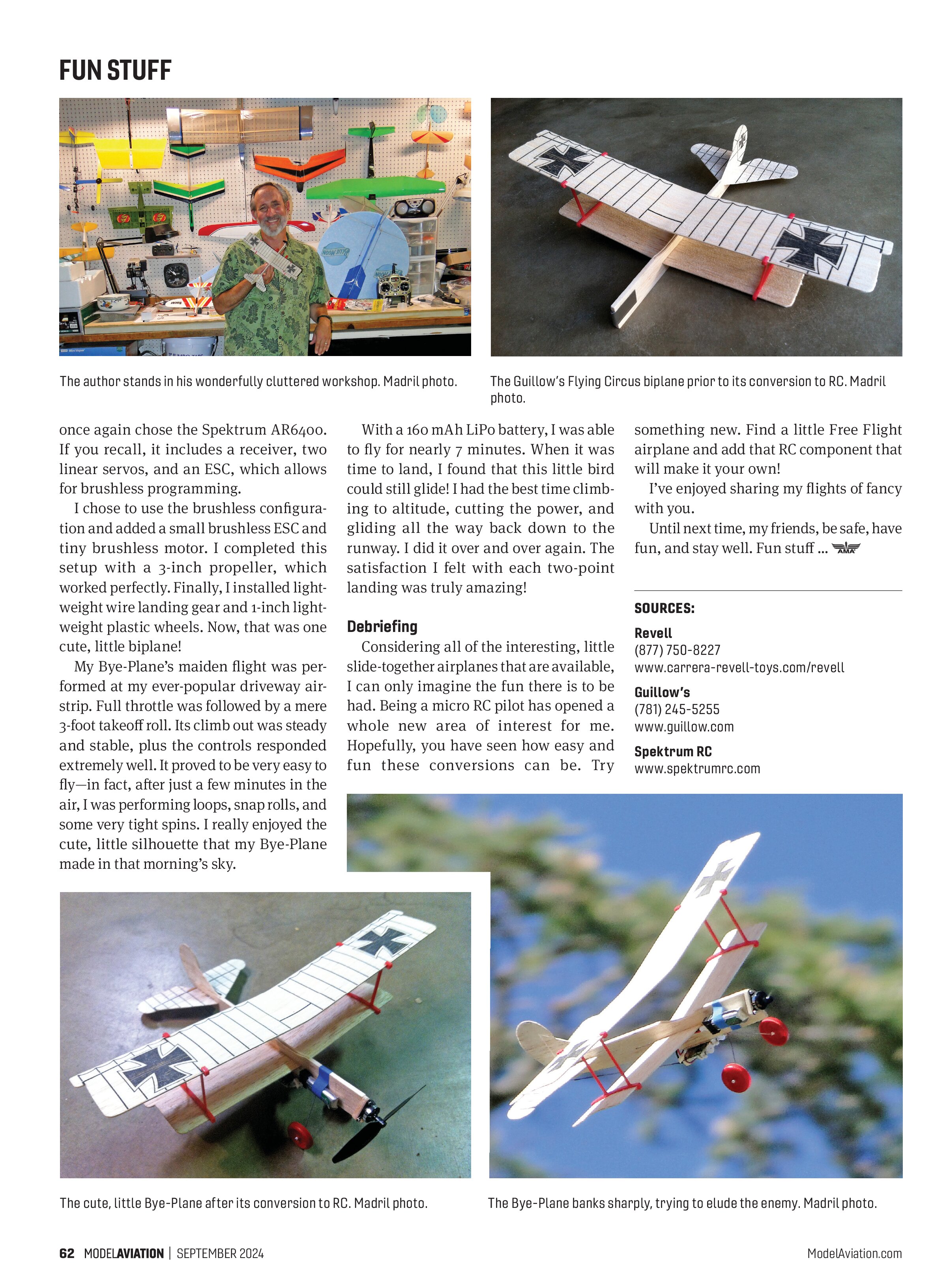
For its maiden flight, I chose to use my RC club’s flying field. With all hands on deck, I headed to the runway. When I was in position, I aimed my creation into the light wind and advanced the throttle. With little effort, the 4-Mation accelerated forward and, in 20 feet, was airborne. It was no powerhouse, but it had a nice, steady rate of climb.
At altitude, I throttled back and tried a few turns. Thankfully, all of the control systems worked, but I must admit that it handled differently from any airplane I had previously flown.
What I found interesting was that the rudder function turned the 4-Mation the best. Even though the aileron function produced a roll, it really didn’t help during a turn. The elevator functioned pretty well, but it was power management (throttle) that mainly determined its rate of climb. Still, I was just happy that it stayed airborne!
When it was finally time to land, I flew a wide pattern with an extended final. Using power, I gradually descended and flew it all the way to the ground. At approximately a foot high, I cut the throttle, and with my fellow pilots cheering in the background, I flared and landed. It’s a unique airplane for sure, and such fun to see fly!


Bye-Plane
As a kid, one of my favorite gliders was the Guillows’s Flying Circus biplane. There were actually two different designs. One was configured as a World War I German fighter, and the other as its British adversary. Both were terrific flyers because their wings provided plenty of lift. I concluded that it was because they had a slight airfoil, held in place by two plastic wing struts. With its ample wing area, this glider was very near the top of my RC conversion “to-do list.”
For this project, I chose the German biplane, which I named the Bye-Plane. I loved the rounded lines of this little aircraft and decided that rudder and elevator control would work just fine.
After carefully cutting out both control surfaces, I hinged them with small strips of Blenderm tape. For the receiver unit, I
once again chose the Spektrum AR6400. If you recall, it includes a receiver, two linear servos, and an ESC, which allows for brushless programming.
I chose to use the brushless configuration and added a small brushless ESC and tiny brushless motor. I completed this setup with a 3-inch propeller, which worked perfectly. Finally, I installed lightweight wire landing gear and 1-inch lightweight plastic wheels. Now, that was one cute, little biplane!
My Bye-Plane’s maiden flight was performed at my ever-popular driveway airstrip. Full throttle was followed by a mere 3-foot takeoff roll. Its climb out was steady and stable, plus the controls responded extremely well. It proved to be very easy to fly—in fact, after just a few minutes in the air, I was performing loops, snap rolls, and some very tight spins. I really enjoyed the cute, little silhouette that my Bye-Plane made in that morning’s sky.

With a 160 mAh LiPo battery, I was able to fly for nearly 7 minutes. When it was time to land, I found that this little bird could still glide! I had the best time climbing to altitude, cutting the power, and gliding all the way back down to the runway. I did it over and over again. The satisfaction I felt with each two-point landing was truly amazing!
Debriefing
Considering all of the interesting, little slide-together airplanes that are available, I can only imagine the fun there is to be had. Being a micro RC pilot has opened a whole new area of interest for me. Hopefully, you have seen how easy and fun these conversions can be. Try something new. Find a little Free Flight airplane and add that RC component that will make it your own!
I’ve enjoyed sharing my flights of fancy with you.
Until next time, my friends, be safe, have fun, and stay well. Fun stuff …
SOURCES:
Revell
(877) 750-8227
www.carrera-revell-toys.com/revell
Guillow’s
(781) 245-5255
www.guillow.com
Spektrum RC
www.spektrumrc.com