2024 UAS4STEM PRELIMINARY RESULTS
By Gwen Mathis | gwenm@modelaircraft.org

IT CAN BE VERY DIFFICULT to talk about yourself and your accomplishments. We don’t often truly understand how impressive our accomplishments are because we’re so focused on reaching the finish line. When we finally get the chance to talk about the process and the many steps we must take to achieve our final goals, however, it becomes clear that we do great things at every stage of a project.
This is why the UAS4STEM preliminaries are an important part of the months-long competition. By the time the teams reach this stage of competition in late April, they’ve been working for months to program their drones and prepare for their team presentations.
The AMA Education team and guest judges also love the UAS4STEM preliminaries; we get the chance to see what impressive things the teams have done and are able to recognize all of their hard work thus far.
What Is UAS4STEM?
UAS4STEM is AMA’s STEAM drone competition. It began originally as a Naval Air Systems Command Program sponsored by AMA. After a successful first year of implementation, the program was officially turned over to AMA.
The team in charge of implementing and running the UAS4STEM competition is comprised of many individuals across various backgrounds and disciplines; however, every member of the team is dedicated to providing a professional and challenging environment to all competitors.
UAS4STEM competitors are anywhere between the ages of 11 to 19. These UAS enthusiasts do incredible things that are made even more impressive because of their young ages. While adults might think that programming and flying a drone could prove to be nearly impossible for young people, our competitors demonstrate every day that this is not the case. In fact, many of them make it look like a breeze!
Each competitor must be a part of a team. Teams are composed of four to 10 participants and one to two adult mentors. Once a team is formed, it’s up to the youth members and their adult mentor(s) to assign roles and responsibilities within the team. These roles include, but aren’t limited to, the remote pilot in command, the safety pilot, the safety officer, the ground station officer, the visual observer, and flight operations. It is the responsibility of the teams to ensure that each individual is trained and prepared to act in their role.
There are two levels of competition: Beginner and Advanced. The Beginner division was created to reduce the barriers of entry into the competition because competition organizers have to create new challenges every year in order to keep it fresh and challenging! The Beginner division allows teams to focus on the fundamental skills of drone programming and flying.
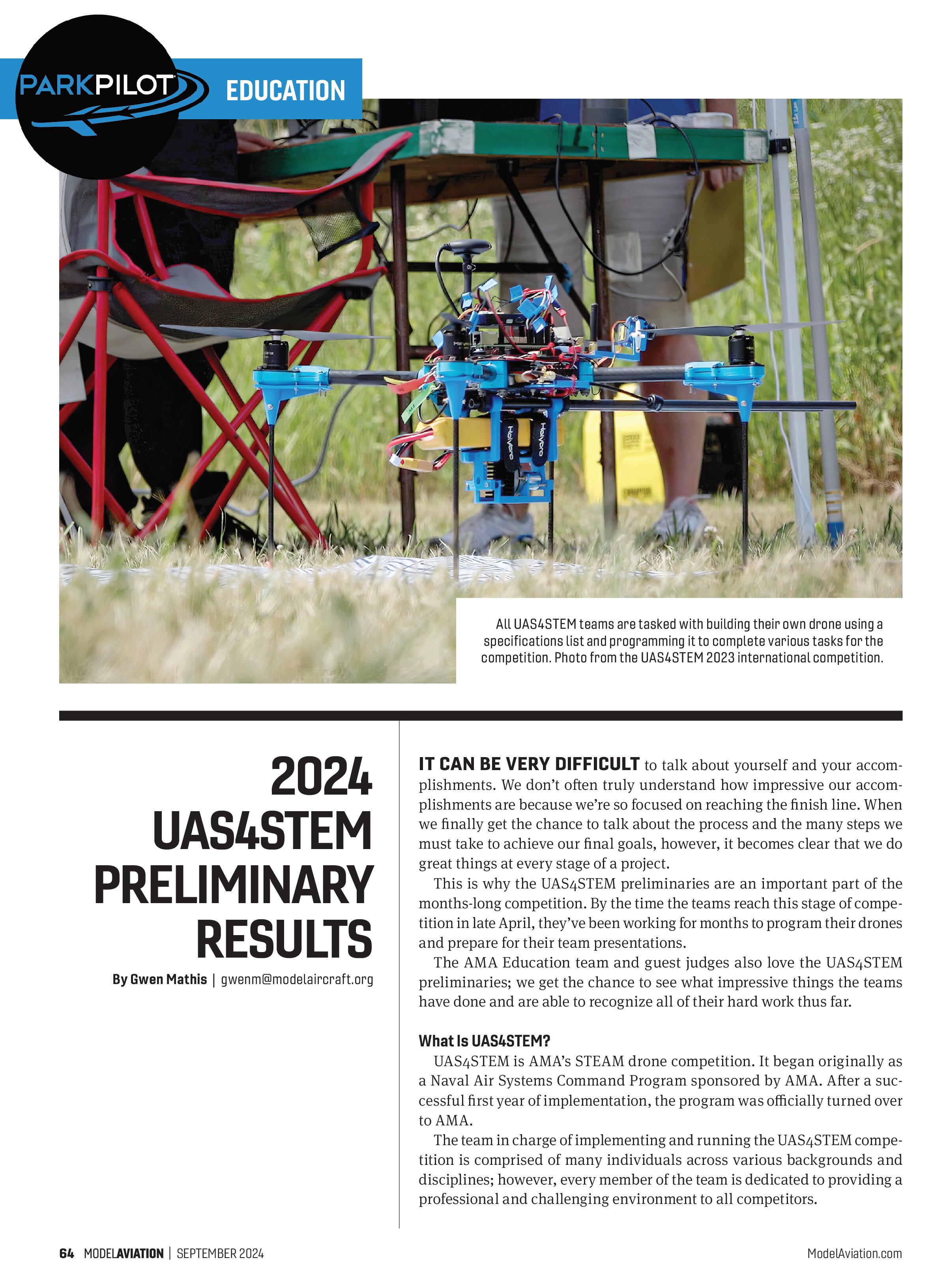
The Advanced division creates new curveballs so that teams must build on their skills from the previous year(s). For example, teams participating in the Advanced division in 2023 had to create their own mechanism(s) to pick up and transport items to specified drop-off points.
Prior to flying, presenting, or competing, all participants must complete the UAS4STEM Ground School Course. This online course is Next Generation Science Standard aligned, meaning that it meets the national standards that many schools implement into their STEAM learning environments. Ground School introduces UAS4STEM participants to the fundamentals of sUAS, the fundamentals of flight, aviation safety, the National Airspace System, and so much more. The course ensures that competitors are prepared and knowledgeable when it comes to flying UAS. Ground School can be completed at each competitor’s own time and pace; however, the course should be completed by the preliminary competition to ensure that all participants are ready to fly.
Once April finally rolls around, it’s time for teams to present their Flight Readiness Reviews (FRRs) at the virtual preliminary competition. Teams have 50 minutes to provide a proof-of-flight video submission, their virtual FRR presentation, a 15-minute mission-planning software assessment, and a video that they created to highlight what UAS4STEM is.
Beginner teams film videos that focus on sharing what they are doing, what they are learning, and/or what their teams’ goals are. Advanced teams’ videos are intended to mentor new teams; their videos might share a technique or process that works for their team, or maybe even a component of their build.
The preliminary competition is scored based on introductions of each team member and their roles, their support/training video for new teams, their system overview, a synopsis of their system safety, their developmental test results, any evidence of mission accomplishments, a pre-mission briefing, and the accuracy, clarity, logic, precision, relevance, depth, and suitability of their presentation.
Top-scoring teams are invited to the international UAS4STEM competition at the Experimental Aircraft Association (EAA) AirVenture Oshkosh in Wisconsin. It is a huge honor that EAA has invited our young competitors to conduct flight operations in the world’s busiest airspace at the largest celebration of flight.
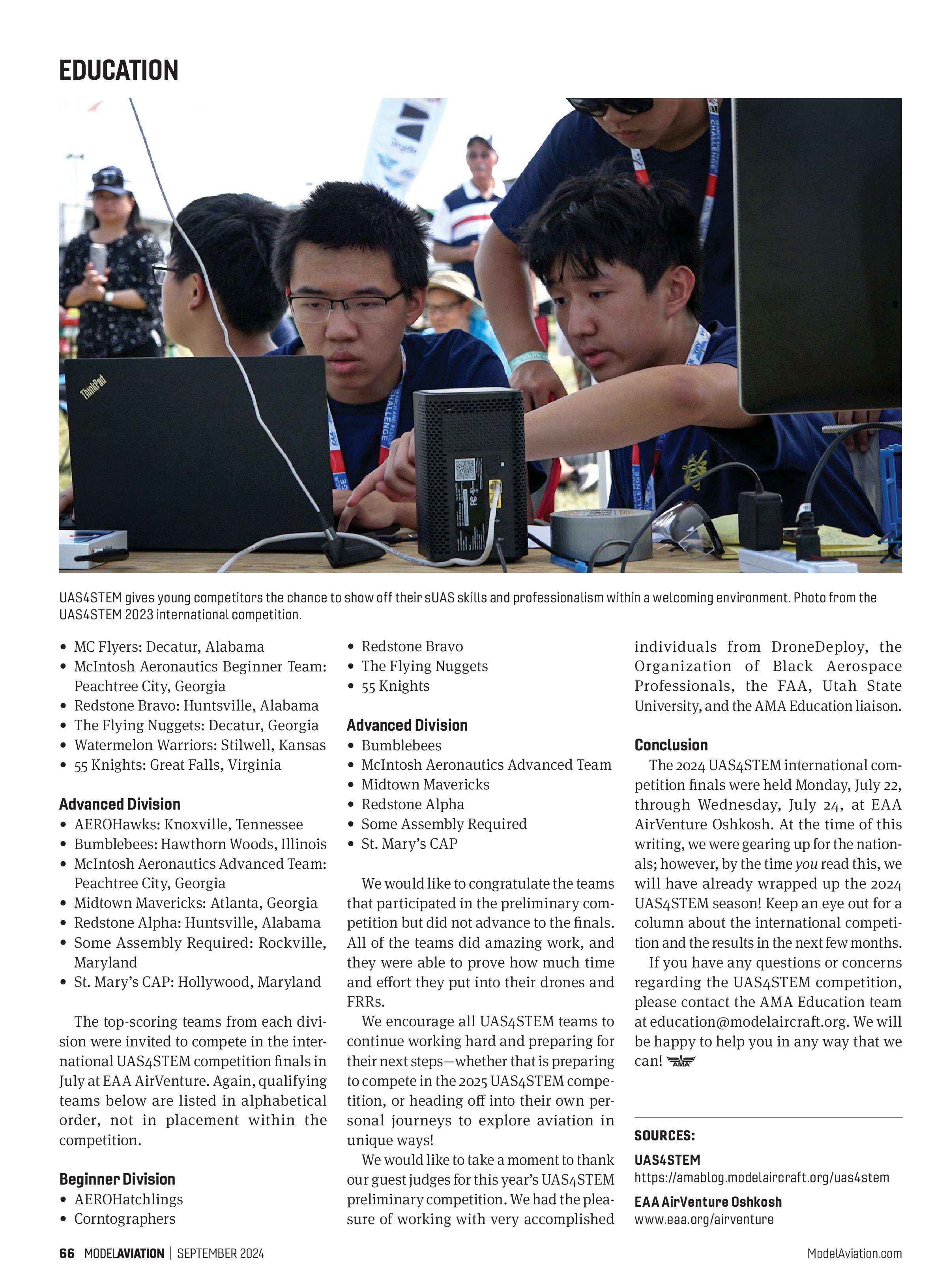
On top of putting immense trust into our teams, EAA rolls out the red carpet by providing participants with admission and lodging for the length of their stay. During the international competition, teams once again present their updated FRRs, carry out a set of UAS tasks that they’re given months in advance, and meet all sorts of aviation professionals and enthusiasts. Throughout their time at AirVenture, these young pilots are able to demonstrate their professionalism and sUAS skills, and parents and observers are always impressed.
UAS4STEM Preliminary Competition Results
Seventeen teams in total participated in the UAS4STEM 2024 preliminary competition, with 10 in the Beginner division and seven in the Advanced division. These teams are from all over the US, from New York to Hawaii and everywhere in between!
Note that all teams listed below are in alphabetical order and not in order of placement.
Beginner Division
- AEROHatchlings: Knoxville, Tennessee
- Adobo Racers: Waipahu, Hawaii
- Corntographers: Yorktown Heights, New York
- Cranes Fly Together: Bloomfield Hills, Michigan

- MC Flyers: Decatur, Alabama
- McIntosh Aeronautics Beginner Team: Peachtree City, Georgia
- Redstone Bravo: Huntsville, Alabama
- The Flying Nuggets: Decatur, Georgia
- Watermelon Warriors: Stilwell, Kansas
- 55 Knights: Great Falls, Virginia
Advanced Division
- AEROHawks: Knoxville, Tennessee
- Bumblebees: Hawthorn Woods, Illinois
- McIntosh Aeronautics Advanced Team: Peachtree City, Georgia
- Midtown Mavericks: Atlanta, Georgia
- Redstone Alpha: Huntsville, Alabama
- Some Assembly Required: Rockville, Maryland
- St. Mary’s CAP: Hollywood, Maryland
The top-scoring teams from each division were invited to compete in the international UAS4STEM competition finals in July at EAA AirVenture. Again, qualifying teams below are listed in alphabetical order, not in placement within the competition.
Beginner Division
- AEROHatchlings
- Corntographers
- Redstone Bravo
- The Flying Nuggets
- 55 Knights
Advanced Division
- Bumblebees
- McIntosh Aeronautics Advanced Team
- Midtown Mavericks
- Redstone Alpha
- Some Assembly Required
- St. Mary’s CAP
We would like to congratulate the teams that participated in the preliminary competition but did not advance to the finals. All of the teams did amazing work, and they were able to prove how much time and effort they put into their drones and FRRs.
We encourage all UAS4STEM teams to continue working hard and preparing for their next steps—whether that is preparing to compete in the 2025 UAS4STEM competition, or heading off into their own personal journeys to explore aviation in unique ways!
We would like to take a moment to thank our guest judges for this year’s UAS4STEM preliminary competition. We had the pleasure of working with very accomplished individuals from DroneDeploy, the Organization of Black Aerospace Professionals, the FAA, Utah State University, and the AMA Education liaison.
Conclusion
The 2024 UAS4STEM international competition finals were held Monday, July 22, through Wednesday, July 24, at EAA AirVenture Oshkosh. At the time of this writing, we were gearing up for the nationals; however, by the time you read this, we will have already wrapped up the 2024 UAS4STEM season! Keep an eye out for a column about the international competition and the results in the next few months.
If you have any questions or concerns regarding the UAS4STEM competition, please contact the AMA Education team at education@modelaircraft.org. We will be happy to help you in any way that we can!
SOURCES:
UAS4STEM
https://amablog.modelaircraft.org/uas4stem
EAA AirVenture Oshkosh
www.eaa.org/airventure