
MY 50-YEAR ADVENTURE WITH A JENSEN UGLY STIK
Inspired readers
can build their
own
By Brian Crossley
bcplanes@msn.com
Photos provided by the author
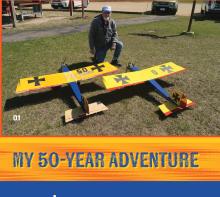
The Ugly Stik was my first RC model. I built it in the winter of 1974, learned to fly with it, and have flown it as my first flight in the spring for 51 consecutive flying seasons. In the winter of 1974, I was in the San Jose, California, area on a job assignment. One day, when leaving work, I heard the sound of a model airplane. I had flown Control Line (CL) in the 1950s, so I knew the sound.
I tracked it down and found a flying field, where I became infected with the RC bug. It was an asphalt field and the club was quite large—more than 200 members! Throughout the next few weeks, I hung around and asked a lot of questions about how to start and what to start with.

The consensus was that I should buy and build a Jensen Ugly Stik kit and use a K&B .61 engine with a Kraft radio. There were many of these being flown by the club members and it seemed to be a good choice.
History of the Jensen Ugly Stik
This was the airplane that started it all. There are slow sticks, twin sticks, biplane sticks, ultra sticks, sticks, or stiks. They are still sold in many sizes and variations (mostly ARFs now). They all fly well and are easy to get into the air. But you could always tell an original Jensen Ugly Stik because it had a 60-inch wingspan, dihedral, and scalloped ailerons and elevator.
I think the Jensen flies better than most other sticks—it might be the dihedral. The dihedral also prevents it from having that “droopy-wing” look that the straight, high-wing sticks have. It is still a
pleasure to fly. It will do most of the basic aerobatic maneuvers, including inverted flight. It has even been used by many people for novice RC Aerobatics (Pattern) flying.
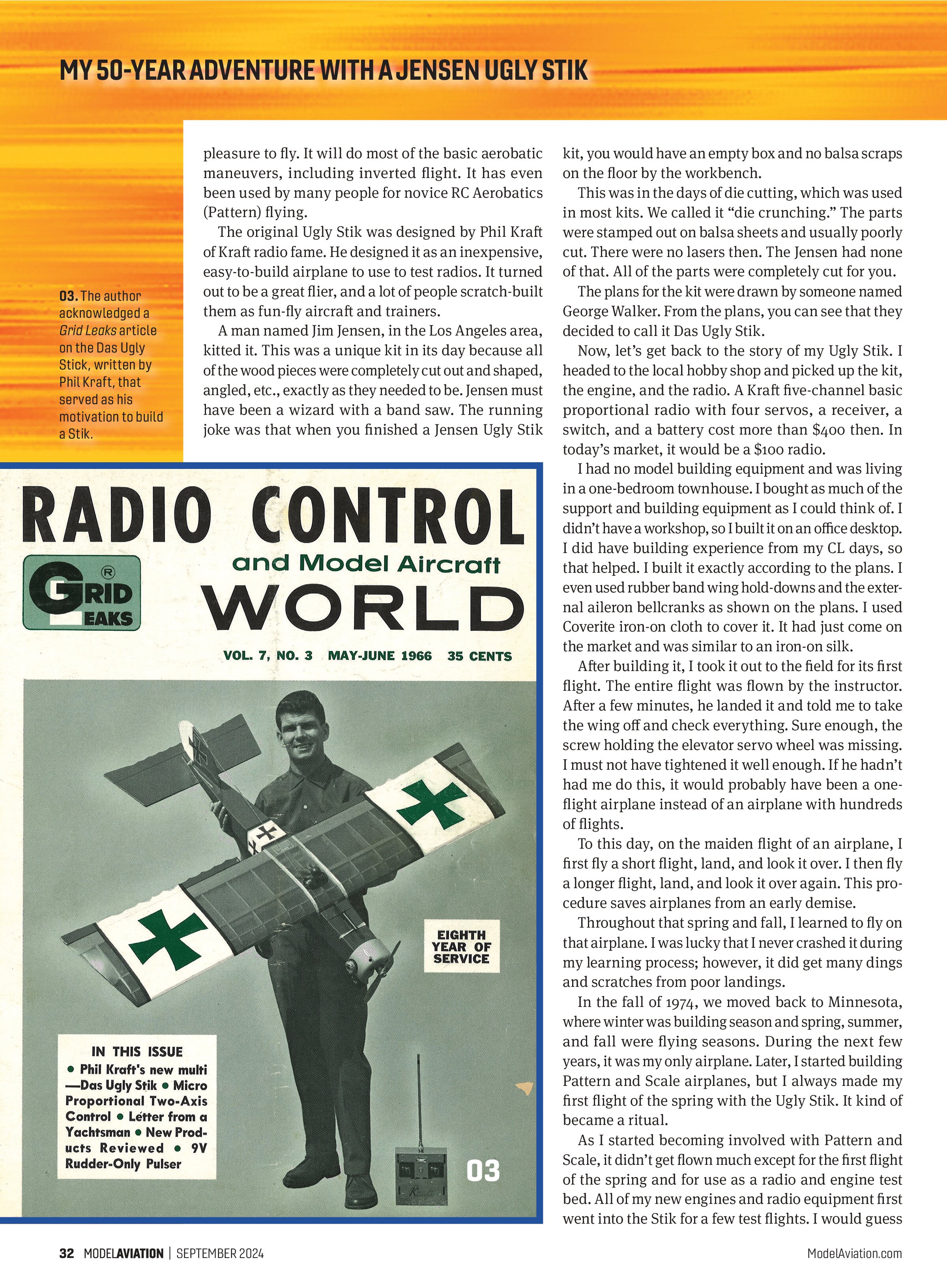
The original Ugly Stik was designed by Phil Kraft of Kraft radio fame. He designed it as an inexpensive, easy-to-build airplane to use to test radios. It turned out to be a great flier, and a lot of people scratch-built them as fun-fly aircraft and trainers.
A man named Jim Jensen, in the Los Angeles area, kitted it. This was a unique kit in its day because all of the wood pieces were completely cut out and shaped, angled, etc., exactly as they needed to be. Jensen must have been a wizard with a band saw. The running joke was that when you finished a Jensen Ugly Stik

kit, you would have an empty box and no balsa scraps on the floor by the workbench.
This was in the days of die cutting, which was used in most kits. We called it “die crunching.” The parts were stamped out on balsa sheets and usually poorly cut. There were no lasers then. The Jensen had none of that. All of the parts were completely cut for you.
The plans for the kit were drawn by someone named George Walker. From the plans, you can see that they decided to call it Das Ugly Stik.
Now, let’s get back to the story of my Ugly Stik. I headed to the local hobby shop and picked up the kit, the engine, and the radio. A Kraft five-channel basic proportional radio with four servos, a receiver, a switch, and a battery cost more than $400 then. In today’s market, it would be a $100 radio.
I had no model building equipment and was living in a one-bedroom townhouse. I bought as much of the support and building equipment as I could think of. I didn’t have a workshop, so I built it on an office desktop. I did have building experience from my CL days, so that helped. I built it exactly according to the plans. I even used rubber band wing hold-downs and the external aileron bellcranks as shown on the plans. I used Coverite iron-on cloth to cover it. It had just come on the market and was similar to an iron-on silk.
After building it, I took it out to the field for its first flight. The entire flight was flown by the instructor. After a few minutes, he landed it and told me to take the wing off and check everything. Sure enough, the screw holding the elevator servo wheel was missing. I must not have tightened it well enough. If he hadn’t had me do this, it would probably have been a one-flight airplane instead of an airplane with hundreds of flights.
To this day, on the maiden flight of an airplane, I first fly a short flight, land, and look it over. I then fly a longer flight, land, and look it over again. This procedure saves airplanes from an early demise.
Throughout that spring and fall, I learned to fly on that airplane. I was lucky that I never crashed it during my learning process; however, it did get many dings and scratches from poor landings.
In the fall of 1974, we moved back to Minnesota, where winter was building season and spring, summer, and fall were flying seasons. During the next few years, it was my only airplane. Later, I started building Pattern and Scale airplanes, but I always made my first flight of the spring with the Ugly Stik. It kind of became a ritual.
As I started becoming involved with Pattern and Scale, it didn’t get flown much except for the first flight of the spring and for use as a radio and engine test bed. All of my new engines and radio equipment first went into the Stik for a few test flights. I would guess that this airplane has had dozens and dozens of servos, dozens of receivers and batteries, and a couple of dozen engines in it.

It has had screaming Rossi, Webra, and Kraft Pattern engines in it. It still has a bracket for the tuned-pipe mount on the side of the fuselage. I found that the Ugly Stik has a terminal velocity. It didn’t fly any faster in level flight with a hot Pattern engine than it did with the K&B sport engine; however, it would climb straight up for a longer time and perform bigger loops!
It has had only one mishap during its life. In roughly 1980, I was testing a variable-pitch propeller on it. It was a device from a man named Geizendanner in Switzerland for use in Pattern to slow the downlines. (Does anyone remember Geizendanner wipers for Kraft servos?) In flight, it threw a propeller blade and, before I realized it, the vibration shook the tail section away from the fuselage.
I cut the power and it crashed to the ground with the stabilizer, elevator, fin, and rudder hanging on by the pushrods. The tail unit and wing were fine, but I had to rebuild the box fuselage. I painted the rebuilt parts blue.
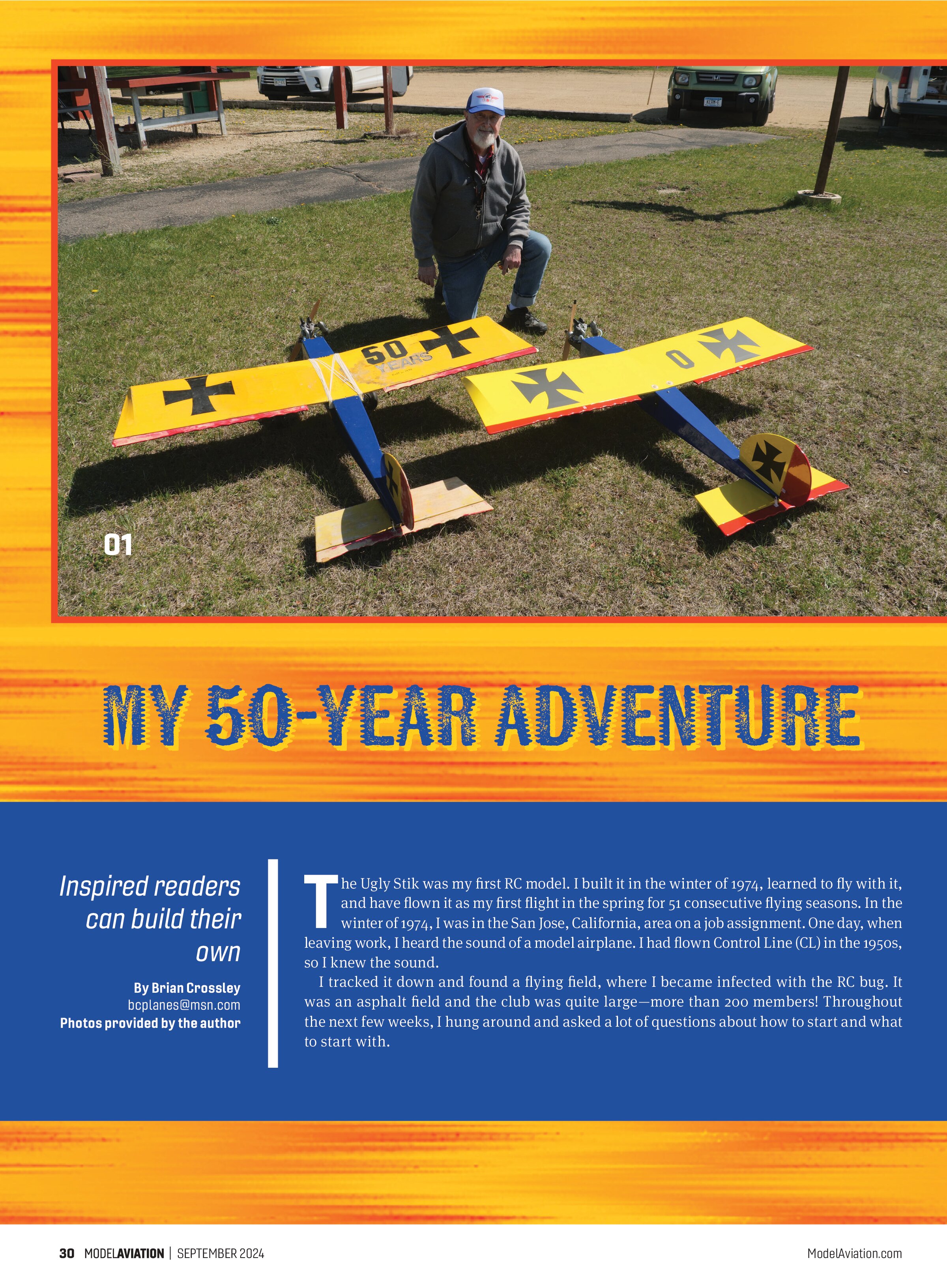
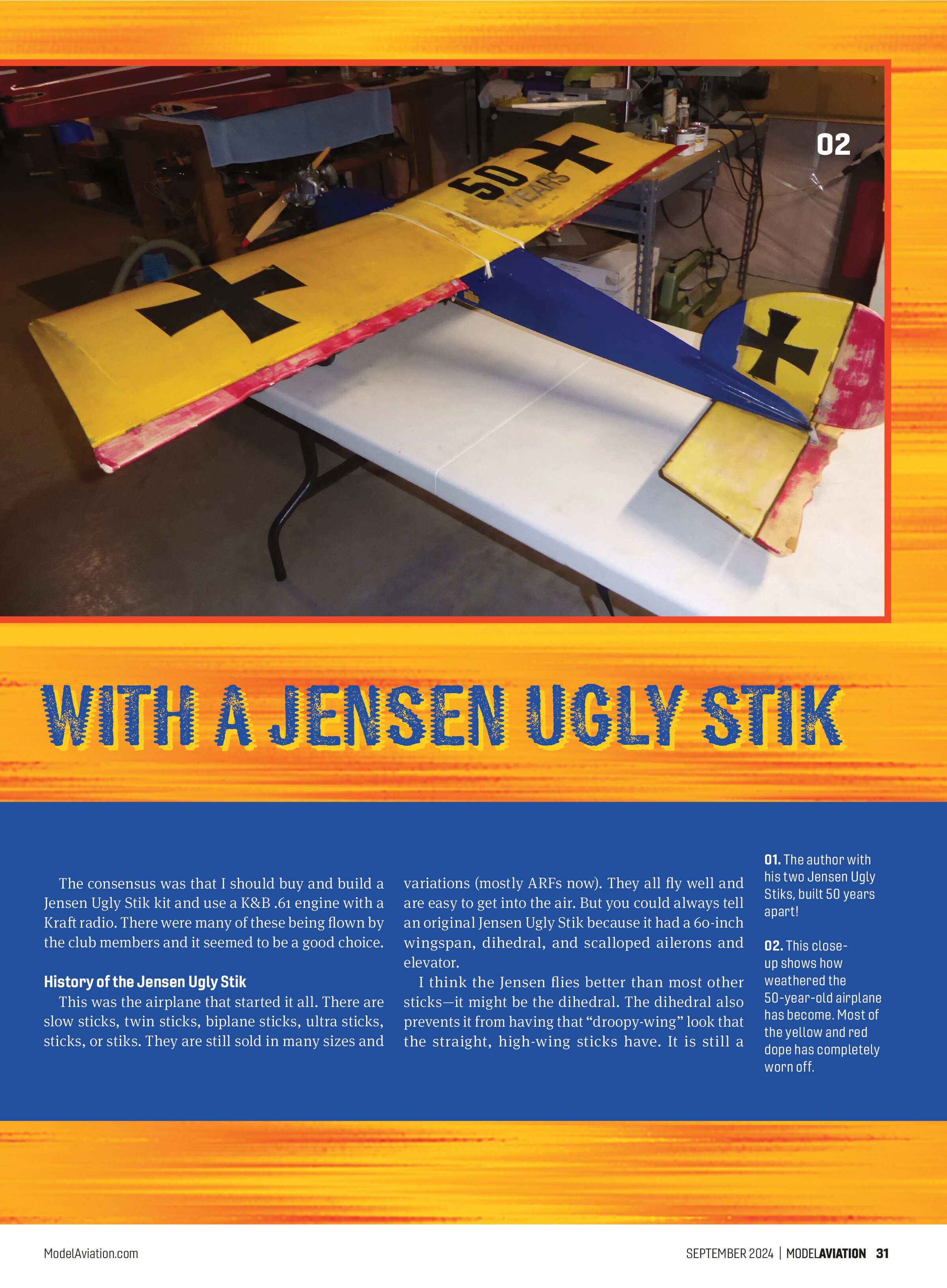
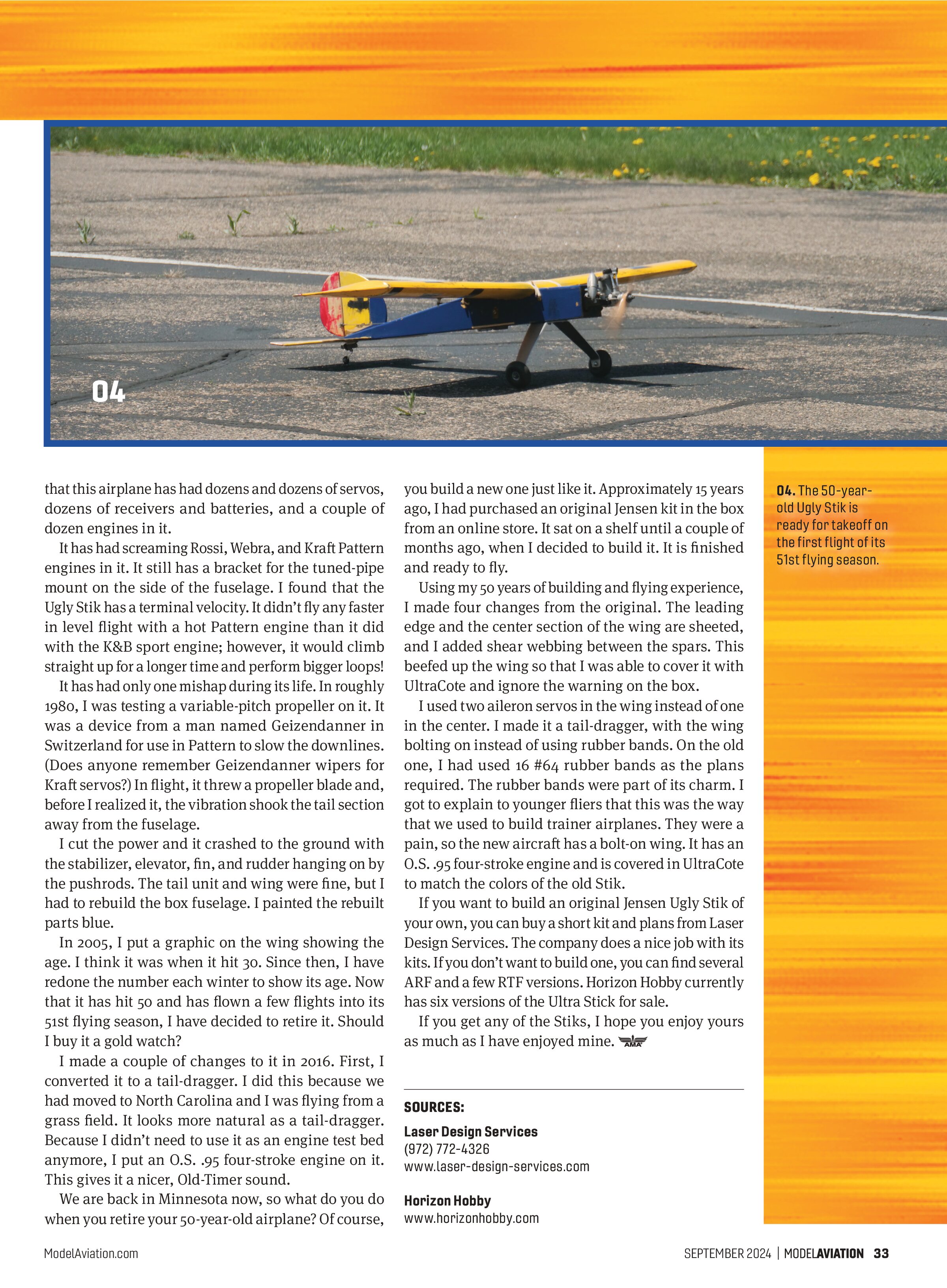
In 2005, I put a graphic on the wing showing the age. I think it was when it hit 30. Since then, I have redone the number each winter to show its age. Now that it has hit 50 and has flown a few flights into its 51st flying season, I have decided to retire it. Should I buy it a gold watch?
I made a couple of changes to it in 2016. First, I converted it to a tail-dragger. I did this because we had moved to North Carolina and I was flying from a grass field. It looks more natural as a tail-dragger. Because I didn’t need to use it as an engine test bed anymore, I put an O.S. .95 four-stroke engine on it. This gives it a nicer, Old-Timer sound.
We are back in Minnesota now, so what do you do when you retire your 50-year-old airplane? Of course, you build a new one just like it. Approximately 15 years ago, I had purchased an original Jensen kit in the box from an online store. It sat on a shelf until a couple of months ago, when I decided to build it. It is finished and ready to fly.
Using my 50 years of building and flying experience, I made four changes from the original. The leading edge and the center section of the wing are sheeted, and I added shear webbing between the spars. This beefed up the wing so that I was able to cover it with UltraCote and ignore the warning on the box.
I used two aileron servos in the wing instead of one in the center. I made it a tail-dragger, with the wing bolting on instead of using rubber bands. On the old one, I had used 16 #64 rubber bands as the plans required. The rubber bands were part of its charm. I got to explain to younger fliers that this was the way that we used to build trainer airplanes. They were a pain, so the new aircraft has a bolt-on wing. It has an O.S. .95 four-stroke engine and is covered in UltraCote to match the colors of the old Stik.
If you want to build an original Jensen Ugly Stik of your own, you can buy a short kit and plans from Laser Design Services. The company does a nice job with its kits. If you don’t want to build one, you can find several ARF and a few RTF versions. Horizon Hobby currently has six versions of the Ultra Stick for sale.
If you get any of the Stiks, I hope you enjoy yours as much as I have enjoyed mine.
SOURCES:
Laser Design Services
(972) 772-4326
www.laser-design-services.com
Horizon Hobby
www.horizonhobby.com