FOCAL POINT
Interested in sharing your handiwork? Visit www.ModelAviation.com for submission guidelines.
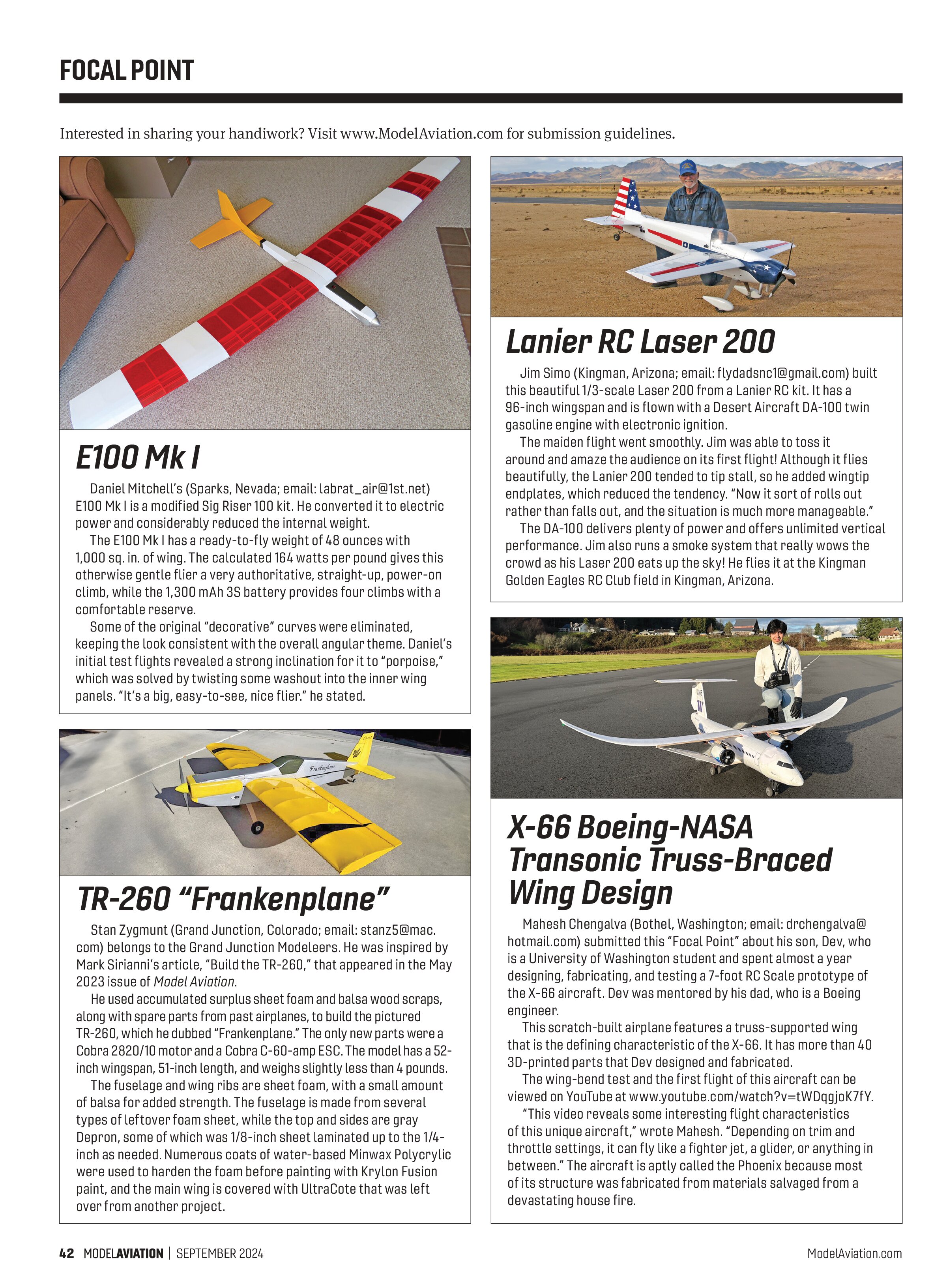
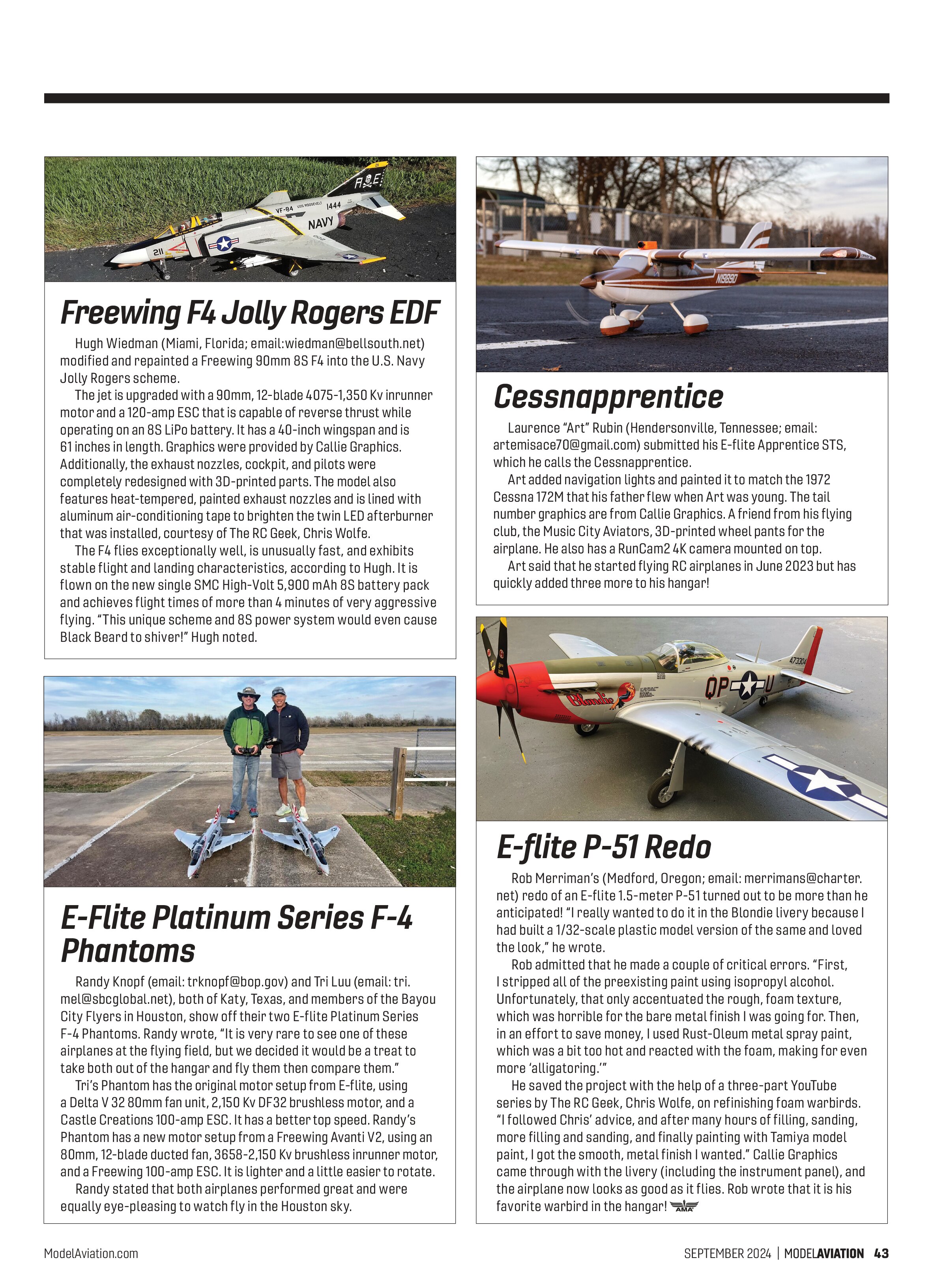
E100 Mk I
Daniel Mitchell’s (Sparks, Nevada; email: labrat_air@1st.net) E100 Mk I is a modified Sig Riser 100 kit. He converted it to electric power and considerably reduced the internal weight.
The E100 Mk I has a ready-to-fly weight of 48 ounces with 1,000 sq. in. of wing. The calculated 164 watts per pound gives this otherwise gentle flier a very authoritative, straight-up, power-on climb, while the 1,300 mAh 3S battery provides four climbs with a comfortable reserve.
Some of the original “decorative” curves were eliminated, keeping the look consistent with the overall angular theme. Daniel’s initial test flights revealed a strong inclination for it to “porpoise,” which was solved by twisting some washout into the inner wing panels. “It’s a big, easy-to-see, nice flier,” he stated.

TR-260 “Frankenplane”
Stan Zygmunt (Grand Junction, Colorado; email: stanz5@mac.com) belongs to the Grand Junction Modeleers. He was inspired by Mark Sirianni’s article, “Build the TR-260,” that appeared in the May 2023 issue of Model Aviation.
He used accumulated surplus sheet foam and balsa wood scraps, along with spare parts from past airplanes, to build the pictured TR-260, which he dubbed “Frankenplane.” The only new parts were a Cobra 2820/10 motor and a Cobra C-60-amp ESC. The model has a 52-inch wingspan, 51-inch length, and weighs slightly less than 4 pounds.
The fuselage and wing ribs are sheet foam, with a small amount of balsa for added strength. The fuselage is made from several types of leftover foam sheet, while the top and sides are gray Depron, some of which was 1/8-inch sheet laminated up to the 1/4-inch as needed. Numerous coats of water-based Minwax Polycrylic were used to harden the foam before painting with Krylon Fusion paint, and the main wing is covered with UltraCote that was left over from another project.

Freewing F4 Jolly Rogers EDF
Hugh Wiedman (Miami, Florida; email: wiedman@bellsouth.net) modified and repainted a Freewing 90mm 8S F4 into the U.S. Navy Jolly Rogers scheme.
The jet is upgraded with a 90mm, 12-blade 4075-1,350 Kv inrunner motor and a 120-amp ESC that is capable of reverse thrust while operating on an 8S LiPo battery. It has a 40-inch wingspan and is 61 inches in length. Graphics were provided by Callie Graphics. Additionally, the exhaust nozzles, cockpit, and pilots were completely redesigned with 3D-printed parts. The model also features heat-tempered, painted exhaust nozzles and is lined with aluminum air-conditioning tape to brighten the twin LED afterburner that was installed, courtesy of The RC Geek, Chris Wolfe.
The F4 flies exceptionally well, is unusually fast, and exhibits stable flight and landing characteristics, according to Hugh. It is flown on the new single SMC High-Volt 5,900 mAh 8S battery pack and achieves flight times of more than 4 minutes of very aggressive flying. “This unique scheme and 8S power system would even cause Black Beard to shiver!” Hugh noted.

E-Flite Platinum Series F-4 Phantoms
Randy Knopf (email: trknopf@bop.gov) and Tri Luu (email: tri.mel@sbcglobal.net), both of Katy, Texas, and members of the Bayou City Flyers in Houston, show off their two E-flite Platinum Series F-4 Phantoms. Randy wrote, “It is very rare to see one of these airplanes at the flying field, but we decided it would be a treat to take both out of the hangar and fly them then compare them.”
Tri’s Phantom has the original motor setup from E-flite, using a Delta V 32 80mm fan unit, 2,150 Kv DF 32 brushless motor, and a Castle Creations 100-amp ESC. It has a better top speed. Randy’s Phantom has a new motor setup from a Freewing Avanti V2, using an 80mm, 12-blade ducted fan, 3658-2,150 Kv brushless inrunner motor, and a Freewing 100-amp ESC. It is lighter and a little easier to rotate.
Randy stated that both airplanes performed great and were equally eye-pleasing to watch fly in the Houston sky.

Lanier RC Laser 200
Jim Simo (Kingman, Arizona; email: flydadsnc1@gmail.com) built this beautiful 1/3-scale Laser 200 from a Lanier RC kit. It has a 96-inch wingspan and is flown with a Desert Aircraft DA-100 twin gasoline engine with electronic ignition.
The maiden flight went smoothly. Jim was able to toss it around and amaze the audience on its first flight! Although it flies beautifully, the Lanier 200 tended to tip stall, so he added wingtip endplates, which reduced the tendency. “Now it sort of rolls out rather than falls out, and the situation is much more manageable.”
The DA-100 delivers plenty of power and offers unlimited vertical performance. Jim also runs a smoke system that really wows the crowd as his Laser 200 eats up the sky! He flies it at the Kingman Golden Eagles RC Club field in Kingman, Arizona.

X-66 Boeing-NASA Transonic Truss-Braced Wing Design
Mahesh Chengalva (Bothel, Washington; email: drchengalva@hotmail.com) submitted this “Focal Point” about his son, Dev, who is a University of Washington student and spent almost a year designing, fabricating, and testing a 7-foot RC Scale prototype of the X-66 aircraft. Dev was mentored by his dad, who is a Boeing engineer.
This scratch-built airplane features a truss-supported wing that is the defining characteristic of the X-66. It has more than 40 3D-printed parts that Dev designed and fabricated.
The wing-bend test and the first flight of this aircraft can be viewed on YouTube at www.youtube.com/watch?v=tWDqgjoK7fY.
“This video reveals some interesting flight characteristics of this unique aircraft,” wrote Mahesh. “Depending on trim and throttle settings, it can fly like a fighter jet, a glider, or anything in between.” The aircraft is aptly called the Phoenix because most of its structure was fabricated from materials salvaged from a devastating house fire.

Cessnapprentice
Laurence “Art” Rubin (Hendersonville, Tennessee; email: artemisace70@gmail.com) submitted his E-flite Apprentice STS, which he calls the Cessnapprentice.
Art added navigation lights and painted it to match the 1972 Cessna 172M that his father flew when Art was young. The tail number graphics are from Callie Graphics. A friend from his flying club, the Music City Aviators, 3D-printed wheel pants for the airplane. He also has a RunCam2 4K camera mounted on top.
Art said that he started flying RC airplanes in June 2023 but has quickly added three more to his hangar!

E-flite P-51 Redo
Rob Merriman’s (Medford, Oregon; email: merrimans@charter.net) redo of an E-flite 1.5-meter P-51 turned out to be more than he anticipated! “I really wanted to do it in the Blondie livery because I had built a 1/32-scale plastic model version of the same and loved the look,” he wrote.
Rob admitted that he made a couple of critical errors. “First, I stripped all of the preexisting paint using isopropyl alcohol. Unfortunately, that only accentuated the rough, foam texture, which was horrible for the bare metal finish I was going for. Then, in an effort to save money, I used Rust-Oleum metal spray paint, which was a bit too hot and reacted with the foam, making for even more ‘alligatioring.’”
He saved the project with the help of a three-part YouTube series by The RC Geek, Chris Wolfe, on refinishing foam warbirds. “I followed Chris’ advice, and after many hours of filling, sanding, more filling and sanding, and finally painting with Tamiya model paint, I got the smooth, metal finish I wanted.” Callie Graphics came through with the livery (including the instrument panel), and the airplane now looks as good as it flies. Rob wrote that it is his favorite warbird in the hangar!