ADVANCED FLIGHT TECHNOLOGIES
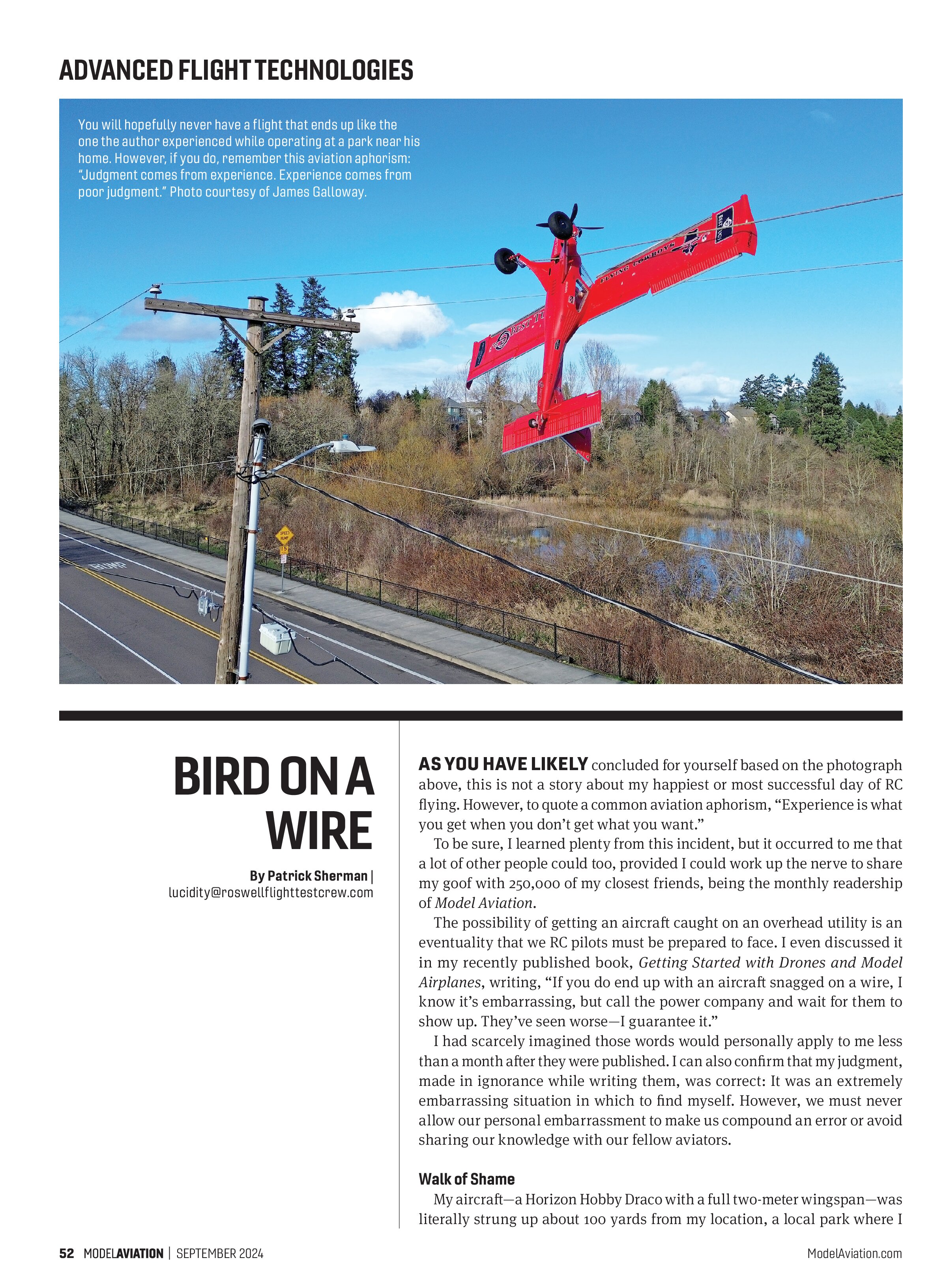
You will hopefully never have a flight that ends up like the one the author experienced while operating at a park near his home. However, if you do, remember this aviation aphorism: “Judgment comes from experience. Experience comes from poor judgment.”
BIRD ON A WIRE
By Patrick Sherman
lucidity@roswellflighttestcrew.com
AS YOU HAVE LIKELY concluded for yourself based on the photograph above, this is not a story about my happiest or most successful day of RC flying. However, to quote a common aviation aphorism, “Experience is what you get when you don’t get what you want.”
To be sure, I learned plenty from this incident, but it occurred to me that a lot of other people could too, provided I could work up the nerve to share my goof with 250,000 of my closest friends, being the monthly readership of Model Aviation.
The possibility of getting an aircraft caught on an overhead utility is an eventuality that we RC pilots must be prepared to face. I even discussed it in my recently published book, Getting Started with Drones and Model Airplanes, writing, “If you do end up with an aircraft snagged on a wire, I know it’s embarrassing, but call the power company and wait for them to show up. They’ve seen worse—I guarantee it.”
I had scarcely imagined those words would personally apply to me less than a month after they were published. I can also confirm that my judgment, made in ignorance while writing them, was correct: It was an extremely embarrassing situation in which to find myself. However, we must never allow our personal embarrassment to make us compound an error or avoid sharing our knowledge with our fellow aviators.
Walk of Shame
My aircraft—a Horizon Hobby Draco with a full two-meter wingspan—was literally strung up about 100 yards from my location, a local park where I have been flying regularly for a decade. I had cleared those same powerlines successfully on literally thousands of previous occasions. To be sure, I was frustrated, but in the time that it took me to walk that distance, my mood had become one of gratitude. The situation could have been far worse, I realized.
The following is a partial list of all of the awfulness that did not occur:
- Nobody was hurt or endangered by the collision.
- As best as I could tell with my untrained eyes, there was no damage to the infrastructure, so I didn’t cause a blackout.
- The substantial six-cell 5,000 mAh battery powering the aircraft had been ejected upon impact and landed on soft grass, meaning that there was no danger of fire.
- My model appeared to be completely intact, albeit inaccessible to me for the moment.
Ever so briefly, I considered the possibility of attempting to recover the aircraft myself, until I remembered another bit of wisdom that I had sought to share with my readers: “Transmission lines are not something you want to be playing around with on your own. They can literally make you dead in a heartbeat.”
With no practical alternative apart from calling the local power company, I dug out my phone, looked up the number, and made the call. It was answered by a chipper computer that asked me to describe the reason for my call in a few words. I responded: “My model airplane is stuck on an above-ground utility wire.”
“Hang on,” the computer said. “Let me connect you with someone who can help.”
High-Wire Act
I told the human dispatcher who I spoke to next what had happened. Understandably, I suppose, his first concern was whether or not the electricity was still flowing. I explained that I was standing in the middle of a park with no obvious indicators either way, but there was no damage that I could discern.
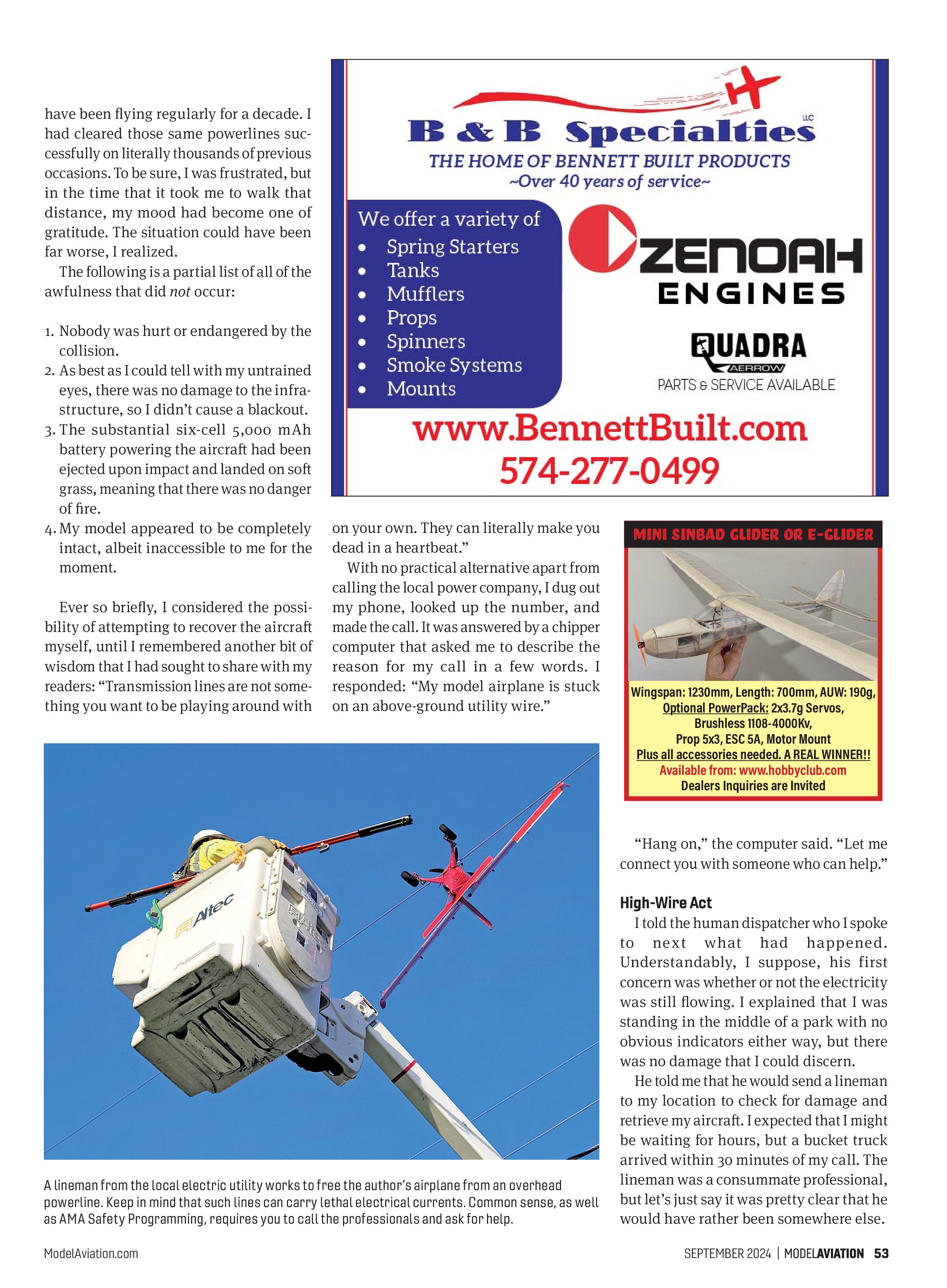
He told me that he would send a lineman to my location to check for damage and retrieve my aircraft. I expected that I might be waiting for hours, but a bucket truck arrived within 30 minutes of my call. The lineman was a consummate professional, but let’s just say it was pretty clear that he would have rather been somewhere else.


After studying the situation, he asked if I would be able to catch the aircraft if he disentangled it from the line and let it drop. I explained that this would not be my preferred outcome because, owing to the size of the model, there was a good chance that it would be damaged. He replied, “Well, you’ve hit a live wire, and I’m not going to risk my life for your airplane.”
To this, I responded, “I care 100% about you and 0% about the aircraft. Do whatever you need to do in order to be safe. If the airplane is destroyed in the process, I couldn’t care less.”
With that, he hoisted himself up to the level of the powerlines and began trying to work the aircraft free using a pair of insulated poles with hooks on the ends.
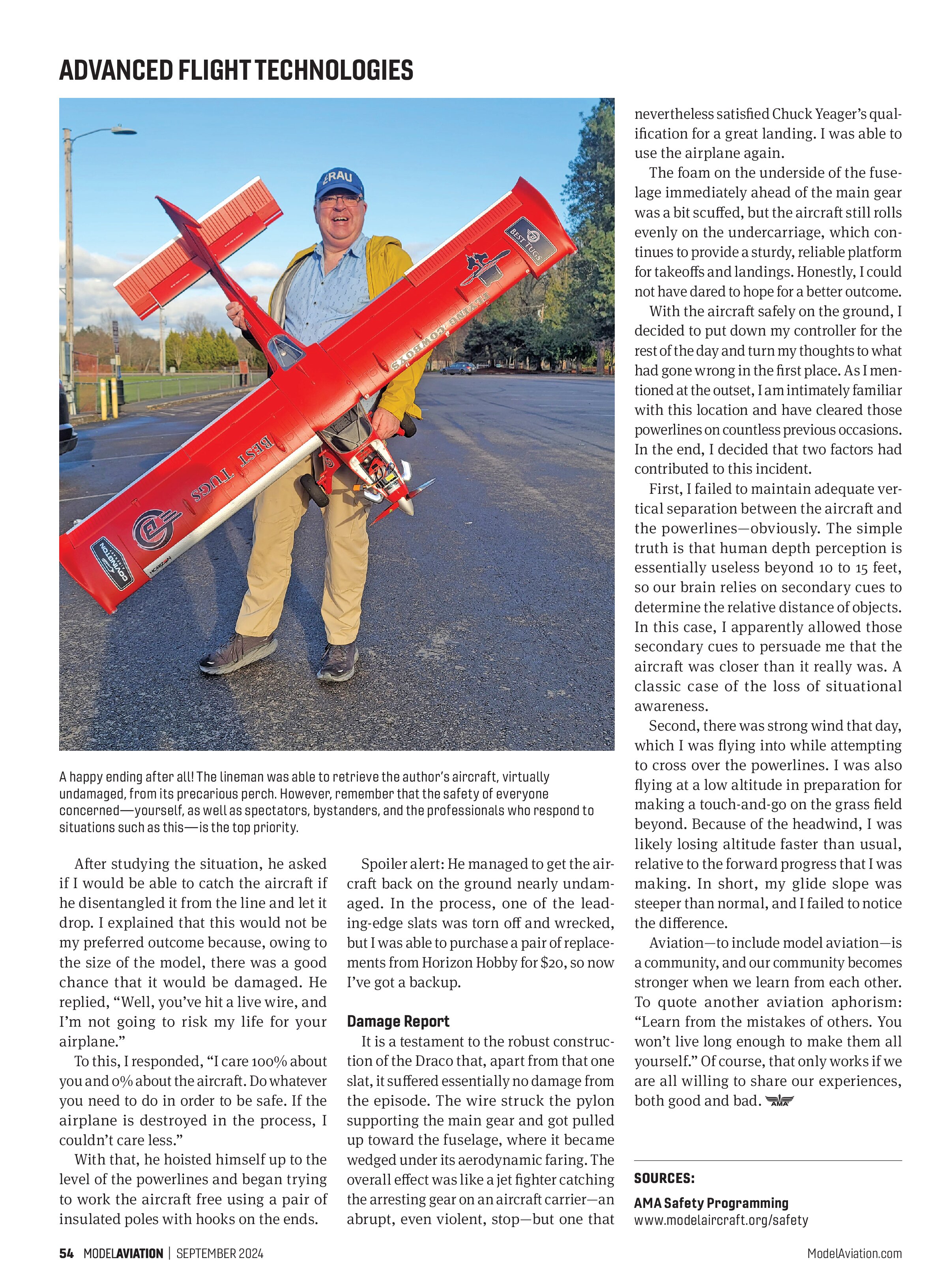
Spoiler alert: He managed to get the aircraft back on the ground nearly undamaged. In the process, one of the leading-edge slats was torn off and wrecked, but I was able to purchase a pair of replacements from Horizon Hobby for $20, so now I’ve got a backup.
Damage Report
It is a testament to the robust construction of the Draco that, apart from that one slat, it suffered essentially no damage from the episode. The wire struck the pylon supporting the main gear and got pulled up toward the fuselage, where it became wedged under its aerodynamic fairing. The overall effect was like a jet fighter catching the arresting gear on an aircraft carrier—an abrupt, even violent, stop—but one that nevertheless satisfied Chuck Yeager’s qualification for a great landing. I was able to use the airplane again.
The foam on the underside of the fuselage immediately ahead of the main gear was a bit scuffed, but the aircraft still rolls evenly on the undercarriage, which continues to provide a sturdy, reliable platform for takeoffs and landings. Honestly, I could not have dared to hope for a better outcome.
With the aircraft safely on the ground, I decided to put down my controller for the rest of the day and turn my thoughts to what had gone wrong in the first place. As I mentioned at the outset, I am intimately familiar with this location and have cleared those powerlines on countless previous occasions. In the end, I decided that two factors had contributed to this incident.
First, I failed to maintain adequate vertical separation between the aircraft and the powerlines—obviously. The simple truth is that human depth perception is essentially useless beyond 10 to 15 feet, so our brain relies on secondary cues to determine the relative distance of objects. In this case, I apparently allowed those secondary cues to persuade me that the aircraft was closer than it really was. A classic case of the loss of situational awareness.
Second, there was strong wind that day, which I was flying into while attempting to cross over the powerlines. I was also flying at a low altitude in preparation for making a touch-and-go on the grass field beyond. Because of the headwind, I was likely losing altitude faster than usual, relative to the forward progress that I was making. In short, my glide slope was steeper than normal, and I failed to notice the difference.
Aviation—to include model aviation—is a community, and our community becomes stronger when we learn from each other. To quote another aviation aphorism: “Learn from the mistakes of others. You won’t live long enough to make them all yourself.” Of course, that only works if we are all willing to share our experiences, both good and bad.
SOURCES:
AMA Safety Programming
www.modelaircraft.org/safety